Choose the kind of Hakone trip before buying a pass. For a return day trip from Tokyo, make the mountain route and lakeshore your two priorities. For dinner and breakfast at a ryokan and time in a garden, plan around the accommodation’s location and final dinner arrival first. A Freepass simplifies several journeys, but it does not reserve Romancecar seats, make every museum free, or guarantee a complete circuit in wind and rain. This guide works through gateways, tickets, daily restrictions, and accommodation so that Owakudani, Lake Ashi, and Gora become choices you can adjust rather than a challenge to ride every transport service in one day.
Choose a day trip or an overnight before committing to the loop
A Hakone day trip suits travelers who can leave Tokyo early, return in the evening, and make the journey through the mountains and across the lake their main activity. An overnight adds time for dinner at your accommodation and a slower morning. These are different trips, rather than the same checklist at two speeds. If you are only leaving the airport that morning, or flying out early the next day, reduce the loop instead of treating queues, meals, and check-in as spare time.
For a first visit, choose two priorities: Owakudani and a lakeside walk, for example, or one museum and an onsen stay. Add other stops only if transport and energy allow. A suspended ropeway then changes part of the day rather than ruining its entire purpose. If everyone is looking forward to the hotel, arriving early enough to enjoy it is more useful than finishing a circuit and missing dinner. Travelers who dislike repeated transfers can also spend a satisfying day around Yumoto and Gora.
Check the overnight against your usable sightseeing days and connections between Japanese cities. Four nights in Tokyo followed by a night in Hakone is different from moving your final Tokyo night to Hakone and heading straight to the airport afterward. Before booking, write down where you will sleep on either side and your realistic arrival and departure times. That establishes whether a dinner-and-breakfast plan will actually be relaxing.
Understand the five connections: Yumoto, Gora, Sounzan, Owakudani, and Togendai
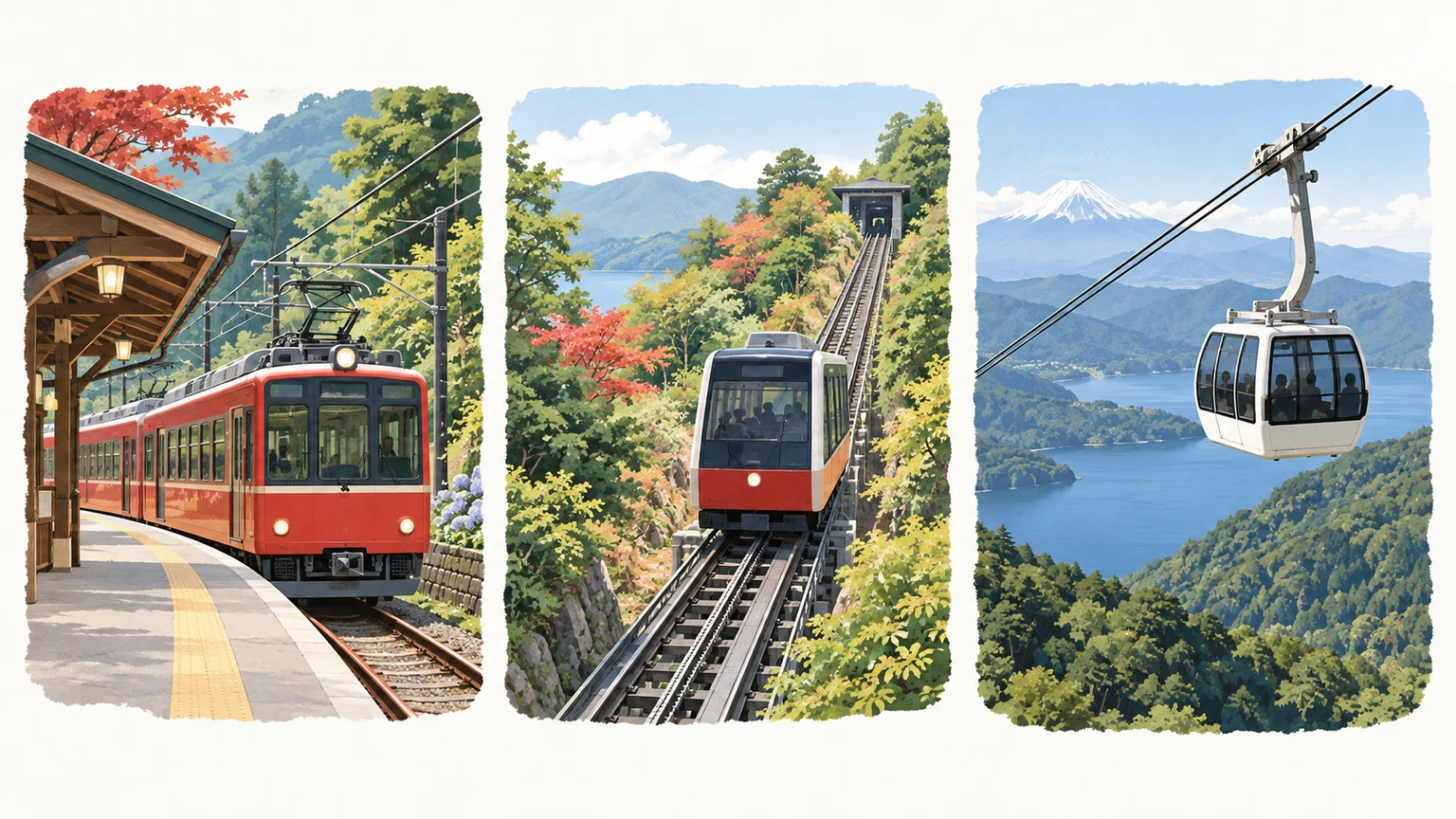
Hakone is not a single town that you can cover on foot after getting off one train. A common circuit takes the Hakone Tozan train from Hakone-Yumoto to Gora, the ground-running cable car to Sounzan, and the aerial ropeway through Owakudani and Ubako to Togendai. A boat crosses to the other side of the lake, and a bus completes the return. Each stage has its own stop names, boarding point, and operating status. Saving only a pin marked “Hakone” leaves most of the navigation unresolved.
Open the transport operators’ Hakone route maps before departure and place your hotel, lunch, and chosen museum on the relevant side of the circuit. Motohakone-ko, Hakonemachi-ko, and Togendai-ko are separate ports. Gora and Sounzan are also separate stations, even though descriptions often mention them together. For a hotel shuttle, record the full port name and bus stop so that you do not wait at a different pier.
It helps to think in two parts: the mountain route and the lakeshore. You might spend one day on volcanic scenery and art and the next beside the lake, or reverse that order. This is a planning aid, not a claim that all stops within either part are walkable. Whenever you add somewhere, check both its arrival connection and the onward journey. Distance from Hakone-Yumoto alone will not reveal a detour that forces you to retrace your route.
Arriving from Tokyo, Kansai, or an airport: choose the right gateway
If you are staying near Shinjuku and want to use Odakyu, Shinjuku can be a practical gateway. From the Tokyo Station or Shinagawa side of the city, or when arriving from Kansai, compare a route through Odawara instead of crossing Tokyo just to use a Shinjuku-origin pass. For a Shinkansen journey, check that your particular train stops at Odawara; not every Tokaido Shinkansen service does. A nationwide JR pass also does not automatically cover transport around the Hakone mountains.
For a trip that continues to another city, separate the journey into the ticket to Odawara, transport within Hakone, and the long-distance ticket after leaving. Mishima and Gotemba offer other approaches, but check the bus stops and covered sections individually. A product carrying the Hakone name does not mean that any journey through Tokyo, the Fuji Five Lakes, and Shizuoka is included.
On a flight-arrival day, allow time for immigration, baggage, transfers, and delays. If you want to go straight to a hotel with dinner included, obtain its acceptable arrival and dining times first, then work backward to see whether the flight fits. Spending the first night in the city is a reasonable alternative. Compare Tokyo bases for airport arrivals and onward travel, rather than placing dinner and the final mountain connection inside the same uncertain arrival window just to avoid moving hotels.
Hakone Freepass prices: compare duration and departure station together
Checked on October 21, 2026, Odakyu’s current Hakone Freepass price list offers two-day and three-day versions. Adult prices from Shinjuku are ¥7,100 and ¥7,500; local-origin adult versions from places including Odawara are ¥6,000 and ¥6,400. The official Traditional Chinese page also retains a table for prices through September 2025, so read the effective date before treating a number as the current purchase price.
When searching for a one-day Hakone Freepass, distinguish a one-day visit from a ticket’s validity. The Hakone Freepass compared here is a two-day or three-day product. You can consider a two-day ticket for a day trip, but that does not make it good value automatically. If you are only visiting Yumoto for food and a bath, compare the transport you would actually buy separately. Other one-day or limited-area products have their own names and coverage.
Choose the duration by the days when you will actually use transport, rather than counting hotel nights alone. An overnight commonly involves two sightseeing dates; compare the extra ¥400 for an adult three-day version only if a third day’s covered travel is useful. Children’s prices are listed separately in the table. Do not assume every pass costs half an adult fare, or use a hotel’s bed-sharing age policy to decide which transport ticket a child needs.
| Origin / validity | Adult | Child |
|---|---|---|
| Shinjuku / two days | 7,100 | 1,600 |
| Shinjuku / three days | 7,500 | 1,850 |
| Local, including Odawara / two days | 6,000 | 1,500 |
| Local, including Odawara / three days | 6,400 | 1,750 |
Eight transport categories: check covered sections and supplements
The Freepass covers eight transport categories, including the mountain train, ground-running cable car, aerial ropeway, sightseeing pirate ships, and specified bus services. Eight describes the product’s categories; it is not a requirement to ride eight vehicles in one day. Buses have covered routes and sections, and another company’s Lake Ashi cruise is not interchangeable with the pirate ships. The Komagatake ropeway is also a different service from the Hakone Ropeway through Owakudani.
The official coverage and supplement explanation helps identify the services involved. For a version with Odakyu travel, the departure-station–Odawara section is limited to one round trip, rather than unlimited returns to Tokyo during the validity period. Romancecar and other listed upgraded services require their respective supplements. If you leave the area and plan to return again, check whether you need another ticket instead of relying on the fact that the pass is still in date.
A facility benefit may be a discount rather than admission included. Gora Park offers free entry with qualifying passes, while museums, workshops, food, and upgraded seats or cabins may have separate charges. Show an eligible pass before payment and compare online admission with an on-site discount; do not assume that two reductions can be combined afterward. Use the route-based method for comparing Japanese transport passes to keep the long-distance and Hakone-area budgets separate.
Adding Romancecar: the basic fare and reserved-seat supplement are separate
Romancecar is an all-reserved-seat limited express. Its ticket structure combines a basic fare with a limited-express charge. If your Freepass covers the corresponding origin and section, confirm that basic travel is included and buy the limited-express ticket for the particular train separately. A limited-express ticket alone does not pay an otherwise unpaid basic fare. Conversely, buying a Freepass does not reserve a seat: you still need the relevant train and direction.
Odakyu’s limited-express fare table currently lists the adult Shinjuku–Hakone-Yumoto supplement as ¥1,150 each way when bought ticketless online, or ¥1,200 at the regular limited-express rate. A ¥7,100 Shinjuku two-day adult pass plus two ¥1,150 supplements totals ¥9,400. That total covers this transport combination only, excluding accommodation, meals, and museums.
Choose trains that fit check-in and the return journey before chasing a front observation seat. The shortest advertised train journey is not the door-to-door time to your hotel. For the return, include possible road delays, collecting stored bags, and moving through the station. If flexibility matters more, compare ordinary trains and their transfers or possible standing time. You do not have to build the entire day around a particular train type. Changes, missed trains, and refunds remain subject to the limited-express ticket you buy.
Buying digital tickets: distinguish individual and designated group products
Hakone Freepasses are available through EMot and its online-ticket service, as well as stations and other sales channels. Before purchase, check the origin, dates, two-day or three-day duration, adult and child quantities, and product terms. Confirm which account you are using and how you will receive messages. A travel-agency package or another platform may handle exchange, distribution, and refunds through the original seller; do not assume that another sales channel’s screenshots describe your own process.
The current EMot digital-pass basic terms distinguish ordinary tickets from products designated as group tickets. The latter can show tickets for multiple people on one device in the manner permitted by the product, but generally require the group to travel together and cannot be split informally. Some package-specific companion instructions instead require a smartphone for each traveler. Neither an older one-phone-per-person guide nor the group-ticket exception should be applied to every Hakone product.
After buying, open the real ticket on your own phone while still at your accommodation and understand how activation and the different gates work. Follow the product’s instructions when you actually begin using it. If a dead battery or broken phone prevents the valid ticket from being displayed, a payment email is not a substitute. Do not distribute group-ticket screenshots to people traveling separately. If your party might split up, choose a suitable ticket type before purchase and plan for power and usable connectivity.
Is the Freepass worth it? Answer three questions before comparing savings
First, which sections will you really complete? List the gateway journeys, mountain services, boat, and buses, keeping museum admission separate. If you only travel to Gora for one museum and return, an operator’s savings example for a full circuit may not describe your day. Adding an unwanted boat journey merely to make the pass appear to pay for itself costs sightseeing time as well as another queue and transfer.
Second, how were you going to arrive and leave? The adult two-day prices of ¥7,100 from Shinjuku and ¥6,000 locally differ by ¥1,100, but that difference alone does not establish the cheaper overall trip. A Shinkansen approach through Odawara and your onward direction still have separate costs. If you are arriving from Kansai and continuing to Tokyo, list the complete one-way journeys instead of counting an unused Shinjuku return entitlement as money saved.
Third, would you still want this itinerary if a service stopped? If the aerial ropeway is the main attraction, check maintenance and weather before paying and accept a mountain-train-and-museum alternative. The local digital version’s activation, suspension, and refund conditions distinguish several situations and specified amounts; rain does not mean an automatic full refund. Keep the correct terms and sales-channel details so that you can explain which service remained entirely unused, rather than relying only on a weather screenshot at the end.
Clockwise or counterclockwise: let your hotel and connections decide
Traveling from Yumoto through Gora, Sounzan, Owakudani, and Togendai gives a straightforward sequence and lets you complete the mountain section before deciding how long to spend by the lake. The reverse starts with a bus toward the lakeshore, then a boat to Togendai and the ropeway uphill; it may suit a lakeside stay or an early shrine visit. Both depend on that day’s connections and crowds. One travel report’s queue comparison is not a permanent rule.
Before choosing, list the fixed commitments: a museum reservation, hotel dinner, nature-trail check-in, and the train out of Hakone. Put the most important one in an earlier, more controllable part of the day and arrange flexible stops around it. If you visit the lake first, check the ropeway’s closing time. If you take the mountain route first, make sure an appropriate boat and onward bus still fit after reaching Togendai.
Reversing the route does not remove every traffic jam, and arriving early cannot guarantee a queue-free day. You can control how many optional stops you add and know where to leave the circuit. If you fall behind, finish sightseeing at Gora or the lakeshore and return using the services actually operating. The loop connects places; completing it need not be the day’s goal.
From the mountain train to the cable car: allow time inside stations
The mountain railway’s curves, changes of direction, and views are part of the experience. At Gora you change to the ground-running cable car for Sounzan, where you connect to the aerial ropeway. These are separate stages, not a single direct cable service. For the Open-Air Museum, get off at the relevant station or work it into the return journey instead of reaching Gora first and immediately doubling back for a photograph.
Check the operating status of Hakone’s individual transport services separately: mountain train, cable car, ropeway, and boat. Normal operation on one does not establish the status of the next. If replacement transport is offered, check its boarding and arrival points, accepted tickets, and waiting arrangements. A replacement-bus map retained online from an older disruption is not evidence that the same service runs today.
With a large suitcase, treat two transfers as two separate pieces of baggage handling. Decide where it can go, who will look after children, and whether you need elevator assistance. Let passengers get off first and leave space at the doors and in queues. For someone moving at a slower pace, using a gap between departures as a rest is often more sustainable than trying to catch the preceding service at every connection.
Owakudani: read the volcanic-gas restrictions before planning the views
Owakudani’s steam vents, exposed slopes, and aerial views offer a different experience from the lakeshore. Seeing Mount Fuji still depends on clouds and visibility that day; a clear promotional image does not mean that it will be visible on every visit. Nor do you need to stand in a windy spot waiting for thick fog to lift. Black eggs and souvenirs are optional stops. Leave enough time for the return journey, and do not treat folklore about food as a medically supported health benefit.
Before traveling, read the ropeway operator’s volcanic-gas precautions. The official rules prohibit people who have allergic asthma, bronchial or lung conditions, heart conditions or a pacemaker, or who are feeling unwell, from taking the Sounzan–Ubako section. Separate advice asks pregnant travelers, infants, older people, and others who may be particularly sensitive to consider their decision carefully, including giving up the ride. A service operating normally does not establish that every person in your party can use it.
These are restrictions on a particular section, rather than an instruction for everyone to take the same mountain route. If someone cannot use it, choose suitable town, museum, or lakeside activities and confirm workable transport with the operator. A mask, damp towel, or your own inability to smell gas does not replace the official conditions. Entry to the Owakudani Nature Research Trail has stricter requirements: visiting ordinary viewing areas and reserving access to the volcanic trail are separate decisions.
The Nature Research Trail: language, eligibility, and check-in are separate checks
The official Owakudani Nature Research Trail booking page describes a reservation-only activity lasting about 40 minutes and requiring an understanding of Japanese instructions. Staff provide safety supervision, rather than a foreign-language sightseeing tour. Do not book simply because a slot is available and expect one companion to translate every safety instruction for the group while walking. On the date checked for this guide, all four sessions showed a safety-related cancellation; that was the day’s status, not evidence that every future session was canceled.
The trail’s participation and safety conditions exclude preschool children, pregnant people, cane users, anyone unable to run and evacuate independently, and people with the listed medical conditions, among other restrictions. Elementary-school children need an accompanying guardian who meets the official condition of junior-high-school age or older. Online booking closes 60 minutes before each session. Eligible visitors must still allow for delays and follow their confirmation’s arrival instructions: the homepage says to arrive at the information center 20 minutes before the start, while the precautions page says reception opens 30 minutes before and closes five minutes before. That final cutoff is not the recommended arrival time.
The current safety contribution is ¥800 per person, paid cashlessly. The trail has steps and changes in level; helmets are required, and umbrellas and pets are not permitted. Wind, rain, gas, or other safety factors can cause a late cancellation or interruption. For two participants the contribution totals ¥1,600, but payment does not guarantee suitable conditions. If you do not meet the requirements or do not understand Japanese, choose views from areas legally open to ordinary visitors and an appropriate museum instead.
Lake Ashi and Hakone Shrine: identify the port and allow time on foot
When taking a pirate ship from Togendai to the opposite side of the lake, check its destination and calling order before deciding where to get off. If you want to visit Hakone Shrine, do not treat Hakonemachi and Motohakone as the same place. You can plan a lakeside walk between the two ports, but it involves actual walking, rather than an effortless connection to add after everyone is already tired. On board, keep your footing and look after children while taking photos; there is no need to crowd one side throughout the journey.
Use the Hakone Sightseeing Cruise routes and services to identify your boat, keeping other operators’ piers and tickets separate. If you want one scenic crossing, plan how you will return to your accommodation after disembarking. When staying near Togendai, do not overlook the final departure or hotel shuttle just because a cruise looks as though it could take you around the lake. Special cabins and separately charged products follow the ticket you buy; a general Freepass does not establish that an upgrade is included.
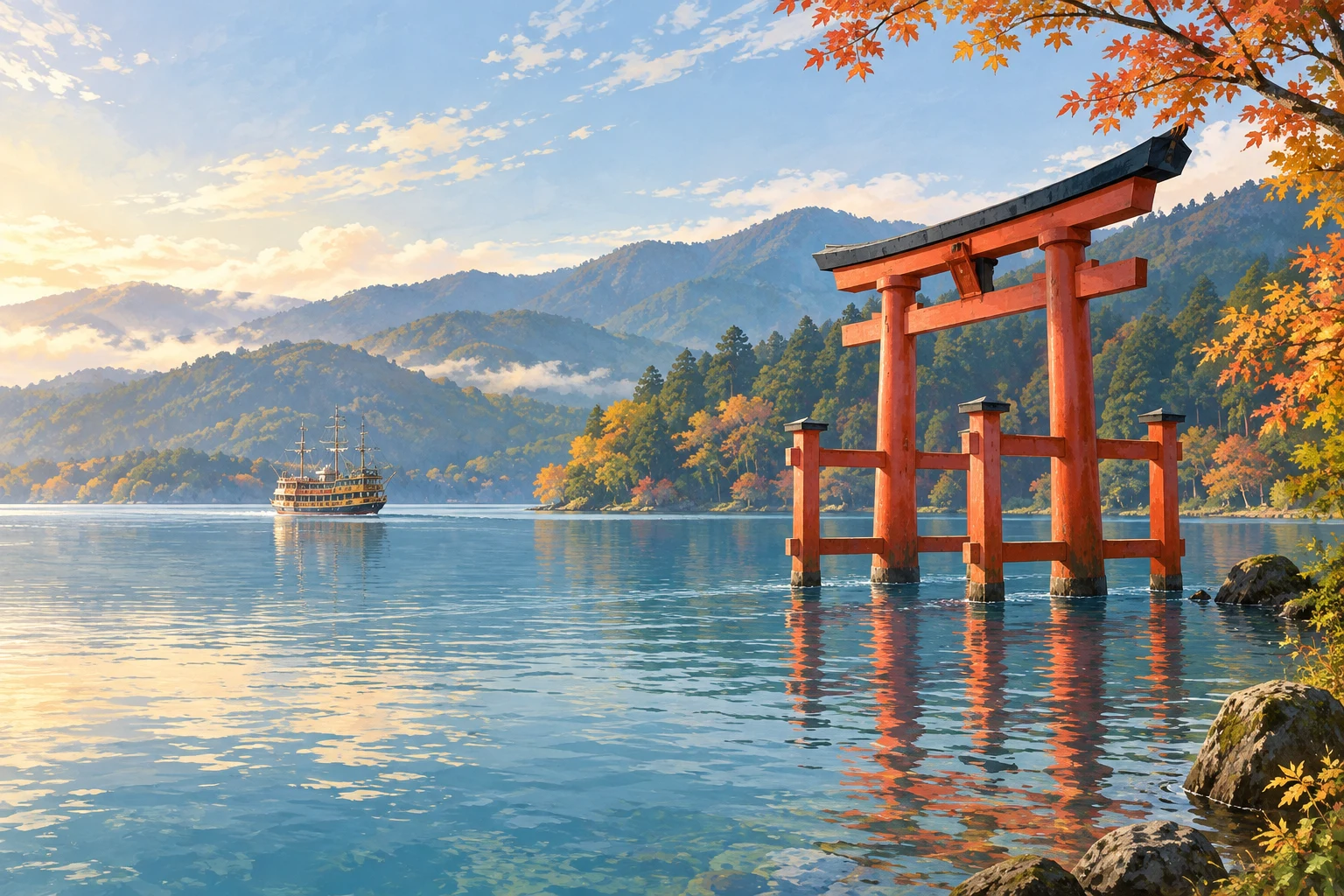
The Hakone Shrine grounds guide distinguishes the approach, main shrine buildings, and Heiwa no Torii by the water. Stone steps and worshippers’ routes are part of the visit; the lakeside gate photo is only one element. If the photo queue is long, you can worship first, walk beside the lake, and then decide whether to wait. Reaching the front is not a reason to miss your boat, cross a restriction, or obstruct other worshippers for a camera angle.
Hakone Museum of Art and the Open-Air Museum: different places, different closures
For outdoor sculpture, mountain views, and indoor exhibitions, compare the Hakone Open-Air Museum’s hours and admission options. Current hours are 9 a.m.–5 p.m., with final admission 30 minutes before closing; adult admission is ¥2,000 on site or ¥1,800 online. Outdoor work is an important part of the museum, so this is not a guarantee of an entirely indoor day in heavy rain. Choose according to the exhibitions and your party’s interests before deciding whether to allow half a day or replace one part of the circuit.
Hakone Museum of Art in Gora, known for its garden and collection, is a separate destination. The Shinsenkyo renovation announcement states a complete closure from May 7 through October 29, 2026. The café, annex, and temporary exhibition space are scheduled to open first on October 30, with the renovated main building scheduled to open on December 23. These are planned stages, not a full reopening of every gallery on October 30. Check the latest implementation notice before an autumn visit.
Choose the kind of art and space you actually want rather than putting every result for recommended Hakone museums into one day. Gardens, sculpture, and indoor collections call for different visits, and a Freepass discount does not make every museum free. Selecting one can leave time to look at work and sit down for a meal, instead of buying several tickets and stopping mainly for entrance photos. Follow each museum’s current photography and interaction rules.
Gora Park: an admission benefit still involves slopes and steps
The current Gora Park admission, opening, and slope information lists ordinary adult entry at ¥650, with free entry for holders of eligible Hakone Freepasses. Usual hours are 9 a.m.–5 p.m., with final entry at 4:30 p.m., subject to special notices. Count the benefit if you already want to visit. If everyone mainly wants to sit down, free admission is not a reason to make them walk around a park with substantial changes in level.
The operator specifically warns that steep slopes and steps make wheelchair and stroller use difficult. Koen-Shimo station is nearer the main entrance and Koen-Kami nearer the west entrance. Starting at the west and walking downhill may be easier, but that entrance can close because of snow or other conditions. Easier downhill walking is not the same as a fully accessible route. For significant mobility needs, establish the actual entrance, usable areas, and rest points before deciding whether the park fits.
A visit fits naturally into half a day when staying in Gora or already nearby; crossing the whole Hakone area just for an admission discount is less useful. For crafts or refreshments, separately check dates, reservations, and charges: entry does not include every activity. If some companions prefer a shorter visit, agree on a clear rest area and meeting place rather than requiring everyone to cover the grounds for the same flower photograph.
Hakone autumn foliage: choose dates and a workable alternative for the same day
Hakone’s autumn foliage is spread across mountain routes, parks, gardens, and the lakeshore. They will not all look the same on one date. Choose a kind of visit you would enjoy, then read that year’s local updates shortly before departure. Old photos, past peak dates, and articles with only the year changed in the title cannot guarantee the colors on the day you arrive. Our guide to reading Japanese flowering, foliage, and forecast information explains how those different reports should be interpreted.
For an initial accommodation window, the operator’s area-by-area foliage guide updated in September 2026 gives general viewing periods: late October through late November along the cruise’s lakeshore, early through late November along the ropeway, late November at Gora Park, and early to mid-November at Hakone Museum of Art. These are the locations’ introductory seasonal windows, rather than a daily forecast or live peak report for 2026. If your visit falls within only part of them, prioritize the more suitable area instead of expecting all four to peak together.
If Gora’s gardens matter most, put actual opening dates and current notices before assumptions about the season. The museum renovation is an example of an otherwise promising foliage date not necessarily allowing the visit originally planned. For lakeshore views from a boat, accept that wind, rain, and fog can change visibility. A photograph taken in sunshine does not guarantee the same scene with your ticket, or justify abandoning a safe return journey to wait for better light.
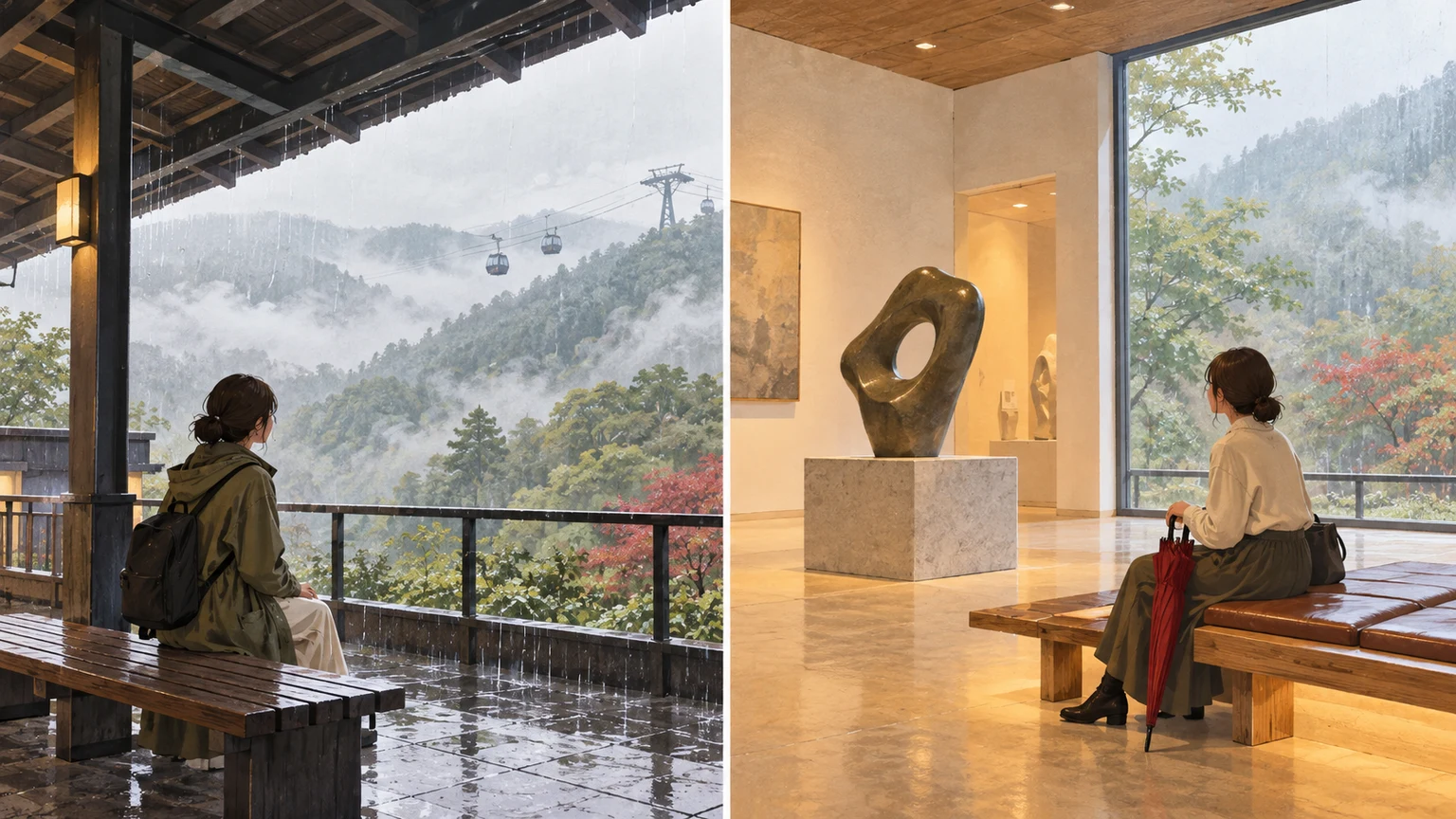
Prepare three versions within the same area: lakeside walks and a park in clear weather, one museum with a short walk in light rain, and activities around Yumoto or your accommodation during strong winds or disruption. An alternative needs a workable lunch and return route too; writing “museum if raining” at the end of the itinerary is not enough. Watch wet leaves, steps, and traffic while taking pictures. If a path or facility is restricted, choose another view legally open to visitors.
| Viewpoint | Introduced seasonal window | Still check |
|---|---|---|
| Lakeshore along the pirate-ship route | Late October to late November | Daily sailings, wind and rain, actual lakeshore conditions |
| Along the aerial ropeway | Early to late November | Daily service, gas restrictions, and visibility |
| Gora Park | Late November | Current park conditions, entrance, and walking ability |
| Hakone Museum of Art | Early to mid-November | Areas actually included in the staged 2026 opening |
A one-day itinerary: keep the mountain and lake route, drop the extra museum
This is an editorial suggestion for what a day can hold, not a departure-by-departure timetable. Leave Tokyo in the morning and aim to connect to the mountain route after reaching Yumoto. Between Gora, Sounzan, and Owakudani, allow for a break and actual transfers. If you are already far behind in the morning, make the lake optional rather than still requiring a boat, shrine, museum, and bath that afternoon. Recheck services for your date; this guide does not promise arrival at each stop at fixed times.
Have lunch on the side of Hakone where you know you will stop, choosing somewhere with a tolerable queue. Keep an alternative ready instead of crossing the whole area in search of a famous restaurant at lunchtime. If services are operating normally in the afternoon, take a boat from Togendai across the lake, choose the shrine or a short lakeside walk, and return to Yumoto by a suitable bus route. For an onsen bath, shorten or remove one activity rather than adding two hours to the unchanged plan.
Allow ample time for mountain transport to get you to a reserved train back to Tokyo. Choose a sightseeing cutoff before leaving: after that, return directly instead of planning on both the final boat and the last usable bus. With children, older relatives, or anyone who dislikes repeated transfers, Yumoto and one museum can work well. Fewer transport modes still allow a meal, art, and a mountain-town walk; completing a circle is not the measure of a worthwhile day.
Two days and one night: protect check-in first, then visit the lake
For a Gora stay, one option is to travel uphill from Yumoto on the first morning and choose either the Open-Air Museum or Gora Park. After lunch, go to your hotel for confirmed luggage storage or check-in and keep the afternoon for a nearby walk and rest. After breakfast the next day, decide on Sounzan, Owakudani, Togendai, and the lakeshore according to the weather. This puts a fixed dinner on a more controllable day and lets you shorten day two according to departure time, instead of discovering late on day one that your lakeside stop leaves several transfers back to the hotel.
If staying near Motohakone or Togendai, order the first day’s mountain and lake stops to reach that side early, then move toward your exit on day two. You do not need to repeat the same route from Yumoto every day. Ask your own accommodation about early room access, storage, and shuttles; being close to another hotel does not mean that its shuttle is shared. For a dinner-inclusive booking, the final dining arrival and late-arrival policy matter alongside the reception desk’s last check-in time.
An overnight need not fill both days. In wind or rain, breakfast, a nearby museum, and an earlier departure can replace the circuit. If you arrive from Tokyo only in the afternoon, treat day one as hotel time rather than trying to recover an entire sightseeing morning. Use our checks for dinner-and-breakfast plans, arrival, and cancellation to record the fixed conditions before choosing transport tickets. That helps protect the experience you actually paid to enjoy.
Where to stay in Hakone: the trade-offs between Yumoto, Gora, and the lake
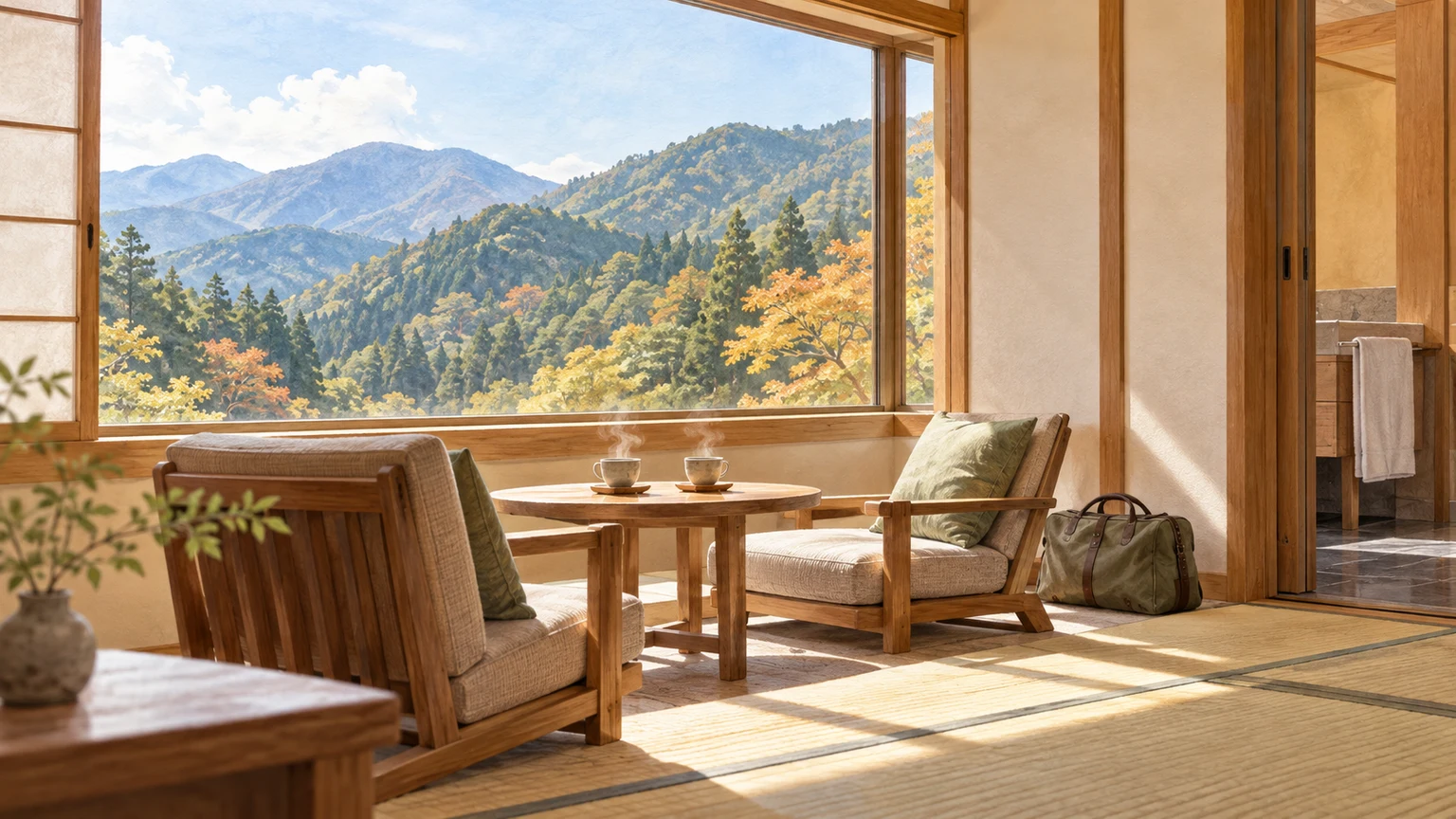
Yumoto suits travelers who want a simpler gateway and will move on the following day; reaching the lake or Owakudani still requires onward transport. Gora connects well with the mountain railway and uphill activities, but a hotel entrance is not necessarily beside the station. Check slopes and the final shuttle or walk. A lakeside base combines accommodation with lake views and walks, at the cost of arrivals, meals outside the hotel, and departures being more dependent on particular stops and services.
One verifiable lakeside example is Hotel de Yama’s shuttle information from Motohakone-ko. The pickup is stop 6 on the pirate-ship pier side. The current page lists departures starting at 9:10 a.m., at :10, :30, and :50 each hour, with the last at 5:10 p.m., and notes that winter arrangements may change. Do not apply this schedule to another lakeside property or wait at Hakonemachi-ko instead.
Compare room type, number of beds, meals, bathing facilities, and access in the same set of notes, then recheck the price for your dates and every guest. An onsen in a hotel’s name does not mean that every room has a private bath; lake views may also vary by room type. If reducing luggage handling or finding your own dinner is the priority, those conditions will often decide the more comfortable base better than a single room photograph.
| Base | Consider for | Check before booking |
|---|---|---|
| Hakone-Yumoto | Simpler gateway and onward travel the next day | Station side, entrance, and transfers uphill |
| Gora | Mountain route, one museum, and hotel time | Slopes, final shuttle or walk, and dinner |
| Lakeside, including Motohakone or Togendai | Combining a lake visit with the stay | Exact port, final shuttle, evening meals, and departure |
A Gora example: Hakone Yutowa’s child, dining, and payment conditions
The current Hakone Yutowa FAQ provides concrete conditions to check when comparing Gora stays. Check-in is at 3 p.m. and checkout at 10 a.m.; guests arriving after 6 p.m. should contact the hotel first. Dinner is listed from 5:30 to 9 p.m., with final entry at 7 p.m. Getting a room key is not the only concern when arriving late: establish whether your plan includes dinner and how a late meal arrival is handled, especially when returning from the lake.
The hotel permits one child to share each bed. Ages 0–2 share free, while bed-sharing for ages 3–6 is ¥3,000; the listed charge with bedding is ¥5,000. Elementary-school children have a separate rate. These are this hotel’s conditions, not a rule permitting the same occupancy throughout Hakone, and no extra bed does not always mean no child charge. Enter every guest’s age and the chosen room type, then check the total, meals, and bedding instead of assuming that an adult double-room result accommodates the whole family.
Two other conditions may determine whether to book: the hotel says buffet cross-contact is possible and it cannot provide dedicated allergy meals, and it has been fully cashless since July 1, 2026. Anyone needing dietary accommodation should establish what is acceptable before payment; food symbols do not guarantee a segregated kitchen. Ingredient labeling and payment arrangements can change, so older trip reports about meals and paying cash should not be treated as the current conditions.
Day-use onsen: an overnight is optional, but a private bath needs its own booking
For a Hakone day trip with a bath, compare day-use facilities near Yumoto and reserve the time they actually need. Hakone Yuryo’s conditions exclude preschool children from the communal baths, making the private-room options a separate consideration. However, guests who use diapers are not accepted for bathing; a private room is not an exception admitting every infant. Wheelchair access to an entrance does not mean uninterrupted wheelchair use inside a communal bathing area. Read the rules for the particular area your family would use, rather than assuming that family pictures establish access to every bath.
The current private open-air bath room price table for Hanare Yuya Kaden charges per room for two hours. Type I, Ichi no Maki, takes up to two people and costs ¥10,400 on weekdays; Type II, Ni no Maki, takes up to four and costs ¥12,400 on weekdays. Holidays and specified periods differ. Four people cannot book the two-person type by multiplying or dividing its rate. A private-bath charge also does not automatically include separately charged communal baths or dining.
Online reservations are currently accepted until 3 p.m. on the previous day; later reservations or changes need confirmation by phone. Groups in which every member is under 18 are not accepted. If you only want food or a rest, ask about the relevant areas rather than buying an unwanted bath package. Bathing etiquette, tattoos, and swimwear follow the current rules at the facility you choose; another ryokan’s practice does not establish the rules here.
Fit Hakone food into the route: identify the meal and the branch first
For Japanese yam soba in Yumoto, Hatsuhana can be one option, after checking the main restaurant’s and annex’s separate opening and closing days. Both currently list 10 a.m.–7 p.m., with the main restaurant closed on Wednesdays and the annex on Thursdays; arrangements may shift around public holidays. Sharing a brand does not mean that both branches open every day. Put it into a lunch or early dinner when already passing through Yumoto, instead of returning from the lake and then heading uphill again.
Check the actual ingredients in soba dishes too. The restaurant’s description of its Japanese yam soba includes egg and buckwheat, among other ingredients. A dish looking meat-free does not establish suitability for a vegan diet or a particular allergy. If stock ingredients or cross-contact matter, ask the restaurant directly and have an alternative meal ready. This guide does not turn promotional health descriptions into treatment claims or use ratings and rankings to promise that everyone will like the food.
For something before a connection, consult the official Hakone Bakery branch list. Its Odawara shop, for example, is on the station side and currently lists shortened hours of 7 a.m.–8 p.m. The brand name does not establish an equivalent branch in Yumoto or at every mountain station. Keep afternoon snacks modest if your ryokan includes dinner. With a room-only booking, identify restaurants actually open in the evening rather than assuming that a lively daytime shopping street guarantees late-night food.
Bags and shuttles: the final connection matters more than a map distance
For one night, consider leaving a large suitcase at your original Tokyo hotel if you are returning and the hotel agrees. Take clothes, medication, and necessary items into Hakone. If you will not return there the next night, compare confirmed hotel storage or formal forwarding instead of relying on a station always having an available locker. Include bag dimensions, collection time, and your next train in the plan rather than leaving storage as the day’s final unresolved task.
A baggage-delivery service links Hakone-Yumoto with some accommodation in the area, but the operator announced a revised charging system from April 2026. Before paying, confirm that your hotel participates, the day’s acceptance cutoff, delivery and collection times, item quantities and dimensions, and restrictions. Do not copy a price from an older trip report. Even if your bags arrive first, you must still arrange your own journey and hotel dinner; forwarding does not replace arriving on time.
For a hotel shuttle, ask for the complete stop name, reservation requirements, final departure, and procedure for arriving late. Save the shuttle confirmation as text available offline. An electronic transport ticket still needs its valid ticket screen, rather than a screenshot. At the station, locate current signs and contact the hotel with its name and your booking name if needed. If the shuttle has stopped or finished, establish a confirmed alternative before continuing to shop, rather than dragging a suitcase along mountain roads after dark to find an entrance.
Hakone accommodation and bathing taxes: separate current charges from proposals
When searching for Hakone accommodation tax, distinguish the bathing tax on a hotel bill from a separate accommodation-tax system. Hakone Town’s current bathing-tax explanation lists ¥150 per person per night for overnight bathing and ¥50 per person for day-use bathing, with exemptions including age-related conditions. This is not a uniform percentage applied to every room price, nor should every stay without bathing automatically be treated identically. Ask your accommodation to confirm the bill for your actual circumstances.
In its August 2026 published response to consultation on the accommodation-tax ordinance outline, the town still describes April 2028 as the target introduction date. Proposed amounts should not be applied as a tax already operating for a 2026 stay, and a target is not an unchangeable implementation guarantee. For future dates, reread formal notices and the booking’s tax explanation, particularly where a prepaid room has some charges collected locally.
Label budget assumptions clearly. For two adults staying one night, both subject to the current bathing tax, ¥150 each totals ¥300; it is not ¥150 for the whole room. Do not add it twice if the booking already includes it. List taxes, meals, private baths, and transport separately so that a price difference between hotels can be traced to a room type or an extra charge missing from one screen.
An overnight budget: replace assumptions instead of treating an example as a quote
This is a hypothetical budget for two adults. Each buys a ¥7,100 Shinjuku two-day Freepass and a ¥1,150 limited-express supplement in each direction, giving ¥18,800 in transport for two. Assume ¥40,000 total for one double room with dinner and breakfast, ¥4,000 total for both travelers’ lunches and drinks, and ¥300 in separately listed bathing tax: the subtotal is ¥63,100. The ¥40,000 room and ¥4,000 food amounts are replaceable assumptions, not a verified deal at a named hotel.
Adding two adult online tickets to the Open-Air Museum at ¥1,800 each brings that example subtotal to ¥66,700. Shopping, other admission, extra meals, and transport outside the included coverage still need adding. If the ¥40,000 hotel price already includes bathing tax, remove the duplicate ¥300. If the quoted room price is actually ¥40,000 per person, accommodation for two has a different total. Keep the guest count, dates, and meal conditions visible instead of comparing only “from per night” figures.
Savings should serve your actual trip. Avoiding the limited express may reduce supplements while adding transfers or standing. Making a day trip saves accommodation but removes a slower morning and hotel time. Skipping multiple museum admissions leaves more time to visit one properly. Use our Japan-wide budget examples for shopping and transport to reassess the full trip, rather than adding an unnecessary night in another city just to obtain one Hakone discount.
Rain, wind, and suspended services: secure the return journey before a refund
Check operating status the night before and again in the morning, then check the next section at each transfer point. The ropeway, boats, and buses can be affected differently. A weather app showing rain does not mean everything is suspended, and a running train does not prove that a boat will depart. If you already know your main activity cannot operate, use the remaining flexibility to switch to Yumoto and one museum or exchange the day with indoor activities in Tokyo.
If disruption occurs while you are in the mountains, follow the operator’s directions to establish a usable return route. Prioritize accommodation, medication, children, and onward trains before discussing missed sights. Do not walk unfamiliar mountain roads to complete the loop or wait for a bus shown only on a replacement-service map from years earlier. A rainy-day alternative needs an entrance, opening hours, food, and a return journey, rather than just another saved place name on a phone.
For refunds, return to the correct product and seller. Before travel begins, the original purchaser of the local digital pass can use EMot or the online-ticket service, with the current ¥220 fee deducted per ticket. After travel begins, applications go to the customer center and are handled according to the circumstances. One specified case concerns weather-related suspension where that transport system was never used during the validity period, allowing the corresponding refund without a handling fee. The terms explicitly exclude a separate refund for Gora Park’s closure. Keep use records, dates, and customer-service confirmation. Not seeing Mount Fuji is not evidence that transport was not provided, and hotel and limited-express bookings retain their own cancellation rules.
Children, strollers, and wheelchairs: entry to one place does not establish a whole route
Choose the day’s main activity as a family and include meals, diaper changes, seated breaks, and toilets in the route. They are not spare minutes that automatically appear between sights. With a stroller, establish boarding and alighting arrangements and available assistance for each stage. Being able to use one transport service does not establish the suitability of park slopes or shrine steps. If a child does not qualify for the research trail or communal bath, choose a suitable activity instead of expecting an exception for an age close to the cutoff.
Wheelchair users can first identify transfer ability, the assistance needed, and whether any short steps are manageable, then confirm entrances, toilets, and room types separately with transport and accommodation providers. Hotel de Yama’s port shuttle, Gora Park’s upper and lower entrances, and Yuryo’s universally designed private bath are three different questions. None alone guarantees access throughout Hakone. Anyone sensitive to volcanic gas or with a listed condition should also resolve ropeway eligibility first.
A useful version may stay within one area: lunch in Yumoto with a suitable day-use facility, one museum near Gora plus hotel time, or lakeside accommodation with a short walk. If the party splits up, agree on a precise meeting place and time and check whether the tickets can be used separately. Removing a boat stage or mountain stop can leave everyone time to eat and return comfortably, which is often more practical in this geographically spread-out area.
Gotemba, Kawaguchiko and Hakone: decide which half day belongs to shopping or lights
Hakone, Gotemba and Kawaguchiko often appear on the same regional map, but they are not one attraction area that you can freely connect on foot. Before adding the outlets or Fuji Five Lakes, check the cross-area operator, departures, payment and ticket coverage, then decide whether to add a night. Completing the Hakone loop and adding an evening return to Kawaguchiko on the same day usually leaves little actual visiting time and ties the return to fewer choices.
For one extra destination beyond Hakone, Gotemba lends itself to two plans: daytime outlet shopping, or arriving at Tokinosumika toward evening for the lights and staying overnight. The first should replace half a day by the lake or in a museum; the second adds evening transport and may justify spending a second night in Gotemba. With only two days and one night, more practical combinations are Hakone’s mountain route on day one, a Hakone overnight, then the outlets before Tokyo; or the outlets on day one, a Tokinosumika overnight with lights, then Tokyo. The latter shifts the focus to shopping and night scenery; it should not also promise the complete Hakone loop.
Go directly to transport from Tokyo and Gotemba Station, brands in the three zones and winter sale dates, outlet-side, station-front and onsen accommodation bases, Tokinosumika illumination tickets, or Tokyo connections and return times. Coming from Hakone, use the actual bus drop-off point to choose where to start shopping instead of circling back to an entrance to reproduce a fixed online route.
Ask whether you most want Hakone’s mountain-and-lake transport and onsen, or close views of Mount Fuji and time in a different lake district. With two days, one complete area is easier to arrange; with more days, write the transfer day separately. The guide to checking long-distance and regional ticket coverage can help list excluded sections so nearby-looking place names do not lead to buying the wrong pass.
Tokyo to Gotemba’s outlets: a direct bus saves changes; rail plus shuttle makes other stops easier
For a shopping-focused day from the Shinjuku side of Tokyo, compare Odakyu Highway Bus’s Shinjuku–Gotemba route. The official table checked on October 22, 2026 lists an adult single to the outlets at ¥2,000 and a child single at ¥1,000. The scheduled outbound journey is about 1 hour 50 minutes; the return to Shinjuku about 2 hours 20 minutes. Those are different directions, not 100 minutes each. Children under six also need a child ticket to secure a seat. Holders of a Shinjuku-issued Hakone Freepass can travel at a discounted single fare of ¥1,400 on specified sections between Shinjuku and the Gotemba area. It is not free, and an Odawara-area pass does not qualify.
Seats on this bus can be reserved. The website says sales open at 10:00 on the same date one month before travel. If that date does not exist in the preceding month, sales open at 10:00 on the first day of the travel month: March 31 tickets, for example, open on March 1. Booking both directions before shopping helps define your time better than choosing a return after arrival. Changes and refunds depend on payment: specified online electronic payments can be handled through the original account before the stated deadline; other channels may require a refund with a fee and a new purchase. Post-purchase changes and refunds are not handled by telephone. Check the deadline tied to the service’s starting station, rather than treating departure from your own boarding stop as the final time to act.
Rail may suit travelers who want food or luggage storage at Gotemba Station, or another connection the next morning. From Shinjuku, take the limited express Fujisan to Gotemba, or Odakyu to Shin-Matsuda, walk to Matsuda Station and change to the JR Gotemba Line. From the Tokyo Station side, another route changes to the Gotemba Line at Kozu. At Gotemba, use stop 2 outside Hakone-Otome Exit for the free outlet shuttle. The stated ride is around 15 minutes, plus waiting and boarding queues. This supports a station-based overnight; for a simple mall return, frequent changes reduce time for trying on clothes and resting.
The current shuttle leaves the station at :00, :15, :30 and :45 each hour, and the outlets at :10, :25, :40 and :55, from WEST ZONE stop 1 on the return. Operating limits move with mall hours: the station’s first and last departures are 30 minutes before opening and 30 minutes before closing; the last outlet departure is 40 minutes after closing. That is the timetable, not a guarantee of boarding every 15 minutes. Full buses and traffic affect the actual return. From Hakone there is also the L route from Yumoto and specified buses connecting Sengoku, Gora and Kowakien; check each segment against the earlier Freepass coverage.
Three outlet zones: circle your brands, then separate winter sales from lucky bags
The official floor map dated October 9, 2026 places Gucci, Prada Outlet and Coach in WEST ZONE; Nike, Adidas and outdoor stores such as The North Face / Helly Hansen in EAST ZONE; and Lego, Puma, Le Creuset and the ITADAKI TERRACE dining area in HILL SIDE. These are current map examples, not exclusive product categories for each zone, proof that the shops offer lucky bags, or a promise of extra discounts on everything.
The station shuttle arrives in WEST. If your list mainly contains sports shoes and outdoor clothing, go toward EAST, then decide whether to continue to HILL SIDE. HOTEL CLAD guests can start or finish at HILL SIDE and take shopping bags back to the room. Bridges and outdoor walks link the zones. Three or four priority shops, with separate time for fitting, payment and food, are usually more useful than aiming to finish every store. Arriving after lunch before Tokinosumika’s lights, choose just one or two zones; for careful size and price comparisons, leave the lights for the night you stay nearby.
The current opening-hours notice checked on October 22, 2026 says 10:00–20:00. However, the official Traditional Chinese page and October 9 map give different winter hours, so closing in December and January is not settled. Recheck the notice for your winter date; do not treat 20:00 as year-round. The sale dates below are published, but this check did not obtain official 2027 Gotemba shop-by-shop lucky-bag lists, preorder dates, quantities, queue-ticket rules or special New Year opening times. Published sales do not establish published lucky-bag details, and early-2026 information cannot simply have its year changed. If one particular lucky bag is essential, keep plans flexible; a guaranteed purchase cannot yet justify the hotel cost.
For winter clothing, the published mid-January Bargain dates offer another option besides New Year’s Day. For a particular brand’s lucky bag, wait for its announcement before comparing reservations, collection, queues and purchase limits. Sizes may not be selectable, and an outlet price does not establish unrestricted returns or exchanges. The table follows the operator’s published event schedule; it does not guarantee discount percentages, stock or individual-shop return policies.
| Event | Published dates | How to use the dates |
|---|---|---|
| Premium Outlets Sale | November 6–15, 2026 | A window for late-autumn shopping; shop-specific offers are announced separately |
| Black Friday | November 20–29, 2026 | Can be combined with the current Tokinosumika illuminations and an overnight |
| New Year Sale | January 1–3, 2027 | Opening-sale dates are listed; Gotemba lucky bags and special opening times remain unverified |
| Premium Outlets Bargain | January 15–24, 2027 | Another defined window for winter discount shopping |
Where to stay in Gotemba: beside the outlets, by the station, or at Tokinosumika
Choose the base around your final evening activity. Staying on the outlet grounds reduces carrying if you want to try things on until closing; staying by the station simplifies an early JR or bus departure; staying inside Tokinosumika puts lights, dinner and bathing within a walking-based evening. Straight-line distance does not make all three equally convenient outlet hotels. Without a car, another evening shuttle is a real cost.
HOTEL CLAD offers forest-side or Fuji-view Twin and Double rooms. To see the mountain from the room, select the corresponding category; weather still affects the view. Ordinary rooms mainly have showers; only Fuji-view Deluxe Twin, Deluxe Double and Brooklyn Room have bathtubs. With a small child, that can matter more than the hotel having an onsen. The website lists a ¥1,500 facility fee per preschool child aged three and over, including the stay, bathing and breakfast, with dinner extra. Under-threes are free but cannot use the large communal bath.
To follow CLAD’s official arrival route, take the free mall shuttle from the station to WEST, walk to HILL SIDE, then use the P4 parking-area elevator marked CLAD フロント階. The station shuttle does not deliver you to the room door. Before driving, ask the hotel to confirm parking fees and the permitted start and end times for your booked plan. Confirm the arrangements if you want to leave bags before shopping or keep the car parked after checkout. The official booking profile lists room check-in from 15:00 and checkout by 10:00. Permission to park does not extend use of the room.
For a station base, compare Toyoko Inn Gotemba Ekimae. Its website shows single rooms and explicitly lists a Triple Room, worth checking for solo or three-person travel. It is about one minute on foot from Hakone-Otome Exit, with 15:00 check-in, 10:00 checkout and free breakfast from 6:30–9:00. The 28 parking spaces cost ¥1,500 per night, first come, first served; they are not reserved free spaces. A separate free guest/member bus links Toyoko hotels around Mount Fuji and the outlets. Confirm departures and book through the dedicated reservation page; it is a separate service from the public station shuttle, with no interchangeable frequency.
| Base and named option | Suits | Transport, parking and trade-offs |
|---|---|---|
| Outlet grounds: HOTEL CLAD | Many shopping bags, shopping in two sessions, or driving | Walk from WEST to HILL SIDE; parking is available, but confirm fees and permitted hours for your booked plan; ordinary rooms may lack a bathtub or Fuji view |
| By Gotemba Station: Toyoko Inn Gotemba Ekimae | Early JR connections, solo or three-person travel | One-minute station walk; 28 parking spaces at ¥1,500 per night; a shuttle is still needed to the mall |
| Inside Tokinosumika: Hotel Tokinosumika / Gotemba Kogen Hotel | Illuminations, dinner on the grounds and bathing | Free non-reservable shuttles from Mishima or Gotemba; ordinary-car parking is free; outlet shopping requires another transfer |
Staying inside Tokinosumika: compare private bathrooms and included admission separately
For bathing, Hotel Tokinosumika connects indoors to Kirakubo. Japanese-Western rooms suit families; the 16-tatami Japanese rooms and four-bed Western rooms without baths mean accepting no private bathroom in the room, and both categories face the parking area. Other Western rooms are on the second floor, with no Fuji view and no elevator service to that floor: stairs are required. With a stroller, heavy luggage or limited stair access, do not book from the word Western alone. This hotel has 15:00 check-in and 11:00 checkout.
Gotemba Kogen Hotel has Western twin rooms and Japanese-Western rooms combining twin beds, an eight-tatami Japanese area and living space. The latter is listed for one to five people, with guests laying out their own futons. Compare this separation if children may sleep while others continue talking. Its guests and those of Hotel Brush Up may use Yuzu-no-yu. Brush Up emphasizes single rooms, so solo travelers need not pay for a family room; checkout is 10:00, an hour before Kogen Hotel’s 11:00. Staying on the grounds does not make every other bath, including Kirakubo or Chame Yudono, free.
Booking channels change illumination costs. Under the official-website booking benefit from September 1, 2026, qualifying stays receive a passport at check-in for Okyu-no-oka, Mori-no-sumika and Suichu Rakuen Aquarium, valid from check-in through checkout day. Telephone and other booking platforms do not qualify, nor do Hotel Brush Up and OUTDOOR HILL VILLAGE’s unassigned-pitch camping area. If two adults would otherwise buy combined illumination tickets, their ¥3,600 total belongs in the comparison of accommodation plans, without buying the same admission twice. There is no refund when benefit facilities stop for weather or equipment reasons. The room’s cancellation terms still belong to its booking plan; this benefit does not make the room freely cancellable.
Tokinosumika lights in 2026–2027: free walks, fountains and reserved light art
This season of Hikari-no-sumika runs October 9, 2026–March 7, 2027. General lighting hours have three periods: October 9–31, 17:00–22:00; November 1–January 11, 2027, 16:30–22:00; and January 12–March 7, 17:00–21:30. Opening day, October 9, follows its lighting ceremony separately, so the general 17:00 start cannot be imposed on it. Arriving for food before dark and then walking the lights is easier than filling the afternoon with distant attractions while waiting for switch-on.
For a photographic walk, start with the free light tunnel, night-sky path and cloud path. A combined ticket is not required simply to enter the whole grounds. Choose Okyu-no-oka for the fountain laser show and Good Night Dome, then add Mori-no-sumika if indoor projected light art interests you. When seeing both, the combined ticket saves ¥200 per adult and ¥100 per elementary-school child against separate purchases. A tired child or early return is still a reason not to add another fixed time slot just for a discount.
The combined electronic ticket defines adults as 13 and over and elementary-school children as ages 6–12; the event page separately lists preschool children as free. Mori-no-sumika is reservation-only: arrive at the designated time, though admission order may still mean a wait of around 20 minutes. Late arrivals cannot enter and receive no refund. Fix that slot before the free lights, dinner and fountains. Staff operate the electronic ticket’s start-use button; do not press it yourself beforehand.
Paid areas do not allow reentry, and severe weather may stop the fountains. The purchase page contains conflicting refund information: its restrictions say no refunds, including weather cancellations, while a cancellation field below lists 0% until 21:00 on the day and 100% afterward. This does not justify promising free cancellation throughout the day. If flexibility determines whether you buy, have the seller clarify the rules for your selected ticket first. For companions who dislike cold or fountain spray, use free walks and indoor food as the main plan, with the fountains optional.
| Paid attraction | Adult | Elementary-school child | Main content |
|---|---|---|---|
| Okyu-no-oka | 1,300 | 700 | Fountain laser show, Good Night Dome and other attractions |
| Mori-no-sumika | 700 | 400 | Immersive light art inside the chapel; reservation required |
| Combined admission to both | 1,800 | 1,000 | Buy after confirming both experiences fit before your return |
Tokyo to Tokinosumika and back: lights outlast the shuttles, so what does a night add?
Coming from Tokyo just for the lights, take a Shinkansen that stops at Mishima, then the operator’s free shuttle from Mishima Station North Exit. The Mishima tourism association lists about 60 minutes from Tokyo by Kodama or 45 by Hikari, but only some Hikari trains stop. The current shuttle includes a 15:05 Mishima departure arriving outside Kogen Hotel at 15:40. That 35 minutes is this bus’s scheduled journey; add the walk from the Shinkansen to the north exit and the wait. The shuttle is free and cannot be reserved, so no seat is held.
From Gotemba’s outlets, take the mall shuttle back to Gotemba Station, then change to the Tokinosumika shuttle. A current option leaves the station at 16:45 and reaches Kogen Hotel at 17:10. These are not jointly guaranteed connections: finish payment at the mall early enough for traffic and the station wait. The outlets, Gotemba Station and Tokinosumika are not a continuously available shuttle loop. Ordinary-car parking on the grounds is free, but busy dates still need time for entry, exit and finding a space.
For Tokyo, the 20:00 departure outside Kogen Hotel reaching Mishima North Exit at 20:35 is an earlier return candidate. Check onward Tokyo trains for your actual date and leave transfer time; no specific Shinkansen connection has been verified for you. A later current bus leaves at 21:20 and reaches Mishima at 21:50; the last Gotemba Station bus leaves at 21:10 and arrives at 21:35. Lighting runs until 22:00 in most periods, after these shuttles depart. Seeing everything until closing and then taking the free bus home therefore does not work. With a late light-art reservation, leave earlier or stay on the grounds instead of treating the last bus as risk-free.
There is also a dated stop change: from November 21, 2026–January 11, 2027, after 16:00 daily, Tokinosumika North Exit stop is suspended and passengers use the stop outside Kogen Hotel instead. This is not an all-day closure of the north stop or cancellation of every shuttle. Staying on the grounds lets you check in after 15:00, leave bags, eat early, attend the reserved light art, then walk free areas or bathe. After breakfast, return to Gotemba for shopping or to Tokyo through Mishima. That night buys evening time without chasing a last bus; it does not create enough time to add the complete Hakone loop.
Before paying: accommodation, fixed activities, transport, then flexible stops
Confirm people, dates, and the cities before and after Hakone. Then review the room and meal plan you actually want, including the final dinner arrival, children, baths, and cancellation conditions. If a particular activity is the purpose of the visit, establish its eligibility, language requirements, and reservable dates next. If the Nature Research Trail does not fit, change the route now rather than after buying other nonrefundable items. Separate valid bookings still need to combine into a day you can complete.
Choose the transport gateway and pass next, buying any required limited-express seats separately. Save each ticket’s dates, direction, and purchasing account. Confirm that electronic tickets open after purchase without accidentally activating them at home. Explain any requirement to travel together on a group ticket to your companions in advance. Only then add a park, souvenirs, or another museum to the remaining space, marking which stop will be removed first if delayed so that every junction does not require a new group discussion.
On departure morning, make a few useful checks: are services running, has the hotel or next stop posted a special notice, can your phone display the ticket, and do the return and meeting arrangements still make sense? If conditions change, use the alternative already prepared in the same area. You do not need to reproduce someone else’s circuit or visit every search result. The point is to leave enough real time to enjoy the art, lake view, or meal you chose.
A few useful answers
Can I buy a Hakone Freepass for just a day trip?
You can compare a two-day pass, but the Hakone Freepass checked here is not a one-day product. Value for a day trip depends on the actual gateway journeys, mountain services, boats, and buses. A visit only to Yumoto for a bath may not justify a full-area circuit pass.
Does the Hakone Freepass include Romancecar?
The corresponding origin version can cover the specified basic-fare section, but you must separately buy the limited-express ticket for your chosen train. Buying a Freepass does not reserve a seat, and the limited-express ticket does not replace an otherwise unpaid basic fare.
From Tokyo, should I buy the Shinjuku or Odawara version?
Use your actual gateway. For a Shinjuku round trip, compare the version with Odakyu return travel. From the Tokyo Station side or via Odawara from Kansai, calculate the long-distance ticket and local pass separately instead of making a detour merely to use the Shinjuku version.
Can a family show all digital passes on one phone?
Only designated group products allow tickets for several people to be shown on one device in the permitted manner, generally with the group traveling together. Other tickets and packages may require separate receipt by each person. Check your actual product before buying, and do not distribute screenshots for separate travel.
Is the Owakudani Nature Research Trail suitable if I do not speak Japanese?
The official conditions require understanding Japanese safety instructions and separately restrict age, health, and independent evacuation ability. It is a reservation-based activity under safety supervision, not an ordinary unrestricted walk or foreign-language tour. Choose another legally open activity if the conditions do not fit.
Can I visit Hakone Museum of Art in autumn 2026?
The official announcement lists complete closure through October 29, with October 30 and December 23 as planned staged openings. Check the actual date and accessible areas, and do not confuse this museum with the Hakone Open-Air Museum.
Does rain or a suspended ropeway guarantee a full Freepass refund?
No. The seller, whether travel has begun, and whether the affected transport system was used all matter. The current local digital ticket has specified conditions and amounts. Gora Park closure does not receive a separate refund.
What else should I check with a Hakone dinner-and-breakfast room price?
Confirm whether it is per person or per room, every guest, children’s bedding and meals, final dinner arrival, baths, and included taxes. The current bathing tax and a proposed accommodation tax are separate matters; check the stay date and booking.
Can I combine Hakone and Kawaguchiko in one day?
First check cross-area transport and realistically available time. Both having Fuji views does not mean that one Hakone pass covers everything. With a Hakone circuit and onsen too, you will generally need to cut activities or add a day while keeping a reliable return route.
Check with the source
Schedules, availability and rules can change. These official sources are the place to confirm details before you book.
- Odakyu: Hakone Freepass coverage, current prices, and sales channels
- Hakone Navi: Traditional Chinese Freepass explanation and dated price tables
- Hakone Navi: regional transport route maps
- Hakone Navi: current transport operating status
- Odakyu: Romancecar limited-express charges and basic fares
- EMot: digital-pass basic terms, group products, and device conditions
- EMot: local Hakone digital Freepass terms
- EMot: digital Freepass terms with Odakyu travel
- Hakone Navi: volcanic-gas riding restrictions and precautions
- Hakone Tourism Association: Owakudani Nature Research Trail bookings and daily status
- Hakone Tourism Association: trail eligibility, reception, and charges
- Hakone Sightseeing Cruise: official routes and services
- Hakone Shrine: grounds, approach, and Heiwa no Torii
- Hakone Open-Air Museum: hours, admission, and visitor information
- Shinsenkyo: 2026 Hakone Museum of Art renovations and planned staged reopening
- Gora Park: hours, admission benefits, slopes, and entrances
- Hotel de Yama: Motohakone-ko shuttle and access
- Hakone Yutowa: check-in, children, dining, and payment FAQ
- Hakone Yuryo: family, mobility, and facility FAQ
- Hakone Yuryo: Hanare Yuya Kaden private open-air bath rooms
- Hatsuhana: main restaurant and annex opening hours and closing days
- Hatsuhana: Japanese yam soba and restaurant introduction
- Hakone Bakery: official branches and opening hours
- Hakone Navi: April 2026 baggage-delivery charging revision
- Hakone Town: current bathing tax and exemptions
- Hakone Town: accommodation-tax outline consultation response and introduction target
- Odakyu Hakone: official seasonal video listing
- Hakone Navi: area foliage periods in the guide updated September 2026
- Odakyu Highway Bus | Current Shinjuku–Gotemba fares, directional journey times, changes and refunds
- Gotemba Premium Outlets | Rail and the free station shuttle
- Gotemba Premium Outlets | Three-zone shop map dated October 9, 2026
- Gotemba Premium Outlets | Current opening-hours notice and information
- Premium Outlets | Published 2026–2027 sale schedule
- HOTEL CLAD | Room types, bathtubs and child facility fees
- HOTEL CLAD | Arrival walk and guest parking
- Toyoko Inn Gotemba Ekimae | Rooms, breakfast, access and parking
- Toyoko Inn | Mount Fuji-area free bus and dedicated reservation page
- Hotel Tokinosumika | Rooms, bathrooms, stairs and the Kirakubo connection
- Gotemba Kogen Hotel | Japanese-Western and Western rooms and guest baths
- Hotel Brush Up | Single rooms, baths and checkout
- Tokinosumika | Official-site booking admission benefit from September 2026 and exclusions
- Tokinosumika | 2026–2027 illumination dates, hours, prices and admission restrictions
- Tokinosumika | Official introduction to free and paid light areas
- Tokinosumika official electronic tickets | Combined-ticket reservations, ages and cancellation fields
- Tokinosumika | Complete free shuttle timetable in both directions and parking
- Mishima Tourism | Shinkansen travel from Tokyo to Mishima
- Tokinosumika | North Exit stop restrictions after 16:00 from November 21, 2026
- Gotemba Premium Outlets | Traditional Chinese winter hours differing from the Japanese map