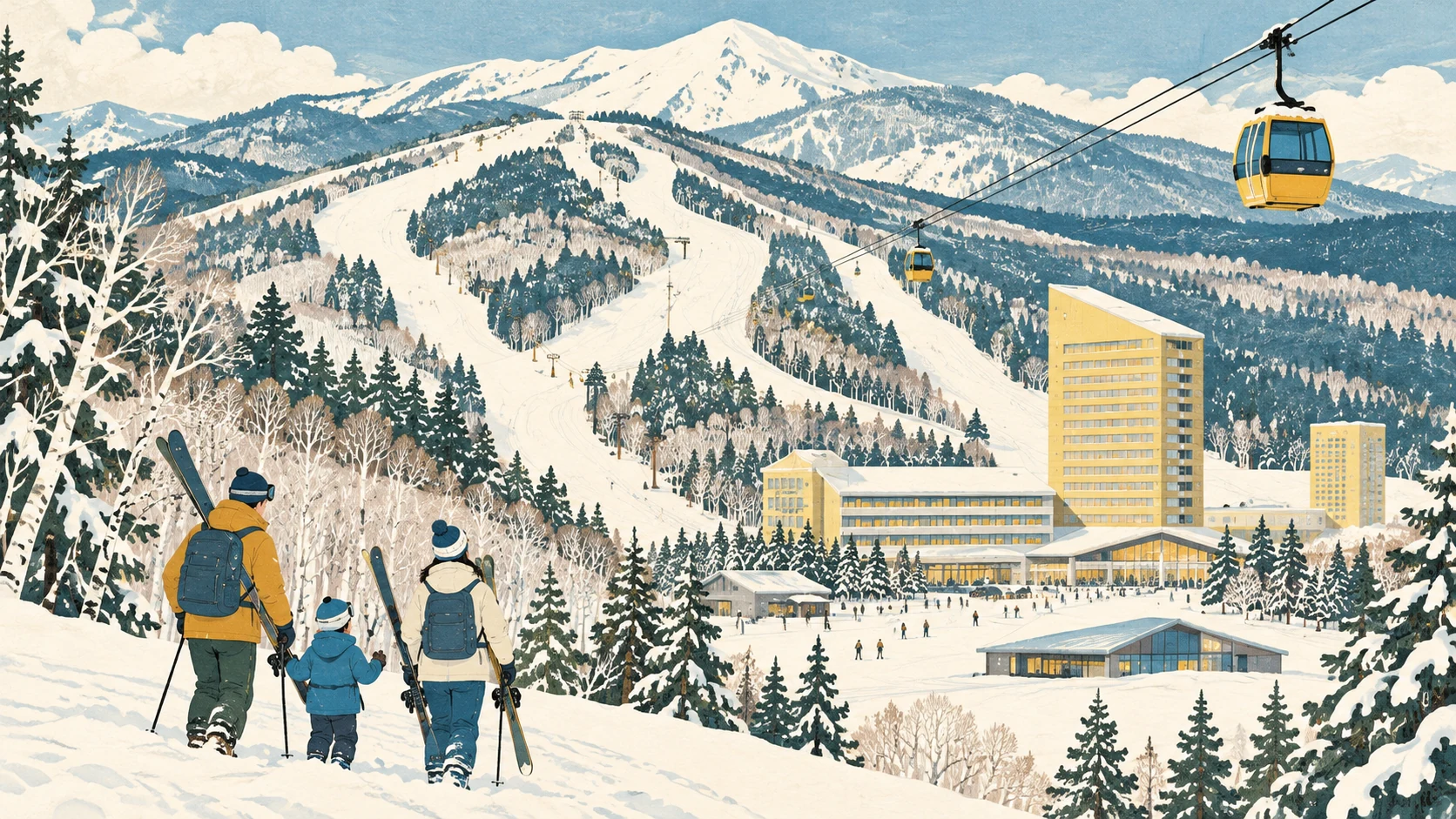
Choose accommodation around real ski days, then connect rental, lessons, buses and dinner. Compare announced new-season costs separately from day tickets awaiting updates.
Choose your skiing days before choosing where to stay in Appi Kogen
The differences between Appi Kogen bases become tangible when you put on ski boots and carry your skis out in the morning. Beside the slopes, you can exchange travel time for rest. At a pension, breakfast, transfers and dinner need to work together. In Morioka, a daily bus journey buys city dining and fewer changes of accommodation. Writing down how many days you actually want to ski is more useful than sorting rooms by price first.
For a first ski trip, leave arrival and departure as half-days and use the full day between them for lessons and practice. If you already control your speed and want two consecutive ski days, three days and two nights depend on the first and last transport connections. Four days and three nights more easily preserve two full days. This is an itinerary suggestion, not a promise that booking accommodation guarantees all that skiing time.
This guide plans the 2026/27 season using official information available on October 22, 2026, separating announced products from items awaiting updates. If combining Appi with Tokyo or other Tohoku cities, work back from arrival and departure planning for a first independent Japan trip to find the full days available. Landing, collecting bags and renting equipment are not skiing time.
Read season dates together with daily lift operations
Appi's 2026/27 lift operating schedule lists opening on December 5, 2026, continuing at most through May 5, 2027. December 5–18 is early season; December 19–January 31 and February 1–March 28 are two regular-season periods, followed by spring skiing from March 29. The latest possible closing date does not guarantee snow or every run being open.
Lifts on that same schedule have different hours. Appi Gondola is listed at 8:30–15:00 during early season and the first regular period, extending to 15:30 in the second regular period and spring. Central Quad is listed until 17:00 during regular season. A lift still running at the base does not mean you can still board the one to the summit. Families and anyone finishing early should first mark the facilities needed for their return.
Compare lower room prices, available runs and operating areas separately when choosing a month. Early or spring skiing can suit travelers who accept changes, but not someone whose sole goal is a particular upper-mountain run. For broader clothing and weather decisions, see Japan's seasonal packing and itinerary trade-offs. An Appi opening announcement cannot forecast conditions at another Japanese resort.
Beginners: understand Shirakaba before choosing a long green run
Appi's official information lists 21 runs, 43,100 meters of total skiing distance and a beginner/intermediate/advanced split of 30%, 40% and 30%. Those figures describe resort scale, not the routes you can use on every outing. A complete beginner's first goal should be stopping, turning and using lifts on a suitable gentle slope, rather than maximizing distance on day one.
In the official run difficulty and gradient information, Shirakaba is beginner-rated, 1,000 meters long, with an average nine-degree and maximum 16-degree gradient. Karugamo is beginner-rated, 1,200 meters long and averages ten degrees. A low average does not mean an evenly flat descent: ice, visibility and traffic still affect the experience. Let the day's instructor and actual openings determine the practice area and progression.
Yamabato is also beginner-rated, but its 5,500-meter length, maximum 20-degree gradient and average 15-degree gradient place different demands on stamina and continuous control than a short base slope does. Family members of different abilities can meet at a base restaurant rather than all going up together. Before trying the long run straight after a first lesson, ask the instructor whether you are ready and establish how to return if tired.
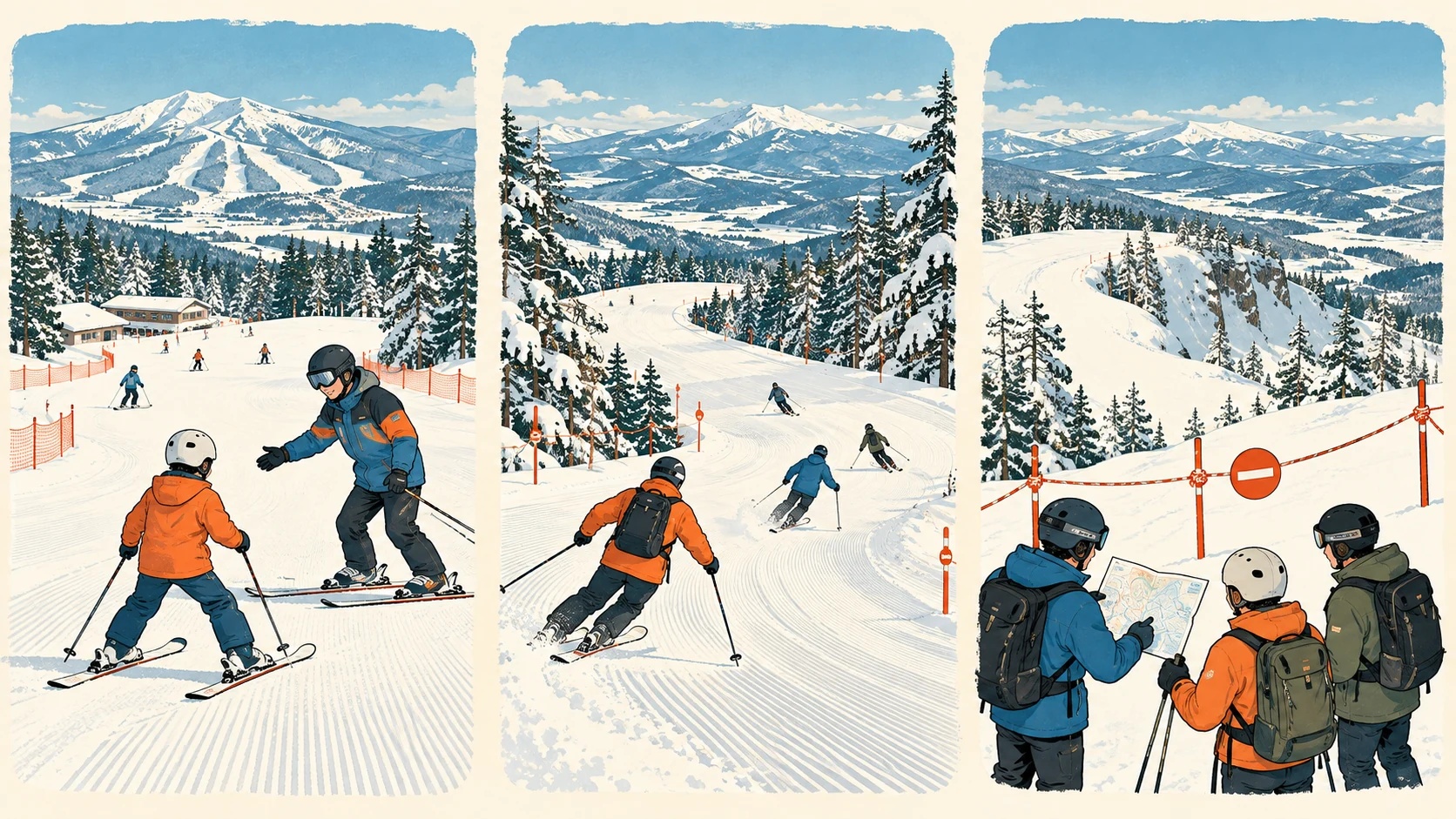
Advanced runs and tree areas cannot be chosen from photographs alone
The run table rates Second Sailer A advanced, 2,300 meters long with a maximum 34-degree gradient. Nishimori's Yamagara is 900 meters, maximum 32 degrees, average 23 degrees and entirely ungroomed. Read gradient, grooming and distance together; having skied a red run does not establish suitability for every advanced area. Attractive scenery does not justify crossing a closure sign.
The resort's skiing-area and no-rope-crossing rules prohibit going beyond the managed area, entering closures, crossing ropes or entering undesignated areas. Tree-skiing zones are for advanced users and have their own rules. Other woodland is not thereby opened, and a more expensive pass does not override a closure.
Lesson content also needs checking. The official ski school's current-season notice says safety management rules exclude lessons in tree areas, off-piste powder and terrain parks. For those activities, separately verify an authorized activity product, meeting requirements and insurance. A general private lesson is not an off-piste guiding service.
Children's lessons, language and lift tickets are separate arrangements
The school entry page lists general private lessons from age seven, group junior lessons for ages 7–12 and adult groups from 13. Shinchan's children's school has courses for ages 3–9. The age conditions for each lesson category are a starting point: open the product for the actual language and date. Overlapping ages do not make the three lesson types interchangeable.
The Chinese-language Shinchan course description includes its dedicated skis, boots, helmet and practice-area use; parents still provide clothing, gloves, goggles and other personal items. Challenge lessons using ordinary lifts are offered only in the private product, while courses including lunch require advance booking on the official website. Avoid renting the same included equipment again, and do not assume every course has lunch.
Put the collecting adult, meeting point, toilet needs and finish time in the same family schedule before drop-off. A parent taking a long adult lesson must confirm they can collect the child, not just compare starting times. A Chinese interface lets you research a Chinese-language product; it does not guarantee an instructor for every date and group size. Confirm the selected course before paying.
Rental in 2026/27: standard station and Executive Lounge are different
The current SALOMON rental prices and size information are marked 2026/27, with the standard station in Appi Resort Center. An adult three-piece ski set means skis, boots and poles, ¥7,000 for one day. The two-piece snowboard set means board and boots, also ¥7,000. Neither is head-to-toe equipment: clothing and helmet are additional.
The adult standard jacket-and-pants set is ¥6,000 a day and helmet ¥1,500. Adding ¥7,000 + ¥6,000 + ¥1,500 gives ¥14,500. Children's standard equipment is ¥4,500, clothing ¥4,000 and helmet ¥1,000, totaling ¥9,500. Ask the rental shop to confirm whether its child classification applies rather than applying the hotel or lesson age boundary.
The Executive Lounge inside Crowne Plaza uses a different list: adult equipment ¥15,000, clothing ¥12,000 and helmet ¥3,000, totaling ¥30,000. It is not the standard station's ¥14,500 product. Confirm collection point and product name, especially before assuming collection inside a hotel uses the standard prices. Keep owned and rented equipment costs separate too.
Calculate hotel-guest rental savings across the complete set
The standard list also gives hotel-guest prices: adult equipment ¥6,000 and clothing ¥5,000, with the helmet still ¥1,500, totaling ¥12,500. Children who meet both the rental child category and hotel-guest requirements have equipment ¥3,500, clothing ¥3,000 and helmet ¥1,000, totaling ¥7,500. Ask the rental desk which properties and evidence qualify; a booking at any Morioka hotel or Appi pension does not automatically confer this rate.
For two adults and one eligible child renting standard equipment, clothing and helmets for a day, ordinary prices total ¥14,500 × 2 + ¥9,500 = ¥38,500. Confirmed hotel-guest rates total ¥12,500 × 2 + ¥7,500 = ¥32,500, a ¥6,000 difference. Two days of the same combination cost ¥77,000 versus ¥65,000, a ¥12,000 difference, before lift passes, lessons, accommodation or transport.
The rental site closes online reservations at noon two days before use; later requests go through the on-site desk, with payment on site. Enter actual height, boot size and equipment needs, then schedule the lesson around collection. Completing a reservation does not resolve every fitting issue. Bring gloves, goggles and warm accessories, and ask staff to check the fit at collection rather than discovering a problem on a run.
BLUE, GOLD and BLACK: check the season before comparing upgrades
The year shown on the official winter day-ticket page remains 2025/26; 2026/27 day-ticket information awaits updating. The older BLUE covered ordinary lifts and gondolas, GOLD added specified priority boarding and summit space, and BLACK listed snowcat travel, First Track and a dedicated lounge. These explain the system, not a confirmed list of products on sale for 2026/27.
The old page also has introductory prices and tables including a card deposit. Copying just one number can mix products even within the same year. The old ¥9,000 online BLUE and ¥4,500 spring price are not new-season quotations. Nor can its old primary-school-free FAQ be applied to every 2026/27 product. Before buying, check date, adult and child rules, deposit, night-skiing inclusion and refund/change terms.
Separately, the green-season ticket at the general ticket entry point lists ¥2,200 adult and explicitly prohibits skiing or snowboarding on that ticket. A low price found while searching for Appi ski-pass prices may be a sightseeing gondola fare. For someone learning only half a day, asking which ticket the course area needs is more useful than buying the highest tier first and paying twice.
Announced season passes: do not force a break-even calculation with old day prices
The 2026/27 season-pass Final Sale terms offer ¥89,900 from September 1 to November 30, 2026, with the same price for adults, seniors and junior-/senior-high students. A regular season pass is ¥110,000, a nominal ¥20,100 difference. This compares two announced season-pass prices on one page; it does not establish savings for a short stay, particularly while new day prices remain unknown.
The season-pass page separately states that primary-school children living in Tohoku qualify for free tickets, provided a guardian accompanies them. From other areas, one child is free with one adult, with a charge of ¥3,000 for the second child onward. Those application conditions do not mean every child's day ticket worldwide is free. Purchases are nonrefundable, with no replacement for loss or damage. Online production during the season can take around a week, so immediate collection on arrival is not guaranteed.
A date discrepancy needs resolving before payment. The run page starts December 5 and ends at most May 5, while the online pass summary starts December 6 and remains valid through May 6, 2027. Do not choose the more convenient dates from the two pages to construct a trip. For opening or closing day, obtain ticket-office confirmation before booking nonrefundable transport and a room.
Morioka buses: separate ordinary routes and marked departures
The phased 2026/27 Morioka–Appi bus timetable gives an ordinary one-way adult fare of ¥1,650 and child fare ¥830, with specified Friday evening services ¥1,850/¥930. Ordinary routes do not require reservations, but operating periods differ. Sparse early-December departures, regular-season times and spring weekend services do not combine into a year-round timetable. Boarding is at Morioka Station west exit stop 26, not any stop in front of the station.
For example, in the December 18–March 22 table, a 9:00 west-exit departure reaches Crowne Plaza at 9:52 and the ski resort at 9:56. The marked 7:40 service applies daily January 3–March 7, 2027, then weekends and holidays March 8–22, going via Hachimantai Onsenkyo. It reaches the resort at 9:06, an 86-minute ride versus 56 minutes at 9:00. Leaving 80 minutes earlier brings you only 50 minutes earlier; compare wake-up and breakfast too.
For a day return from Morioka, use the 9:00–9:56 outbound and resort 16:06–Morioka 17:15 return as a regular-season example. The local window is six hours ten minutes, including collection, changing, lunch and boarding queues, rather than all skiing. Two adults' return ordinary fares are ¥1,650 × 4 = ¥6,600. Recheck your actual date before travel and allow road-delay margin.
Arriving on the Hanawa Line: settle the final transfer first
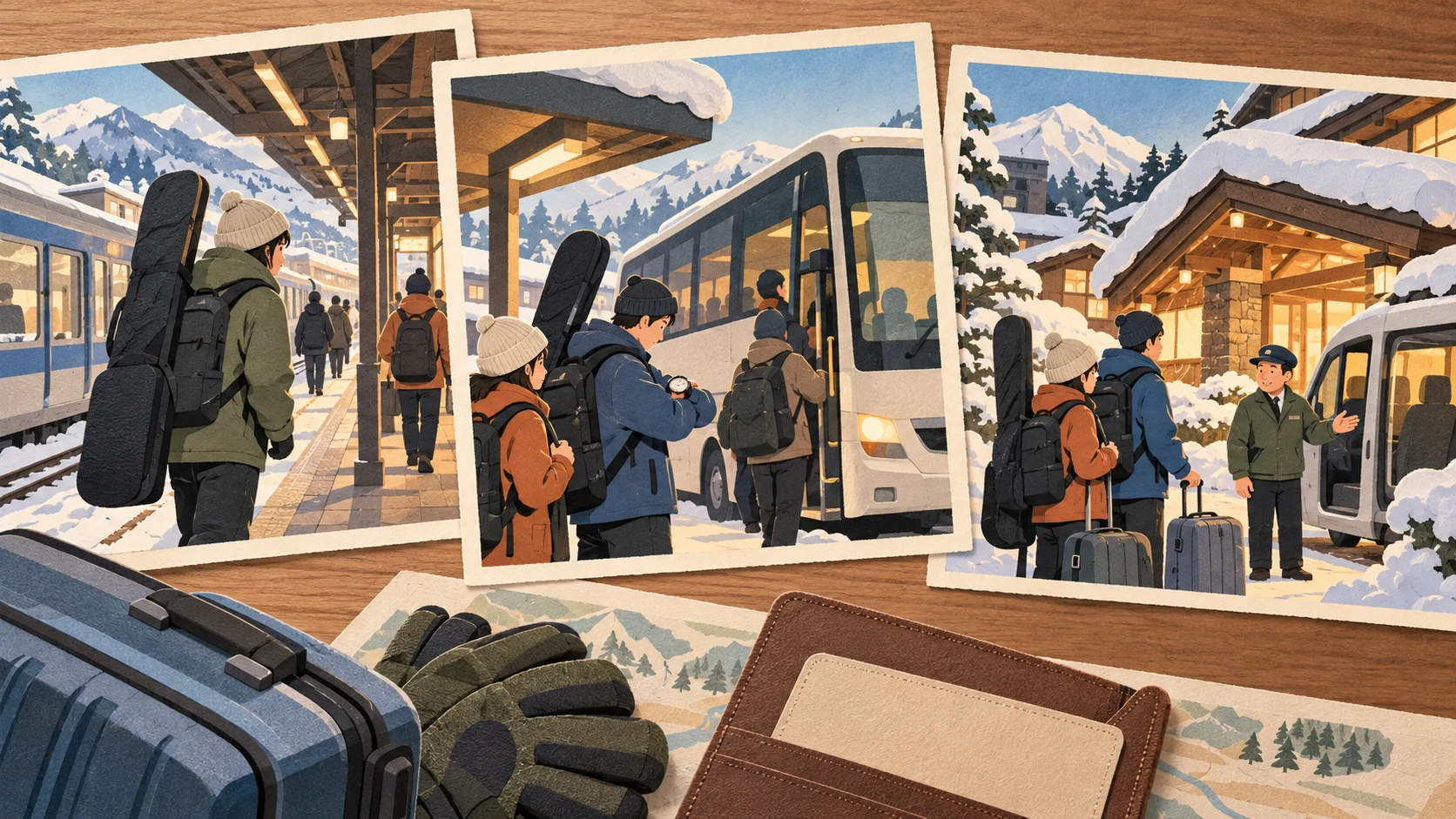
Rail travel runs via IGR and JR Hanawa Line to Appi Kogen Station; that station is not the same stop as resort accommodation. The winter access page gives about 60 minutes and warns of suspensions on some dates and times after April 2026; check JR's information for the day. The station-area shuttle timetable remains in preparation. Do not reuse an unconfirmed old departure or assume a fixed screenshot applies daily all winter. The shared place name does not mean you can walk to your hotel with ski equipment.
IGR's explanation of through tickets helps establish sales coverage between railway companies. Check the actual JR or regional pass product rather than assuming a JR train name makes the whole journey free. Give the arrival time to your actual accommodation and confirm transfer acceptance, booking deadline, meeting point and contact arrangements if full or affected by train changes.
The official Appi Hanawa Line boarding-point video below helps identify the transfer route at Morioka; times and prices still depend on your journey. If using the shinkansen elsewhere, list this connection separately when comparing Japanese individual rail tickets and passes, so you account for more than Tokyo–Morioka, including the final fare and waiting time.
Hanamaki Airport: ordinary and reserved services use different child categories
The official comparison of Hanamaki Airport's two winter bus products lists the APPI Airport Liner route service December 19, 2026–March 22, 2027, at ¥3,000 adult/¥1,500 primary-school child one way, preschoolers free, no reservation required. The hotel-guest charter runs December 5–April 4 at ¥3,500 for ages 13+, ¥1,750 ages 4–12 and free ages 0–3, with booking four days ahead.
Two adults and a primary-school child pay ¥3,000 × 4 + ¥1,500 × 2 = ¥15,000 return on the route bus. If that same child also meets the charter's 4–12 condition, the family charter return is ¥3,500 × 4 + ¥1,750 × 2 = ¥17,500, ¥2,500 more. First check eligible hotel bookings, which service connects with the flight and time for bags and immigration after arrival.
The route-bus section's footnote says “as of October 20, 2027,” incompatible with this review date and the season in its own table. Do not treat that as an update that has already occurred. Confirm with the operator or booking desk before selecting a departure; a delayed flight does not guarantee an extra bus. The video featured on the website shows a bus-stop sign and a section of covered walkway. International passengers need their own terminal's meeting instructions.
| Product | Adult | Child or free category | Booking and coverage |
|---|---|---|---|
| Morioka ordinary route bus | ¥1,650; specified Friday evenings ¥1,850 | Ordinary child ¥830; specified evenings ¥930 | No reservation; operating periods and marked departures differ |
| Morioka guest charter | Ages 13+ ¥2,200 | Ages 4–12 ¥1,100; 0–3 free | By 23:59 the previous day; verifiable accommodation required |
| Hanamaki Airport Liner route bus | ¥3,000 | Primary pupils ¥1,500; preschool free | December 19–March 22; no reservation |
| Hanamaki guest charter | Ages 13+ ¥3,500 | Ages 4–12 ¥1,750; 0–3 free | December 5–April 4; book four days ahead |
Morioka hotel-guest charters are not free shuttles
The Morioka hotel-guest charter runs December 5, 2026–April 4, 2027, one-way ¥2,200 for ages 13+, ¥1,100 ages 4–12 and free ages 0–3, with booking by 23:59 the day before. The IHR guest-service timetable and cancellation terms require a verifiable accommodation record and travel dates corresponding to the stay. It can sell out before the deadline; it is not a free hotel vehicle you can board merely by appearing at the west exit.
The table gives west-exit stop 26 departures at 12:00, 15:15 and 18:30, reaching Crowne Plaza at 13:15, 16:30 and 19:45. Return departures 9:00, 13:30 and 16:45 reach Morioka at 10:15, 14:45 and 18:00. The heading broadly says about one hour ten, but every listed journey is 75 minutes. Plan from the individual times, then add road margin; do not shorten a connection using the smaller overview figure.
InterContinental guests also board and alight at Crowne Plaza; the hotel brand does not imply a stop outside your own lobby. Meet ten minutes before departure. Charter cancellation costs 30% from seven days before use until departure, then 100% after departure or for no-show. Thirty percent of a ¥2,200 adult single is ¥660; for the ¥3,500 airport adult single it is ¥1,050. Calculate against the actual canceled booking.
Slopeside, pension village or Morioka: compare how you use the whole day
For consecutive ski days or children needing breaks, slopeside hotels make returning to the room and changing the pace easier. Actual ski-in/ski-out access still depends on the hotel exit, run connection and openings that day. The resort's official accommodation areas and properties are a location starting point, not evidence that every Appi Kogen-area door opens beside a lift.
A pension suits guests who value dinner, prefer a small property and can follow agreed times. Ask when and where the morning drop-off is, when the afternoon collection runs and whether late arrival allows dinner. Morioka suits alternating city and ski days or groups with nonskiers. Add daily return fares, waiting and changing time before deciding how much a cheaper room really saves.
The table compares two resort hotels with different positioning, Pension Aara-Wakka and Richmond near Morioka Station, focusing on the whole day's use and cost. A lowest starting price found one day does not represent every winter date or room. Choose the base matching your mornings, meals and finish time, then compare the same date, group size and meal conditions.
| Example and base | Suitable pattern | Actual comparison | Confirm first |
|---|---|---|---|
| Crowne Plaza, slopeside | Consecutive skiing, family room breaks | Standard Twin Plus/Family Triple and other rooms, rental and meeting points | Beds, building, restaurant and ages 4–12 on-site charges |
| InterContinental, slopeside | Skiing with views and hotel rest | Complete Slope View/Mountain View room names | Bathroom and shared bath, meals and actual charter stop |
| Aara-Wakka, pension base | Fixed meals and small-property stays | Corner twin/raised-tatami triple, free private-use tubs | 18:30 dinner, transfer restriction and heating fee |
| Richmond Morioka Ekimae, city base | Alternating city and ski days | Standard Twin 21.55 square meters/Deluxe Twin 26 square meters | West-exit stop access, beds, daily return bus and city tax |
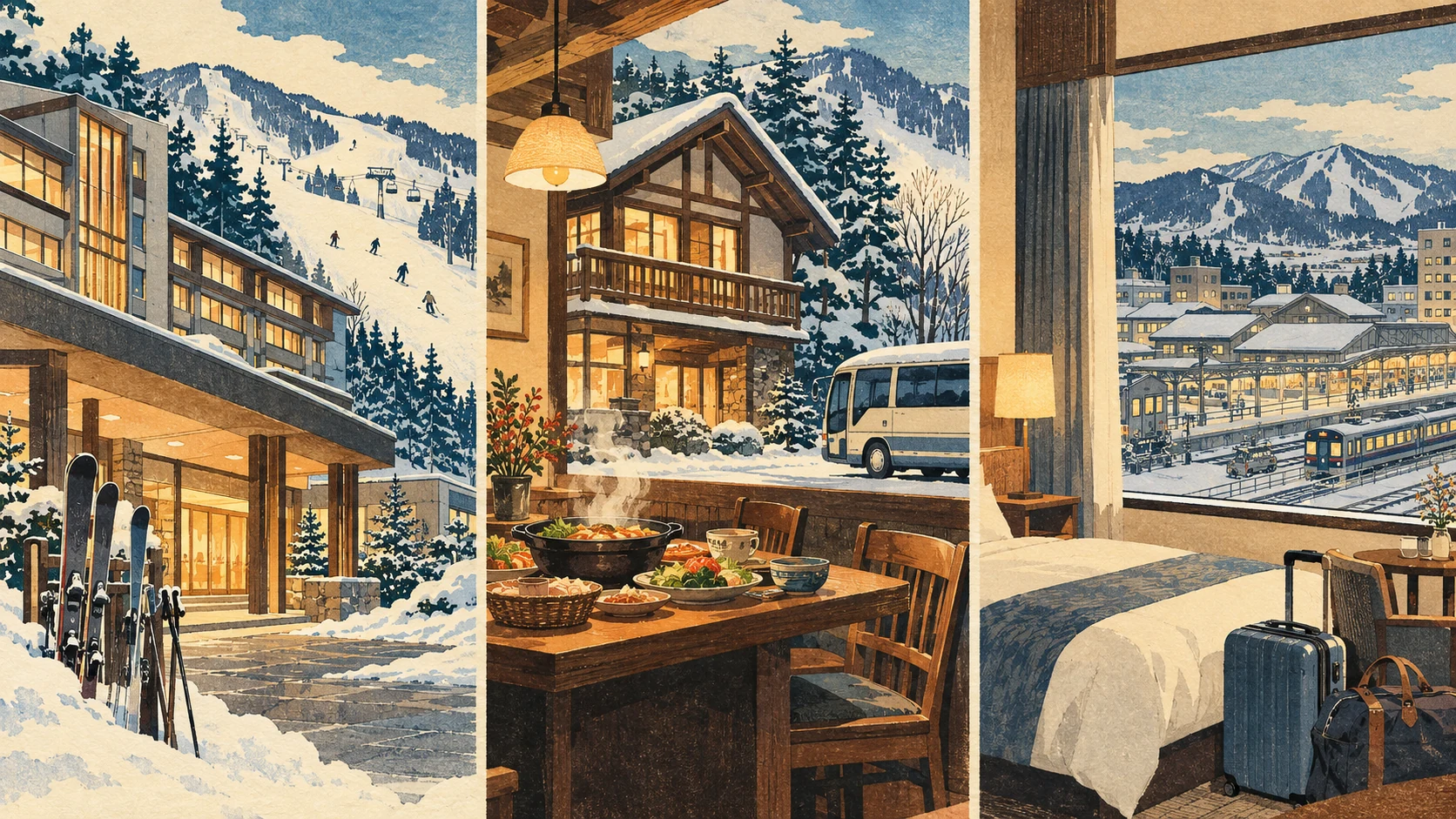
Crowne Plaza: choose the room, then calculate children's complete price
ANA Crowne Plaza Resort Appi Kogen's current room entry point lists Standard Twin Plus, Standard Large Twin Plus, Family Triple and Standard Maisonette. Two adults and a three-person family should start with the beds they need, not assume Twin or Family permits extra beds. For a maisonette, request the actual layout to judge sleeping levels and movement at night.
The resort accommodation page lists it as ski-in/ski-out, with fitness, pool and dining facilities inside. For families learning to ski, a more useful comparison is the route from the actual building to rental, lesson meeting point and dinner restaurant. Check operating dates, charges and inclusion against the booking plan; a facility existing in a hotel does not mean free use.
The page prominently warns that IHG.com's displayed total excludes additional charges for children ages 4–12, payable at check-in; ages 13+ must be entered as adults. This changes an apparently low room price. Before submitting the booking, ask the hotel to specify on-site payment using actual ages, separate-bed needs and meals, then compare complete totals across channels.
InterContinental: confirm view categories and private bathing separately
ANA InterContinental Appi Kogen Resort's room names include “2 Double Corner Classic Slope View” and “2 Double Classic Mountain View,” with Premium options featuring a terrace or private garden. Choose by the complete booked room name. Promotional photographs do not guarantee the same slope view, terrace or garden in every room.
The website lists a large shared bath with open-air bathing and sauna, not a private onsen in every room. If someone cannot use a shared bath, first clarify the room bathroom, any reservable private option and extra charges. For resting, viewing snow and afternoon tea, confirm your plan's actual service hours so these do not compete with a full ski day.
The InterContinental and Crowne Plaza have different positioning but may use the same long-distance charter stop. An expensive room does not remove the final transfer, lesson meeting or road delays. The IHG.com warning about extra charges for ages 4–12 appears here too; ages 13+ book as adults. Set group sizes and ages identically before comparing view and meal premiums.
Aara-Wakka: named rooms, fixed meals and transfer restrictions
Pension Aara-Wakka's corner twin and raised-tatami triple offer different layouts, alongside a 6.5-tatami twin, family rooms and other options. Room facilities list a modular bathroom/toilet, air conditioning and an empty fridge. The website's per-person starting rate with two meals is not tied to your winter dates; do not treat it as an actual peak-season quotation. Confirm the precise room name, occupancy and whether the bathroom is in the room.
The pension lists check-in from 15:00, checkout by 10:00, dinner at 18:30 and breakfast at 8:00. Free Appi Kogen Station and resort transfers require advance contact, avoiding 18:00–20:00. Aara-Wakka's meal and transfer instructions affect night skiing and the first lift: leaving only after breakfast does not guarantee being on an 8:30 first departure.
Its facilities page also lists winter heating at ¥300–500 per person before tax. Ask for the actual tax-inclusive amount, whether it is charged per person per night and whether the booking channel already includes it; a starting price is not automatically all-inclusive. Free private-use tubs do not establish natural hot-spring water. For pets, confirm the actual accepted room rather than applying the website's separate Asangi building rules to the main pension.
A Morioka base: matching Richmond rooms to the mountain journey
Richmond Hotel Morioka Ekimae's room specifications give Standard Twin at 21.55 square meters, two 110-centimeter beds and one to two guests. Deluxe Twin is 26 square meters with two 110-centimeter beds and an additional 100-centimeter bed for a third guest. Three adults needing individual beds cannot book the ordinary twin as though it were a triple.
The website describes a roughly three-minute walk from Morioka Station. That is not the time from your room to west-exit bus stop 26. Allow for luggage, crossing the station and locating the platform or bus stop. For the 9:00 mountain bus, finish breakfast and travel in ordinary shoes, changing to ski boots at the resort. A station-front room does not make a transfer wearing ski boots and carrying equipment an easy stroll.
Morioka City's accommodation tax starts October 1, 2026 at ¥200 per staying guest per night. Two adults for three nights pay ¥200 × 2 × 3 = ¥1,200. Ask the property about children sharing beds and extra beds rather than excluding every child from the budget. This is Morioka City's rule; do not apply it to Appi properties in Hachimantai City.
A BLUE PASS accommodation plan: one night is not two ticket days
The current 2026/27 early-booking accommodation plan with lift passes lists stays December 19, 2026–March 28, 2027, subject to exclusion dates and booking at least seven days ahead. The discount is up to 10%, not a fixed 10% every day. Full prepayment is nonrefundable, so consider flight, road and personal changes before committing to dates.
Each guest age 13+ receives one BLUE PASS one-day exchange voucher per night, collectable at reception before check-in. It includes a ¥500 IC-card deposit, refundable when the card is returned after use. Two eligible adults staying two nights receive four one-day tickets by that per-night calculation, not a ticket each on all three arrival-to-departure days. Confirm use dates, exchange location and collection order before payment.
Children's lift tickets are not included; the page directs guests to buy them separately on site under the applicable conditions. It also says vouchers are nonrefundable for any reason, including severe weather. Crowne Plaza's two-meal version specifies buffet dinner; the InterContinental version has specified restaurant choices and booking requirements, not free use of every restaurant. Separate ticket, meal and room conditions within the package total to match your actual ski days.
The same child can fall into different categories at different desks
There is no universal “children free” boundary for an Appi trip. IHG hotel notices specify additional charges for ages 4–12 and treat 13+ as adults. Guest charters use child ages 4–12 and free ages 0–3; Hanamaki route buses use primary-school and preschool categories. School products include Shinchan ages 3–9 and general junior groups 7–12. Compare each separately.
For example, a child already 13 cannot still be priced as a primary pupil in hotel or package bookings. A child who has just turned four already pays the charter child fare despite being below school age. Rental tables give adult and child columns without clearly establishing the same age rule beside the prices, so ask the rental desk. Include passport birth date and actual school grade in inquiries to reduce repricing on site.
When searching for ANA Holiday Inn Resort, distinguish Hills from the Onsen building and confirm accepted seasonal dates, room types and slope access. A bus stop name does not establish room availability on every date; old ski-in/ski-out FAQ wording does not guarantee opening for a new booking. Begin with the Crowne Plaza, InterContinental or pension options examined above rather than using a brand name in place of a specific product.
Dinner and equipment returns determine when to start packing up
Dinner in a two-meal room rate is not necessarily available whenever you arrive. The resort's restaurant-booking and accommodation FAQ requires advance dinner time and group-size reservations whether or not the stay includes two meals. Lesson finish, equipment return, changing and the transfer to lodging need a sequence you can complete, not four tasks assigned the same time.
Aara-Wakka guests should note the 18:30 dinner and 18:00–20:00 transfer restriction. If eating elsewhere to ski at night, do not assume the unused dinner is deducted from a meal-inclusive rate. Obtain agreement and clarify transport first. To catch the first lift, check whether 8:00 breakfast leaves enough time to eat and depart; do not ask a whole pension to move its schedule at the last minute.
Large hotels and small pensions have different meal and bath rules. “Two meals” does not establish room service, any restaurant you choose or unlimited drinks. Use checking meal and bathing arrangements at a first Japanese inn stay to organize questions. Choosing a plan whose meal times you can follow is easier than booking the cheapest and trying to change every service.
Shared baths or private-use facilities: do not infer from the room name
Appi's current onsen and private-spa introduction separates Shirakaba no Yu, Crowne Plaza's shared hot-spring bath and MAKIBA's reservable natural-hot-spring facility. They are not one interchangeable bath covered by any accommodation record, nor does every room include a private onsen. Ask which is included in your plan, how to reach it and whether booking is required before allocating post-ski time.
The lift-pass accommodation offer describes Shirakaba no Yu bathing vouchers as usable “when operating,” not a guarantee it opens on your arrival date. Families needing private use should check slots, capacity, cost and child rules; anyone unable to share should also verify the room bathroom. Looking for a private-bath slot only after lessons may squeeze dinner or transfers. Address it when selecting the room instead.
Aara-Wakka's free private-use facilities are described as a whirlpool and granite tub; that description does not claim a natural spring source. Wanting private space and requiring natural onsen water are different needs. Clarifying them before booking is more accurate than filtering only for “bath,” and avoids mixing photographs of an annex, main building and nearby onsen.
Large bags and equipment delivery need the exact hotel name
The resort accommodation FAQ says delivered luggage is accepted and asks guests to provide the actual hotel name, check-in date and, where needed, pronunciation of the guest's name. Bring the delivery receipt for collection on arrival. Crowne Plaza and the InterContinental both have Appi addresses but different receiving desks. Before shipping, confirm how many days early bags may arrive, how to label ski bags and whether forwarding to the next lodging is available.
The resort luggage-delivery and Ski Valet page still lists 2025/26 service periods and prices. Last season's nightly storage charge is not a new-season quotation. Ask the actual hotel or desk about 2026/27 acceptance, closing time and payment. Do not settle a budget from the old page and discover different rules on arrival.
For consecutive days from Morioka, compare taking equipment back daily with leaving it at the resort after receiving a current storage quotation. Keep personal medication, documents, warm base layers and tomorrow's clothing rather than shipping everything. Know whether replacement rental is possible and what it costs if equipment arrives late. This does not predict a delay; it prevents one luggage arrangement from making a lesson day impossible to begin.
Night skiing: check dates before deciding to stay
The 2026/27 run page gives the night-skiing period as December 19–March 28, operating on weekends, holidays and specified dates December 24–30, February 12 and February 22, with separate extended operation on December 31. It lists an ordinary latest night boarding time of 19:30 and a legend for extended periods. Do not import the old season's 20:00, or interpret the overall period as nightly operation.
Before staying for the lights or another run, open the current night-skiing dates and last-boarding calendar, confirm your actual day, then check open terrain, ticket night coverage and your return. The summit gondola's daytime closing differs from base-area night skiing. Do not plan the long daytime mountain route again after dark.
A Morioka guest who has found only a 17:06 return from the resort cannot plan to finish at 19:30 that same day. Pension guests need dinner and transfers arranged; slopeside guests should still consider energy after lessons. Night skiing can be an optional addition when conditions suit, without displacing agreed meals, child collection and sleep.
Three days, two nights: preserve one complete beginner day
Use day one to reach the accommodation and confirm tomorrow's meeting point, equipment sizing and dinner. The 12:00 Morioka charter is scheduled at Crowne Plaza at 13:15, leaving a wait before normal 15:00 check-in. Collecting lift vouchers early does not mean early room access. Keep essentials in a small bag and ask where luggage may go, rather than assuming free early check-in.
Day two is for the confirmed lesson, allowing collection and changing beforehand and suitable practice afterward according to the instructor. Lunch, toilets and indoor rest belong in the same day; parents need not expect a child to ski from opening to closing. If adults and children take separate lessons, settle meeting and collection arrangements. Nonskiers also need a realistic base-area plan.
Work backward on day three from the actual departing bus or train, rather than forcing in a ski morning because checkout says 11:00. Return equipment, change to normal shoes, collect bags and walk to boarding. With only two days and one night, preserve one introductory lesson and reduce ski expectations instead of compressing this three-day plan by removing rest.
Four days, three nights or a Morioka commute: place two ski days deliberately
A four-day, three-night stay near the resort separates arrival on day one, full skiing on days two and three and departure on day four. Learn facilities and suitable runs on the second day, then decide whether to practice longer, add a lesson or finish early on the third. A ticket-per-night offer gives three nights against two complete ski days; verify whether the extra day is useful to you.
If the wider trip includes Morioka, consider whether changing hotels is necessary; saving a bus ride can instead create two extra rounds of packing large bags. Two adults commuting by ordinary bus for two days pay ¥6,600 × 2 = ¥13,200. Staying in Appi and using only one ordinary trip each way costs ¥6,600 for both, ¥6,600 less, but lodging, meals and rental eligibility still need separate comparison.
Morioka and the resort are not joined by an anytime urban subway. A city breakfast and afternoon arrival on one day mean accepting less skiing time. For an early lesson, use an earlier service valid for that date or stay the night before. If companions split up, agree which lodging to meet at that evening. A charter restricted by accommodation records is not a general commuting pass.
Wind, limited snow or fatigue: keep the trip adjustable
For a snow trip, preserve alternative accommodation and transport choices rather than assuming a run will definitely open. Check operating status that day and ask reception or instructors which areas suit you. A suspended main gondola does not establish all facilities are closed; conversely, open base lifts do not make the original upper-mountain plan appropriate.
After a weather change, distinguish unavailable activities from ones you still want. Beginners can ask whether the lesson runs, where and with what possible adjustment. Nonskiing companions should confirm indoor facilities, food and bathing are actually open instead of using last year's hours for alternatives. If nothing suitable is available, finishing early is a reasonable choice.
Keeping emergency contacts, booking numbers and transfer details is more useful than holding only an attraction list. Stop when injured or unwell and seek on-site help; personal health issues belong with appropriate professionals. Promotional descriptions of snow cannot replace that day's local judgment. Continue or stop according to your condition and the actual environment.
Budget from known costs; leave rooms and day tickets for real quotations
For two adults based in Morioka three nights with two full ski days, standard equipment, clothing and helmet at ¥14,500 per adult per day make four adult day-rentals totaling ¥58,000. Two days of return ordinary buses are ¥13,200; three nights of Morioka tax for two are ¥1,200. Together these three items total ¥72,400, still excluding rooms, lift tickets, lessons, food and international travel and travel to Morioka.
Let H be the actual room quotation per room per night and L the applicable new-season adult day ticket. Known items plus rooms and tickets in this example are ¥72,400 + 3H + 4L. Fill H and L using the same travel dates and conditions, not starting room prices or an old day fare. If breakfast is included, do not add that same breakfast again in meals.
With confirmed hotel-guest rental eligibility, the same four adult day-rentals are ¥12,500 × 4 = ¥50,000, ¥8,000 less than ordinary rental. Enter the difference in fixed and variable items in an overall Japan travel budget, but do not use it alone to declare a pricier resort hotel good value. Compare rooms, meals, transfers, ticket inclusion and cancellation flexibility in one table.
| Item | Calculation | Amount in yen | Condition |
|---|---|---|---|
| Two days of Morioka ordinary return buses | 1,650 × 2 people × 2 directions × 2 days | 13,200 | Excludes specified Friday evening fares |
| Two days of standard equipment, clothing and helmets at ordinary rates | 14,500 × 2 people × 2 days | 58,000 | The same standard products each time |
| Same equipment combination at eligible guest rates | 12,500 × 2 people × 2 days | 50,000 | Replaces the previous row; do not add both |
| Morioka tax for two over three nights | 200 × 2 people × 3 nights | 1,200 | Morioka stays only; not Hachimantai City |
Nonrefundable plans, bus cancellation and weather suspension are separate
The early-booking lift-pass stay explicitly requires full nonrefundable prepayment, and ticket vouchers are not refunded for severe weather. Those accommodation and lift-pass rules do not automatically apply to other transport or transfer bookings. Check the individual booking terms for accommodation, lessons, rental, charter transfers and flights. Check who changes the booking, cutoff time zone and refund channel before exchanging flexibility for a lower price.
Guest-charter cancellation reaches 30% from seven days before travel, and 100% after departure or for no-show. Two adults' Morioka one-way total of ¥4,400 incurs ¥1,320 in the 30% band. If the same order contains other passengers or a return leg, calculate the actual canceled scope, not the entire round-trip price as though it were a single fare. If the operator suspends service, ask how it will handle the situation rather than applying voluntary-passenger cancellation rules yourself.
The general resort FAQ still lists winter cancellation periods for 2025/26. Do not replace the year and apply them to 2026/27. Compare the new order and selected plan's actual terms. To retain flexibility, compare refundable rates with prepayment discounts first, rather than buying a cheap nonrefundable plan and expecting an exception for a personal change.
Driving exchanges transfers for other responsibilities
The winter access page requires snow tires, chains or suitable winter equipment and time for weather and road conditions. Without snow-driving experience, do not decide solely from a dry-road navigation estimate and cheap rental. Collection, clearing snow, parking, finding the actual hotel entrance and organizing luggage before return all consume arrival and departure time, just as bus waits do.
For Crowne Plaza and InterContinental guests, the official accommodation FAQ lists free guest parking. That does not establish free use of all resort lots, nonguest parking or every special space. Ask a pension about spaces and snow clearing; in Morioka, check partner-lot hours, re-entry limits and overtime charges. Separate each location's parking rules to judge whether driving really fits the budget.
If the sole reason to rent a car is the short Appi Kogen Station–hotel leg, first compare accommodation pickup. To combine other Tohoku places, rebuild the route around real roads, weather and nightly bases. Snowy mountain roads are not city travel. Avoid placing night skiing, dinner and a long drive on the same night with fatigue addressed only at the end.
Booking order: settle the conditions you cannot interchange
First fix travel dates and complete resort days, then choose a base for bed count, meal times and any need to return to the room. Confirm each child's product charges, actual transfers and places in the required lesson language before comparing packages, separate day tickets and season passes. If one element is unavailable, you can still change the others instead of discovering an impossible connection after paying for everything.
Keep the full hotel name, room type, guest ages, meals, prepaid and on-site amounts, cancellation terms and each service's meeting point together. Paper or offline copies help, but dynamic tickets must still be shown as the operator requires; a screenshot is not universally valid. Add equipment collection and return, changing and meeting times to each day afterward.
Appi Kogen rewards considering slopes and lodging together, but need not be every visitor's fixed answer for Japanese winter. With mainly nonskiers or only one tightly connected day, first reconsider combining cities and outdoor activities in a Japanese winter trip, then decide whether to add a mountain stay. Other Iwate ski areas, Tohoku places and next year's operations each require their own checks; do not reuse Appi's seasonal prices and times for them.
A few useful answers
When does Appi Kogen’s 2026/27 season start?
The run schedule lists December 5, 2026 through at most May 5, 2027; snow, weather and facility operations can change. The pass page separately starts December 6 and gives validity through May 6. Confirm first or last-day use with ticketing rather than combining two pages into a guarantee.
What are 2026/27 BLUE, GOLD and BLACK day-ticket prices?
At the time of checking, the winter day-ticket page still showed 2025/26. The old ¥9,000 online BLUE and other old prices are not new-season quotations. Announced new season passes are Final Sale ¥89,900 and regular ¥110,000; day prices, arrangements for children and upgrade benefits need to be confirmed for the relevant product.
Should a complete beginner immediately try the 5.5-kilometer Yamabato run?
Not based on the beginner label alone. Yamabato is listed at 5,500 meters, maximum 20 degrees and average 15, unlike a short base slope. Learn stopping and turning in a suitable open area with an instructor’s assessment before choosing a long descent.
Are all children’s lift tickets free?
No universal rule applies. The 2026/27 season-pass page has residence and accompanying-adult conditions; the ticket-inclusive stay excludes child passes. Hotels, rental, lessons and buses have separate categories. Check each actual product rather than using last season’s day-ticket FAQ for everything.
How do the ordinary Morioka bus and guest charter differ?
The ordinary regular one-way fare is ¥1,650 adult/¥830 child, with date periods and marked services; no reservation is required. The guest charter is ¥2,200 adult, ¥1,100 ages 4–12 and free ages 0–3, booked by 23:59 the previous day with eligible accommodation records matching the dates.
Can I travel directly from Hanamaki Airport to Appi?
There are phased route buses and guest-only reserved charters. The route service runs December 19, 2026–March 22, 2027 at ¥3,000 adult/¥1,500 primary pupil. The charter runs December 5–April 4 at ¥3,500 adult/¥1,750 ages 4–12, booked four days ahead. Check terminal, service, eligibility and the official page’s anomalous footer year.
Can I walk from Appi Kogen Station to the hotel with ski gear?
Do not assume so from the shared name. The official station-area shuttle table remains in preparation. Give your actual train time to the property and confirm the final pickup, booking deadline and meeting place, and recheck partial-date train suspensions.
How much is a day of standard equipment, clothing and helmet?
For 2026/27, adult standard-station costs are ¥7,000 + ¥6,000 + ¥1,500 = ¥14,500. A shop-confirmed child category costs ¥4,500 + ¥4,000 + ¥1,000 = ¥9,500. Eligible hotel-guest prices are ¥12,500 and ¥7,500. The Executive Lounge has a different price list.
How many tickets do two adults receive with a two-night ticket-inclusive stay?
The reviewed early-booking plan gives each guest age 13+ one one-day voucher per night: two adults for two nights receive four. It does not give each person tickets for all three arrival-to-departure days, and children are excluded. Confirm use dates, collection and nonrefundable terms; one per night is not a three-day pass.
What should I confirm at Aara-Wakka?
Check the actual room, in-room bathroom, heating fee and meals. The official site lists 15:00 check-in, 10:00 checkout, 18:30 dinner and 8:00 breakfast. Free station and resort transfers require advance contact, avoiding 18:00–20:00. Free private-use tubs do not establish natural hot-spring water.
Can I add Morioka accommodation tax to an Appi hotel?
No. Morioka City’s ¥200 tax per staying guest per night starts on October 1, 2026: two adults for three nights total ¥1,200. Appi lodging is in Hachimantai City, so do not transfer the rule. Ask each property about child bed-sharing, extra beds and on-site charges.
Is night skiing daily, and are stays and passes fully refundable in severe weather?
Neither is guaranteed. Night skiing in 2026/27 runs on specified weekends, holidays and special dates; check daily operations and transport. The reviewed early-booking ticket stay requires nonrefundable prepayment, and vouchers are not refunded for bad weather. Transport, lessons and other orders have separate terms.
Check with the source
Schedules, availability and rules can change. These official sources are the place to confirm details before you book.
- Appi Kogen: 2026/27 lift hours, night-skiing calendar and run details
- Appi Kogen: skiing areas, tree zones and lift safety rules
- Official Appi ski school: current booking, languages and lesson scope
- Appi Kogen: private, group and Shinchan course entry points and ages
- Official Appi school: Chinese children’s courses, equipment and lunch
- Appi Kogen: 2026/27 standard and Executive Lounge rental prices
- Appi Kogen: winter day tickets still labeled 2025/26
- Appi Kogen: green-season sightseeing gondola tickets explicitly excluding skiing
- Appi Kogen: 2026/27 season-pass Final Sale and conditions
- Appi Kogen: phased 2026/27 buses, rail and winter access
- IGR Iwate Galaxy Railway: through-ticket sales and coverage
- Appi Kogen resort: accommodation areas and partner properties
- ANA Crowne Plaza Appi Kogen: rooms, facilities and child-price notices
- ANA InterContinental Appi Kogen: room names, facilities and booking notices
- Pension Aara-Wakka: rooms, bathrooms, private-use tubs and heating fees
- Pension Aara-Wakka: meals, transfers and current notices
- Richmond Hotel Morioka Ekimae: bed widths, room areas and capacity
- Morioka City: accommodation-tax rate, area and start date
- Appi Kogen: 2026/27 early-booking accommodation with BLUE PASS
- Appi resort: arrivals, dining, deliveries and accommodation FAQ, with old winter cancellation dates
- Appi Kogen: Shirakaba no Yu, shared baths and private spa
- Appi Kogen: luggage and Ski Valet page still listing 2025/26 periods