Give Nyuto's dinner and bathing and Yokote's nighttime snow-house walk different evenings. Choose Akita accommodation using named rooms, the right year's dates and return transport.
Choose the night first: Nyuto's hot springs or Yokote's snow houses
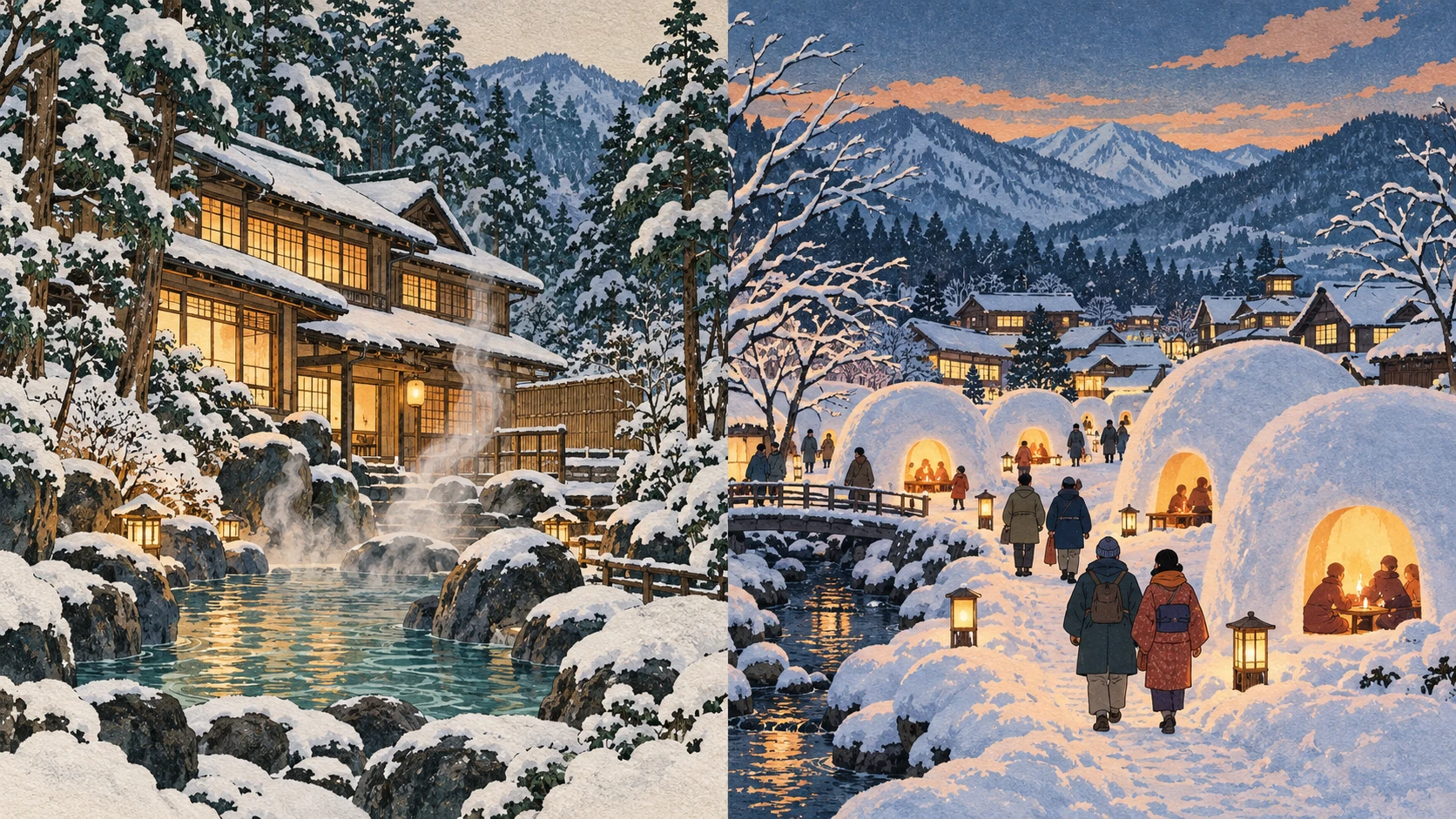
Two common hopes for winter in Akita work better with separate overnight bases. Nyuto Onsen calls for an early arrival, dinner and bathing in the mountains. Yokote's kamakura festival puts the emphasis on walking through town at night. Ryokan dinner, mountain buses and festival lighting each have their own times. Squeezing them into one day often sacrifices rest before you discover that the transport does not connect.
To experience both, begin with one night at a mountain onsen and two in Yokote, then adjust to your arrival date. This is a suggestion about pace, not a guarantee that a particular inn has rooms. With children or people unused to snow, establish whether they need an in-room toilet, beds rather than futons, and a direct return to the hotel at night. Compare photographs and prices after those practical needs.
This guide uses official information available on October 22, 2026; amounts are in yen. Announced 2027 dates, previous years' programs and assumed budgets are labeled separately. For a first independent Tohoku trip, arrange your Japan travel days and city sequence first. Then decide whether Akita will be a full stop or whether to keep just one of these destinations.
Akita Shinkansen to Tazawako; for Yokote, check the Omagari connection
Tazawako Station is a common rail gateway to Nyuto Onsen, followed by Ugo Kotsu's Nyuto bus uphill. For Yokote, consider Omagari and the Ou Main Line. Yokote City's rail-access explanation lists the combination from Morioka through Omagari to Yokote. Search Tazawako, Omagari and Yokote as separate stations rather than treating every overnight destination as a shinkansen stop.
The Akita Shinkansen Komachi has no unreserved-seat cars. JR East's explanation of reservations and special limited-express tickets describes a specific arrangement for using vacant ordinary-car seats between Akita and Morioka: you must move if someone holds that seat's reservation. Coming from Tokyo or anywhere south of Morioka, buy suitable tickets for your complete journey. The exception for one section cannot be applied to the entire trip.
When booking, first establish the inn's desired arrival time, then work backward through the mountain bus and shinkansen. If sleeping in Omagari or Yuzawa after the festival, separately check that day's train back from Yokote rather than just a daytime outbound journey. Seats, transfer platforms and walking pace affect connections. With large bags, avoid making a combination that fails after one delay your only plan.
Current Nyuto bus fares: when to use 950 and 750
Ugo Kotsu's main-section fare table from Tazawako Station identifies conditions as of April 1, 2026: Taenoyu Onsen-mae, Kyukamura-mae and Nyuto Ganiba Onsen each cost 950; Alpa Komakusa costs 750 and Tazawako-han lakeshore 400. Some hotel access pages still show older amounts. Build the budget from the bus operator's current table, checking again for changes before departure.
The official Nyuto timetable PDF from the same revision includes Tazawako 13:30–Taenoyu Onsen-mae 14:15, a scheduled 45 minutes. A return example leaves Taenoyu at 15:40 and reaches the station at 16:28, scheduled 48 minutes. These illustrate reading the current table, not confirmed February 2027 services. They do not remove the need for snow-delay margins.
The same table warns that some departures do not connect with the shinkansen. Writing 'about an hour on the bus, then work it out' is insufficient. Note your stop, departure, next-service alternative and inn contact. The lakeshore can be an en-route stop, but getting off requires a new calculation for the next fare and bus. The direct price is not a pass allowing unlimited exits and reboarding.
For Tsurunoyu, arrange pickup at Alpa rather than trusting the entrance stop's name
Tsurunoyu's route is particularly easy to misunderstand from the stop name. The bus PDF expressly says Tsurunoyu Onsen Iriguchi is about 50 minutes on foot from the inn and asks visitors to contact the property for pickup at Alpa Komakusa. Pulling bags along that mountain road in snow is entirely different from stepping off at the front door. Resolve this final leg first when planning Nyuto transport.
Tsurunoyu's own arrival instructions ask you to select a Nyuto-line bus and then tell the inn which one, connecting at Alpa. Its listed transfer route links Tsurunoyu, Yama no Yado and Alpa. It is not an on-demand Tazawako Station pickup or a car to detour around any lake attraction. Giving the train and bus times together is clearer than simply saying you will arrive in the afternoon.
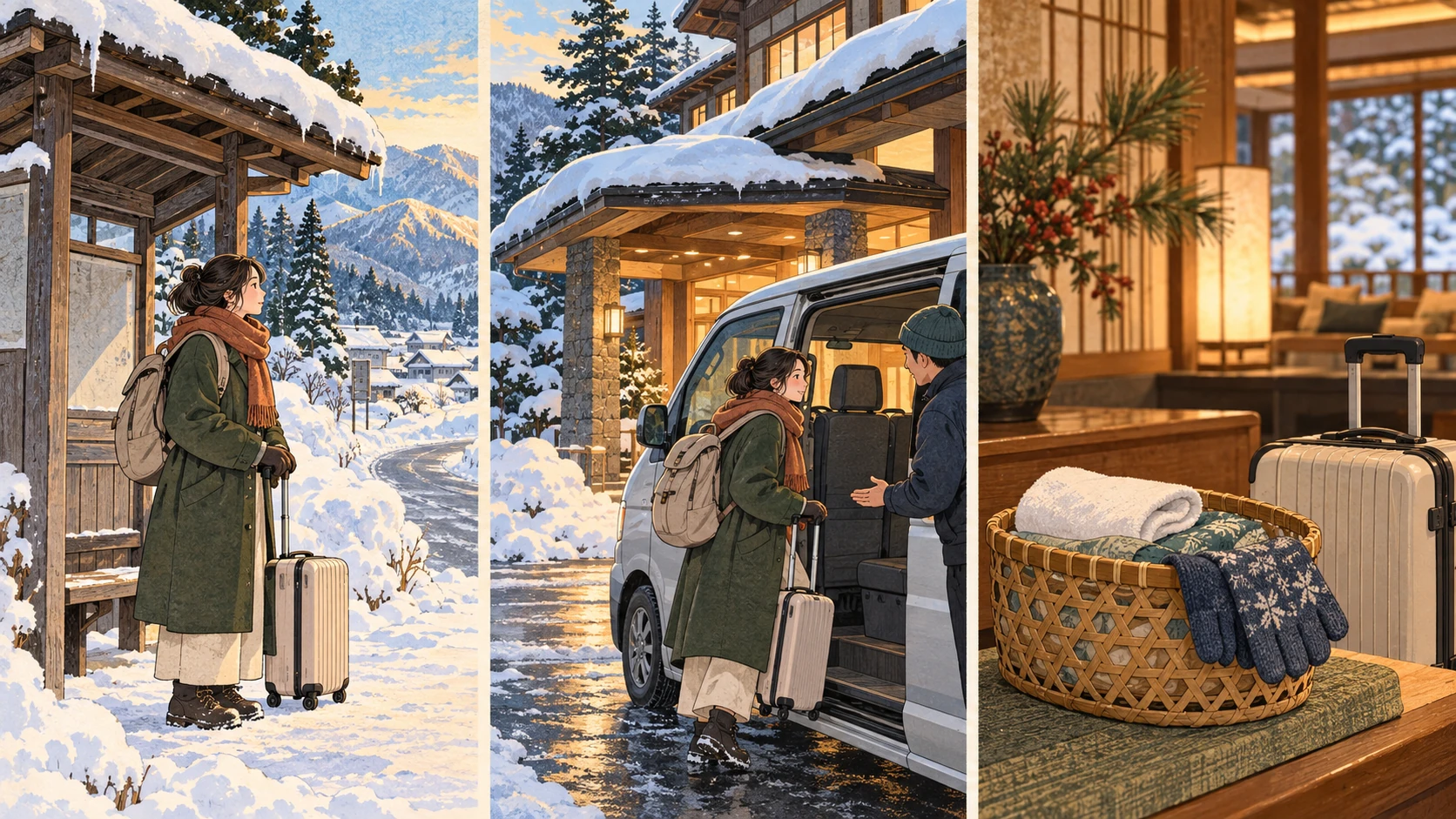
If the original train is delayed, contact the inn while you still have communication and waiting space, asking what happens to pickup and dinner. Do not independently switch to the entrance stop while the property waits for another bus. Mention in advance if someone needs luggage assistance, cannot climb a high vehicle step or cannot wait outside long. The transport arrangement should fit actual mobility.
Choosing the seven inns: operating conditions before water color and scenery
Nyuto Onsen's seven establishments normally mean Tsurunoyu, Taenoyu, Kuroyu, Ganiba, Ookama, Magoroku and Kyukamura. Seven names do not mean seven available overnight stays on any date or a winter bus circuit that can visit every bath. Kyukamura's overview of the seven baths and touring system helps explain the group, but each property's current notices determine its operation, prices and maintenance.
For a first snow-view outdoor-bath trip, narrow the choice to one overnight inn and one day visit. Study Tsurunoyu for historic buildings, Taenoyu or Kyukamura for an in-room toilet, and Magoroku if comfortable with a forest walk on arrival. Anyone uneasy with mixed bathing should check separate baths and hours first. A beautiful outdoor pool is not suitable for every companion, and completing seven names is not an obligation.
The table below establishes a choice sequence; detailed restrictions follow. Snow, closures and unplanned maintenance may make staying in your own inn the best option that day. Time for reading, food and dry clothing can make the mountain stay more enjoyable than repeatedly entering different pools in a short window. It also leaves more energy for long-distance travel after check-out.
| Property | Needs to investigate first | Notable current limitation |
|---|---|---|
| Tsurunoyu | Historic buildings, milky baths and a mountain stay | Monday day-use closure; contact for Alpa pickup |
| Taenoyu | In-room toilets, river-view categories and reserved bathing | Tuesday day-use closure; ordinary bathing and private use are separate charges |
| Kyukamura Nyuto Onsenkyo | Named bed arrangements, Japanese rooms and bath touring | No free transfer from Tazawako Station |
| Magoroku Onsen Rokuan | A small set of named rooms and forest walking access | Year-round P3 approach, about 15 minutes on foot; Friday day-use closure |
| Ganiba Onsen | Forest outdoor pool and separate indoor baths | Reaching the outdoor pool requires a walk of about 50 m outside in your own shoes |
| Ookama Onsen | Day bathing and a wooden building | Overnight stays suspended from January 1, 2026; day bathing continues |
| Kuroyu Onsen | Green-season and autumn stays, including self-catering | Official bath season roughly mid-April to early November; choose elsewhere in winter |
Tsurunoyu day visits: check Monday closure and towel rules together
Tsurunoyu's bathing notice lists day admission at 700 for adults and 300 for children, with towels sold separately for 200. Monday day visits are suspended, moving to the next weekday if Monday is a holiday. The inn's English page gives 10:00–15:00. Some overview tables still describe Monday as cleaning only the outdoor pool. Follow Tsurunoyu's own day-use closure rather than assuming its indoor baths will certainly receive visitors.
Before departure, reconfirm which baths day visitors and overnight guests may use, final admission and cleaning. A 700 ticket is not a package with towels, lunch and unrestricted room use. This price passage also does not fully define the children's age range; ask with small children. If your date is a Monday, leave Tsurunoyu for another day and use the system at your overnight property instead.
Tsurunoyu's English guidance says not to dip towels into the bath. Another inn allowing a bath towel to cover the body in mixed bathing does not replace that rule. Pack a small towel, bath towel and wet-item bag, asking the rules of each pool on entry. Photography also depends on permitted areas: an exterior and a changing room are different settings. Recording your trip must not compromise others' privacy.
Booking Tsurunoyu: Building 2 and Honjin have different conditions
The Tsurunoyu rooms and reservations page identifies Building 2 as a building for longer hot-spring stays, with six-tatami rooms, shared toilets and washbasins, and breakfast and dinner at Honjin's dining area. It can suit people who accept communal facilities and want to prioritize the mountain stay. If you need a toilet inside the room at night or have knee difficulties, ask about other available buildings before pursuing the lowest number.
The same page's 'when two people stay' column lists Building 2 at 11,700, with single use separately at 13,570. The inn's English price list identifies this main-complex price set as effective from November 2026. Obtain a specific-date quote for winter 2027. Heating is 1320 per room, roughly October–May with weather adjustments. Confirm per-person or per-room units, meals, tax and date. Honjin appears as both 15,550 in the table and 15,500 below it; do not choose one yourself as a guaranteed selling price.
The current room page offers telephone reservations or the Nihon Hitou wo Mamoru Kai web entry and expressly excludes email. Prepare dates, adult and child numbers, acceptable buildings, meal needs and transport before asking about rooms. Searches for Tsurunoyu's official website or booking instructions should lead to the same operator's current page. An old price list remaining online does not turn it into a new accommodation plan.
Shin-Honjin and Yama no Yado: ask exactly where you eat and how you sleep
Tsurunoyu's Shin-Honjin and Higashi-Honjin have different arrangements. The room page separates room numbers assigned meals at an irori hearth from those assigned meals in the large dining room. 'Shin-Honjin' does not establish hearth dining for every room. Building 1 also has upstairs rooms. Describe your actual movement limits when seeking fewer stairs, asking the property to confirm the allocation rather than inferring the route from room photographs.
Tsurunoyu Yama no Yado is a separate accommodation option. Yama no Yado's room and booking explanation lists bedrooms connected to Japanese rooms in a relocated traditional house and rooms built with local timber. The property has no televisions or air-conditioning throughout. Those features can suit a quiet stay but also require confirming beds, in-room facilities and meal arrangements before booking.
Yama no Yado accepts telephone or front-desk reservations, with no online reservations or email handling, and states a six-month booking horizon. This is its own method, not proof that every Tsurunoyu building releases rooms at the same time. Prices and heating on that page also belong to Yama no Yado. Ask for a fresh quote for the stay date rather than combining the main building's and annex's two lists into one bill.
Taenoyu room choices: compare Momiji, Sakura and Tsubaki
Taenoyu can suit a mountain stay with a toilet inside the room. The current room categories list Momiji Special River View, Momiji Twin, Momiji River View, Sakura River View and Tsubaki. The property says every room has a toilet; this does not mean every room has a private hot-spring bath. Choose beds or futons first, then compare river views and size.
The room introduction still linked by the inn describes Momiji Special River View as roughly 16 tatami upstairs. Momiji and Sakura River View are 10–12 tatami, Tsubaki 7–8; Momiji Twin has two beds. These categories cannot guarantee every room's floor, view angle or child capacity. With older companions, directly communicate stair and bed-height needs and request the inn's confirmation.
Taenoyu's own site links its reservation system. Select dates, then verify meals, cancellation and payment. If you want to bathe privately without leaving the room, ask first: Taenoyu's reserved-use bath is a separate system. A toilet in an ordinary guestroom and a private time slot in a shared-area bath are different things when caring for a child at night.
Taenoyu day and private use: what 1000, 3300 and 5500 buy
Taenoyu's gold-and-silver bathing and day-use rules give ordinary day bathing as 10:30–15:00, final admission 14:00, with Tuesday closure. Under Japan's school-stage categories, adults pay 1000 and elementary-school pupils and younger children 500. Some baths may be unavailable in winter. Check the actual open areas; weather and cleaning can change an outdoor riverside experience, so a photograph cannot promise the same scene on your selected day.
The reserved Yawaragi bath uses the silver water. Overnight guests use it free according to the inn's system; day visitors pay 3300 for one hour within 11:00–15:00, requiring advance telephone booking in order of acceptance. If an overview site has an older private-use price, prioritize Taenoyu's own. Ask whether ordinary admission and private use can be combined, how many people may bathe and how the charges are settled.
The separate 5500 charge is per private rest room, not the price of an in-room hot spring. The bathing page lists 10:30–14:00, while the dining page lists an ending at 14:30. Confirm that discrepancy at booking rather than using it to plan right against the last bus. A rest room, a reserved bath and an overnight stay are three products. Two travelers should not treat a per-room or per-session fee as a per-person admission.
Taenoyu's arrival, meals and stairs also shape the stay
Taenoyu's access information points to Taenoyu Onsen-mae on the Nyuto line, then about a minute's walk. The FAQ expressly says there is no free station transfer. Budget the 950 from Ugo Kotsu's 2026 table rather than the inn's older 820. With bags and snowy walking, choose an earlier bus, settle in and only then consider another day bath.
There are steps and stairs inside. Taenoyu's facility and meal questions help establish requirements before booking. Mention allergies and ingredients you do not eat in advance; the inn requests at least three days’ notice, without guaranteeing complete allergen removal. If you need a step-free route, a particular toilet or movement assistance, ordinary help should not be taken as a fully accessible building.
Taenoyu's introduction to Akita cooking describes kiritanpo rice-stick hotpot in Hinai-jidori chicken broth and seasonal ingredients. This indicates the meal style without promising an identical menu on your travel date. For lunch alone, the page lists 11:30–14:00, cold Inaniwa udon sets at 2420 and hot sets at 2200 including tax. Ask about operation, reservations and combining lunch with bathing first.
Kyukamura Nyuto Onsenkyo: check beds, toilets and occupancy together
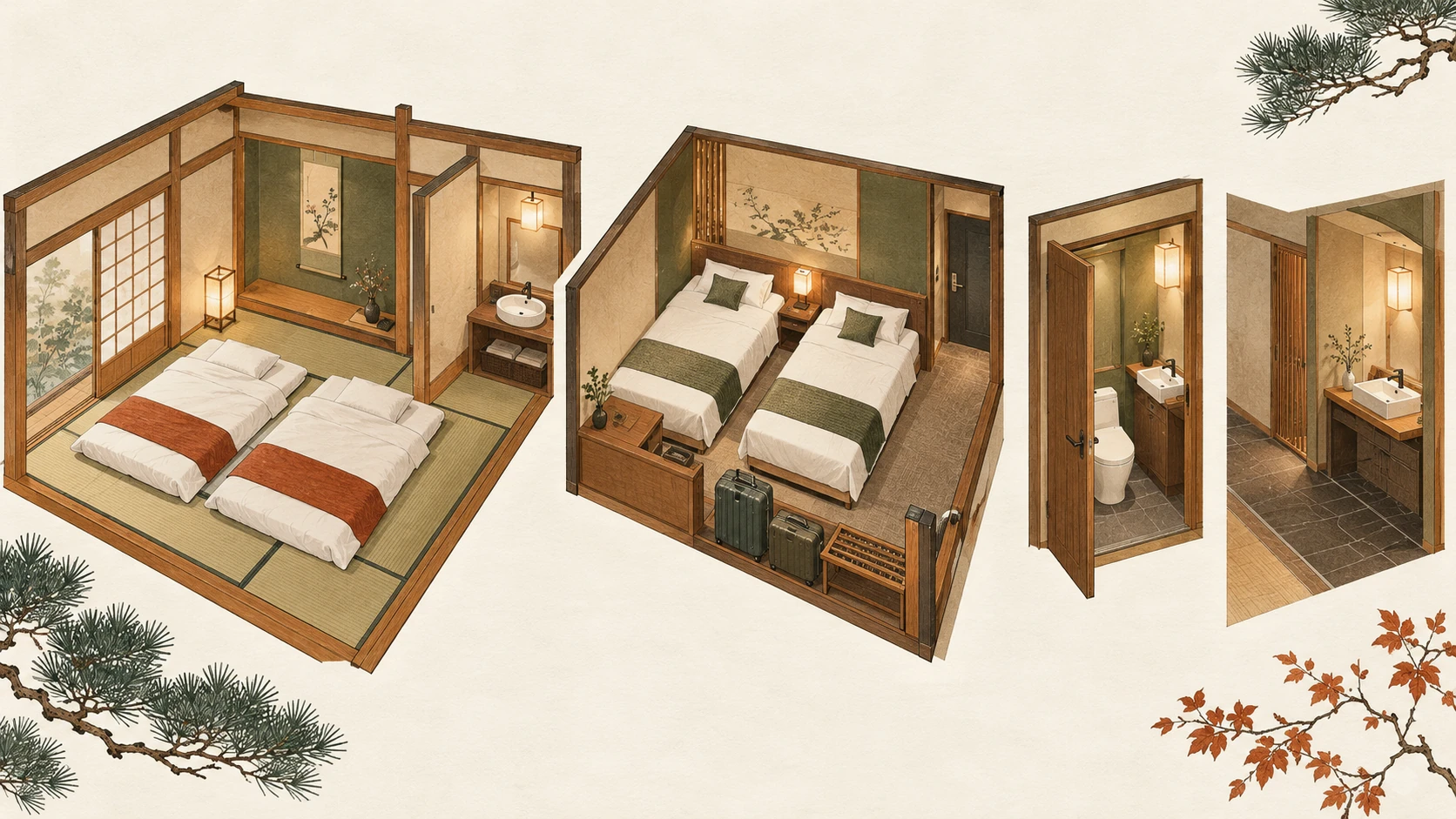
For an in-room toilet and readily comparable accommodation details, start with Kyukamura Nyuto Onsenkyo's named rooms. Eight-tatami Japanese rooms hold up to three and ten-tatami rooms up to five, both listing toilets and washbasins. Standard Western rooms are 17.8 m² for up to two with two single beds. Maximum occupancy does not mean a permanent bed for everyone. Futons and additional sleeping arrangements need separate attention.
Western rooms with a bath are 20.8 m², accommodating two plus an extra bed for a third. The official site also notes some floor-level differences in this category. Another Japanese Twin is ten tatami for up to two, with two beds. Keep the full room name to compare word for word with confirmation. The word 'Western' alone easily mixes up an in-room bath, extra-bed eligibility and a flat floor.
Usual check-in is 15:00 and check-out 10:00. The FAQ allows guests to use the onsen from 11:00 before check-in, but room handover is separate. There is no free Tazawako Station pickup: take the public bus to Kyukamura-mae. For larger families, count everyone's bedding and meals before deciding whether to buy the bath circuit. If staying mostly inside, a suitable room matters more than another bath stamp.
Kyukamura booking and cancellation: telephone and online openings differ
Kyukamura's own reservation questions give telephone opening at 10:00 on the same calendar date six months ahead of the stay, with online sales from midnight on the following day. If there is no corresponding calendar date six months before the stay, telephone bookings open on the first day of the following month. Telephone bookings can fill the property before online release, and there is no general waitlist hold. For a particular winter date, check updated rules and prepare using Japan's local calendar. No rooms online does not itself establish a system fault.
For the general rule covering 30 people or fewer, the same page bases cancellation on one night's accommodation with dinner and breakfast before consumption tax: 50% on the day or for no-show, and 20% one to seven days before. Other plans, groups and channels can differ, with the actual contract taking priority. This is unlike some city hotels' 100% on the day, but does not establish that all hot-spring inns charge only half.
Changes and cancellations through another website or travel agency generally return to the original channel. In an emergency, you can first call the property, but notification does not complete a refund. Save the free-cancellation deadline, charge basis and transport-disruption contacts, particularly before noncancelable bookings. To understand the two meals, baths and room terms, check confirmation against planning a first Japanese ryokan stay.
Magoroku Onsen Rokuan: new room types and year-round walking access
Magoroku's current accommodation name is Rokuan. Magoroku Onsen Rokuan's room and arrival information lists three detached rooms with outdoor baths, Renko, Seoto and Tamayura; two maisonette Japanese-Western rooms, Kagetsu and Suiho; and Japanese-Western Shinen. Only a category explicitly listing an outdoor bath supports choosing private bathing. Do not describe all six rooms as having the same in-room bath.
The inn describes itself as a property reached on foot. P3 on the Ookama side is available year-round, about 15 minutes' walk; P1 and P2 on the Kuroyu side are summer-only, about five minutes. Natural ground and snow are not a level urban footpath. Ask about current snow, bag handling and the approach before booking. One vehicle entrance closing in winter is different from the entire inn closing, so an old simplified guide cannot settle the question.
Day use is listed at 10:00–15:00, closed Fridays and subject to seasonal changes. The 700 adult light plan uses separate indoor baths with showers; the 3000 full plan adds mixed indoor and outdoor baths, a barrel sauna and cold pool. Under Japan's school-stage categories, elementary-school pupils and younger children pay 400 and 2000 respectively. Mixed areas require yubugi bathing garments. Ask about equipment and rental rather than treating an ordinary small towel as equivalent.
Ganiba Onsen: put on shoes before walking outside to the forest bath
Ganiba is another practical option near the Nyuto line's terminus. Ganiba's day-visit circulation notice describes reaching the outdoor pool by passing through an emergency exit and walking about 50 meters outside, using your own shoes. Dress again when moving to another bath. Snow-view bathing preparation therefore involves more than towels: consider footwear suitable for a short snowy walk and easy to take on and off.
Ganiba's current bath information lists day use at 800, 9:00–16:00, closed Wednesdays. Separate indoor baths allow washing; do not carry the entire washing routine into the outdoor pool. If bathing outside and then returning indoors, count both changes and the outdoor round trip. Arriving minutes before the deadline does not leave guaranteed time for every bath.
The mixed outdoor Karako no Yu's women-only period is 19:30–20:30, beyond day-use hours. Do not present it as guaranteed access for a daytime visitor. People uneasy with mixed bathing can choose separate indoor baths or accommodation offering reserved use. Companions need not use the same pool. A meeting place and time agreed beforehand lets everyone preserve a comfortable experience.
Ookama still offers day bathing, but overnight stays have been suspended since 2026
Seeing Ookama among the seven does not mean a night is currently bookable. Ookama Onsen's operating announcement suspends accommodation for maintenance from January 1, 2026, with reopening to be announced, while day bathing continues. Separate properties actually accepting overnight guests from day-only baths when searching for Nyuto stays. That avoids arranging dinner and pickup around an accommodation product not presently available.
Current Ookama day use is 9:00–16:30, final admission 16:00, closed Thursdays, with adults at 700 and children 350. A small towel is 300 to buy and a bath towel 500 to rent. This price passage does not fully define the child age range, so ask for young children. Maintenance can also alter bathing hours. Checking before arrival is more reliable than relying on one comparison chart of the seven.
If your interest is the wooden building and its hot water, consider a short day visit while staying elsewhere instead of forcing in a night here. Ookama is also near the direction of Magoroku's year-round P3 entrance. However, proximity does not make their transfers, luggage storage and bag carrying interchangeable. Ask each property's rules, then choose whether to bathe or check in first. That is calmer than asking door to door with a suitcase.
Kuroyu belongs to green-season and autumn planning, not a February bath list
Kuroyu Onsen's facilities and seasonal guidance lists bath operation roughly mid-April to early November, with exact annual dates to confirm. This directly changes an itinerary: a trip centered on Yokote's February 2027 kamakura should not treat Kuroyu as a guaranteed mountain stop. For late spring or autumn, compare its inn and self-catering stays again.
The ryokan section and self-catering building provide different kinds of stays. The inn lists toilets, washbasins, televisions and Wi-Fi in ryokan rooms and describes semi-open bathing facilities designated for the two rooms Momiji and Sakura. Do not extend those specific facilities to every room. Self-catering rooms require separate checks for season, bedding, kitchen and towel preparations. Booking methods should also follow the actual product.
General day use Thursday–Tuesday is 9:00–16:30, final admission 16:00; Wednesday shortens to 9:00–11:00, final admission 10:30, with possible holiday adjustments. Adults from Japanese junior-high level pay 800 and elementary-school pupils 400. A reserved bath is 2750 per group for 45 minutes plus bathing tax. Do not assume all participants' general admission is included. With only half a day, compare what you can actually use before paying.
Yumeguri-cho is sold only to guests of the seven inns: check validity and buses
The Yumeguri-cho is called a bath booklet or touring pass, but eligibility matters more than the translation. Under the booklet's purchase conditions, it is only for overnight guests of the seven: 2500 including tax for adults and 1000 for elementary-school pupils, using Japan's school-stage categories. It provides one bath entry at each property within a year of issue and use of the Yumeguri bus according to its system. Staying in an ordinary hotel around Tazawako does not automatically qualify.
A year's validity does not mean every bath opens year-round or that buses run whenever you want. Winter roads and individual inn operation narrow the choices. Ask for the season's route, stops and operating arrangements on the travel day. Also check current rules such as possible supplements for Magoroku's different bath plans. 'Once at each inn' does not automatically include every higher-category facility.
The property information says booklets and touring maps are bought with cash. Preschool children travel free on the touring bus when accompanied by a parent or grandparent holding a booklet or map; bath facilities still apply their own rules. Check transport, bathing and meals separately for children. If you only want your own inn's baths, restricted sale is not a reason to buy. The saved time can go to resting before dinner.
The day-visitor touring map: 1000 for transport, with bath admission extra
Without seven-inn guest eligibility, consider the Yumeguri map. Kyukamura uses Japan's school-stage categories, listing adults at 1000 and elementary-school pupils at 500 for the touring bus on the purchase day only, with bath admission charged separately. This differs from the year-long booklet including one entry per inn. It directly changes day-trip costs. Reading 'bath-tour bus' does not allow removing all bathing fees from the budget.
As an adult day-price comparison, Tsurunoyu at 700 plus Taenoyu at 1000 gives 1700; adding the 1000 map makes 2700, before Tazawako Station travel, towels and lunch. The 200 difference from the adult 2500 booklet does not mean any visitor can choose the cheaper one. The booklet requires a qualifying stay with its own accommodation cost. These numbers compare listed items; they do not prove which complete trip is cheapest.
Before buying, verify both inns' opening, bus connections and final admission. Tsurunoyu's Monday and Taenoyu's Tuesday day closures alone make different weekdays substantially different plans. For just one inn reachable by your existing bus or the property's arrangement, compare transport and single bath admission item by item. Do not add unwanted baths solely to use the map.
Two winter baths can be enough: luggage and changing take time too
Traveling between inns that look close together on a map may involve waiting, walking through snow, changing shoes, changing clothes and taking breaks. Start winter planning with one day visit and your own overnight inn's baths rather than seven tasks in a day. Before adding another, check weekly closure or reduced hours. Do not simply rely on the departure times from your previous trip; before departure, recheck the seasonal timetable and winter road conditions.
After check-out, do not assume every day-bath property stores large luggage. Kyukamura's arrangements for staying guests differ from accepting pure day visitors. Ask where bags go, when they can be collected and whether you must return to the original inn. A small bag makes bath touring easier, but a detour back uphill to collect a suitcase can consume all the energy saved.
Bag wet towels separately from snowy outerwear. Keep dry socks and easily removable shoes accessible. A companion wanting only one bath can meet you in a rest area rather than continuing to bathe for the group. Drink water before entering and stop if unwell. With existing health limitations, follow advice from a medical professional instead of treating a water-properties description as a promised course of travel treatment.
Staying around Tazawako: Lake Resort's Twin and Japanese-Western rooms
If the chosen mountain inn is full or companions need beds and larger rooms, expand the search to Tazawako Lake Resort. Lake Resort's room specifications give the main-building Superior Twin as 21 m² for up to two, with two 120-centimeter-wide beds. Superior Japanese-Western is 42 m² for up to five, with two beds, a daybed and two futons. A larger party should first accept that someone will sleep on the daybed or futons.
This is a base in the surrounding area. Tazawako in the name does not establish a lakeshore walk outside the door or lake views in every room. The hotel's transfer booking conditions list station departures at 15:30, 16:30 and 17:30, and hotel returns at 8:20, 9:20 and 10:20. Telephone booking is required by 17:00 the previous day; the roughly ten-minute trip depends on weather. The property also expressly says there is no ski-area transfer.
Staying here does not qualify as a seven-inn stay. Day visits to Nyuto still need separate transport and admission costs. Dinner-and-breakfast guests need to return for meals; breakfast-only guests should note the hotel's questions about nighttime food and children: there is no place providing late-night meals or snacks inside. Establish dinner first before leaving the snowy evening to a more distant town, rather than returning to discover no suitable food.
One onsen night: do less on arrival, then consider one day bath tomorrow
With only one Nyuto night, arrival day can focus on reaching the inn on time, settling bags, understanding bath rules and eating dinner. After breakfast, decide whether to add one day bath instead of racing through every pool before check-out. This prioritizes rest without guaranteeing early room access, late departure or free luggage storage. Each item should follow your actual booking confirmation.
At Tsurunoyu, coordinate Alpa pickup and the departure service; at Taenoyu or Kyukamura, identify the nearest stop and intended bus. To include Tazawako's shore tomorrow, first ask how luggage can be carried or stored en route, then check the next bus after descending. If also continuing to Yokote, make the day bath removable so long-distance travel and city check-in stay feasible.
With a second night, put touring in the middle without repeatedly moving bags and rooms. Still ask about different meals across consecutive nights, staying in during cleaning and bath maintenance times. An extra night's main value is less pressure to rush. It does not guarantee weather, roads or every day-use inn operating to plan.
Yokote Kamakura 2027 is announced for February 12 and 13
When searching for Yokote's 2027 snow-house festival, check the year first. Yokote City's current kamakura date announcement explicitly gives Friday, February 12 and Saturday, February 13, 2027. From 2026 the event moved to February's second Friday and Saturday. Pages still show February 13–14, 2026, or the older February 15–16 convention. Changing a heading's year alone does not update the dates.
The tourism association's festival introduction still displays 2026 dates, general evening hours of 18:00–21:00 and multiple city venues. These explain the event's format, but at this guide's update do not establish that every 2027 venue, shuttle, parking area and bookable experience has been fully announced. Hold accommodation dates first and wait for that year's detail rather than buying unchangeable transport prematurely.
For just one night, choose the 12th or 13th according to transport and room availability, not an obligation to repeat the same attraction twice. With children, unfamiliar snow walking or a desire for weather flexibility, two nights offer more room to adjust. After booking, keep checking the city’s and tourism association’s updates. Announced dates and whether the event can proceed normally are two separate things to monitor.
Understanding Yokote kamakura: the water deity, hospitality and etiquette
Yokote kamakura is a Little New Year observance honoring a water deity. The tourism association's cultural introduction describes children inviting travelers inside, worshipping the deity and sharing amazake. Its appeal is not only the white snow structures but contact between people. If someone invites you, understand the local order before entering. Do not treat every snow house as a private photo booth you can occupy freely.
Space inside is limited. Backpacks, wet coats and tripods set up for long periods affect others. Ask before photographing people and allow children a choice about interacting. Follow directions for any worship or hospitality arrangements. Whether amazake, mochi or other food is provided, its recipe and allergens require confirmation on site. A traditional description is not a promise that every visitor receives the same meal.
Japanese winter festivals and Tohoku snow festivals are broad subjects; Yokote represents one local tradition. Use the evening to understand kamakura, then arrange events in other cities around their own announced dates. Similar search names do not turn snow lights, snow festivals, Bonden and Inukko into one program. Understanding a little more about local life often creates a stronger memory than collecting more venues in one night.
Festival venues and transport: start with one core area before adding another
The association's existing introduction lists the main city hall forecourt, Yokote Park and Futabacho among the venues. Choose the core area you most want first, then add or remove others according to that year's walking routes and transfers. Do not join every name into a nonstop circuit. Slopes, wet snow and photographs lengthen movement; ordinary walking speed cannot simply be carried over.
A station-area hotel helps with luggage, extra clothing and an early meal, but being near Yokote Station is not being beside every venue. Festival traffic needs the official 2027 map and restrictions. Last year's shuttle eligibility, frequency or stopping places cannot be treated as current services. Drivers should also check whether hotel parking and venue restrictions are compatible, not merely whether free spaces exist.
Choose a return meeting point where you can rest and check directions, including when phones lose power. If staying in Omagari or Yuzawa, work backward from the return train to decide when to leave the venue, including walking to the station and waiting. Until that day's last service is checked, preserve cancelable lodging options. Staying in Yokote usually gives more control over returning after a late evening, but rates and availability still need actual comparison.
Bonden remains February 16–17, several days after the snow-house nights
The basic Yokote Bonden competition and offering arrangements list the competition outside the main city hall on February 16, 9:30 to around 12:00, and an offering at Asahiokayama Shrine on the morning of February 17. This is official basic observance information. Detailed 2027 procedures, transport and viewing positions still need that year's explanation. Moving kamakura to the weekend does not move Bonden to the same two evenings.
Bonden are decorations acting as vessels for a deity's presence. The association describes hopes for good harvests, household safety and business prosperity. Competition viewing and shrine offerings have different spaces, movements and crowds. Follow instructions about where to stand. Do not obstruct a procession for a close photograph or expect free access to every position as though visiting an open lantern display.
To see both kamakura nights on February 12 and 13, 2027, and the offering on the 17th, checking in on the 12th and out on the 17th means five nights; if you see only the kamakura night on the 13th, checking in on the 13th and out on the 17th means four. The 14th and 15th are not automatically extended kamakura evenings. Arrange rest or other Akita sights confirmed open. Only after counting those intervening nights and transfers can you decide whether the two events suit one trip.
Outside festival dates, Kamakurakan has a subzero snow-house display
Missing the festival does not mean you cannot learn about the snow houses during the rest of the year. Kamakurakan's exhibition and admission information describes a chamber around −10 °C with a snow house made from Yokote snow and images introducing the four seasons. It is an indoor exhibition, different from children hosting guests, neighborhood lights and outdoor festival snow. Preserve that distinction in the itinerary description.
Listed opening is 9:00–17:00 except December 29–January 3 and temporary closures. A same-day combined ticket, using Japan's school-stage categories, costs 100 for high-school students and older, covering Kamakurakan, the Gosannen War Kanazawa Museum, Yojiro Ishizaka Literary Memorial and Yokote Park observatory. Junior-high pupils and younger enter free. The ticket does not mean all four open every day. A low price is no reason to force an impractical route between distant stops.
The snow display generally has about a week's maintenance between mid-August and mid-September and another between mid- and late February. The page's February 20–27, 2026 maintenance and reopening on the 28th are a past-year example, not 2027 dates. If staying after kamakura for Bonden, particularly check whether the chamber is being rebuilt. An indoor backup is not permanently available without exceptions.
Choosing Yokote accommodation: station access, an in-room onsen or an onward train
The first accommodation question is how far you are willing to move after the evening. Staying near the station helps with rail arrival and luggage arrangements but still leaves a walk to venues. An in-room onsen keeps rest in the room, potentially with higher dynamic rates and few rooms in that category. Omagari or Akita's Yuzawa adds a train and last-service restriction. Compare the full evening timetable instead of assigning one universal hotel ranking.
Write down separate beds, shared sleeping, bath and toilet requirements first, then find a matching category. A large communal bath is not an in-room onsen; a double room may have one bed. For wheelchair use, examine the whole route through the room, elevator, restaurant and baths. A single 'Universal' label does not establish independent access throughout public areas.
The following named categories and official conditions are checkable, but live rates and 2027 festival vacancies have not been checked. Choose two acceptable bases, then compare the same date, party, meals and cancellation terms. If Yokote Station hotels are full, a substitute still needs an acceptable return. Do not pay for distant noncancelable lodging before discovering you cannot finish the activity you wanted.
| Property | Comparable category | Decision-changing condition |
|---|---|---|
| Yokote Plaza Hotel | Twin, 17 m² | About 30 seconds from the station; natural onsen in another building |
| Hotel Plaza Annex Yokote | Room with a natural hot-spring outdoor bath, up to three | Third guest on a sofa bed; dinner in a dedicated dining area |
| Hotel Plaza Annex Yokote | Universal Twin, 25 m² | Different from the outdoor-bath room; ask about shared-area routes |
| Route-Inn Omagari Ekimae | Twin, 14 m², beds 120 cm wide | About three minutes from Omagari Station; requires a train after the festival |
| Yuzawa Grand Hotel in Akita | Standard Twin, 22 m², up to two | About four minutes from Yuzawa Station; not Echigo-Yuzawa in Niigata |
Yokote Plaza Hotel: a 17 m² Twin, with the onsen in another building
Yokote Plaza Hotel's location information gives roughly 30 seconds on foot from JR Yokote Station, useful when prioritizing rail travel and nighttime return. It is not the door of every kamakura venue; walk according to that year's map. Using the station for meeting and collecting bags can, however, keep movements relatively straightforward.
Plaza's room specifications give Twin as 17 m² with beds 110 centimeters wide; Single is 11 m² with a 110-wide bed, and Semi-double also 11 m² with a 120-wide bed. Two adults with large bags have different usable space in a small one-bed room and a Twin. Capacity for two does not guarantee equal comfort. Confirm nonsmoking status and the actual allocation too.
Plaza's facilities and stay conditions list general check-in at 16:00, check-out 11:00 and free use of natural hot springs in the separate Hotel Plaza Geihin building, with alternatives during maintenance. It is not an in-room bath. With mobility aids, ask about the between-building and bathing route. General cancellation examples are 50% the previous day and 100% on the day or for no-show, but specific dates and plans may differ. The booking screen takes priority.
Annex in-room outdoor baths: check the third bed and dinner too
For bathing inside your own accommodation, examine Hotel Plaza Annex Yokote's natural hot-spring outdoor-bath rooms. The property lists eight, with separate living and sleeping areas, holding up to three people. The third uses a sofa bed. Do not turn that into three permanent beds or describe every Annex Single and Twin as having an outdoor bath.
The same page separately lists Universal Twin at 25 m². Decide whether you need private bathing, wider passageways or separate beds rather than merging everything as a 'large room.' Even with an accessibility-oriented category, ask whether the bath, thresholds, restaurant and public onsen fit your companion's needs. A room's advantage should correspond to actual daily use.
Annex's arrival and dining explanation lists outdoor-bath room check-in at 15:00 and check-out 12:00. Meals are in a dedicated dining room, not delivered to the guestroom. Dinner plans require arrival by 19:30, with dinner starts selectable from 17:00 to 19:30. Using the existing 18:00–21:00 kamakura reference, eat early or choose a suitable meal plan. Do not assume returning at 21:00 preserves dinner.
Omagari stays: station-side Route-Inn helps transfers, but check the return
Omagari connects the shinkansen and Ou Main Line toward Yokote, useful for prioritizing rail flexibility. Route-Inn Omagari Ekimae's basic location puts the hotel about three minutes on foot from the station; the hotel provides breakfast and other facilities. It can be an alternative when Yokote is full, but returning after the festival depends on the trains that day. A three-minute walk cannot solve a service that has already ended.
Omagari Route-Inn's Twin and other room categories list Twin at 14 m² with 120-centimeter-wide beds and Comfort Twin also at 14 m². Singles and Semi-doubles are 12 m². Choose the right Twin category when needing two beds; Semi-double does not mean two separate beds. Some categories require telephone reservations. Confirm particular access needs directly before booking.
The Omagari property's bath hours are 15:00–2:00 the following day and 5:00–10:00. This is a radium-type artificial hot-spring communal bath, not a natural mountain source or an in-room private bath. Recheck breakfast, laundry and cancellation for consecutive stays. Omagari's summer fireworks sellouts cannot establish availability for winter 2027.
Staying in Yuzawa: confirm Akita, not the area near GALA
Searching Yuzawa accommodation easily mixes in Niigata's Echigo-Yuzawa and GALA. Here, Yuzawa means Yuzawa City in Akita Prefecture. For Yokote or Inukko, check prefecture, station and address first. Two places with hot springs, snow and similarly named hotels do not share transport. It is easier to check the map once more during a lodging search than to correct a mistake about the region after arrival.
Akita Yuzawa Grand Hotel's Standard Twin is 22 m² for up to two, with two beds 125 centimeters wide. Executive Twin is 32 m² for up to two; Grand King Suite is 70 m² but still lists up to two. More floor area does not automatically raise permitted occupancy. For children, a third guest or an extra bed, verify the actual bookable plan.
This Akita hotel's arrival information gives about four minutes on foot from JR Yuzawa Station. To use it for Yokote's night activities, still check rail travel in both directions. If the real purpose is Yuzawa's own winter festival or town, arrange dates around that year's announcement. An Akita address does not make a hotel convenient for every Akita attraction, and an unchecked bath should not turn it into a hot-spring inn.
Inukko 2027 dates remain pending: do not automatically combine it with Yokote
Yuzawa City's official Inukko festival page currently specifies February 14–15, 2026 and introduces snow shrines, dog-shaped offerings and town activities. This helps explain its folk tradition and setting, but changing the year cannot confirm 2027 dates. To see both Yokote and Inukko, wait for both events' complete annual announcements before fixing unchangeable accommodation.
The official introduction links Inukko's origins to small dogs and other offerings made from rice flour to pray for local safety, later continuing through snow shrines and related forms. This distinguishes it from Yokote's water-deity snow houses rather than reducing both to white sculptures to photograph. Food, pet-related participation and reservations for particular prayers depend on each year's program. A dog in the name does not mean every pet may enter every space.
If final 2027 dates do not overlap your itinerary, Yuzawa accommodation can still be assessed for your rail and meal needs. It should not be valued on the assumption that an unannounced festival is guaranteed. Instead of adding a noncancelable room for a guessed date, preserve an adjustable option and compare the actual transport cost of another night once official updates arrive. Akita offers many seasonal subjects; choosing one that matches your own dates is often more dependable.
Dinner before or after the evening: plan kiritanpo and Yokote yakisoba separately
A ryokan night with dinner and breakfast needs a different dining strategy from a city festival evening. Mountain dinner generally follows the booked plan rather than an anytime walk-in restaurant order. In Yokote, eat a full meal first and treat festival hospitality as a cultural experience. With children especially, do not rely on food that might be offered inside a snow house as the whole evening's main meal. Queues and supply can change.
Some Nyuto inns introduce Akita kiritanpo, Inaniwa udon and seasonal produce. Ask about the actual night's provision and dietary limits before reserving. For yakisoba, the Yokote Yakisoba Norenkai shop and annual-guide entry helps identify participating establishments. It publishes a 2026 guide, but each shop's opening, last orders and temporary holidays still need individual checks for your travel date.
Begin meal budgeting with acceptable assumptions, then replace them with actual menus. A lunch allowance of 1500 per person and festival dinner of 2000 are examples, not claims that any named restaurant offers that set. If ryokan dinner is included, do not count the same meal twice. With breakfast only, plan town dining and the hotel return together rather than comparing just the apparently lower room price.
A four-day, three-night example: one mountain night and two in Yokote
Assume arrival on February 11 and departure on February 14, 2027. On the 11th, go uphill from Tazawako and stay one Nyuto night. On the 12th, descend after breakfast, take rail to Yokote, leave bags, eat and join nighttime activities confirmed open that year. On the 13th, rest or visit an exhibition confirmed operating, then choose a second snow-house area according to energy. Leave on the 14th. This is an itinerary suggestion without verifying particular trains, vacancies or all programs being on sale.
That sequence separates onsen dinner and kamakura evening, with consecutive Yokote nights avoiding daily bag moves. If the flight or train on the 11th arrives too late, stay at a transport gateway or move the mountain stay after the festival. Do not force a connection that misses dinner simply to preserve the table's order. People sensitive to cold can watch one evening and keep the other for weather or stamina flexibility.
To see the Bonden offering on the 17th too, add intervening nights rather than appending a morning attraction to the four-day plan. Continuing to Sendai, Yamagata or elsewhere in Tohoku, consult Sendai and Yamagata's hot-spring and seasonal choices. Recheck each transport leg and accommodation date. Events across different areas can look conveniently consecutive on paper while failing to connect in practice.
Budgeting for two adults: official costs separate from assumed room rates
This example covers two adults' local stay: one mountain night with dinner and breakfast and two Yokote nights. Assume 18,000 per person at the onsen and 16,000 per city room per night. These are not named-hotel quotes or a guarantee of festival-week availability. At the current 950 fare, Tazawako return travel for two toward Taenoyu or Kyukamura is 3800. For Tsurunoyu via Alpa, recalculate with 750 and confirm the pickup conditions.
If both are eligible seven-inn guests buying 2500 booklets, bath touring is 5000. Three lunches at 1500 per person total 9000; two city dinners at 2000 per person total 8000. The already included mountain dinner is not counted twice, and amazake and snacks are not treated as main meals. If using only the overnight inn's baths without booklets, delete that row instead of adding spending to match the example.
The table totals 93,800, averaging 46,900 each. It excludes long-distance travel to Akita, rail such as Tazawako–Yokote, city breakfasts, snacks, drinks, extra baths and separately charged plan taxes. Raising the assumed onsen room cost by 5000 per person adds 10,000 for two, giving 103,800. Dynamic room rates usually affect the total more than a few hundred yen of admission. Substitute real lodging first, then decide whether to reduce a night or change base.
| Item | Calculation | Two-person amount |
|---|---|---|
| One onsen night with dinner and breakfast, assumed | 18,000 × 2 people | 36,000 |
| Two city nights, assumed | 16,000 × 2 nights in one room | 32,000 |
| Return mountain bus from Tazawako, current example | 950 × 2 journeys × 2 people | 3800 |
| Guest bath booklets, optional | 2500 × 2 people | 5000 |
| Three lunches, assumed | 1500 × 3 meals × 2 people | 9000 |
| Two city dinners, assumed | 2000 × 2 meals × 2 people | 8000 |
| Table subtotal | 36,000 + 32,000 + 3800 + 5000 + 9000 + 8000 | 93,800 |
Cancellation follows the accommodation contract; snow is not an automatic waiver
Check cancellation separately when choosing Akita hot-spring and festival stays. Kyukamura's general terms, Plaza's date-specific plans and Akita Yuzawa Grand Hotel's accommodation cancellation table differ. The latter's general bookings for 14 or fewer list no-show at 100%, same day 80% and previous day 20%, with a particular contract's terms taking precedence. Do not copy banquet or wedding percentages from the same page as room conditions.
Lake Resort's FAQ separately lists general bookings for 14 or fewer: ten to four days before at 20%, three to one day at 50%, same day 80% and no-show 100%, based on the basic accommodation charge. Groups of 15 or more and agency reservations differ. These illustrate variation; save the confirmation for the dates, category and plan actually booked. Special rates, events and packages may impose other restrictions. A general FAQ cannot guarantee a refund.
If trains stop or roads have problems, organize the latest operating information and your booking, then contact the original booking channel and inn. Do not assume snow always means free cancellation, or wait until becoming a no-show to explain. Preserving an adjustable transport segment and choosing acceptable terms beforehand gives more control than attempting to replace the contract with a travel article on departure day.
Children and reduced mobility: check beds, baths and snow separately
Nyuto does not have one uniform child-age table. Taenoyu ordinary day use says 500 for elementary-school pupils and younger under Japan's school-stage categories, while Kuroyu treats junior-high level and older as adults. The booklet's elementary-school price and preschool bus conditions are another system. Accommodation also separates meals, bedding, shared sleeping and facility fees. One free item does not make the whole trip free. Give each operator actual ages and required beds.
As a general example, Lake Resort's FAQ gives elementary-school pupils with meals and bedding as 70% of the adult price, preschoolers from three as 50%, and ages zero to two without meals sharing bedding as a 1650 facility fee. Elementary-school-age children and older cannot book the shared-sleeping rate. The actual available plan still takes priority. Do not directly apply these percentages to this guide's assumed room price unless the hotel confirms the base and calculation method.
Reduced mobility requires checking the entire route: station to vehicle door, bus stop to entrance, room to restaurant and then baths. An in-room toilet does not establish a step-free pool entrance. Universal in the room name does not make a separate building's public bath flat too. Explain step-crossing ability, standing time and assistance needed, then ask what the property can arrange. That produces a more useful answer than simply asking whether it is accessible.
Final checks: leave space in the mountains and a way home on snowy evenings
Before completing reservations, write each overnight location, meal time, final arrival leg and post-event return on one page. Nyuto inns and Yokote hotels have different advantages; the question is whether they fit your companions' pace. When a segment only works through an unknown pickup or an unannounced service, reduce the itinerary first. Add activities when the missing information becomes available.
Before departure, recheck Ugo Kotsu times and fares, day-bath closures, accommodation pickups, 2027 kamakura venues and Bonden procedures. Videos introduce forest hot springs and Yokote culture, not current roads, prices or event announcements. Illustrations explain travel choices rather than establish real room layouts or snow conditions. If notices differ on site, follow the operator and staff that day.
If budget, time or stamina permits only one theme, choose the night you most anticipate. It might mean returning early, eating and bathing, or dressing warmly for illuminated snow houses with the option to return to a station-area hotel to rest. A few complete arrangements help more than additional unconfirmed destinations. Other Akita stays and travel, and Tohoku hot springs, can wait for a suitable season.
A few useful answers
Can I visit Nyuto Onsen and Yokote's kamakura festival in one day?
They can share a trip, but separate overnight evenings are preferable. Mountain dinner, downhill buses and Yokote's nighttime activities have their own times. A same-day visit first needs workable connections. One onsen night and two Yokote nights are an adjustable starting point.
What are the Yokote Kamakura Festival 2027 dates?
Yokote City has announced Friday, February 12 and Saturday, February 13, 2027. The existing tourism association page still contains 2026 dates and general evening information. Check annual announcements for detailed 2027 venues, shuttles and experiences.
Does Bonden move with the kamakura dates?
Official basic information still lists the February 16 competition and February 17 offering at Asahiokayama Shrine. Do not move it automatically to kamakura's weekend. Confirm detailed 2027 procedures separately. Checking in on the 12th and out on the 17th is five nights, not five consecutive snow-house festival nights.
How much is the bus from Tazawako Station to Nyuto?
Ugo Kotsu's April 1, 2026 table lists Taenoyu Onsen-mae, Kyukamura-mae and Nyuto Ganiba at 950, and Alpa Komakusa at 750. Recheck services and prices before travel. Tsurunoyu guests should arrange the Alpa connection rather than treating the entrance stop as the inn's front door.
Can day visitors buy the Yumeguri-cho booklet?
The booklet including one bath at each inn is restricted to overnight guests of the seven, costs 2500 for adults and lasts a year. Day visitors can consider the adult 1000 map for the touring bus on that day, with bathing extra. Verify seasonal stops and opening.
Does every Taenoyu room have a private onsen?
The inn says every room has a toilet, not that every room has its own hot spring. Reserved Yawaragi is a separate system: day visitors pay 3300 for an hour and book by telephone. A 5500 private rest room is not the price of a private bath either.
Is Tsurunoyu Building 2 suitable for a first ryokan stay?
Compare it if comfortable with six-tatami Japanese rooms, shared toilets and washbasins and meals in Honjin's dining area. If needing an in-room toilet, beds or fewer stairs, ask about available rooms in other buildings, the actual quote's units and heating charges.
Do all seven inns offer overnight stays and baths all winter?
No blanket rule applies. Ookama suspended overnight stays from January 1, 2026 while keeping day baths. Kuroyu's bath season is roughly mid-April to early November. Magoroku's current year-round P3 entrance still needs a walk, and other inns have their own closures and maintenance.
Are Omagari or Yuzawa convenient for Yokote's festival?
They can be alternatives, but check the return train from Yokote on the event date and walking margin to the station. Without the last service checked, a return after the whole evening is not guaranteed. Yuzawa here means Akita, not Niigata's Echigo-Yuzawa or GALA.
Do three guests get three beds in Annex's outdoor-bath rooms?
The inn lists up to three, but the third uses a sofa bed rather than a third permanent bed. Dinner is in a dedicated dining room, not delivered to the room. For kamakura that evening, coordinate dinner's start and the latest permitted arrival.
Can I see a Yokote snow house outside festival dates?
Kamakurakan has an exhibition around −10 °C, usually 9:00–17:00. The combined ticket is 100 for Japanese high-school level and older, with junior-high and younger free. New Year closures and rebuilding may apply. It is an indoor exhibition, not the whole street festival moved inside.
Can Inukko 2027 be added after Yokote?
The checked Yuzawa City page still specifically lists February 14–15, 2026, which does not establish 2027 dates. Wait for that year's official announcement before comparing stays, Yokote connections and activity times. Do not pay for noncancelable lodging around a guessed date.
Check with the source
Schedules, availability and rules can change. These official sources are the place to confirm details before you book.
- Yokote City | Rail and arrival routes
- JR East JRE Media | Komachi reserved seats and special limited-express tickets
- Ugo Kotsu | Main Tazawako Station fares as of April 1, 2026
- Ugo Kotsu | Nyuto timetable revised April 1, 2026
- Tsurunoyu | Alpa transfers and arrival
- Kyukamura Nyuto | Seven baths, booklet, map and touring bus
- Tsurunoyu | Day use and Monday closure
- Tsurunoyu | English operating guidance and prices from November 2026
- Tsurunoyu | Buildings, rooms and reservations
- Tsurunoyu Yama no Yado | Rooms and booking methods
- Taenoyu | Current room categories and in-room facilities
- Taenoyu | Named room introductions
- Taenoyu | Day baths, private use and private rest rooms
- Taenoyu | Station and bus access
- Taenoyu | Facilities, allergies and transport questions
- Taenoyu | Akita cooking and lunch
- Kyukamura Nyuto | Japanese and Western rooms and bedding
- Kyukamura Nyuto | Booking, cancellation and use questions
- Magoroku Onsen Rokuan | Rooms, day use and walking entrance
- Ganiba Onsen | Day-visit circulation and outdoor walking
- Ganiba Onsen | Baths, day use and exclusive time slots
- Ookama Onsen | Overnight suspension and day bathing
- Kuroyu Onsen | Facilities, seasons, day baths and self-catering
- Tazawako Lake Resort | Named rooms and sleeping arrangements
- Tazawako Lake Resort | Station pickups and booking deadlines
- Tazawako Lake Resort | Meals, children and cancellation
- Yokote City | 2027 kamakura dates and folk tradition
- Yokote Tourism Association | Kamakura culture and previous-year introduction
- Yokote Tourism Association | Bonden competition and shrine offering
- Yokote Tourism Association | Kamakurakan exhibition and admission rules
- Yokote Plaza Hotel | Station-side location
- Yokote Plaza Hotel | Room specifications
- Yokote Plaza Hotel | Separate-building onsen, facilities and cancellation
- Hotel Plaza Annex Yokote | Outdoor-bath rooms and Universal Twin
- Hotel Plaza Annex Yokote | Arrival and dinner times
- Route-Inn Omagari Ekimae | Location and basic facilities
- Route-Inn Omagari Ekimae | Room specifications
- Route-Inn Omagari Ekimae | Artificial hot-spring baths and hours
- Akita Yuzawa Grand Hotel | Room area, occupancy and beds
- Akita Yuzawa Grand Hotel | Yuzawa Station arrival
- Yuzawa City | Inukko culture and current 2026 page
- Yokote Yakisoba Norenkai | Shops and annual-guide entry
- Akita Yuzawa Grand Hotel | Accommodation cancellation conditions
- Kyukamura Nyuto | Website adopting the official video
- Yokote Tourism Association | Official website and channel link