Choose the character world you most want to explore, then give it a day with enough time to enjoy it. The Ghibli Museum in Mitaka, Harry Potter Studio Tour in Nerima, Chiikawa Park in Ikebukuro and Sanrio Puroland in Tama each have different sales, ticket, group-entry and cancellation rules. These planning modules keep those differences clear, including separate alternatives at the zoo in Hino and on a Seiseki-Sakuragaoka neighbourhood walk.
Choose one character world rather than four venues in one day
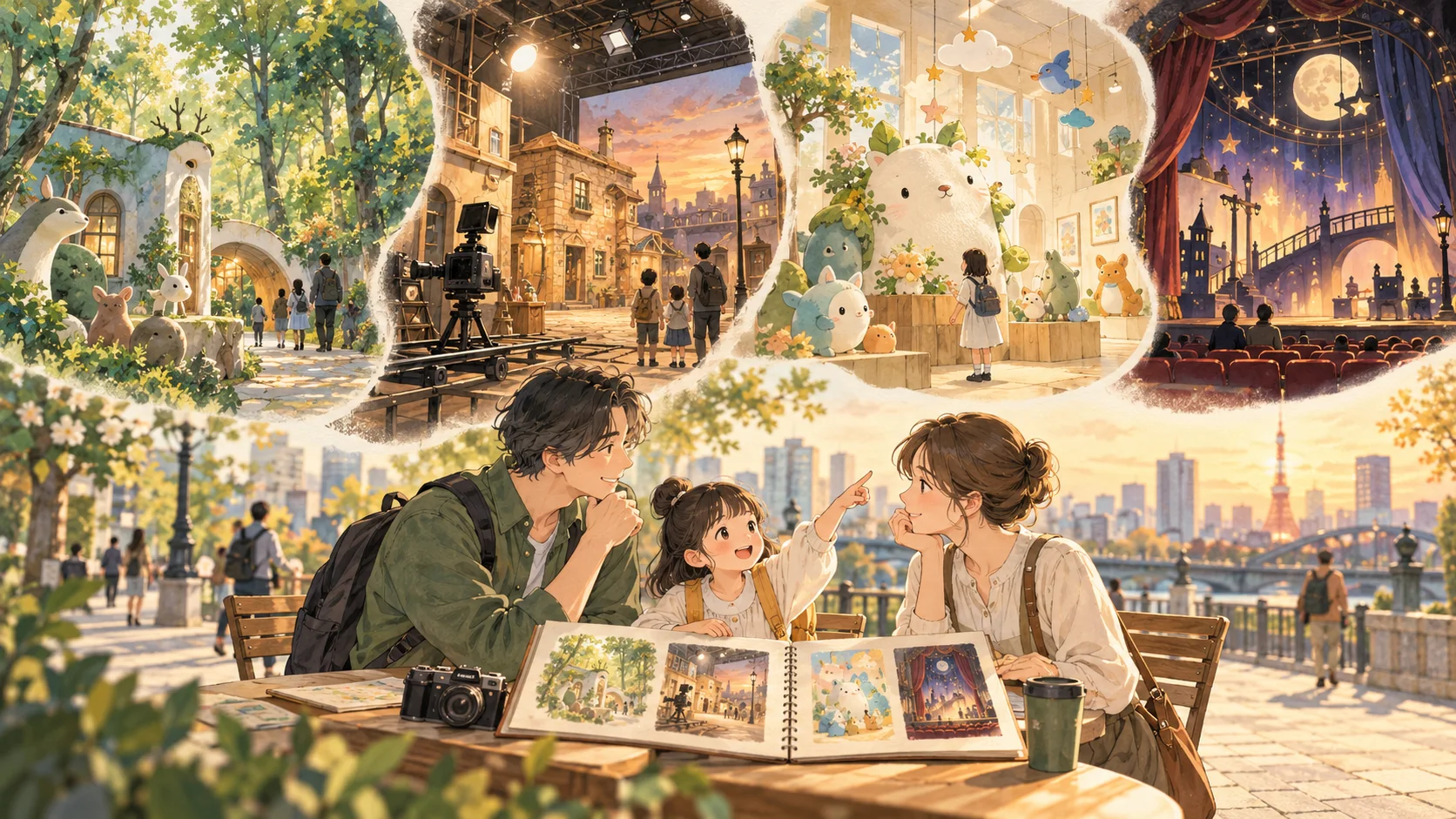
Mitaka suits an interest in animation; the Warner Bros. tour in Nerima focuses on film sets; Ikebukuro’s Chiikawa Park offers a character world with interactive elements; and Puroland in Tama Center combines Sanrio characters, shows and attractions. Start by asking what each person most wants to see. Even people who love the same work may have very different levels of patience for exhibitions, shopping or waiting for a stage performance.
Keep one major timed reservation as the day’s anchor, with a flexible walk or meal around it. Mitaka, Toshimaen, Ikebukuro and Tama Center lie in different directions, so a string of short-looking visits can become a day of checking train connections. If you are travelling with children, include naps and time to find lifts; those needs use real time rather than fitting automatically into the gaps.
The information below was checked on 21 October 2026, and all prices are in Japanese yen. Dates, school-grade categories and sales channels are treated separately. For other character days, consult the Tokyo Disney ticket and arrival guide or the separate guide to Ghibli Park in Aichi. A Ghibli Museum ticket does not include admission to either of those attractions.
Compare the content, available time and people entering together
First decide whether your priority is an exhibition, filmmaking or a stage performance, how much time you can give it, and whether everyone can arrive together. Then check the actual date you can go. Someone who mainly wants a photograph outside a building needs a different plan from a visitor who wants time to understand a long exhibition. Looking at that difference before buying tickets helps you choose a venue rather than simply collecting four familiar names.
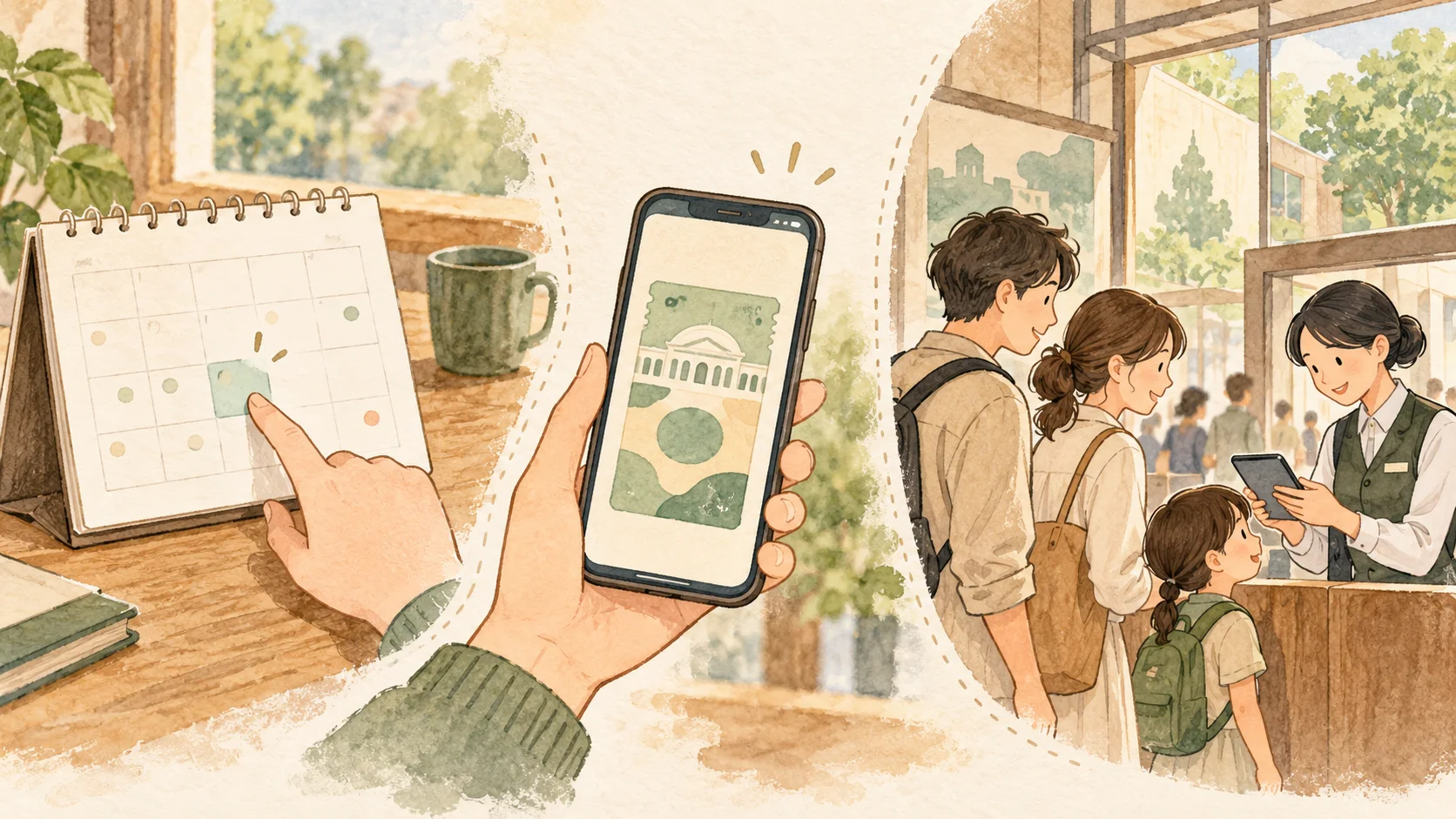
Check opening days, valid tickets and booking requirements before confirming accommodation and other nonrefundable activities. A lottery, first-come-first-served sale, timed admission ticket and separate arrival reservation are different steps. Winning a draw does not necessarily mean payment is complete, and payment does not always mean an additional arrival reservation has been made. Read the process for your particular purchase and keep the confirmations that establish each required step.
When a date is sold out, check other dates, eligibility and actual remaining inventory. Do not assume Chiikawa Park accepts walk-in visitors or that an older Sanrio ticket automatically covers your chosen date. Keep an alternative walk without a fixed admission time so that an unsuccessful ticket search does not force a second unsuitable purchase.
| Main interest | Primary venue | Time to allow | What to check first |
|---|---|---|---|
| Animation and the creative process | Ghibli Museum, Mitaka | A half-day with the park or Kichijoji | Date, sales channel and new November 2026 ticket system |
| Film sets and production details | Harry Potter Studio Tour, Nerima | Official three to four hours, plus food and travel | Standard ticket or package, and the change deadline |
| The Chiikawa world and exclusive merchandise | Chiikawa Park, Ikebukuro | Flexible time for entry, interactions and shopping | First-come-first-served sale; purchaser and whole group together |
| Characters and indoor family entertainment | Sanrio Puroland, Tama | Full day or a reduced afternoon plan | Admission plus arrival reservation; extra show-area passes |
The Ghibli Museum is in Mitaka, not at Ghibli Park in Aichi
The Ghibli Museum stands on the western side of Inokashira Park in Mitaka, Tokyo. Ghibli Park is in Nagakute, Aichi, and has its own tickets and area rules. Mitaka is also not a large amusement park built around mechanical rides. Choose it because you want to explore animation and the museum’s small spaces, rather than expecting the experience of a ride-based theme park.
The museum’s exhibition and Saturn Theatre introduction describes the permanent exhibition Where a Film Is Born, with worktables, drawings and rooms that reveal aspects of animation. The Saturn Theatre screens original short films on a changing schedule. That does not mean you can choose a favourite feature-length film and expect it to be shown on the day you visit.
Allowing roughly two to three hours, plus meals and travel, is a planning suggestion rather than an official average visit length. If your entry is late in the afternoon, walk in the park beforehand and avoid placing another fixed booking immediately afterward. You can visit the public park without a museum ticket, but that does not give access to museum exhibitions.
Ghibli Museum ticket dates, age categories and the new November system
The museum’s Japanese ticket page states that the following month’s tickets go on sale at 10:00 a.m. Japan time on the 10th of each month. Museum hours are normally 10:00 a.m.–6:00 p.m., with hourly entry slots from 10:00 a.m. to 4:00 p.m.; enter within one hour of your booked slot, rather than treating it as a compulsory exit time. Tuesdays and maintenance periods need a calendar check. In November 2026, the published calendar closes 4–18 November and 24 November, while 3 November is open.
The Japanese page lists ¥1,000 for adults and university students, ¥700 for junior and senior high school students, ¥400 for elementary school students, and ¥100 for preschool children aged four and older. Under-fours enter free without a reserved ticket. The official English page instead lists ages 19+, 13–18, 7–12 and 4–6 at the same respective prices. Use the categories on your actual sales channel at age or school-grade boundaries; do not automatically equate the two systems. There is no general group or advance-purchase discount.
The 6 October announcement of the new ticket system introduces a new QR ticketing system for November 2026 admission, sold from 10 October, with a tax-inclusive system fee of ¥110 per ticket. Electronic display and LAWSON paper-ticket collection are separate procedures. Check the product you buy rather than combining an older app, an old fee description and the conditions of an overseas package into one supposed rule.
Overseas Ghibli purchases and domestic LAWSON tickets have different conditions
For an overseas purchase, start with the museum’s official English ticket entry point, which names LAWSON’s English service and JTB Sunrise Tours packages. A package price covers the contents of that itinerary, not just a standalone museum ticket. Check the venue, admission date, sales channel and particular order conditions before paying; a familiar character image alone does not establish an authorised ticket.
The domestic LAWSON named-ticket rules describe tickets bought through the account of a person actually visiting. The domestic rule allows one purchase per account per admission month, for up to six tickets, with no subsequent change of representative, date change or refund. The named holder must enter with the group, and identification may be checked. Borrowing an absent friend’s account is not a safe workaround, and domestic inventory is not automatically an overseas visitor’s usable allocation.
The ticket seller’s museum-specific FAQ also distinguishes the domestic representative rule and electronic tickets that cannot simply be distributed for separate entry. The November domestic system uses MOALA in a browser rather than the old app, and requires the registered phone, SMS capability and an internet connection; QR screenshots and printed copies are not accepted for that domestic Ghibli ticket. An overseas order has its own identification and display conditions. Do not impose every domestic phone requirement on every overseas product.
Ghibli Museum access: choose a station and include the walk
The museum’s recommended access route starts at JR Mitaka Station’s south exit. The reference journey from Shinjuku is about 20 minutes on the Chuo Line Rapid, followed by approximately 15 minutes walking along the Tamagawa Josui or about five minutes on the community bus. Those are separate components, not a hotel-to-door promise. Add time for platforms, the station exit and a possible bus queue.
The bus currently costs ¥230 for adults with cash or IC, while a child fare is ¥120 in cash or ¥50 with IC. An old return-ticket product was discontinued with the September 2024 fare change, so older screenshots can mislead. The museum-route bus does not run on museum closure days. Its single wheelchair space also means that the service exists without guaranteeing room on the next departure.
Kichijoji and Inokashira-koen stations offer walking approaches of roughly 15 minutes. Linking one of those approaches with a park walk can keep the route coherent; in rain or with a pushchair, minimise unnecessary carrying and backtracking. There is no general dedicated visitor parking lot, and visitors with special parking needs should inquire in advance. Choose either Mitaka or Kichijoji for the return rather than feeling obliged to cover both.
Inside the museum: photography, pushchairs and the roof have limits
The museum’s visitor and accessibility information prohibits photography and video indoors. The Saturn Theatre is a once-per-person experience, while the Catbus is for elementary school children and younger; paying extra does not remove that age restriction. Take permitted photographs outdoors, and let the indoor visit be time to look at the exhibits rather than continuously checking for a photo opportunity.
Pushchairs go into the designated storage area. The basement permanent exhibition includes flashing lights, which visitors sensitive to light should check in advance. Lifts, accessible toilets and a limited wheelchair loan service support parts of the visit, but there is no lift to the rooftop, which can also close in unsuitable weather. Admission therefore does not mean every part of the building is equally reachable.
Re-entry is generally unavailable. Free coin lockers require a refundable ¥100 deposit; ask staff about oversized items, while preferably leaving large luggage at your hotel or a station beforehand. Check the specific arrangements for nursing, nappy changes and subtitles if those will affect your visit. A general label such as family-friendly cannot replace the details you actually need.
Build a Mitaka half-day around the museum, not a second timed ticket
With a morning ticket, explore the exhibitions and short film before lunch. For an afternoon visit, eat in Kichijoji first, walk through the park and leave an arrival buffer. There is no need to make every exhibition detail, shop purchase and nearby attraction compulsory. A half-day works better when you know which parts matter most and can let the others remain optional.
The current Straw Hat Café introduction describes fresh pork cutlet sandwiches, hot dogs, baked goods and drinks, with indoor service from 10:30 a.m. and terrace service from 11:00 a.m. This café is inside the paid museum, rather than a public neighbourhood café anyone can enter. Menus and waits vary on the day. For dietary needs, ask about ingredients and cross-contact rather than assuming a character shape or a low-allergen description establishes safety.
The Inokashira Park area and access guide distinguishes generally free, continuously accessible park grounds from separately managed facilities such as the culture park and shops, each with its own hours or charges. Keep the museum, general park and other paid facilities as three distinct entries in your plan. Being able to walk through one does not confirm admission to the others.
Warner Bros. Studio Tour Tokyo is a filmmaking visit in Nerima
Warner Bros. Studio Tour Tokyo – The Making of Harry Potter is in Kasugacho, Nerima, by Toshimaen. It is separate from the Harry Potter area at Universal Studios Japan and from the former Toshimaen amusement park, which has closed. Check that full venue name when looking at tickets, transport and hotel suggestions so that search results from a different attraction do not shape your day.
The Studio Tour’s set introduction features sets including the Great Hall, Platform 9¾, the Forbidden Forest, the Ministry of Magic and Diagon Alley. Film-team involvement in recreating Tokyo sets does not make every object an original screen-used prop. Some costumes are described as screen-used; preserve that distinction when deciding what you particularly want to see.
The operator suggests around three to four hours for the tour. Add meals, shopping and transport to that figure. It is neither a compulsory exit after three hours nor evidence that the final admission slot offers the same amount of available time as a morning slot. If filmmaking details interest you, leave space to read rather than treating the visit as a quick photo stop.
Studio Tour ticket prices: check school-grade exceptions and optional extras
The current standard admission price table lists prices that vary by date and time: adults ¥6,300–¥7,300, juniors ¥5,200–¥6,000 and children ¥3,800–¥4,400. The displayed age bands are 18+, 12–17 and 4–11, but the Japanese FAQ applies school grade on the visit date, with the school year changing on 1 April. A 12-year-old in sixth grade can fall in the child category, and an 18-year-old in the third year of high school can fall in the junior category. Ask about overseas school documentation rather than assuming a universal student or Nerima-resident discount.
Children aged three and younger enter free, but their infant tickets must be selected during booking; mentioning a baby in an order comment is not the same step. Children and infants require continuing adult supervision, whereas juniors may visit without an adult. Age identification may be requested. Work through each person’s age, grade and accompanying adult before selecting quantities.
The digital guide is an optional ¥1,480 per device, and the official guidebook is ¥2,500. A package may have its own collection point, timing and included items; those are not automatically part of ordinary admission. The family budget later in this guide starts with admission only, so that these optional additions remain visible rather than disappearing inside an unexplained total.
Studio Tour cancellations and date changes depend on your product
The Studio Tour’s current ticket FAQ says ordinary personal cancellations are not refundable. For an official standard ticket, contact Visitor Services before the original admission date and time to request a new available slot; the change fee is ¥1,500 per change. Ask the operator about any price difference. This does not give a right to turn up on any later day, change after expiry or receive a refund if the preferred replacement slot is unavailable.
A guided tour generally has a deadline seven days before the visit; afternoon-tea and evening-high-tea packages have a deadline 72 hours before entry. Workshops and events can set their own rules. Purchases through another seller go back to that seller. A digital guide device is also different from a guided group tour with a fixed appointment, so do not apply one product’s deadline to the other.
The ticket terms for operator changes explain that a material operator time change of four hours or more allows accepting the new time, agreeing an alternative or contacting the operator about cancellation and refund. Operator cancellation or closure has its own provisions. These are different from a general right to cancel for personal reasons. Save the confirmation and correspondence relevant to the actual change.
Reach Toshimaen early enough for your particular Studio Tour slot
The Studio Tour’s official rail directions give a reference journey of about 17 minutes from Ikebukuro to Toshimaen on a direct Seibu Ikebukuro/Toshima Line service, or around 20 minutes from Shinjuku on the Toei Oedo Line, followed by a walk of about two minutes. These times start at the named stations. They do not cover your hotel exit, finding a platform, waiting for a train or gathering the whole group.
The lobby is generally available one hour before the booked time, but for the first slot that allowance is only 30 minutes. Enter the actual tour within 30 minutes after the booked slot. Late visitors may be offered the next available time or may be unable to enter that day; a missed timed package or workshop does not automatically get a replacement. Early arrival is not a guarantee of a full hour in the lobby for the first session.
Parking also has a dated change: the arrival page’s 2026 and 2027 arrangements require a parking ticket reserved when booking admission, for visits through 31 December 2026; cars and motorcycles other than scooters cost ¥2,000 per vehicle for that period. From 1 January 2027, parking tickets are no longer sold in advance: pay on site, with cars at ¥2,000 and motorcycles free. Under that later arrangement, scooters can use the bicycle parking area free. Check the rule for your date rather than relying on an older snippet. Starting with rail can avoid both traffic uncertainty and questions about parking inventory.
Leave time for set details and budget paid experiences separately
Use the Great Hall as a starting point and choose one detail to study closely in major spaces such as the platform or Ministry of Magic, adjusting your time at other sets according to your interests. The operator says visitors generally cannot move backward through the tour, and an ordinary ticket does not allow leaving and returning. Do not skip every display panel in the expectation of reading them on a second circuit. Agree on a few photographs in each major space so the group can move together.
Personal phones and cameras are allowed in most areas, with restrictions in places such as the introductory film and green-screen areas. Check the actual product and cost of a broomstick image experience or finished images: the current price list separately shows a ¥5,500 broomstick experience. A promotional photograph of an area does not mean every image product is included. Choosing one optional purchase beforehand is easier to budget than adding pictures one by one at checkout.
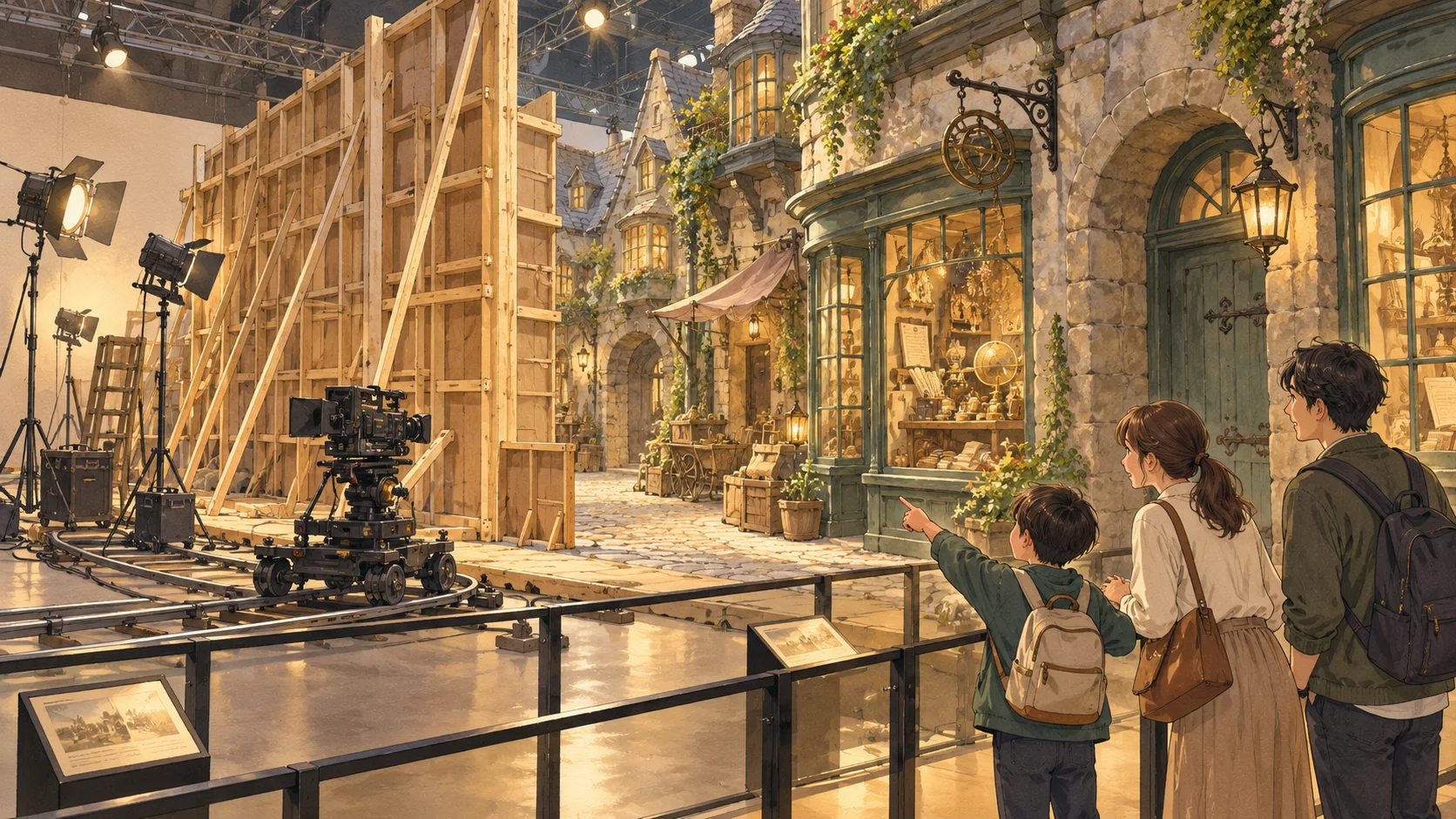
The digital guide includes Japanese, English, Chinese, Korean and Taiwanese Mandarin content for visitors interested in production background. The operator also says it is not an audio-description service designed for visitors with visual impairments. If someone mainly needs help with directions, transfers or seating, consult the accessibility information separately. The illustration below shows the concept of set fronts and supports, without promising backstage access or a working film crew on your visit.
Studio Tour meals, sensory needs and mobility support
The operator’s food and drink layout places the Food Hall and Frog Café in the part accessible before or after the tour, with Backlot Café as a possible meal stop partway through, plus the Butterbeer Bar. Plan a seated meal if you want a long exhibition visit. If you booked timed afternoon tea, arrange the route around that appointment; it is not a general meal voucher redeemable whenever you reach a café. A seasonal menu photograph also does not extend its availability into a later season.
For children sensitive to spiders, sudden sounds, darkness or flashing lights, explain the nature of spaces such as the Forbidden Forest first, then ask about ways to bypass particular areas. There are no conventional mechanical theme-park rides, but there is still a considerable amount of walking. Younger children need not complete every interaction. Agree which adult handles rests and which holds the group’s tickets before arriving, rather than repeatedly splitting up without a plan.
The official accessibility information allows manual and powered wheelchairs, while mobility scooters and senior mobility carts have transfer-equipment requirements and loan equipment is limited. Ordinary pushchairs are allowed, but child trailers and handled tricycles have separate restrictions. Visitors with disabilities normally buy standard admission; one free companion may be available when the stated evidence conditions are met, excluding the companion service for an under-four visitor. Overseas documentation must match the listed requirements rather than simply being any foreign disability card.
Finish a Studio Tour half-day on the same side of Tokyo
If you stay in Ikebukuro, make Toshimaen the day’s main destination and return to the same neighbourhood for dinner. From Shinjuku, compare the actual hotel exit and Oedo Line connection rather than moving hotels for one tour. Extend the visit with food, prop displays and shopping if you want a full day. If you love another character venue too, giving it a separate day preserves time to look closely instead of rushing toward a second admission deadline.
Before shopping, choose one souvenir you truly want, then consider its size, luggage space and budget. Robes, wands, guidebooks and personalised products have different prices and return conditions. The official online shop and the physical tour shop need not share stock for every item. With a limited budget, one durable keepsake can leave more flexibility later in the trip than buying every paid image product.
Do not squeeze the Studio Tour into the few hours after landing while your flight and ground transport remain uncertain. Use the Tokyo airport arrivals and late-arrival planning guide to work out luggage, hotel access and travel, then choose a complete half-day afterward. If a delay becomes certain, contact the original channel before the original booking date and time under that ticket’s conditions. A later slot showing as available is not a promise of a free change after the entry deadline.
Chiikawa Park in Ikebukuro is separate from shops and themed restaurants
Chiikawa Park is an indoor facility in Ikebukuro themed around the world of Chiikawa. It is separate from character shops, pop-ups, ramen outlets and other collaboration restaurants around the station. Fans who want the themed spaces and interactions can make it their main half-day reservation. If you only want one item of merchandise, decide whether you also want to pay for the full admission experience rather than navigating every Chiikawa-branded business as if it had the same entrance.
The park’s address and operating notices list B1 and 1F of Sunshine City Annex, 3-3-5 Higashi-Ikebukuro, Toshima-ku, Tokyo. Annex is part of the location: searching only for Sunshine City can lead you to another building. Current general hours are 10:00 a.m.–7:00 p.m., with last admission at 5:40 p.m.; special dates have their own notices. Check the booked slot alongside that day’s operating arrangements.
A starting allowance of about one and a half to two hours covers entry, interactions and shopping, with adjustments for your interests. That is a planning estimate, not an operator-published average or a guaranteed completion time. Do not book a late slot and infer from the morning opening time that you will have identical access to everything. Leave the following meal flexible if you want time for photographs, details or a game queue.
Chiikawa tickets are currently first come, first served
The current Chiikawa Park ticket rules use first-come-first-served sales at noon Japan time on the 15th of each month for the entire month two months ahead. If the 15th is a weekend or Japanese national holiday, sales move to the preceding weekday. This is a different phase from the opening-period lottery. Old lottery-payment questions remaining in an FAQ do not turn today’s sale back into a lottery.
For example, 15 November 2026 falls on a Sunday, so the stated rule points to noon on Friday, 13 November for January 2027 sales. Check the announcement and sales page for that particular release before acting. Convert Japan time into your own time zone and settle the group size beforehand. Signing in on time or starting the purchase process does not guarantee that you will secure tickets.
The park links to Asoview for purchases, with a maximum of five people in one purchase per account. Personal cancellations, changes and refunds are not accepted after purchase. If flights or companions are undecided, avoid buying merely because a slot appears available. Keep the full confirmation after payment succeeds. If tickets sell out, choose an Ikebukuro walk or another activity with confirmed eligibility and inventory rather than treating a queue at the venue as a replacement-ticket route.
Chiikawa prices, student evidence and entering as one group
Current prices are ¥3,500 for adults, ¥1,800 for children and ¥2,800 for eligible students. The ordinary adult category starts at age 12 and the child category covers ages 4–11, with an exception for a 12-year-old still in elementary school. Student eligibility separately lists junior and senior high school, university, graduate school, junior college and vocational school categories, with the required evidence. Check whether overseas enrolment documents qualify rather than assuming age, residence or a Chinese-language interface establishes eligibility.
Free entry for ages 0–3 has an accompanying-person limit: each paying adult or eligible student of junior-high-school age or above may bring at most one free infant. Elementary school children and younger also cannot enter alone; they need an accompanying adult or qualifying student ticket holder. List each visitor’s age, school stage and accompanying relationship before buying. A change in headcount does not make the original order freely divisible or transferable.
The operator’s purchaser and companion FAQ requires the purchaser to show the tickets personally and the whole group to enter together; identification may be checked. Resale, transfer and lending are prohibited, including giving a ticket to a friend for free. If the purchaser cannot go, sending another companion an image is not a completed name change. Likewise, do not assume one booking lets late arrivals enter as a second group.
Chiikawa phone rules and games need a careful reading
Two official pages describe entry without a smartphone differently. The FAQ says a smartphone is required, whereas the visitor guide says visitors can print the QR code and purchase details containing the purchaser’s information in advance, with identification potentially checked. If you cannot bring a phone, ask the operator which process applies on your visit date. Paper documents also do not establish access to every QR interaction or reserved experience. If you can bring a phone, prepare the account, battery and connection, and a way to reopen the original ticket.
The park’s entry and interaction guidance generally limits each designated QR experience to once per person. In the game area, each person chooses one of the two games and plays once, paying separately after entry. Admission therefore does not include both games for free, and one person’s phone activity is not proof that the whole group has used its individual entitlement. Let children choose their priority, then set separate limits for a paid game and merchandise.
The venue is cashless; check the current official list of supported payment methods before travelling. Ticket purchase and on-site shopping do not necessarily accept exactly the same methods. You need a valid admission ticket to reach the shop rather than entering solely to browse merchandise. A social-media photograph of a new product does not establish stock or unrestricted quantities on your date. Make a short list of categories you want, then decide from actual availability.
Chiikawa arrival: the Annex address, luggage and special routes
Save the complete address and Annex name in your map, check the train from your hotel to Ikebukuro, then use the operator’s location and map entry to confirm the route toward Higashi-Ikebukuro 3-chome after leaving the station. Different platforms and exits in a large station produce very different walks. Choose a clear station or street-level meeting point so that the person holding all the tickets does not reach one building while the rest of the group waits at another.
There are no visitor lockers inside the park. Store large luggage at your accommodation or a nearby facility rather than assuming a basement venue must have room for a big suitcase. Pushchairs must be emptied, folded and parked as instructed, with limited space; there is no pushchair or wheelchair rental on site. Wheelchair users should bring suitable equipment and check dimensions and route restrictions in advance, rather than expecting another park’s loan service to exist here.
The reference wheelchair dimensions are 70 cm wide and 115 cm long. Some areas require a staff-guided special route, and powered wheelchairs have additional safety requirements such as switching off the power. Ask ahead about larger equipment or other needs. Some content involves darkness, sound or light stimuli; sensitive visitors can read the warnings and ask before entering. Being admitted and being able to take part in every interaction are separate questions.
Keep the rest of an Ikebukuro half-day flexible
Pair Chiikawa Park with a meal in Ikebukuro, but do not treat search results for a Chiikawa restaurant, Ikebukuro PARCO or Chiikawa Land as an included restaurant, another park entrance or a free continuation of the same ticket. They may be separate businesses, temporary collaborations or other branded facilities, each with its own address and rules. If the park is your priority, have an ordinary meal first and save the main block of time for the reserved experience.
Re-entry is generally unavailable; emergencies require a discussion with staff before leaving. Do not walk out for lunch and then expect an automatic return. Complete meals, toilet stops and children’s clothing adjustments before entry, then plan a seated rest afterward. For a late slot, pay particular attention to last admission and closing time rather than extending shopping indefinitely toward a later restaurant reservation.
Split the merchandise budget into one item you want to keep, the number of gifts and available luggage space. Check official notices and the shop for actual stock and purchase limits. Following a social-media shopping list is not worth discovering at checkout that the group cannot carry or afford everything. If you stay in Ikebukuro, returning to the same neighbourhood is easier than carrying large bags across Tokyo for another fixed booking.
Sanrio Puroland is in Tama Center: check the opening calendar
Sanrio Puroland in Tama, Tokyo combines character performances, indoor attractions and food; it is not Harmonyland in Oita, Kyushu. Families and adult fans of Hello Kitty, My Melody and other characters should first choose whether shows, meetings, photographs or attractions matter most, then decide on a full day or afternoon version. The word park does not mean every activity is available without waiting.
The official ticket and visit calendar lists opening hours and prices by date; the park is not open every day throughout the year. Published November 2026 information marks 4 and 5 November as closed and 13 November as 9:00 a.m.–6:00 p.m. Those are arrangements for that checked month, not a fixed weekly closure rule or evidence that every weekday starts at nine. Look up your own date before buying inflexible transport or another activity.
An indoor park still has outdoor approaches, possible entrance waiting and a return journey. Rain does not eliminate the need for rain gear. Check your preferred show times before choosing morning or afternoon admission. A cheaper afternoon ticket may mean omitting a show or attraction, rather than doing exactly the same things in slightly less time.
Puroland prices vary by date; afternoon admission starts at 2:00 p.m.
The main products are a full-day Passport and an Afternoon Passport allowing entry from 2:00 p.m. The categories are adults aged 18–64, children aged 3–17 and high school students, and seniors aged 65 and above; children aged two and younger enter free. This high-school exception differs from another venue’s rule for 12-year-old elementary pupils. Compare window prices with online discounts, special events and agent products separately rather than using one student label for all four venues.
For the published example of 13 November 2026, window prices are ¥4,900 per adult and ¥3,800 per child or senior for a full day; afternoon prices are ¥3,400 and ¥3,100 respectively. The usual official e-ticket discount is ¥100 below the corresponding window price, making that example ¥4,800 and ¥3,700 for a full day, or ¥3,300 and ¥3,000 for the afternoon. This is a specified date and channel example, not an all-month minimum or a check of available ticket inventory.
An afternoon ticket does not let you enter in the morning and start paying at two. A cheaper ticket for the previous day is also not valid for the following day. For an afternoon plan, identify one priority performance and leave other attractions flexible, with lunch before entry. If your favourite show is only in the morning, the cheaper product may simply not fit the purpose of this visit.
Puroland needs both admission and an arrival reservation
A visit requires a valid admission ticket and an arrival reservation. Completing the specified official e-ticket purchase includes that date’s reservation, but that does not mean every paper ticket, exchange voucher, complimentary ticket or agent product does the same. When using Sanrio+ or another channel, check whether your product needs a separate registration, exchange or supporting document. Only treat the visit as confirmed once both required components match.
The official individual e-ticket information allows cancellation through My Page until 11:59 p.m. on the preceding day, with exceptions such as convenience-store payment. Read the actual product conditions. This is not a refund rule for every Sanrio ticket, nor a basis for handling another seller’s order after the deadline. If your date is uncertain, compare actual change and cancellation conditions as well as the displayed price.
Before travelling, check everyone’s tickets, infant numbers, reservation date and a working account login. Avoid a situation in which one adult holds only a reservation and another holds only an exchange code that cannot be matched to the same date. If you have no ticket, keep an adjustable Tama or neighbourhood alternative. A physical ticket window does not guarantee sales or space on every date; the day’s announcement controls that question.
Puroland shows: ordinary viewing and reserved PUROPASS areas differ
The official introduction to The Quest of Wonders Parade describes a roughly 25-minute performance in Puro Village on Level 1 (1F), launched on 5 December 2025. Check the day’s schedule for dates and times. Decide whether you are willing to wait for ordinary viewing before considering an additional reserved area. A basic ticket does not promise a front-row seat or every character at every performance.
The PUROPASS sales page for this parade separately lists ¥3,000 for the front row, ¥2,000 for S seating and ¥1,000 for A seating, with some standing and wheelchair areas at ¥1,000. Valid park admission is still required. Sales generally open at 9:30 a.m. on the 21st for the following month’s dates 1–15, and at 9:30 a.m. on the 6th for dates 16 through month-end. Subject to availability, sales end 45 minutes before the performance; these passes are not sold at an in-park window. Other shows and attractions need their own prices and release rules.
This PUROPASS uses a live display in the LAWSON electronic-ticket app, not a screenshot. The page lists SMS verification for phone numbers beginning 090, 080 or 070, so check usability before buying. Reserved-area guidance starts 25 minutes before the show, with check-in to entrance staff required at least three minutes before it starts. Each paying guardian may accompany one child aged two or younger under the lap-seating or designated standing-area rules. Standing space may not suit a small child. The official video below introduces the show’s key visual, not a complete performance or the view from your actual seat.
Tama Center access and pushchairs: entry is on Level 3 (3F)
The operator’s Tama Center transport guide gives reference journeys of about 30 minutes from Shinjuku on a Keio limited express, 12 minutes from Shin-Yurigaoka on Odakyu, or 23 minutes from Tachikawa on the Tama Monorail, followed by around five minutes on foot from Tama Center. Add your hotel-to-station journey, waiting and the walk to the entrance. Identify whether you arrive at the Keio, Odakyu or monorail station rather than searching repeatedly for a single gate under three names.
Park entry is on Level 3 (3F). Follow the official step-free route through the station exit, pedestrian deck and ramps; a short-looking line on a map does not establish a pushchair- or wheelchair-accessible shortcut. On weekends, holidays and weekdays when the park closes at 6:00 p.m., pushchairs cannot enter levels 1 and 2 (1F and 2F) and must be parked as directed. If your child needs to remain seated throughout, this directly changes the care plan and belongs in the decision before purchasing.
Preschool children generally need a guardian of junior-high-school age or above on attractions, while individual activities have their own age, height or physical conditions. Wheelchair viewing areas, equipment loans and other assistance may also be limited. Read the relevant attraction details and the operator’s practical-use FAQ. Indoor access and ramps do not establish that every attraction can be used without transferring from a wheelchair.
Puroland meals and rests need room between performances
For a show-focused day, eat beforehand and then wait in the viewing area rather than bringing a hungry child into simultaneous restaurant and performance queues. The operator says restaurants generally do not accept reservations, and Yakata no Restaurant uses arrangements such as on-site numbered tickets. Admission is not a table booking. The Character Food Court on Level 1 (1F) has options such as a low-allergen children’s curry, but check the current recipe and ask about preparation; it is not a zero-allergy-risk guarantee.
Packed lunches, fast food and alcohol generally cannot be brought inside; discuss specific dietary needs with the operator. Food needed for children must follow the official exceptions rather than a social-media account of one person being waved through. The Baby Center on Level 1 (1F) and other care spaces are shown in the park services and facilities guide. Locate nappy-changing, nursing and drinking-water points and reserve a genuinely unhurried break.
Lockers cost roughly ¥300–¥1,000 depending on size, with a separate ¥1,000-per-item service for large luggage, subject to space and on-site conditions. Ordinary same-day re-entry requires completing the specified hand-stamp or other procedure before leaving, unlike Mitaka or an ordinary Studio Tour ticket. Ask first if you plan to eat outside rather than trying to establish eligibility after departure. An afternoon ticket still does not let you enter in the morning to store bags.
Alternative one: Tama Zoological Park is in Hino and needs its own ticket
Despite the shared Tama name, the zoo is at 7-1-1 Hodokubo, Hino, Tokyo, rather than beside Puroland in Tama City. The zoo’s official access guide directs visitors to Tama-Dobutsukoen Station on Keio or the Tama Monorail, about one minute from the entrance. This is another station, operator and admission entitlement. A Puroland ticket is not valid, and the two park entrances are not a five-minute walk apart.
The current general zoo admission fees are ¥600 for adults, ¥200 for junior high school students and ¥300 for ages 65 and above, with elementary school children and younger free. Junior high school students living or studying in Tokyo have a separate free-admission qualification and evidence requirements. Normal hours are 9:30 a.m.–5:00 p.m., with last entry at 4:00 p.m.; Wednesday closures and holiday-related exceptions need a calendar check. Animal displays may finish earlier.
Treat it as a day of outdoor observation and walking rather than requiring children to finish a morning zoo visit and every character show that afternoon. The homepage’s important notice, updated 3 October 2026, still lists partial road closures in the Africa Garden following a 22 September landslide, with only some restrictions lifted on 3 October. Check the current closure notice and zoo map before travelling, especially with a wheelchair or pushchair. If you only need a sold-out-ticket backup, ask whether your companions actually want animals; a shared place name is not a reason to substitute automatically.
Tama Zoo’s Lion Bus is suspended: an expected return is not a reopening
At this check, the lion notice published 22 July and updated 5 September still states that lion displays and the Lion Bus have been suspended since 23 July 2026, with resumption to be announced. Its expectation of a return from October onward was an expectation at that time, not evidence that service restarted when October arrived. The current boarding guide also still lists suspension. If the bus is your sole reason for going, wait for a clear official resumption notice.
The bus normally has a separate ride ticket from zoo admission. After resumption, check the then-current sale and boarding rules rather than treating a pre-suspension price as something available to buy today. Handling of affected past online orders follows the operator’s notice; an automatic refund for those orders is not a general refund right when you cancel another date or product yourself. Other exhibits actually open on the day are the usable alternative while service remains suspended.
Koalas and other animals likewise depend on the day’s display arrangements, care and health. A visit does not guarantee a particular pose, feeding or activity. For a shorter half-day, choose two or three genuinely interesting, open areas and adjust for slopes and children’s energy. That is more likely to leave time for a comfortable return than following an online ranking through every corner of the zoo.
Alternative two: a Seiseki-Sakuragaoka neighbourhood walk
Seiseki-Sakuragaoka in Tama City offers a neighbourhood walk associated with Whisper of the Heart, not an indoor museum selling admission to film scenes. The city’s account of the film and neighbourhood connection identifies the Seishun no Post monument by the station’s west exit, walking maps and the use of a Country Road melody at the station. Start nearby if you want a brief taste of that atmosphere; there is no need to match every scene to a real building.
For a longer walk, consult the local shopping association’s Whisper of the Heart map and select a route for the weather and the group’s mobility. A published map does not establish that every stretch is flat or every shop is open. Respect homes, private land and everyday roads rather than entering property or blocking traffic to recreate a shot. A short version can begin with the west-exit monument and immediate surroundings before deciding whether to continue.
Keep this walk for a day without tickets, an early finish or a wish to avoid another admission charge, while still budgeting trains, meals and individual purchases. Puroland, Hino’s zoo and Seiseki-Sakuragaoka provide three different kinds of day. Choose one anchor and perhaps a short extension if time allows. No single supposed Tama City sightseeing pass resolves their different opening days, tickets and walking demands.
Compare family budgets with the same people and the correct child category
The examples use two adults and one eight-year-old elementary school child, covering the relevant ordinary admission only. Transport, meals, souvenirs, hotels and paid experiences are excluded. The Ghibli Museum’s English age bands give ¥1,000 × 2 + ¥400 = ¥2,400. If the chosen channel applies the new ¥110-per-ticket fee, three tickets add ¥330, making ¥2,730. That fee example has a channel condition; it does not set the cost of JTB packages or every overseas order.
Using the Studio Tour’s published standard starting prices gives ¥6,300 × 2 + ¥3,800 = ¥16,400. Availability and prices for a particular date have not been checked, so a starting price is not a quotation for your day. Chiikawa’s ordinary adult and child tickets give ¥3,500 × 2 + ¥1,800 = ¥8,800, excluding games and shopping. Eliminate experiences you do not want before comparing suitable choices, rather than dividing admission by hours to assign a score to a favourite character.
For the Puroland official e-ticket example on 13 November 2026, full-day admission is ¥4,800 × 2 + ¥3,700 = ¥13,300, and afternoon admission is ¥3,300 × 2 + ¥3,000 = ¥9,600, a ¥3,700 difference. If your priority show happens earlier, that saving comes with a real reduction in the plan rather than an unconditional discount on the same day. You might separately allow ¥1,500 per person, or ¥4,500 for the family, for meals, plus your own urban-transport reserve. These are budgeting assumptions, not fixed local meal or train prices.
| Venue and basis | Calculation and total (yen) | Excluded or requiring another check |
|---|---|---|
| Ghibli Museum: English-page face prices | 1,000 × 2 + 400 = 2,400 | Add 330 if the new 110-per-ticket fee applies; check the actual overseas order |
| Tokyo Harry Potter Studio Tour: standard starting prices | 6,300 × 2 + 3,800 = from 16,400 | Actual date/time price, guide, food and paid images |
| Chiikawa Park, Ikebukuro: ordinary tickets | 3,500 × 2 + 1,800 = 8,800 | One optional game and merchandise extra; student eligibility separate |
| Puroland: 13 November official e-ticket example | Full day 13,300; afternoon 9,600 | Afternoon starts at 14:00; reserved show areas extra; not year-round prices |
Choose a hotel base by rail direction rather than moving for every ticket
Mitaka and Tama Center are both west of central Tokyo, but their railway approaches differ. Shinjuku is a useful comparison point, provided you check the Chuo, Keio or Odakyu connection from the actual hotel entrance. Ikebukuro can suit separate days toward Chiikawa Park and Toshimaen. Two places being on the same side of the city does not establish a direct connection, or mean that changing hotels saves more time than packing and moving uses.
Use the Tokyo neighbourhood and transport-base comparison to shortlist an area, then check room configuration, occupancy, cancellation date, lifts and late check-in. If accommodation is sold with tickets, verify the authorised channel, the actual ticket included and its admission date. An attraction photograph on a hotel page does not establish complimentary admission. Keep separate confirmations that can be checked for the hotel and the museum, studio or park.
With one family base, pack a small day bag the evening before and leave suitcases at the accommodation. On checkout day, verify that the hotel, station or other service can store luggage until your return. Limited venue lockers are not a replacement warehouse for every hotel, and buying admission does not guarantee a large empty compartment. On the final day, put airport transport on the same timetable; that can matter more than squeezing in one additional show.
Rain, young children and access needs change the day’s usable capacity
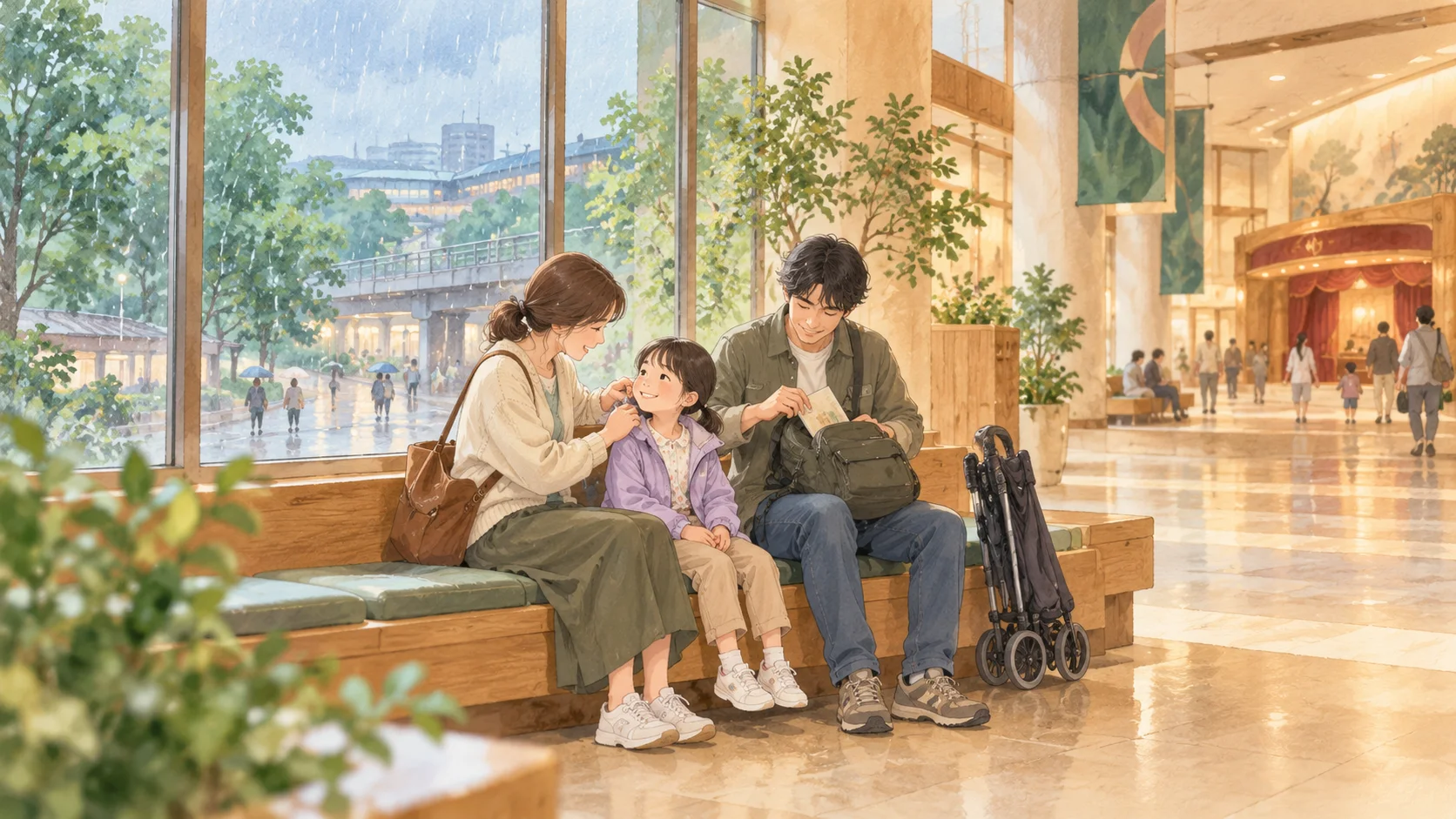
Most main content at these four venues is indoors, but rain still affects station approaches, folded pushchairs, clothing and queues. Mitaka’s roof may close in bad weather, and other venues have their own safety adjustments. Ordinary rain does not automatically give visitors a free-cancellation right. Carry compact rain gear, separate wet items and plan a seated lunch instead of arriving with nowhere to unpack the whole family’s belongings.
With a young child, choose a care rhythm that gives nappy changes, drinking water, naps and quiet time actual space. Mitaka requires pushchair storage; Puroland restricts them on levels 1 and 2 (1F and 2F) on specified days; Chiikawa also has folding and parking rules; and the Studio Tour allows ordinary pushchairs but involves a long walk. Check equipment against your own needs. A family-friendly label cannot answer whether you can push through, borrow equipment or qualify for a companion ticket.
For wheelchair users or people sensitive to sound and light, check the particular spaces you care about first. Rooftop lift access, special routes, powered equipment, seating and walking support differ by venue. Agree which parts you are comfortable skipping, and allow companions to take turns resting rather than treating every incomplete circuit as a failure. The first Japan trip guide to realistic daily capacity helps fit care needs into the half-day you actually have.
Three common booking mistakes, and one useful correction for each
The first is heading straight from arrival to a nonrefundable booking. Any delay at Narita or Haneda—immigration, luggage, city transport or storage—uses up the entry window. Put the character ticket on the next complete day instead. If you already have a standard Studio Tour ticket and know you will miss it, follow the original channel’s change process before the original admission time, rather than searching for later inventory after expiry. Other venues do not inherit the Studio Tour’s change rules.
The second is booking Mitaka in the morning, Chiikawa in the afternoon and Puroland in the evening, assuming each visit can be brief. Keep the ticket you most want and check the other products’ change conditions individually. Before buying, remove the second fixed reservation. A meal in Kichijoji or Ikebukuro gives the first attraction genuine visiting time rather than making every display a reminder of the next deadline.
The third is paying a proxy seller merely because it promises that the named purchaser need not attend or that every hotel booking includes a ticket. Check authorised channels and named-ticket rules with the operator, not an unfamiliar person’s screenshot. If tickets are unavailable, keep a park, neighbourhood or confirmed open alternative. Separating cancellable and noncancellable spending in your Japan budget makes it easier to judge what is actually worth locking in early.
Turn each confirmed ticket into a usable half-day
Keep the full venue name, address, date, Japan time, ticket type, purchaser and group size together. Add who must enter together, identification requirements and how to open the original phone ticket or order. Domestic Ghibli MOALA tickets, Chiikawa Asoview tickets, Studio Tour confirmations and Puroland e-tickets are not interchangeable formats. A screenshot cannot solve every live-display requirement, and companions should know who holds the group’s information.
Next outline the return, meals and rain version. Would rain shorten the park walk? If a child is tired, which performance are you willing to skip? Can an early finish lead back to a meal near the same hotel? Compare suitable urban rail products using the Japan rail guide’s route-and-total-cost method, rather than taking a detour simply to use a pass you already own.
Finally, identify the one experience you most want to complete and let the other options adjust around it. These four character venues offer different Tokyo memories, and a favourite work deserves an unhurried block of time. If operations, availability or someone’s condition changes, return to the original seller and that day’s official notices. A comfortable arrival, a worthwhile visit and a manageable journey back are the practical goals of the day.
A few useful answers
Can I use one ticket for the Ghibli Museum and Ghibli Park?
No. The museum is in Mitaka, Tokyo, while Ghibli Park is in Nagakute, Aichi. Each has its own tickets, dates, transport and area rules. This guide covers Mitaka; Ghibli Park has a separate guide.
If Ghibli Museum tickets sell out, can I queue at the museum?
The museum requires advance reservations for a specified date and does not offer a general walk-up replacement-ticket route. Check official overseas channels for products with actual availability and suitable eligibility. Without a confirmed ticket, choose Inokashira Park or Kichijoji; agent inventory and hotel-ticket packages are not guaranteed.
Can an overseas visitor borrow a Japanese friend’s account for a domestic Ghibli ticket?
Domestic LAWSON rules require purchase by an actual visitor, with the named holder entering together with the group and no subsequent representative change. Overseas visitors should read their own order conditions through the museum’s listed overseas channels rather than assuming domestic phone specifications or inventory are usable.
Can I cancel or change a Tokyo Harry Potter Studio Tour ticket?
Ordinary personal cancellations are not refundable. For an official standard ticket, request a new available slot before the original admission date and time, with a ¥1,500 fee per change. Guided and dining packages have separate deadlines; agent purchases go back to the original seller. Major operator time changes and cancellation have their own refund provisions.
Does a 12-year-old need an adult ticket at all four venues?
Not necessarily. Mitaka’s Japanese page uses school stages and its English page uses age bands. The Studio Tour has a child-category exception for a 12-year-old sixth grader, Chiikawa allows its child ticket for a 12-year-old elementary pupil, and Puroland lists ages 3–17 plus high school students in its child category. Check each actual product’s eligibility.
Are Chiikawa Park tickets still sold by lottery?
Current sales are first come, first served at noon Japan time on the 15th for the whole month two months ahead, moving to the preceding weekday for a weekend or Japanese holiday. Older lottery questions remaining in the FAQ do not describe the current process. Check the announcement and sales page for the particular release.
Can I enter only the Chiikawa merchandise area without admission?
No. Shop access requires a valid admission ticket, with the purchaser and whole group entering together. Official smartphone and printed-entry descriptions differ, so visitors without a phone should ask the operator about the process for their date. Games cost extra and each person chooses one of two, rather than receiving all games free.
Does having a Puroland ticket guarantee entry?
You also need the corresponding arrival reservation. Specified official e-tickets include that date’s reservation; other paper tickets, exchange vouchers and agent products follow their own process. Ordinary admission does not include every reserved show-area PUROPASS.
Can I use a cheaper Puroland afternoon ticket to store bags inside in the morning?
No. Afternoon admission starts at 2:00 p.m. Arrange storage, meals and shows around that entry restriction. The 13 November price example in this guide is also not a year-round fixed price.
Can I visit Sanrio, Tama Zoo and Seiseki-Sakuragaoka in one day?
Choose one main activity, then a short extension if energy permits. Puroland is in Tama City and Tama Zoological Park is in Hino, with different stations and tickets; Seiseki-Sakuragaoka is a neighbourhood walk. Shared use of the name Tama does not resolve transport or opening days.
Has Tama Zoo’s Lion Bus resumed by October 2026?
The official pages checked on 21 October still list suspension from 23 July with resumption to be announced. The September update’s expectation of October or later is not a reopening notice. If the Lion Bus is your only reason to visit, wait for an explicit official resumption announcement.
Can I get a free rain cancellation at all four venues?
Ordinary rain does not automatically trigger a refund. Follow the ticket, seller and any operator cancellation or adjustment rules. Roofs, outdoor approaches and facilities can also face safety restrictions. A shorter route with rest time is more reliable than assuming you can freely switch the ticket to tomorrow.
Check with the source
Schedules, availability and rules can change. These official sources are the place to confirm details before you book.
- Ghibli Museum | Japanese tickets, time slots and school-stage prices
- Ghibli Museum | New November 2026 admission system and per-ticket fee
- Ghibli Museum | Official overseas purchase channels, age prices and calendar
- Ghibli Museum | Permanent exhibitions, building and Saturn Theatre
- Ghibli Museum | Access, community bus and child cash/IC fare difference
- Ghibli Museum | Photography, pushchairs, roof and visitor facilities
- Ghibli Museum | Straw Hat Café
- LAWSON | Domestic Ghibli Museum sales and named electronic tickets
- LAWSON | Ghibli Museum purchase, companion and overseas-channel FAQ
- Ghibli Museum | Warning about fake official ticket sites
- Tokyo Metropolitan Park Association | Inokashira Park
- Warner Bros. Studio Tour Tokyo | Sets and filmmaking content
- Warner Bros. Studio Tour Tokyo | Standard prices and optional extras
- Warner Bros. Studio Tour Tokyo | Changes, school stages and visiting FAQ
- Warner Bros. Studio Tour Tokyo | Ticket terms and operator changes
- Warner Bros. Studio Tour Tokyo | Rail routes and location
- Warner Bros. Studio Tour Tokyo | Arrival and the 2027 parking change
- Warner Bros. Studio Tour Tokyo | Food, drink and rest stops
- Warner Bros. Studio Tour Tokyo | Wheelchairs, pushchairs and companion eligibility
- Chiikawa Park | Address, opening times and current operating notices
- Chiikawa Park | Current first-come sales, prices and purchaser rules
- Chiikawa Park | Phone, companions, shop and re-entry FAQ
- Chiikawa Park | Games, special routes and visitor restrictions
- Sanrio Puroland | Ticket types, ages and operating calendar
- Sanrio Puroland | Official e-tickets, reservations and cancellation exceptions
- Sanrio Puroland | Tama Center access and entrance
- Sanrio Puroland | Pushchairs, re-entry, food and visitor FAQ
- Sanrio Puroland | Park services guide
- Sanrio Puroland | The Quest of Wonders Parade and official video
- Sanrio Puroland | This parade’s PUROPASS prices, timings and viewing areas
- Sanrio Puroland | Original public November 2026 calendar data
- Tama Zoological Park | Tickets, school eligibility exceptions and hours
- Tama Zoological Park | Hino address and station access
- Tama Zoological Park | Lion display and bus suspension, September update
- Tama Zoological Park | Current Lion Bus boarding guide
- Tama City | Whisper of the Heart, Seiseki-Sakuragaoka and Seishun no Post
- Seiseki-Sakuragaoka shopping association | Whisper of the Heart walking map
- Tama Zoological Park | Current homepage notices and Africa Garden road closures