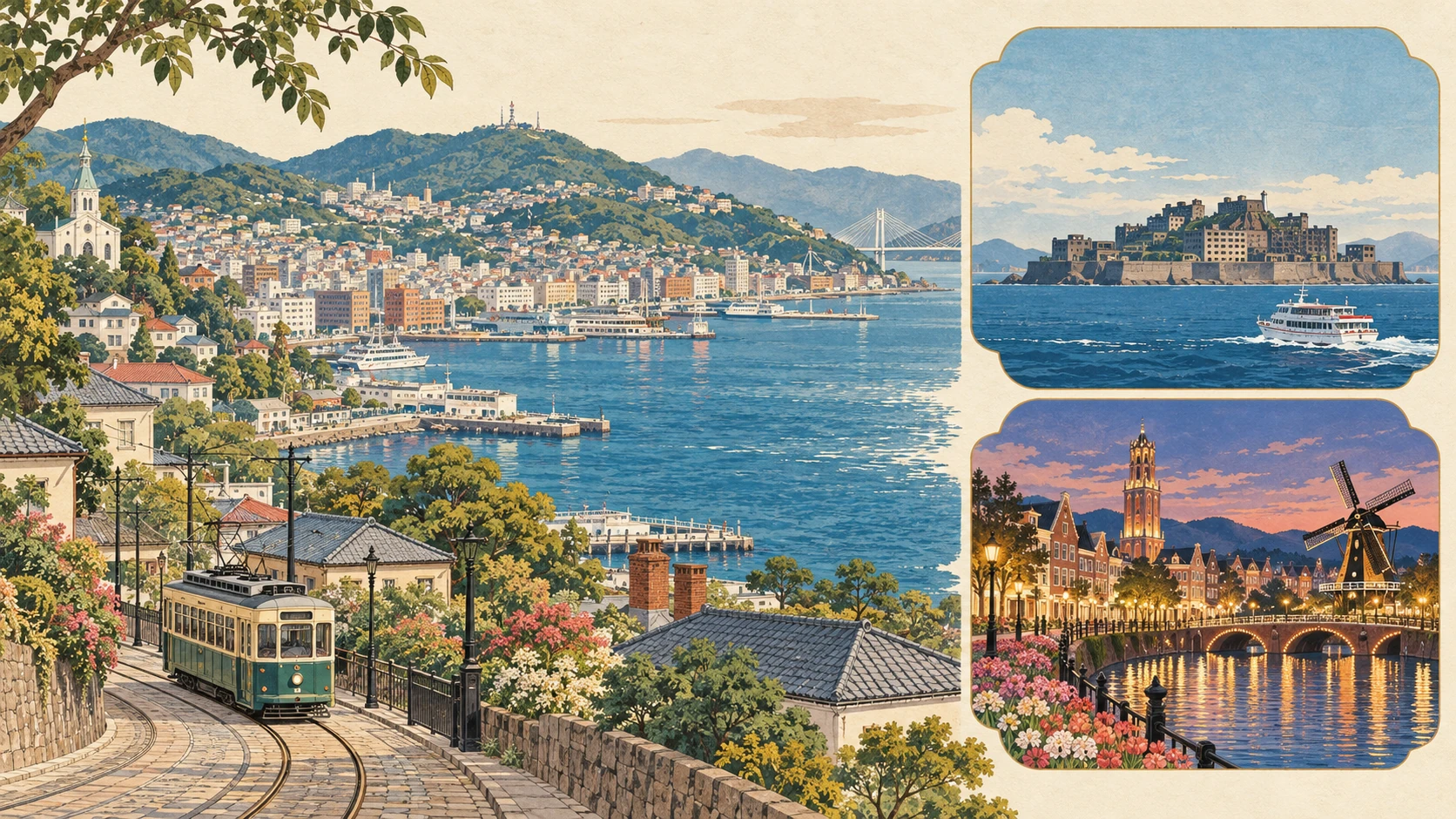
Use a practical Nagasaki base for three nights, give two days to the city and choose Gunkanjima or Huis Ten Bosch for one larger excursion. Check landing restoration, companions' ages and park return transport before rooms and tram tickets, keeping a complete backup when sailing is cancelled.
Choose one big excursion before planning four days in Nagasaki
The key to four days and three nights in Nagasaki is securing activities with fixed departure times first. On a first visit, spend three nights in the city, leave two days for the harbour, Yamate hillsides and Urakami, and choose one for the sea or Huis Ten Bosch. Gunkanjima emphasises industrial heritage and a guided boat trip; Huis Ten Bosch needs a full day of theme-park energy and an evening return plan. They do not fit comfortably into the same day. To do both, reduce the city visits or add nights rather than hiding travel time.
For accommodation and trams alone, start with four possible overnight bases and calculating a tram pass. Before booking a boat, read the current Gunkanjima restrictions and two operators compared. With children at the park, first check passport ages and prices and the Miffy attractions' restrictions. These branches share a Nagasaki base but have different cancellation, age and return conditions.
This guide uses official public information actually read as of 22 October 2026; amounts are in yen. Specified food and hotel allowances and walking or visiting times are planning assumptions, not a first-hand route record, live vacancy check or weather guarantee. A notice states that Gunkanjima landings are unavailable from 22 October, with restoration still to confirm through the operator. Below are booking methods for after reopening and city alternatives usable while that restriction applies.
A four-day framework: preserve an afternoon you can move
If arriving around midday on day one, leave bags, visit Dejima and walk by the Nakashima River, with dinner around Shinchi Chinatown. On day two, put the Atomic Bomb Museum and Peace Park in the morning, then head to Minamiyamate. Choose Glover Garden or Oura Church for an unhurried visit, adding the other only with enough energy. Save Mount Inasa for an evening with better visibility rather than insisting on the second night. Day three takes the major excursion; day four works around your actual departure.
If Gunkanjima landings resume and you select a morning sailing, there may be an afternoon for unfinished Minamiyamate visits. Do not prepay a timed activity immediately after the expected harbour return. Huis Ten Bosch occupies the entire third day, so finish the city sights that matter most on day two. A late first-day arrival means removing a city stop, not pushing all the lost time into check-out day.
The table allocates time without requiring every stop. If leaving before midday on day four, keep only breakfast, bags and transport to the station or airport. Consider a nearby indoor visit only when you truly have the afternoon before departure. With a pushchair, slower walking or a nap requirement, preserve one main place in each district instead of adding more transfers.
| Day | City and Gunkanjima option | Huis Ten Bosch substitution |
|---|---|---|
| One | Bags, Dejima or Megane Bridge and neighbourhood dinner | Same; complete the most important city visit first |
| Two | Urakami, Minamiyamate and Inasa when weather suits | Same; one or two afternoon sights according to energy |
| Three | Boat after reopening is confirmed; indoor city day if cancelled | Full park day with return confirmed or an overnight stay nearby |
| Four | Short walk, collect bags and leave | Park guests leave from there without detouring into Nagasaki to finish sightseeing |
From Nagasaki Airport: choose the district where you will get off
Airport buses to town include the Dejima-road route through Shinchi Chinatown and Nagasaki-ekimae, and another through Showamachi and Urakami. The airport currently lists a one-way fare to Shinchi Chinatown or Nagasaki-ekimae of 1400 for adults and 700 for primary-school pupils. Chinatown guests need not automatically ride to JR Nagasaki Station and drag bags back again. Choose a stop on the airport's bus routes and fares page, then compare it with the actual hotel entrance.
The airport guide gives about 43 minutes to Nagasaki-ekimae via the Dejima road. That measures road travel, not arrival at the hotel 43 minutes after landing. Immigration, luggage, walking to the stop, waiting and traffic need separate allowances. The observed timetable is valid 1–24 October 2026. For later travel, return to the current city-bound timetable instead of copying its last departure from an expired table.
For the airport return, identify the stop in the correct direction. Arrival and departure stops need not share the same side of the road; check when first reaching the hotel. Before a morning flight, do not insert Gunkanjima, Yamate slopes or a distant park into the approach. Work backward from the airline's check-in requirement, then include bags, waiting and a margin for road changes.
From Fukuoka: Hakata to Nagasaki requires a change of trains
A common rail combination from Fukuoka is the Relay Kamome limited express from Hakata to Takeo-Onsen, then the Nishi Kyushu Shinkansen Kamome to Nagasaki. JR Kyushu explains an opposite-side connection on the same platform, but you still get out and change trains. It is not one through service. Use JR's Relay Kamome and shinkansen transfer explanation to check tickets and reserved seats, rather than booking today's trip from an old Hakata direct-express description.
If already including Fukuoka, group consecutive nights in Nagasaki instead of commuting daily. Beyond time in the train, hotel-to-station travel, waiting and the last departure affect night views and breakfast. First establish whether both ends use Fukuoka, Nagasaki, or one airport and one rail journey; then compare individual fares. Just one return trip to Nagasaki does not make every regional pass worthwhile.
To combine Hakata meals with Nagasaki, begin with allocating three city days in Fukuoka. List actual travel dates using the comparison of separate Japan rail tickets and passes. When reserving accommodation, also review train changes, cancellation and collection conditions. Buying a cheaper ticket does not make the evening when you must leave early a full night-view day.
Read the tram map as four directions
Divide the city into Nagasaki Station, Urakami, Dejima–Chinatown and Minamiyamate. From Nagasaki-ekimae to the Atomic Bomb Museum and Peace Park, look at services 1 or 3 toward Akasako. Oura Church and Glover Garden use service 5 toward Ishibashi, changing at Shinchi Chinatown or Shiyakusho according to your starting point. Recognising a stop name alone can send you the wrong way. Check both service number and terminus before boarding.
The current Nagasaki Electric Tramway route and boarding guide also shows approaches to major sights. Save the hotel's stop, destination stop and interchange beforehand rather than searching for a map inside the carriage. The stop near Megane Bridge is Meganebashi. JR Nagasaki Station and the Nagasaki-ekimae tram stop are also different platforms.
Trams plus walking work for the city; owning a pass is no reason to ride an unnecessary extra stop. Flat harbour paths and Minamiyamate slopes take different effort, and a short map distance can include stairs. Leave large bags first. With pushchairs or wheelchair users, choose each attraction's accessible entrance route, estimating the walk from stop to building separately from the ride.
A day pass breaks even at four rides and saves from the fifth
The current ordinary tram fare is 150 for adults and 80 for primary-school pupils; a day pass costs 600 and 300 respectively. For independent adult rides without short-section discounts or a free transfer, three rides give 150 × 3 = 450, so the pass costs 150 more. Four give 150 × 4 = 600, breaking even; five cost 750, or 150 more than the pass. Ride count is the result: list the routes before deciding on a ticket.
If day one only involves the station to Chinatown and back to the hotel, two ordinary rides total 300, which is 300 less than the 600 day pass. An Urakami morning, Yamate afternoon and central return may need more boardings. The pass helps with spontaneous route changes, but does not save everyone money. Current IC short-ride discounts, children's free days or eligible transfers require using what you actually owe.
The paper day-pass sales information expressly says it cannot be bought onboard. Buy at a listed outlet first, or install and set up a supported mobile ticket. There is also a 24-hour ticket at 700 for adults and 350 for primary pupils, counted from activation rather than valid only on the day of use. Compare it when arriving in the afternoon and travelling into the following midday. Neither ticket includes ordinary buses, the mountain transport or Huis Ten Bosch travel.
IC transfers and mobile passes: keep payment methods clear
The official transfer discount applies to transport IC cards and supported contactless credit-card travel on specified combinations at Shinchi Chinatown, Shiyakusho, Nagasaki-ekimae and Nishihamanomachi, making the second fare free. Getting off and on at those stops alone is insufficient. Exclusions include more than 30 minutes from first alighting to second boarding, one card paying for several people, and split payment because of insufficient balance. Cash does not receive the same transfer arrangement.
With IC or contactless credit payment, tap at both boarding and alighting as instructed. Tell the driver before paying for several people rather than changing the number after tapping. Mobile passes follow their service: official instructions describe Pass Case using the purchase card or specified device, while other listed tickets generally show a valid screen at exit. Do not hold an active pass and also tap an ordinary IC fare unintentionally.
To buy a Nagasaki mobile tram pass, use the operator's ticket-app entry point to check accepted services, activation and phone requirements. Complete purchase and setup before boarding instead of downloading on the way out. Check battery level, connectivity and how companions' tickets can be inspected. A payment screenshot is not necessarily a valid ticket under that service's rules.
Arrival afternoon: include the fatigue of getting there
First handle bag storage, the hotel entrance and tomorrow's transport. With a midday arrival and enough energy, make Dejima the first substantial visit before a flat walk to a meal. Coming into town later, switch to Megane Bridge and Chinatown, moving Dejima to genuinely available time on day four. Do not drag cases up Minamiyamate merely to fulfil a first-day list before rushing to a night view.
Choose the first dinner near the hotel, leaving difficult reservations for an evening less dependent on international arrival. Champon, sara udon and shippoku are different meal formats; one sitting need not include them all. Check hours and final entry before eating. Closing at a certain hour does not guarantee seating a whole family one minute before it.
If the sea already prevents sailing, rearrange the next days on arrival rather than waiting until port check-in to seek a backup. Keep one boat-independent city plan and one park option on the phone without prepaying both. That leaves room to change course after flight delays, rainfall changes or a family member feeling unwell.
Dejima: understand the reconstruction without relying on re-entry
Dejima rewards attention to reconstructed trading life and remains from different periods rather than just a panorama outside the bridge. Begin with the trading-post district, indoor objects and building layouts, then relate the former island to the modern city beside the water. The reconstruction chiefly targets the early 19th century. Do not call every building an Edo structure surviving exactly as originally built.
The official Dejima visitor information currently lists 1100 for adults and 550 for primary through upper-secondary pupils, 8:00–21:00 with last admission 20:40 and no re-entry. Omotemonbashi and Suimon entrances also have different hours. If planning lunch outside followed by more exhibits, eat before admission or establish that you can finish the main visit in one entry.
Initially allow around an hour and a half, adding time if interested in reading. That is a planning suggestion, not an official duration. Rain still leaves indoor exhibits, but moving between buildings involves the outdoors; it is not a fully enclosed shopping centre. With children, one or two understandable trade or daily-life subjects may leave more impression than rapidly passing through every room.
Megane Bridge and Chinatown: make this a flexible walk
Megane Bridge stands on the Nakashima River and combines well with surrounding streets. The city tourism site's bridge and accessibility information helps judge the setting. Do not take pushchairs, wheelchairs or slower relatives down every riverbank staircase simply for a closer reflection photograph. In rain, high water or slippery conditions, viewing from the upper street can still preserve this city observation.
Shinchi Chinatown suits dinner: choose a dish you want and a tolerable queue. It is not on the same corner as the bridge; streets or a ride still separate them. Combining two photographs does not turn them into five minutes. If time allows only one, Chinatown guests can eat first and leave the bridge for day four; station-area guests can decide by the return direction.
This stretch need not accumulate paid attractions to make sense. Leave room for coffee, water and rest, especially before the next morning's peace-related exhibits. The first evening need not end in exhaustion. A hotel avoiding one after-dinner transfer may help a three-night trip more than chasing the lowest single room rate.
Day two morning: explore Urakami's history and peace sites together
The Atomic Bomb Museum, hypocentre and Peace Park form one Urakami visit. Seeing exhibits before walking outdoors makes their relationship easier to understand than separating them across three days. Visit in the morning while everyone can concentrate, allowing family members to stop and read. Do not immediately follow it with a noisy group activity. Leave time for lunch and processing what you have seen.
With children, explain in advance, appropriately for their ages, that some exhibits may be distressing; caregivers decide what to see. If someone needs an earlier rest, agree on a meeting point outside rather than requiring the group to read at one pace. Worship, remembrance and photography also have different boundaries. Follow museum notices and each memorial's rules without making other people's mourning your sightseeing backdrop.
This deserves full attention, rather than filling a gap as an incidental rainy-day stop. If sailing is cancelled, move the original Urakami morning to day three and use day two for Minamiyamate. That changes the sequence; it does not reduce reflection on war and peace to a quick photo stop while waiting for a boat.
Atomic Bomb Museum: check the new price and seasonal hours separately
From 1 April 2026, ordinary permanent-exhibition admission remains 200, while upper-secondary pupils and younger enter free and group prices are abolished. Bring evidence of student status as requested. Some old tourism pages still show 100 for primary through upper-secondary school. This guide follows the museum's current admission-price announcement, keeping old and new prices out of the same budget table.
The museum's visitor guide lists April and September–the following March at 8:30–17:30, admission until 17:00. May–August extends to 18:30, admission until 18:00, with additional extensions 7–9 August. It closes 29–31 December. Use the actual visit date: a summer-holiday extension does not establish equally late autumn afternoons.
Photography of specified works is prohibited; general photography also follows local rules, without flash, tripods or affecting others. Exhibition updates may alter available areas, so recheck the current scope before leaving. Initially allow around one and a half to two hours for the permanent display and a rest, adding time if especially interested. A low admission price does not establish that half an hour is enough.
Glover Garden: slopes, entrances and night opening need separate checks
Glover Garden combines Western-style homes, harbour views and Yamate's terrain, without needing to focus on one famous residence alone. The garden warns of stone paths and gradients. Moving walkways, ramps and some aids exist, but wheelchair users still need assistance inside. With companions who tire easily, choose an approach from the garden map and entrance information. Mechanical assistance does not establish a completely level route.
The current Glover Garden prices and night-opening schedule give adults 1300 and primary through upper-secondary pupils 650 following the 1 April 2026 change. Ordinary opening is 8:00–18:00, with final entry 20 minutes before closing; night opening depends on date. The official table gives until 20:00 for 1 November–31 December 2026, returning to 18:00 in January–March 2027. Private use, weather and specific days may differ. Check the day again.
After the museum in the morning, Glover Garden and Oura together make a tighter afternoon. Allow around an hour and a half for the garden, prioritising homes and views without chasing every photograph. To explore slowly or wait for illumination, move Oura to another afternoon rather than simultaneously demanding two full visits and an exact Mount Inasa arrival.
Oura Church: museum included, but the long stairs remain
Oura and Glover Garden are close, but their tickets and visiting purposes are separate. The church's official visitor guide lists 1000 for adults, 400 for lower- and upper-secondary pupils, and 300 for primary pupils, including the museum. Opening is 8:30–18:00 in March–October and 8:30–17:30 in November–the following February, with last admission 30 minutes before closing. Religious activities can affect access; ordinary hours are not an everyday guarantee.
Photography inside the church is prohibited. Stay quiet, do not eat or drink, and avoid disturbing prayer; follow separate signs in the museum and other areas. Even exterior photographers must respect the paid boundary rather than entering the grounds before buying a ticket. Understanding it as a continuing place of faith helps plan more meaningfully than remembering a World Heritage label alone.
The official guidance explicitly describes long stairs from the forecourt to the church entrance, without an alternative avoiding them completely; wheelchair users need assistance. Ask the administration about realistically available help first. If entry is unsuitable, keep a neighbourhood exterior walk and make the main paid visit somewhere that fits your companions. Completing a list does not justify taking a risk.
Eating in Nagasaki: schedule Shikairou and shippoku when you can arrive
Around Minamiyamate, consider Shikairou for champon or sara udon. Its 1 October 2026 operating announcement lists lunch 11:30–15:00 with last entry 14:00, and dinner 17:00–20:00 with last entry 19:00, possibly earlier when busy. Ordinary restaurant seating is not reservable. Private rooms have separate conditions: at least two business days ahead, four or more people and a course meal. Those requirements are not an ordinary solo-lunch booking system.
The announcement also lists closures including 28 October, 11 and 25 November 2026; other dates need a newer notice. If a morning boat's expected return approaches 13:00, walking and queuing can easily collide with the lunch entry deadline. Choose another meal, putting Shikairou into an earlier Minamiyamate lunch rather than disrupting transport for one restaurant.
For a complete shippoku meal, compare Nagasaki Shippoku Hamakatsu's main restaurant menu and hours. Its page gives 11:00–21:30, ordinary last orders 20:00. A private room requires food from 6500 per person plus a room charge of 10% of total food and drink. That differs from budgeting for one bowl of noodles. Ask whether a course can accommodate dietary restrictions rather than assuming every port-city ingredient is replaceable.
Inasa's night-view transport: two systems cover different sections
The current Nagasaki Ropeway fare from Fuchi-jinja to Inasadake is 1900 return or 1040 one-way for the general category, and 950 return or 520 one-way for primary pupils. The separate Slope Car runs from the mid-hill station to the summit: adults 1000 return or 600 one-way, children 500 and 300. Comparing the word cable car alone conflates different starting points.
From the bottom, check Fuchi-jinja Ropeway prices and approaches; already at the park's middle, compare the mid-hill Slope Car operation. Its cheaper upper-section ticket does not pay for a bus or taxi up to the middle. Compare the same complete transport chain in both directions rather than combining unrelated one-way prices and declaring the lowest cost.
The Ropeway page lists 9:00–22:00 but the last ascent at 21:00, taking about five minutes, with possible evening queues. The Slope Car also lists 9:00–22:00, with different daytime and evening intervals. Last ascent and last descent are distinct. After viewing, leave time to walk to the station and wait. Strong winds, inspections and unplanned suspensions follow that day's notices.
Which night for Mount Inasa? Visibility first, then dinner
Do not fix Inasa's view to one year-round clock time. For harbour outlines, twilight and lights coming on, arrive before your travel date's sunset and allow time for darkness. If low cloud hides the summit or wind affects transport, keep another evening as a candidate. One value of three nights is avoiding dependence on one sunset.
Choose how to return after the lower station. The free circular bus has its own bookings and departures; it is not an on-demand transfer automatically included with the Ropeway. Until confirmed, do not make it your only transport. A hotel on Inasa's hillside is not necessarily at the top, and routes to the cable systems and park stations still need separate checks.
The city tourism site's official downhill bus vlog from Inasayama Park adds context about the hillside city. Actual departures on your date still depend on operator information. For a relaxed central dinner, eat earlier or choose another night rather than assuming every restaurant admits guests after the view. It may be windier on the mountain; bring an outer layer that is easy to pack away.
Nagasaki accommodation: station, Chinatown, hillside or theme park
A hotel ranking by stars says little about daily movement. The station area favours bags, JR and leaving town; Shinchi Chinatown and Hamamachi suit after-dinner walks; hillside accommodation combines night scenery and hotel dining but needs extra city-access planning. Huis Ten Bosch is in Sasebo City, suitable for staying after nighttime events, rather than a district beside central Nagasaki.
Three city nights suit a city-and-Gunkanjima focus, also allowing a light day trip to the park. To finish Huis Ten Bosch's night activities without rushing for transport, move the final night into or near the park and leave from there on day four. Calculate bag handling for the hotel change first, rather than adding a park hotel simply as another desirable property.
The table compares base functions, not current vacancies, lowest rates or harbour views from every room category. After choosing an area, check the room's full name, beds, additional-bed permission, child ages and cancellation. To compare Japanese hotel rooms and meals, use the confirmation sequence for a first Japan accommodation booking before the named categories below.
| Base | Accommodation to compare | Useful purpose and limitation |
|---|---|---|
| Nagasaki Station and Gotomachi | Dormy Inn PREMIUM Nagasaki-ekimae | JR and communal bathing; not beside the platform, with an official ten-minute walk |
| Shinchi Chinatown | Hotel JAL City Nagasaki | Central dinner and walks; FAQ says no in-house coin laundry |
| Mount Inasa hillside | Inasayama Kanko Hotel and other hillside stays | Scenery and hotel meals; confirm promised view, transfers and city return |
| Huis Ten Bosch park area | Hotel Amsterdam | Combine the park evening and next-day benefits; initial entry is not universally free |
Dormy Inn PREMIUM Nagasaki-ekimae: check beds separately from hot springs
At Dormy Inn PREMIUM Nagasaki-ekimae with natural Tsuruminato no Yu baths, Standard Twin is officially 22.5 m² with two beds measuring 1200 × 1950 mm. Standard Triple is 25.9 m² with two of those beds plus an additional bed identified as ハイダーベッド. For two wanting separate beds, compare the Twin; for three needing their own sleeping places, check the Triple's actual bedding rather than assuming a slightly larger Twin permits a free extra guest.
The property's room dimensions and bed arrangements also list Deluxe Twin at 30.4 m², with a different bed combination from Standard Twin. Match the complete name when reserving. Its access page gives around ten minutes on foot from JR Nagasaki Station, relevant when carrying bags. Identify the entrance and walking route; ekimae in the name does not remove travel from the platform.
The 11th-floor natural hot spring is communal, not an onsen bathtub in every room. The property lists 15:00–10:00 the following day, with sauna closure 1:00–5:00, and a tattoo restriction. Follow this hotel's own public-bath rules, without treating potential exceptions in a generic brand FAQ as permission already granted here. For privacy, ask about the room bathroom and applicable conditions before booking.
JAL City Nagasaki: three adults need the right category
Hotel JAL City Nagasaki stands in Shinchi Chinatown. Officially, Standard Twin is 20.5 m² for one or two people, Moderate Twin 23.2 m² with an extra bed allowing three. Superior Twin is larger at 27.1 m² but still listed for one or two. This illustrates why sorting by area is insufficient: three adults need permitted occupancy and bedding, not simply the largest room.
Compare complete names in the NAGASAKI Plus room list. The official FAQ gives about three minutes' walk from Shinchi Chinatown tram stop and expressly says there is no hotel shuttle. This is straightforward for a Chinatown meal followed by a walk home, but an early JR departure still requires adding tram or taxi time to the station.
The FAQ says there is no in-house coin laundry, with nearby facilities introduced and paid laundry service available. To wash during four days and three nights, account for going out and drying time rather than imagining every amenity from a general list beside hotel pictures. Request extra beds or cots in advance instead of adding the third person to a reservation after arrival.
A hillside hotel: make dinner and transfers booking conditions
Inasayama Kanko Hotel occupies Mount Inasa's middle slopes and can be a comparison point for hillside stays. These suit people giving an evening to the hotel and scenery; if you want late central dinners every night, first calculate the return. A booking saying standard room does not automatically promise a harbour night-view room. Seek confirmation matching the category, floor or guaranteed outlook.
Write your requirements: number of beds, a harbour view from the room versus a public space, and where the final meal will be. Use Inasayama Kanko Hotel's official entry point to ask about the named room, travel-day transfer, last dinner start and late-arrival handling. Compare with a central room after receiving answers. Transfer and view should be confirmable booking conditions, rather than assumptions from the hotel's district.
If the hillside rate adds a substantial amount, identify what it buys: the desired room view, included dinner and whether you still need the public observation point. Conversely, two nighttime taxi rides can narrow the difference for a cheaper city room. Use actual quotes and transport answers instead of asking a phrase such as million-dollar view to justify a room price.
Children, cancellation and tax: each hotel has its own system
Dormy Inn's general child-sharing rules allow one child aged zero to two per existing bed free, with ages three through Japanese primary school sharing at 3000 each per night. A separate bed attracts the adult charge. JAL City Nagasaki's general FAQ gives free sharing for preschool children under six, normally one child in a Double or two in a Twin. These are general rules; plans can differ. Enter actual ages and everyone in the party rather than assuming no extra bed also means no charge.
JAL City Nagasaki's frequently asked questions give ordinary cancellation at 20% the previous day, 80% the same day and 100% for no-show, with agencies and groups handled separately. Dormy Inn also warns of property- and plan-specific terms. A cancelled Gunkanjima sailing does not automatically cancel the hotel charge. If the stay dates remain fixed, usually change the activity rather than accommodation. Put free-cancellation deadlines in the itinerary instead of seeking emails the day before travel.
Nagasaki City's accommodation tax uses taxable lodging charges per person per night. For stays through 31 March 2027 inclusive, under 10,000 costs 100, 10,000 to under 20,000 costs 200, and 20,000 or more 500. From stays on 1 April 2027, under 6000 costs 100, 6000 to under 20,000 costs 300, and 20,000 or more 500. The base excludes meals and consumption tax but includes relevant accommodation service charges; it is not simply the total room bill. Use the city's published tax bands for both periods against actual stay dates. Huis Ten Bosch is in Sasebo, where Nagasaki City's system should not automatically be applied.
Gunkanjima landings are currently restricted: check reopening first
On 21 October 2026, Gunkanjima Concierge announced that handrails had been removed because of Typhoon 30's effects, preventing landings from 22 October, without a restoration date in the notice. Before arranging the trip, read the latest landing announcement on the operator's homepage and check your specific company. Ticket sales, sailing, a circuit around the island and permission to land are different states, none guaranteeing the others.
Landing reservations normally begin with company, date and morning or afternoon departure, followed by passenger lists, consent or safety pledges. Piers, ages, costs and refunds vary. This guide compares Yamasa Kaiun and Concierge concretely rather than ranking the whole market. Without reopening or when companions are ineligible, choose a sightseeing cruise or city backup instead of treating asking at the pier as an executable plan.
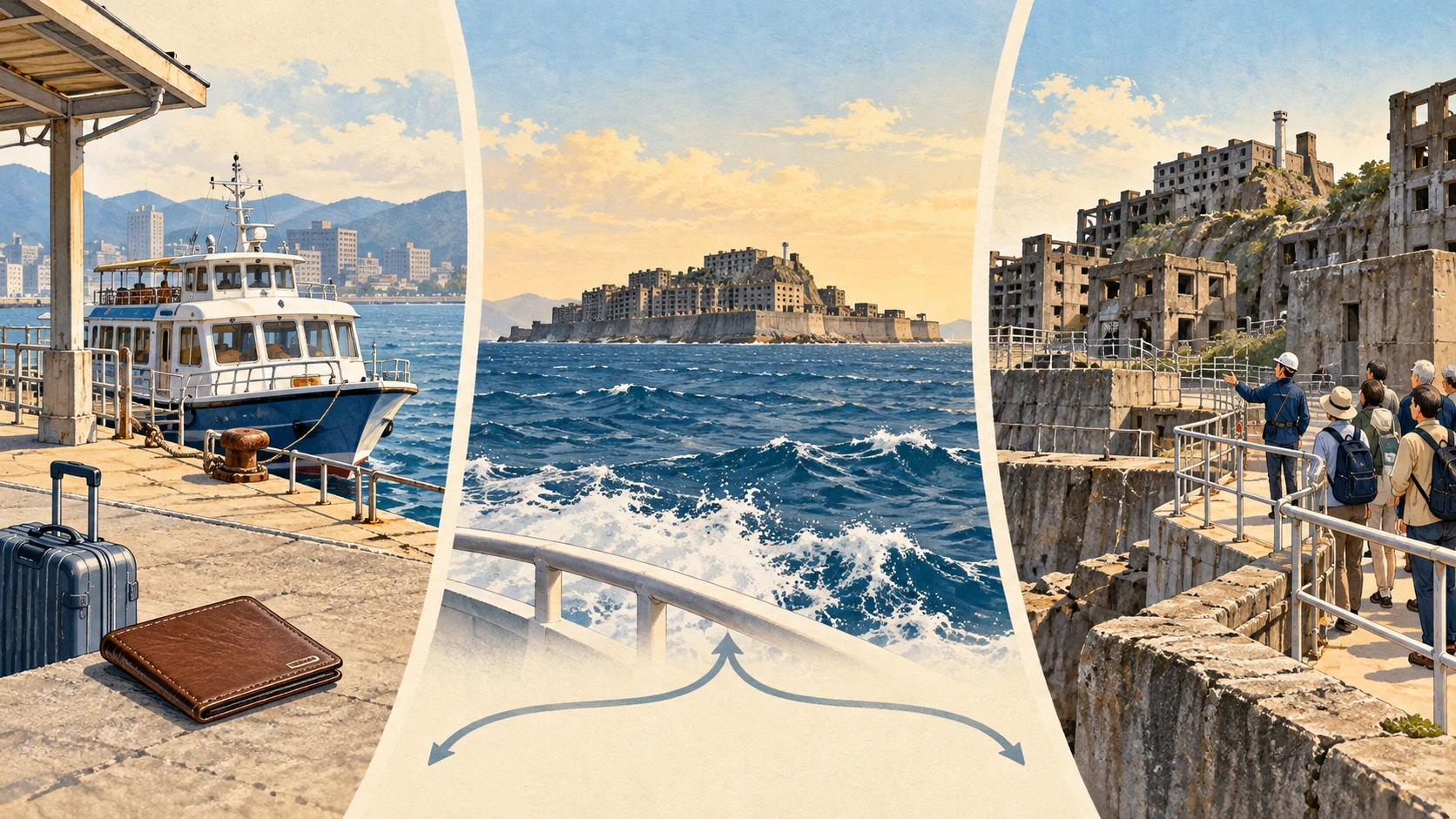
To understand why Gunkanjima merits half a day, use the city tourism introduction to Hashima and its visitor route. Visits follow guides along designated industrial-heritage viewing areas, without free access to residential ruins. People interested in the imagery but unwilling to cross open sea, or travelling with small children, may prefer land-based content such as the digital museum. Choose for your circumstances rather than judging the trip by a successful landing.
Yamasa Kaiun: earlier departure, with check-in at Nagasaki Port
Yamasa's current ordinary adult boat fare is 4700 plus the 650 Hashima facility fee, totalling 5350. Primary pupils pay 2350 plus 320, totalling 2670. Separate early-booking discounts exist, but this budget does not assume an unchecked entitlement. Yamasa Kaiun's prices and sailing table give 9:00 and 13:00 departures, expected returns at 11:30 and 15:30, about two and a half hours overall. Actual departure and arrival can change.
Morning reception begins at 8:15 and afternoon at 12:00. Complete checking, documents and payment at Yamasa's counter in the Nagasaki Port terminal before walking to Motofuna Pier No. 2. Departure time is not counter-arrival time, and another company's queue may lead to Tokiwa instead. Even a station or central hotel needs walking, crossings and finding the entrance included.
The individual cancellation table gives free cancellation 15 days before, 10% at 14–10 days, 20% at nine–five days, 30% from four days until 15:00 the previous day, 50% from 15:00 the previous day to sailing, and 100% after departure. The official until/from wording overlaps exactly at that 15:00 boundary. Ask the operator when reaching it rather than selecting the lower fee yourself. Particular products and channels need their own terms. Distinguish an operator's cancelled sailing from your withdrawal and retain the response.
Concierge: digital museum included, with a different meeting place
Concierge Standard adult weekday boat fare is 5500 plus 650, totalling 6150. On designated dates, such as weekends, holidays and listed vacation periods, the adult boat part is 6000, totalling 6650. Standard weekday primary pupils pay 3000 plus 320, totalling 3320, with different designated-day prices. The digital museum is included, unlike comparing boat fare alone. Upgraded seats have separate age and seating conditions, not a better guarantee of landing.
Concierge's published check-in sequence starts on the digital museum's first floor before moving to Tokiwa Pier. Its morning table gives departure around 10:30 and return around 13:05; afternoon around 13:40 and 16:10. Morning reception and museum visiting can start at 9:00, and afternoon passengers also have earlier check-in arrangements. Follow your booking confirmation rather than remembering only the departure hour.
General cancellation is free eight days ahead, 30% seven to two days ahead, and 100% the previous or same day. Online booking warns that personally cancelling after a switch to a sightseeing cruise can still incur fees. Read the pre-departure cancellation conditions before paying. When the company cancels for bad weather, follow its directions rather than cancelling in your account first and subsequently requesting an operator-cancellation refund.
Young children, sea conditions and landing rates: rules are company-specific
Yamasa allows preschool children aboard with a guardian but not ashore; they must remain on the boat with the accompanying adult. Concierge does not accept under-threes aboard and excludes preschool children from Premium and Super Premium. First decide whether your family accepts someone staying onboard, then select the product. A child ticket does not establish permission to land at every age.
Yamasa lists no-berthing conditions including wind above five metres per second, waves above 0.5 metres, and visibility of 500 metres or less. Even within those values, the captain may decline landing for safety. A calm harbour is not calm open sea. Historical landing rates relate to a past period and denominator; they do not translate into your booking's probability or a month-based guarantee.
The island has no toilets or drink sales; use the boat beforehand. Bring water, a raincoat and shoes securing the heel. An umbrella or parasol does not replace the safety need for available hands. With chronic illness, difficulty on steps or concern about motion, ask the operator about participation before paying, and discuss health and medicine with a suitable medical professional rather than deciding from a travel article.
No sailing, sightseeing only or sailing without landing: refunds differ
Yamasa's terms when landing is impossible describe returning the complete facility fee and 10% of boat fare for a switch to a sightseeing cruise. At the ordinary adult 4700, the boat difference is 470 plus 650, refunding 1120 and leaving 4230 boat fare. This excludes unverified early discounts; check the actual basis of a discounted order. Its FAQ gives a full refund for no sailing. These are not one universal promise of everything refunded without landing.
Concierge Standard weekday adult landing total is 6150 versus a table sightseeing price of 4500, a difference of 1650. Other ages, designated days and seat plans have their own tables. Use the published price differences when landing cannot happen. A credit card may receive a complete reversal and new cruise charge, or the adjusted charge directly. Statement timing depends on the issuer.
Once cancellation is confirmed, preserve the notice, order and company instructions to avoid duplicate cancellation. Withdrawing because you do not want a sightseeing cruise is not necessarily the operator cancelling the entire sailing. Insurance depends on the policy too. A boat refund does not automatically compensate hotels or other reservations, so keep day three's afternoon flexible without a chain of nonrefundable activities after the boat.
The boat-day branch: add just one city theme after returning
After reopening and when personal conditions suit, a morning boat preserves the afternoon for delays and rest. Yamasa's expected 11:30 return allows lunch followed by an unfinished Dejima or Minamiyamate visit. Concierge's 13:05 return should not simultaneously promise Shikairou entry before 14:00 and a full Glover Garden visit. Changing operator changes meal timing as well as price.
If landing is unavailable but the sightseeing boat operates, first accept the product as an exterior sea view and guided explanation, then decide whether to use your order. With complete cancellation, move the museum or Dejima into the morning and rest around Hamamachi and the Nakashima in the afternoon. Confirm whether your specific ticket includes the digital museum and any post-cancellation arrangement; it is not every company's free gift.
Avoid making the fourth day your first Gunkanjima attempt before a fixed flight or shinkansen. Even a seemingly adequate expected return is vulnerable to sea conditions, illness and collecting bags. If landing is impossible this trip, a substantive Nagasaki city day is reasonable. Book again from new notices another time instead of turning departure day into a chase for the boat.
Huis Ten Bosch from Nagasaki does not begin with travelling to Hakata
Huis Ten Bosch is in Sasebo. From Nagasaki Station, the park's rail page lists the rapid Seaside Liner to Huis Ten Bosch Station at about one and a half hours. Hakata is the origin for the Huis Ten Bosch limited express or a separate Haiki connection. Read the park's rail diagram for each starting city separately rather than imposing Hakata's transfer on every Nagasaki train. Direct service or a change depends on the JR search for your date.
An hour and a half each way means around three hours for the round trip, before hotel-to-station travel, waiting and park entry. Different official access entry points give roughly five to seven minutes from station to entrance; walking with children, tickets and inspection need margin. The opening time in a ticket system is not the time to leave your Nagasaki hotel, otherwise the morning may be gone before joining a favourite attraction's queue.
Check at least a main return and an earlier alternative, particularly the last tram or bus still reaching your accommodation. No last train here is asserted as a year-round constant. Weekends, events and timetable changes require current JR information. Without a suitable return after the night programme, stay near the park instead of assuming an improvised long-distance taxi will be available.
Huis Ten Bosch admission: compare 1DAY and After 3 by age
Current 1DAY Passport prices start at 7600 for adults aged 18+, 6600 for lower- and upper-secondary pupils, 5000 for primary pupils, 3800 for ages four to before primary school, and 5900 for ages 65+. Ages three and younger enter free. After 3 starts admission at 15:00 with corresponding starting prices of 5900, 5100, 3900, 3000 and 4700. These are starting amounts changing on designated dates, not one search-result number guaranteed at every checkout.
At ordinary starting prices, two adults, one primary pupil and a four-year-old give 1DAY 7600 × 2 + 5000 + 3800 = 24,000. After 3 gives 5900 × 2 + 3900 + 3000 = 18,700, a 5300 difference. The ages are identical, but cheaper admission omits the morning. Travelling specially from Nagasaki to stay only a few hours for that saving may not fit the family's purpose.
Before buying, use the official Passport and date-price entry point, preparing any age evidence required for senior or preschool rates. 1.5DAY and 2DAY are currently sold at the onsite counter, worth comparing when actually staying across days. Official-hotel guests should check next-day benefits before paying twice for an included day. Exchanging a third-party voucher depends on the order, rather than assuming every phone QR directly grants entry.
Changing a date is not unrestricted refunding: Passport and Express differ
The park's general explanation does not allow arbitrary cancellation or refunds after purchase. A separate date-change procedure applies to tickets bought from 28 June 2026: act at least three days before visiting, buy new tickets for a date on sale, then submit old and new purchase details. After confirmation, the old ticket is cancelled and refunded. The official date-change steps and exclusions are not a guarantee of last-minute changes for every channel and product. Check your ticket's eligibility before paying.
Express Pass and Optional Tickets are outside that procedure. The official Express explanation also says it cannot grant entry alone: a Passport remains necessary. Quantities are limited, with same-day sale only when stock remains. Choose the attractions that matter before buying reduced-wait access rather than assuming one Express means unlimited priority at every park facility.
When comparing Huis Ten Bosch discounts, match date, age, entry period and change conditions first. Two-for-one or channel-limited offers enter a budget only with applicable dates and checkout requirements verified; avoid unauthorised resale. If heavy rain would definitely stop your visit, decide before the change deadline. A sales page saying dates can change does not remove the need for a new purchase and supporting details.
Miffy is more than photographs: height first, then attractions
Miffy fans can make Miffy Wonder Square their daytime theme, selecting one or two attractions plus dining or shops without completing every queue. Miffy’s Dream Storybook combines a picture-book and visual experience, officially around 30 minutes excluding waiting. The Storybook attraction's official information does not guarantee suitability for every child; also follow its on-site restrictions.
Uncle Pilot’s Flight Adventure excludes heights below 90 cm, with a guardian aged 18+ required for riders below 120 cm. Miffy & Friends’ Yacht Sailing also excludes below 90 cm, additionally excludes under-threes, and requires an 18+ guardian for riders below 130 cm. Check the official Miffy area's participation criteria by attraction name. Their accompaniment heights differ; one cannot replace the other.
With a child too young, do not wait until the queue entrance to explain exclusion. Measure height beforehand, choose a theme everyone can share, then add activities caregivers take turns doing. Pregnancy, health, mobility and safety equipment may also restrict participation. Meeting height is not the only condition. Ask staff where necessary; Express does not waive safety requirements.
The park from day to night: leave meal times and check the actual programme
On a day trip from Nagasaki, complete the priority attraction first and seek lunch before restaurants have only their final operating minutes left. Slow the afternoon with streets, gardens or shops so children can rest, rather than treating every map district as compulsory. For European-style streets and illumination alone, After 3 has a purpose, accepting the lost morning.
Check nighttime content against the official schedule for your visit date and opening hours. Illumination, performances, fireworks and special viewing seats can have separate times or charges. A night photograph does not mean daily fireworks. In wind, rain or special events, check what is cancelled before changing order. Indoor attractions are not guaranteed queue-free either.
Before leaving, include toilets, collecting belongings and walking to the exit and station. If the latest show is too close to the last usable connection, choose an earlier performance or stay overnight. A theme-park day depends on more than admission: whether the family can sit down on the return and whether another transfer follows often affect it more.
Hotel Amsterdam: named rooms and next-day tickets do not mean universal free entry
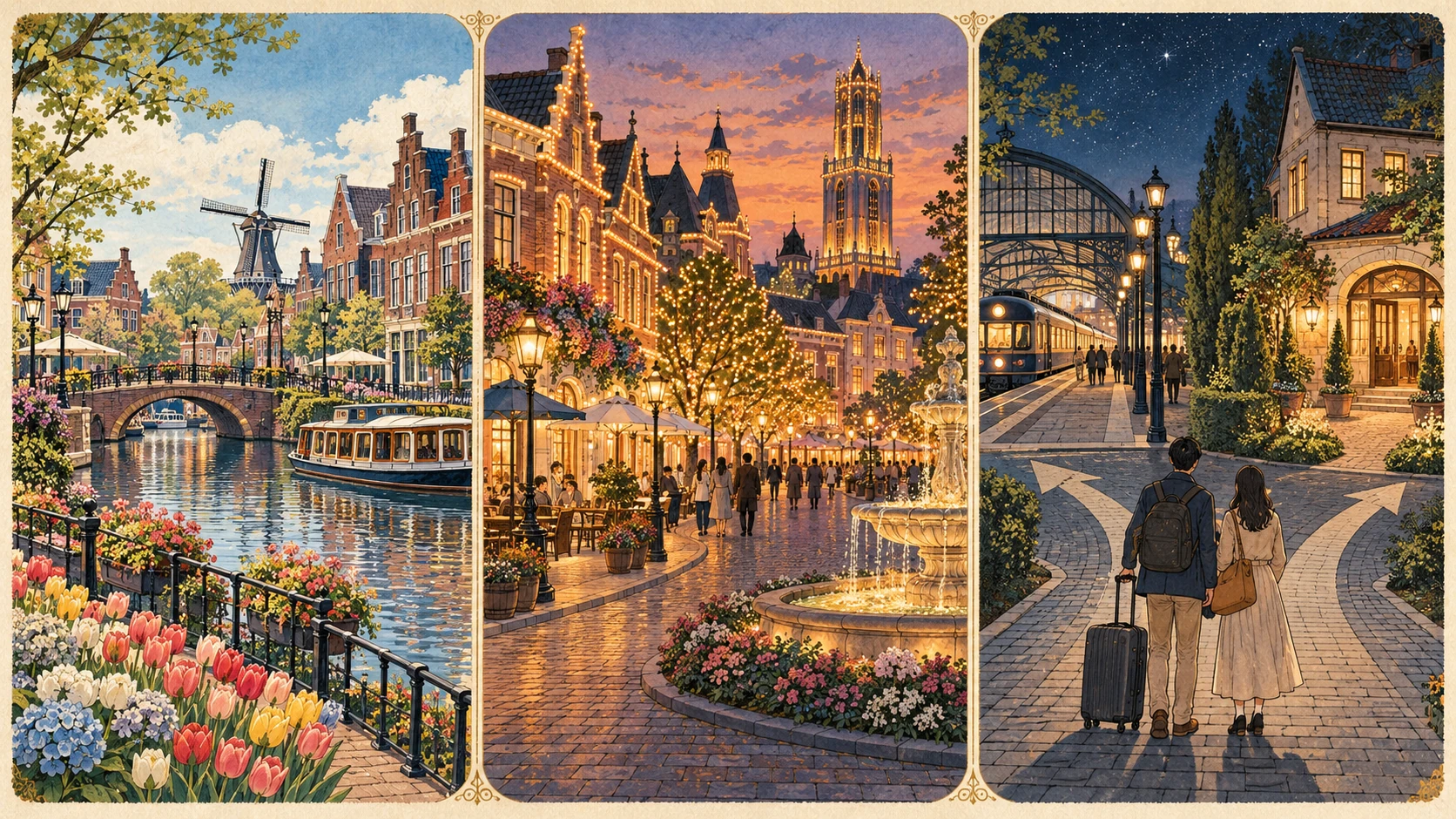
Hotel Amsterdam's Deluxe Designer Room Standard Twin is officially 45 m² with two beds 122 cm wide and 203 cm long, for one or two adults. The same-series Triple adds one 110 × 195 cm extra bed to the two main beds, and Four adds two. Match your order to the official category layouts. A 45 m² label does not turn the standard Twin into permitted accommodation for four adults.
The current five-official-hotel benefit first requires buying an eligible arrival-day 1DAY or After 3 Passport, then receiving subsequent qualifying next-day passports from the hotel. Initial entry is not automatically free for every guest. The hotel entry and bed-sharing conditions also limit children through Japanese primary school using existing bedding: one adult allows at most one sharing child; two or more adults allow at most two per room. Include every child rather than adding people by your own bed count.
The reason to stay is avoiding a rushed return to Nagasaki after night activities. If leaving early tomorrow, the next-day passport may have little practical value; its entire face value is not automatically a lodging discount. Direct airport transfers have specified hotels, room categories and reservations, so retain public transport until service is confirmed. Breakfast, first-day entry and special cancellation follow the actual plan, item by item.
The park-day branch: an overnight stay also changes day four
With three Nagasaki city nights, travel light on day three and check the return before deciding how late to stay. Prepare a small bag and rain gear the previous evening, leaving large luggage at the hotel rather than seeking storage on arrival. If reaching Nagasaki late, eat in the park or before leaving, without assuming famous city restaurants still admit guests.
For a last night at Amsterdam or another nearby hotel, change day three's city check-out, baggage movement and day four's departure together. The park's delivery service has reception and collection times; it does not send any suitcase anywhere at any hour. For a flight, establish airport transport compatibility before deciding whether to use tomorrow's Passport.
This does not suit returning into Nagasaki early on day four for the Atomic Bomb Museum before doubling back toward the airport or Hakata. Detours consume the return time saved by staying overnight. If reflecting on war and peace is the priority, finish it on day two; if the park is the main purpose, omit one or two city stops. Cutting around the main goal is more workable than keeping both complete lists.
Leaving on day four: keep the final stop near your bags
Write the required airport or station arrival first, then work backward through bag collection, reaching the stop and waiting. To add Megane Bridge, Hamamachi or Dejima, choose one by hotel location rather than crossing both Urakami and Minamiyamate after check-out. Rain-slowed walking, storage queues or full lunch restaurants can shrink a seemingly generous half-day.
If time is short, souvenirs and an unhurried lunch are easier than another paid attraction. Save what you truly wanted for another trip instead of spontaneously renting a car to link everything. Park overnight guests should also look onward from their actual base rather than using the central Nagasaki airport-bus timetable.
With only three calendar days, remove the large excursion or reduce Minamiyamate rather than compressing all four days unchanged. Both three-day and four-day, three-night plans can lose mornings or afternoons through flight timing. Count full usable Nagasaki periods before nonrefundable tickets. With late arrival and early departure, prioritise the two middle days especially carefully.
Rain, summer and winter: change order while preserving safety conditions
For rain, bring the museum, indoor Dejima exhibits and city dining forward. Dejima and Minamiyamate still require outdoor movement; nonslip shoes, rain protection and rest remain necessary. Gunkanjima depends on open-sea conditions, while Inasa depends on visibility and operating transport. Neither day's scenery can be inferred from sunny photographs.
In summer, allow water, shade and rest during hill walks, port waiting and open park areas rather than putting every outdoor activity at noon. Winter night views and harbour wind require adjustable clothing and earlier visits under winter closing hours. Seasonal flowers, Christmas and lantern festivals need that year's announcements. Past pictures explain a style without confirming the present season's dates.
If Nagasaki belongs to a Kyushu trip, first use season-by-season Japan days and accommodation planning for the overall direction, then choose the city segment. This guide answers four days in Nagasaki with two substitute excursions, rather than every Kyushu prefecture, flowering destination or onsen. Do not force Unzen or Kujukushima into the same day to make an itinerary appear to contain everything.
A budget you can recalculate: separate official costs from assumptions
First add city places you actually intend to enter. For one adult, Dejima 1100, Glover Garden 1300, Oura Church 1000, the museum 200 and Ropeway return 1900 total 5500. Subtract any omitted visit individually rather than making five admissions compulsory in everybody's minimum budget.
For city transport, illustrate one day pass at 600 plus two days with two ordinary rides each: 150 × 4 = 600, totalling 1200. City visits plus transport therefore give 6700. Add Yamasa's ordinary adult landing total 5350 to reach 12,050; substitute a Huis Ten Bosch adult 1DAY starting at 7600 to reach 14,300 or more. The branch difference is 2250 before round-trip JR travel to the park. Do not call that the complete difference between the two excursions.
Enter accommodation and food allowances you accept. Assume taxable lodging of 12,000 per person per night, three nights totalling 36,000. With all three in Nagasaki City through the 31 March 2027 stay night, tax is 200 × 3 = 600. Food at an assumed 4000 daily over four days gives 16,000. These are calculation inputs, not named-hotel or restaurant selling prices. The Gunkanjima version totals 12,050 + 36,000 + 600 + 16,000 = 64,650. With all three nights from 1 April 2027, that tax band becomes 300 × 3 = 900 and the total 64,950. Both exclude flights, intercity JR, airport buses, shopping and other spending. Across the change, calculate each night separately.
| Item | Calculation | Adjustment |
|---|---|---|
| Five city visits | 1100 + 1300 + 1000 + 200 + 1900 = 5500 | Subtract each attraction you omit |
| Illustrative city trams | 600 + 150 × 4 = 1200 | Recalculate actual rides and discounts |
| Gunkanjima excursion alternative | 4700 + 650 = 5350 | Confirm reopening and sea conditions; discounts and refunds separate |
| Huis Ten Bosch excursion alternative | Adult 1DAY from 7600 | Date-based prices; round-trip JR travel and extra tickets separate |
Reservation order: secure what cannot be repeated at any hour
Confirm arrival, departure and usable time, then accommodation with acceptable cancellation. Third comes Gunkanjima by reopening notices and companions' eligibility, or Huis Ten Bosch by date, children's height and return. Add restaurants requiring courses or private-room booking to an evening already established. Calculate tram passes from each day's routes rather than activating early merely to make everything look purchased.
Before departure, recheck boat-company messages, temporary attraction closures, night transport and park hours. Gather tickets, passenger lists and identification needed on site. Offline copies help find information, but valid electronic tickets still follow the official service; screenshots do not replace dynamic inspection. Late hotel arrival, final restaurant entry and bag collection also belong in the same itinerary.
For a first independent Japan trip, organise expenses with separating accommodation, transport and activities. To add an onsen ryokan night, read Japanese inn meal times, baths and cancellation, preserving a full additional night. A useful four-day Nagasaki result is knowing which day can move, which ticket has conditions and where to go when sailing is cancelled.
A few useful answers
Must four days and three nights in Nagasaki include both Gunkanjima and Huis Ten Bosch?
No. This guide allows two city days, one major excursion and departure margin. Gunkanjima and Huis Ten Bosch are alternative branches. To do both, reduce city stops or add days rather than putting them on the same day.
How much is the current Nagasaki tram day pass?
Adults pay 600 and primary pupils 300; ordinary fares are 150 and 80. Four independent ordinary adult rides break even and the fifth begins saving. IC discounts and eligible transfers need separate calculation.
Can I buy a paper day pass onboard?
No. Buy at an official outlet before boarding, or complete purchase and setup in a supported mobile service, following its inspection method.
How does a 24-hour ticket differ from a day pass?
The 24-hour ticket costs 700 for adults and 350 for primary pupils, counted from activation. A day pass is valid only on its day of use. Neither includes ordinary buses, Inasa's ascent transport or travel to Huis Ten Bosch.
How much is the airport bus into Nagasaki?
The current airport information gives one-way Shinchi Chinatown or Nagasaki-ekimae at 1400 for adults and 700 for primary pupils. Choose a route and stop for the hotel, checking timetable validity and allowing traffic margin.
Could visitors land on Gunkanjima on 22 October 2026?
Concierge announced on 21 October that typhoon-related handrail removal prevented landing from 22 October, without a restoration date. Check your specific company's latest notice before travel. A ticket on sale does not prove reopening.
Is Gunkanjima fully refunded if I do not land?
No sailing and switching to a sightseeing cruise differ. Yamasa lists the facility fee plus 10% of boat fare back for the latter; Concierge applies product-specific differences. Complete cancellation follows company instructions, while personally withdrawing can still incur fees.
Can young children join a Gunkanjima tour?
Company rules differ. Yamasa allows preschool children aboard with a guardian but not ashore. Concierge excludes under-threes aboard and has separate seat-class restrictions. Check each operator individually.
Are Mount Inasa's two transport tickets interchangeable?
They cover different routes. Ropeway links Fuchi-jinja and Inasadake, with general return 1900. Slope Car links mid-hill and summit, with adult return 1000. Reaching mid-hill is a separate transport cost.
Does After 3 suit a Huis Ten Bosch day trip from Nagasaki?
It admits after 15:00, starting at 5900 per adult, without 1DAY's morning. Rail takes around an hour and a half each way from Nagasaki. Check intended activities, date-specific programmes and return before deciding whether the difference is worthwhile.
Does Hotel Amsterdam remove the need to buy park admission?
Not automatically. The current next-day Passport benefit requires an eligible initial-day 1DAY or After 3 purchase and collection under hotel conditions. Check the room category, sharing children and included plan items separately.
Is Nagasaki accommodation tax based on the entire room price?
It uses taxable accommodation per person per night. Through the 31 March 2027 stay: below 10,000 is 100, 10,000 to below 20,000 is 200, and 20,000+ is 500. From 1 April: below 6000 is 100, 6000 to below 20,000 is 300, and 20,000+ is 500. Meals and consumption tax are excluded, related service charges included. Do not automatically apply Nagasaki City's rules to Sasebo.
Check with the source
Schedules, availability and rules can change. These official sources are the place to confirm details before you book.
- Nagasaki Airport | Bus routes and fares
- Nagasaki Airport | Current city-bound timetable
- JR Kyushu | Relay Kamome and Nishi Kyushu Shinkansen transfer
- Nagasaki Electric Tramway | Ordinary fares
- Nagasaki Electric Tramway | Day passes and sales
- Nagasaki Electric Tramway | Mobile tickets
- Nagasaki Electric Tramway | Transfer discount
- Nagasaki Electric Tramway | Routes and boarding PDF
- Dejima | Visiting information and reconstructed district
- Nagasaki tourism | Megane Bridge accessibility
- Atomic Bomb Museum | April 2026 admission revision
- Atomic Bomb Museum | Visiting hours and rules
- Glover Garden | Admission, hours and garden access
- Oura Church | Prices, seasonal hours and etiquette
- Shikairou | October 2026 operating notice
- Nagasaki Shippoku Hamakatsu | Main restaurant information
- Inasayama Park | Ropeway
- Inasayama Park | Slope Car
- Nagasaki tourism | Official Inasayama bus vlog
- Dormy Inn PREMIUM Nagasaki-ekimae | Rooms
- Dormy Inn PREMIUM Nagasaki-ekimae | Access
- Dormy Inn PREMIUM Nagasaki-ekimae | Public baths
- Dormy Inn | Questions and child charges
- Hotel JAL City Nagasaki | Named rooms
- Hotel JAL City Nagasaki | Access, bed sharing, cancellation and laundry
- Inasayama Kanko Hotel | Official site
- Nagasaki City | Current accommodation tax and April 2027 bands
- Nagasaki City | Tax base and multilingual PDF
- Gunkanjima Concierge | Latest notices and prices
- Yamasa Kaiun | Prices, times, landing and cancellation
- Gunkanjima Concierge | Check-in and times
- Gunkanjima Concierge | Cancellation and no-landing differences
- Nagasaki tourism | Gunkanjima guides and designated viewing areas
- Huis Ten Bosch | Official Passport prices
- Huis Ten Bosch | Official English Passport prices and purchase rules
- Huis Ten Bosch | Rail access
- Huis Ten Bosch | Date changes for purchases from 28 June 2026
- Huis Ten Bosch | Express Pass scope and restrictions
- Huis Ten Bosch | Miffy Wonder Square participation criteria
- Huis Ten Bosch | Miffy’s Dream Storybook
- Huis Ten Bosch | Daily programme schedule
- Hotel Amsterdam | Deluxe Designer Room Standard
- Huis Ten Bosch | Hotel benefits and entry conditions
- Nagasaki tourism | Official video library
- Nagasaki Airport | Access guide and indicative travel time