Choose where you return each day and where you take lessons before buying lift tickets. This guide compares Hakuba, Nozawa, Shiga and Myoko in Niigata, travelling through Nagano. It brings actual room layouts, child categories, transport and bathing rules into one decision, with city and onsen rest days for companions who do not ski. For piste choices, start with the three-resort Hakuba ability comparison, Nozawa ascent and Skyline choices or Shiga areas and connections. Accommodation, transport and ticket conditions must still work together; a piste name alone is not a reason to change bases.
Choose where you return each day: Hakuba, Nozawa, Shiga or Myoko
For a ski trip through Nagano, consider whether accommodation, lessons, equipment collection and meals fit into one workable day. The number of resorts matters less. Hakuba suits travellers who want several resorts to choose from and will research village transport. Nozawa suits those who want skiing, dinner and public baths within one village. Shiga suits several consecutive days in the mountains with hotel life in the evenings. In Myoko, choose Akakura or one resort as your base, then plan any changes. Myoko is in Niigata Prefecture; it appears here because you can connect from Nagano, not because it belongs to Nagano Prefecture.
Beginners should find a lesson offered in a language they understand and suited to their age and ability before choosing accommodation. Skiers who can manage independently can put piste connections, mountain access and multi-resort ticket prices earlier in the decision. For non-skiing companions, village life in Nozawa or Nagano city is usually easier to arrange than staying only at a resort entrance. A well-equipped mountain hotel can still be better for someone who enjoys reading, meals and time in the room. These are choices about how a trip works, rather than a ranking for everyone.
The official information below was read on October 22, 2026. Start with your preferred base, then read the accommodation-tax, seasonal and cancellation sections. New-season lift prices, winter buses and lessons are not necessarily announced together. Confirmed new-season terms are separated from information still awaiting an update: a page available this year does not establish a service for your travel date.
| Base | A suitable arrangement | Check before booking |
|---|---|---|
| Hakuba | Flexibility to change resorts, with village transport planned | Main ski area, lesson meeting point and transfers both ways |
| Nozawa Onsen | Stay in one village for skiing, dinner and public baths | Village slopes and equipment collection or meeting at Nagasaka versus Hikage |
| Shiga Kogen | Several days skiing in the mountains and resting at the hotel | Exact area, meal service and each companion's route back to the room |
| Myoko Kogen, Niigata | Base yourself in Akakura or at one resort, then plan changes | Four-resort ticket rights, inter-resort buses and hotel pickups |
From Nagano into the mountains: map the final connection first
The four directions need different transport plans. For Hakuba, check the express bus from Nagano Station's East Exit and whether your stop is Hakuba Station, Happo Bus Terminal or somewhere else. For Nozawa, the usual connection is the Hokuriku Shinkansen to Iiyama, then the Nozawa Onsen Liner. For Shiga, check the express bus from Nagano's East Exit, or Nagano Dentetsu to Yudanaka followed by a mountain bus. For Myoko, take Shinano Railway's Kita-Shinano Line from Nagano to Myoko-Kogen, then a local bus or accommodation pickup. Myoko-Kogen Station and the Shinkansen's Joetsumyoko Station are different stations despite the similar names.
The official ALPICO Nagano–Hakuba page still showed its April 1–November 30, 2026 spring-to-autumn timetable at this check. The Nagaden winter express page still covered December 6, 2025–April 6, 2026. Neither establishes a tight connection for January 2027. Use the route to check the direction of your accommodation, then fix train, pickup and dinner arrangements when the relevant winter timetable is published.
Allow separately for getting off, collecting luggage, finding the pickup point and checking in. An on-time Shinkansen does not guarantee a seat on the mountain bus or punctual snowy roads. On a first trip with ski equipment, consider a first night near Nagano Station and travelling into the mountains in daylight the next day. If using a rail pass, check local railway and bus coverage separately: departing from a JR station does not make a service covered by a JR pass. The Japan rail-pass comparison method can help you check each leg before buying.
Nagano Station or Zenkoji: easy transfers and early temple visits are different stays
For an early mountain bus, the area around Nagano Station makes supplies, luggage storage and meeting points easiest to arrange. Staying near Zenkoji instead gives more time to morning walks and temple activities, but adds the trip back to the station. Do not judge a hotel only by its straight-line distance from the station. East Exit buses and the Zenkoji Exit are on different sides, and crossing the station with ski bags takes time. In rain or snow, check the hotel entrance and elevator locations in advance.
Hotel Metropolitan Nagano's regular-room overview lists the Standard Twin at 25 square metres, for two people, with beds 120 centimetres wide. The Superior Twin is 30 square metres and is also listed for two. Two adults with two children who each need a bed cannot assume that a twin room accommodates four. If you need an extra bed, choose a room and rate that actually accept three guests in the booking system; a sofa in a photograph is not evidence of an additional bed.
A station hotel suits a late arrival, departure for the mountains the next morning or sorting luggage before going home. For a stay built around a temple visit, see Zenkoji's official temple-lodging introduction. Meals, bathrooms, curfews and morning services differ between temple lodgings. Do not expect business-hotel habits of late arrival and late departure to apply. With only one night before an early connection, decide how much travel time you want to devote to the morning activity.
For a stay built around early worship, ask Fuchinobo, a Zenkoji temple lodging. Its overnight package with dinner and breakfast accepts solo guests, provides lockable private rooms and serves shojin vegetarian cuisine for dinner. The named Kiku/Matsu (菊・松) rooms in its rate table accommodate at most two; do not match those names yourself to photographs of seven- or eight-tatami rooms or special rooms. Western-style beds may be requested, but numbers are limited. Confirm the size, bedding count and private or shared bathroom and toilet arrangements for Kiku or Matsu individually. The lodging also lists bathing facilities, and guests who need private use for particular reasons must ask in advance. A lockable bedroom does not establish a private bath.
Fuchinobo’s sample schedule starts with check-in from 15:00, bathing and a shojin dinner, followed the next morning by worship, breakfast back at the lodging and check-out by 10:00. The summer 5:30 and winter 7:00 times are departures from the lodging in that example, not fixed year-round starting times for the main hall’s morning service. Its morning-service explanation also says times vary seasonally. Confirm the day’s meeting time, arrangements and fees, latest arrival for dinner and curfew when booking. The access page directs you from bus stand 1 at Nagano Station’s Zenkoji Exit toward Zenkoji, then about 30 metres on foot after alighting at Zenkoji Daimon. The rate table charges per person and includes the room charge; confirm the total for your date, meals and taxes rather than applying the temple-lodging association’s general rate to this property.
If you want the sleeping arrangements and shared-bathing rules clear before choosing a temple lodging, compare Yakuoin, another Zenkoji shukubo. Its “Superior Japanese-style Room” listed on Rakuten is a ground-floor (Japanese 1F), 15-tatami room for one to five registered guests. The listing explicitly provides futon bedding for the number of guests, with shared bathing facilities and toilets. Two adults registered to stay can plan for two guests’ futon bedding, not two fixed beds. This category does not suit anyone requiring an in-room bathroom or toilet. That platform’s product listing also warns that bathing times may be allocated according to guest numbers on the day. Seeing a family bath listed does not guarantee exclusive private use.
The same page’s basic dinner-and-breakfast package lists shojin cuisine, dinner from 18:00 to 20:00 and breakfast from 7:30 to 9:00. Tell the lodging in advance if you want to attend morning worship. The accredited guide charges no guiding fee, but admission tickets must be bought separately. The same platform’s check-in rules list arrival from 15:00, final check-in at 19:00, check-out at 10:00 and a 21:00 curfew. Contact the lodging before arriving later than your stated time. The 19:00 limit is general final check-in; the page does not separately specify the latest arrival for guests having dinner, so dinner cannot be guaranteed if you arrive at 19:00. For a two-meal booking, plan to arrive before 18:00 and confirm your reservation’s arrangements for dinner if arrival is delayed. This is planning advice for eating on time, not another deadline imposed by the lodging.
For a small inn at Zenkoji’s approach, compare Matsuya Ryokan (地蔵館), which has 11 guest rooms. Its eight-tatami Japanese room is about 13 square metres, accommodates four and lists an in-room bath, shower and warm-water cleansing toilet. Confirm the actual bedding for four; capacity does not mean four fixed beds. A six-tatami room also accepts one guest and has a toilet but uses shared bathing facilities. Do not transfer the eight-tatami room’s private bath to that category. The inn also has separate men’s and women’s communal baths. Whether you accept shared bathing is a more useful room filter than the property name alone.
Matsuya offers dinner-and-breakfast or breakfast-only packages for the eight-tatami room. Its meal information describes a Japanese kaiseki dinner and Japanese breakfast with coffee, with seasonal changes. Check-in starts at 14:00 and ends at 21:00, but guests booking dinner must arrive by 19:00; check-out is by 10:00. The 21:00 arrival limit does not extend dinner service. The access page gives bus stand 1 at the Zenkoji Exit to Zenkoji Daimon, then about five minutes walking toward the temple. Nakamise is a pedestrian street, so drivers approach from the back street. Request a quote stating dates, adult and child numbers, meals, per-person or per-room units, taxes and cancellation terms. Few rooms do not by themselves establish a lower price than a station hotel.
Zenkoji in autumn: separate daytime worship from Omotesando lights
An autumn visit to Nagano does not need to wait for ski resorts to open. Walk the approach to Zenkoji in daylight and leave time around the main hall and seasonal scenery. Leaf colour changes with temperature; no particular date guarantees peak foliage. Zenkoji's current worship tickets cost JPY 800 for ordinary admission to the main hall's inner sanctuary and Kaidan passage, or JPY 1,500 for the three-hall and history-museum combination. The inner sanctuary closes at 16:15 in November and 16:00 from December through February, with additional year-end exceptions. Finish indoor visits in daylight before dinner and evening scenery.
Nagano city's announced Zenkoji Omotesando illuminations run November 14, 2026–February 14, 2027, from 17:00 to 22:00, between the intersection in front of Nagano Station and the Zenkoji intersection. This does not mean the main hall opens every night or that an entire autumn-leaf garden is illuminated. A separate purple lighting of the main hall is scheduled for November 21, 2026, 17:30–20:15, for the campaign to eliminate violence against women. That single event is not an autumn-long sightseeing illumination.
For a half day, arrive around noon, leave luggage, visit in daylight, eat near the temple, then walk back along a chosen part of the illuminated approach. If walking is difficult, the temple's access page directs visitors from bus stand 1 at Nagano Station's Zenkoji Exit toward Zenkoji. You still walk from Zenkoji Daimon to the main hall. Shorten the evening walk on slippery surfaces rather than missing the last part of your transport for the sake of seeing every light.
The Kaidan visit centres on experiencing darkness, not climbing to a viewpoint or viewing indoor exhibits. Zenkoji's official explanation describes a completely dark passage beneath the principal image, where visitors feel for the 'key to paradise'; touching it symbolises a connection with the image. If you fear darkness or cannot comfortably walk slowly without light, keep the inner-sanctuary and temple-ground visit without forcing yourself into the corridor because you bought a ticket. The wheelchair guidance confirms a ramp on the east side of the main hall, but does not establish that the underground passage is accessible. Ask the temple whether suitable assistance is possible; access to the main hall does not establish identical access to every worship route.
Togakushi's Kagamiike is better given a separate hiking day than treated as another stop on Zenkoji's approach. Nagano's official tourism information places it in Togakushi at about 1,200 metres above sea level. Even after reaching Kagamiike Iriguchi bus stop, the walk is about forty minutes each way. Spring-to-autumn transport in 2026 is divided among a reservation-only sightseeing express, route 70 and a local connecting bus. Take the sightseeing express from Nagano to Togakushi Chusha, then the Togakushi sightseeing connecting bus to Kagamiike Iriguchi. The planned April 1–December 4 timetable lists Chusha 9:22–Kagamiike Iriguchi 9:23 and the return Kagamiike Iriguchi 13:56–Chusha 13:57 as examples for that short local leg. Seats and connections between Nagano and Chusha need separate planning. Choose both return buses to Nagano before deciding how long to stay by the pond. The bus stop is not the pond, and the discontinued route 73 and old one-day pass should not be reused.
Drivers also need a seasonal route. The 2026 autumn notice permits entry to the roads around Kagamiike only from the Hokosha side on October 10–November 3, 9:30–16:00; entry from the Chusha and Okusha sides is prohibited. No additional temporary autumn shuttle is provided, which does not mean the regular connecting bus above has stopped. Winter is a different undertaking from an easy walk. The official attraction page notes winter road closure, and the 2025–26 winter equipment notice says the snowy Kagamiike road is not cleared, vehicles may not enter, and snowshoes or similar winter-hiking equipment are needed. Everyday clothes and snow boots alone are insufficient. The previous season's usual December-to-late-April range is not a confirmed closure period for 2026–27; check the new-season notice for exact dates. If daytime Zenkoji and the evening approach are your priorities, retain a city half day and move Kagamiike to another day when you can accept the return transport and walk. After skiing in winter, choose city worship or a bath day first.
Yudanaka and Shibu Onsen: a bath-day base, rather than Shiga's piste entrance
Yudanaka has the Nagano Dentetsu terminus, making it useful for a rail arrival, ryokan pickup and rest day. Shibu Onsen centres on its hot-spring streets and public baths, with luggage usually requiring another transfer from the station to the inn. Neither should be treated as ski-in/ski-out accommodation for Shiga Kogen. For daily skiing, check the uphill bus, downhill service, hire returns and ryokan dinner together. If you want one ski day and other days for baths and walks, staying below the mountain can make a more coherent holiday.
For Shibu's streets and a bath in your room, compare Kokuya's '[Ume] Standard Japanese-style Room with Open-Air Bath'. The official booking page lists one to four guests and an open-air room bath. It is a Japanese-style room without a stated fixed number of Western beds; confirm bedding for each guest. Do not confuse it with a Standard room in the same inn without an open-air bath. The official room information also warns that requests for a particular individual room may not be accommodated.
The same Japanese-style open-air-bath room is offered under separate 'Breakfast + Dinner Included plan' and 'Breakfast Included plan' groups, so dinner depends on the rate you actually choose. Kokuya's free Yudanaka Station pickup starts at 15:00 and requires advance notice of your train's arrival time. This is a station-to-inn service, not an established daily transfer to Shiga's ski areas. For dinner at the inn, the website lists 19:00 as the latest starting time; contact the inn if arriving late. It suits combining a rail arrival, a walk around the hot-spring streets and dinner at the ryokan on the same day.
Shibu Onsen's official day-bathing rules distinguish the nine-bath circuit for staying guests from day admission. Non-staying visitors can use only bath number nine, Shibu Oyu, from 10:00 to 17:00, at JPY 800 for adults or JPY 500 for children, subject to temporary closure. First buy a bathing ticket at the Shibu Onsen tourist information office or an officially listed selling inn such as Kanaguya or Katei. Then show it at a designated unlocking location such as Komatsuya Shoten, Matsuya or Katei and ask staff to open the door. You cannot simply pay coins at the bath or open it yourself with a ticket. Staff may be absent at particular places and times; ask where assistance is currently available when buying, rather than treating 17:00 as a guarantee of immediate entry. Hair washing is prohibited, and shampoo and body wash are not provided. An ordinary bath ticket does not admit you to the other eight baths. If staying locally, confirm whether the inn supplies an external-bath key and when to return it. A ryokan's communal bath, a room bath and the village public baths are different facilities.
Jigokudani Monkey Park can fit this rest day, but is not an indoor attraction beside a bus stop. The park's access guidance requires the trail from the Kanbayashi Onsen side; the forest road through Shibu Onsen to Jigokudani's parking area closes in winter. With children, older relatives or tired legs after skiing, allow for the return walk and icy surfaces. The monkeys are wild, so an itinerary should not promise a particular bathing scene on every visit.
Where in Hakuba: Happo, Wadano, Echoland and Goryu solve different problems
Hakuba is a collection of resorts and accommodation areas. If skiing mainly at Happo-One, check the actual route around Happo Bus Terminal, Nakiyama or Sakka. For a quieter hotel setting among trees, compare Wadano, while checking gradients and the resort entrance. For dinner choices, look around Echoland, then verify daily transport to your lesson meeting point. If Goryu and 47 are your main areas, compare Goryu's base first; more search results for Happo are no reason to cross the village from there every day.
For Tsugaike, Norikura or Cortina, the word 'Hakuba' is equally insufficient for choosing a room. Accommodation can be close to one resort and far from an instructor meeting point at another. The ten resorts covered by the Hakuba Valley pass are not all connected directly by pistes. Read the Hakuba Valley shuttle page alongside resort maps. Check which side of the hotel has the stop, whether you change buses between resorts and what backup remains after missing a return service.
Write 'Where is the first day's lesson?' at the top of your accommodation notes. If family members have different abilities, stay where a beginner can return to the room independently, leaving stronger skiers to make the resort transfers. This is usually easier on everyone than early starts and waiting together for inter-resort buses. Ask whether 'beside the resort' means beside a lift, piste or road: someone who cannot ski independently may be unable to use a ski-in/ski-out return route.
Choose one Hakuba resort according to whether you can stop, turn and return to the meeting point independently. The table uses each operator's piste grades. Beginner does not mean suitable for every person on ice, in poor visibility or when tired, and matching colours at different resorts do not establish identical difficulty. The school still chooses the first lesson's teaching area. Experienced skiers can compare pistes and transport before changing resorts; buying an all-area pass is not a reason to take beginners across areas.
Happo-One's official piste introduction and map identify Sakka at the base as a beginner practice area. The areas around the Sakka No. 2 and No. 3 lifts can pair with lessons there, allowing repeated practice without entering Usagidaira merely for the mountain view. Once skiing independently, consider the intermediate Panorama area. Usagidaira and Kurobishi's well-known moguls and steeper routes are a different proposition: the operator grades Usagidaira advanced, so reachability from a lift station does not make it a beginner teaching area. Purple closed areas and closed pistes on the Happo map must not be entered, even within the resort's managed boundary.
Tsugaike's official introduction places the broad, gentle beginner Kane-no-naru-oka area at the base, suitable for families giving the day to basic practice. Upper routes such as Tsuganomori and Shirakaba are intermediate; the whole resort is not equivalent to Kane-no-naru-oka. At Goryu, pair Iimori's beginner Merry Land or Soft Cream piste with equipment hire and the meeting point in that area. If moving up to Alps Daira Panorama after gaining basic skills, plan the descent first. Goryu's patrol guidance explicitly says ski-down routes from Alps Daira to the base are intermediate or higher, with no beginner bypass. Beginners can follow instructions to ride the Telecabin down instead of forcing a ski descent to the hotel. Goryu and 47 connect higher up, but you still need a workable return and valid ticket rights.
The official Happo download currently available is the 2025–26 edition; Tsugaike's download is still marked 2024–25, and Goryu's filename says 2025. They help explain piste locations and grades, not prove that every route will open on a day in 2026–27. Tsugaike's prohibited areas and separately conditioned DBD area, and Goryu's registration-required Tree Riding Zone, are not ordinary-piste shortcuts. All practice and area-change suggestions here are restricted to managed routes open that day and used under the rules on site.
Beyond the three main options above, changing resorts should serve a specific purpose. Hakuba Valley’s official overview distinguishes basic practice at Jigatake, children’s snow play at Kashimayari, gentle-to-intermediate cruising at Sanosaka, terrain parks at 47, and the different choices at Iwatake, Norikura and Cortina. The table organises them by daily-life and skiing functions; it does not ask you to visit every direction. Official slope proportions guarantee neither personal suitability nor opening on your visit. Fix your intended area, equipment counter and route back to your accommodation before deciding whether a resort change deserves a day.
At Iwatake, separate summit practice from the return to the village. The official trail table lists summit East at Level 1 and Village Side’s SunnyValley at Level 5, with a maximum gradient of 24 degrees. These are the resort’s own numbers, not a conversion to universal beginner, intermediate and advanced grades. Riding up for the view does not mean you can ski the descent back to your hotel. Check downhill gondola ticket rights and the last service separately. Norikura’s official guide grades Family and Wakaguri Forest as beginner, but the Wakaguri–Satomi connecting route as intermediate. Beginners can remain in one teaching area rather than planning two beginner zones as a compulsory through-route.
For 47, compare named routes too. The joint Goryu and 47 trail guide grades R-5, R-6, R-7 and R-8 as beginner, R-1 and R-4 as intermediate, and R-2 and R-3 as advanced. The joint map places R-5 and R-6 partway up the mountain; finding one beginner run does not establish a suitable ascent and descent throughout. Before changing to 47 or Cortina, obtain a usable return route or road transfer for that day and ensure you can get back to the original rental shop and accommodation. If you cannot confirm it, stay in your main ski area. Cortina’s tree skiing and ungroomed terrain are reasons for appropriately skilled skiers to compare it. A beginner-area proportion in the official overview does not make tree routes or areas beyond ropes compulsory beginner terrain. This guide still concerns managed areas open that day.
| Resort and starting area | Beginners or basic practice | Differences and return after gaining ability |
|---|---|---|
| Happo-One: around Sakka | Pair lessons with beginner practice around Sakka No. 2 and No. 3 lifts | Compare intermediate Panorama separately from Usagidaira and Kurobishi moguls or steep terrain; going high is optional |
| Tsugaike: Kane-no-naru-oka base | Broad, gentle beginner area for repeated practice in one place | Tsuganomori and Shirakaba are intermediate; check the open return to the base before ascending |
| Goryu: Iimori or Toomi | Iimori's beginner Merry Land and Soft Cream routes; choose equipment hire around the meeting point | Consider Alps Daira Panorama separately; ski-down routes are intermediate or higher, while beginners can take the Telecabin down |
| Jigatake | A wide, gentle main slope with good sightlines for repeated basic practice; officially 70% beginner terrain | Match the teaching area and return transport; a high proportion does not make every run or snow condition suitable |
| Kashimayari Family Park | Children’s snow play, conveyor lifts and tubing offer a different day from ski practice alone | Check activity ages, ticket rights and opening separately; the resort also has intermediate and advanced runs |
| Sanosaka | Gentle-to-intermediate cruising and views of Lake Aoki give a specific reason to change resorts | A smaller area does not establish fewer people or lower prices; check both journeys from your accommodation |
| Hakuba47 | Compare it for terrain-park goals; upper connection to Goryu and a shared ticket | R-5 through R-8 are beginner graded but still need a return plan; ticket rights do not guarantee opening or a safe return to the rental counter |
| Iwatake | Wide, gentle summit terrain can be considered alongside scenic time for non-skiers | East is Level 1; SunnyValley is Level 5 with a maximum 24°; confirm gondola downhill rights and hours |
| Norikura | Choose named beginner areas such as Family or Wakaguri Forest and lessons in that area | The Wakaguri–Satomi connector is intermediate; do not require beginners to cross it between practice areas |
| Cortina | Compare its tree skiing and ungroomed terrain only with the relevant ability and purpose | The beginner proportion does not establish suitable tree routes or a return; check managed open routes and a backup to your accommodation |
Happo-One lift tickets: one resort or all areas, then each child's age
Happo-One's official 2026–27 prices define the main season as December 19, 2026–March 22, 2027. A day costs JPY 9,800 for adults aged 18–64 or JPY 4,900 for children aged 6–17. The main-season one-day Happo Debut Ticket, for designated base-area lifts, is JPY 4,900 for adults or JPY 2,450 for children. It is not an all-mountain ticket; only the listed lifts in areas including Nakiyama, Shirakaba and Sakka are covered. Ask the school which lifts a lesson uses before choosing a ticket.
The Hakuba Valley all-area day pass for 2026–27 costs JPY 11,100 for adults or JPY 6,400 for children, including consumption tax. Here, adults are aged 13 and over and children 6–12. For two adults and a 15-year-old skiing one main-season day at Happo, resort tickets total JPY 24,500, versus JPY 33,300 for the all-area pass: a JPY 8,800 difference. The latter buys resort-changing flexibility and qualifying daytime shuttle use; it is not better value for every family.
An all-area two-day pass allows two chosen days within four days of first use; a three-day pass allows three within six. Using only the Hakuba Valley Shuttle still consumes a day. Night skiing and night shuttles are excluded. New purchases need collection by the specified method. An old card recharged with a pass must first be activated at a lift gate before the relevant free shuttle benefit applies; an unactivated card is not a free ticket for your first journey into the mountains. At this check, the website expected new-season all-area day passes to go on sale around November. Published prices do not mean every product can already be ordered. The Japanese-resident My Number discount has separate eligibility and is not the ordinary visitor price.
Hakuba equipment and lessons: the meeting point matters more than the resort name
Goryu's direct hire page places GORYU RENTALS on level 2F of Escal Plaza (Japanese floor numbering) and IIMORI RENTALS at Iimori Base Center. These are different counters. If a lesson meets at Iimori, establish where you try boots, collect skis, store items and return equipment before booking, rather than discovering you must carry gear across areas in ski boots. Check each package for skis or a snowboard, boots, poles, clothing and a helmet. Gloves and goggles are not necessarily available to rent.
Use the official school directory for Happo and other Hakuba resorts, then confirm language, meeting point, skiing versus snowboarding, minimum child age and whether complete beginners are accepted. For example, the listed Happo-One Ski & Snowboard School provides English, Chinese and French only for private lessons; group lessons are in Japanese. A Chinese-speaking instructor does not establish Chinese instruction for every lesson format. Lesson fees do not automatically include passes or equipment. A family with snowboarders, skiers and a young child should not assume it fits one group class. Have the school confirm groups before booking compatible accommodation and transport; this avoids buying a cheap time slot you cannot use.
When changing resorts during a Hakuba stay, include a hire provider's storage and size-change terms in the decision, but obtain explicit approval for returning gear to a different branch. Leave space after the final run for equipment return, changing boots and waiting for transport. Lift suspension or strong wind can also prevent returning by the route you planned. Knowing the first and last workable actions of each day is more useful than filling every hour with piste names.
Named Hakuba rooms: a third bed and space for four are separate questions
Hakuba Tokyu Hotel's Standard Twin is 30–34 square metres for one to three guests, with two 120 × 200-centimetre beds and a 105 × 195-centimetre extra bed for the third person. It faces the east-side entrance and parking area; a Northern Alps view is not guaranteed. Three adults can compare a room that genuinely supplies a third bed. Four guests needing beds should check a room with four-person occupancy or two rooms, rather than extending the stated extra-bed limit.
The hotel's room overview lists the Deluxe Twin at 39–41 square metres for one to four guests. With two children, confirm which beds are added for four occupants and how much walking space remains with luggage open. Transfers still matter: the hotel lists about three minutes by its pickup vehicle from Happo Bus Terminal, not a vehicle available for every arrival. Give your service, passenger count and number of ski bags when reserving. Confirm pickup before removing taxis from the budget.
For a shared family living room and kitchen, compare Hakuba Brownie Cottage's A/D buildings separately from a four-person hotel room. Each is a 64-square-metre detached 2LDK cottage; A/D are single-storey, for two to five people. The official plan shows two bedrooms with three beds and two beds respectively, plus one bathroom, a separate toilet, kitchen and living/dining room. B/C/E/F are two-level layouts with a loft, for two to seven guests. Do not mix their stairs and bed arrangements with those of A/D.
A whole cottage suits people willing to shop, cook and clear up after meals. Food may be brought in; a refrigerator, microwave, rice cooker, cookware and tableware are provided, but bring condiments, sleepwear and other personal items. A kitchen does not mean breakfast or dinner is included. The page also lists a JPY 4,000 facility fee per building per night, including heating and cooling; check it alongside the actual accommodation rate when calculating the total. The access page says pickups for bus or rail arrivals can be arranged in advance. Its ski-transport introduction does not give a complete 2026–27 service period, so obtain the meeting point and times for your dates before deciding whether a hire car is necessary.
Compare Hakuba hotel prices for the same dates, guest count, meals and cancellation terms. A breakfast rate can suit two experienced skiers, but children with early lessons also need a workable breakfast starting time. Dinner packages reduce outings on snowy nights; travellers wanting a different village restaurant each evening may pay for meals they do not use. Once the configuration is clear, check the actual total for your dates under matching conditions. An advertised starting price need not apply to your party or dates.
The Hakuba Tokyu Standard Twin described above can also be compared with the hotel’s communal bathing. Its official bath page lists separate men’s and women’s indoor and open-air baths using natural Hakuba Happo onsen water. This does not establish hot-spring water in the Standard Twin’s bathroom or a private in-room onsen. Listed hours are 5:00–11:00 and 13:00–25:00 (1:00 the next morning), with cleaning from 11:00 to 13:00; snowfall may close the open-air baths. Ask whether guest use costs extra or is included in your package. Do not apply day visitors’ admission hours or prices to overnight guests. If communal bathing is unsuitable, confirm whether another private or reservable arrangement meets your needs before booking this room.
For a lodge in Happo, ask about Happo Lodge’s Twin room, whose published specifications include an in-room bath and toilet. “Twin: two rooms” counts guest rooms, not verified occupants per room. Its Skier’s Bed Room is listed for four to eight people and may be shared with other guests. Enquiries are by telephone and it cannot be booked online; do not treat it as a family’s guaranteed exclusive room. Japanese rooms range from 4.5 to ten tatami, with the facilities page indicating no in-room bath. Confirm toilets and sleeping places for the actual room category rather than combining different rooms’ facilities.
The Happo Lodge facilities page lists separate men’s and women’s communal artificial-onsen baths, a ski drying room, 15:00 check-in and 10:00 check-out. Happo Lodge is in front of Happo’s Adam gondola station. Artificial bathing water and Tokyu’s natural Happo spring are different conditions. A station-front location also does not guarantee that skiers of every ability can ski back. The older page prices a dinner-and-breakfast stay according to room and guest numbers but does not state applicability to 2026–27. Before paying, telephone to confirm operation on your dates, bedding and bathroom arrangements, meals, cancellation and the tax-inclusive total. An undated starting price does not establish that it is cheaper than a hotel or cottage. Early-arrival or late-departure luggage storage does not mean early access to the bedroom.
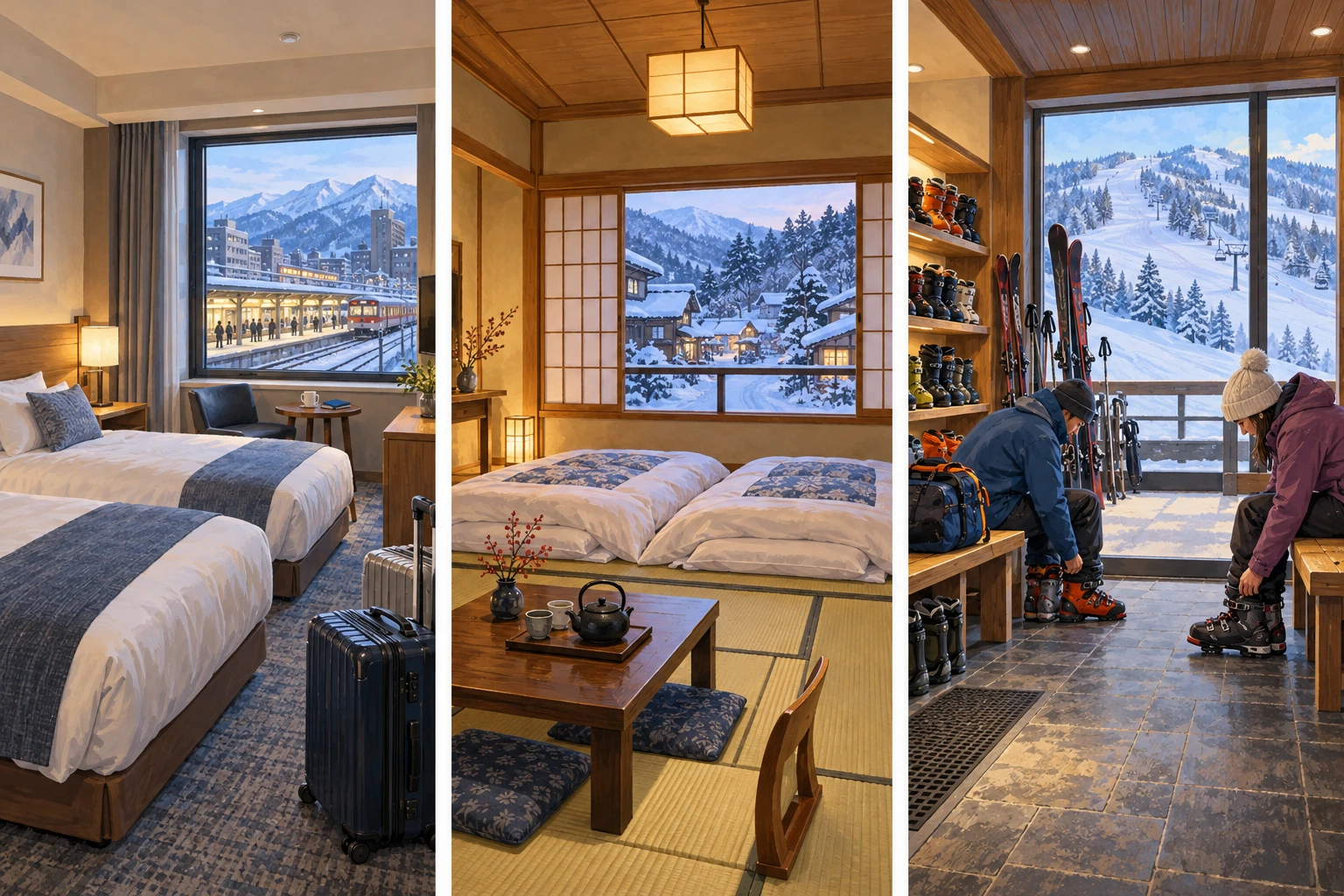
Getting into Nozawa and choosing a village location: slopes remain after Iiyama
The Nozawa Onsen Liner is the direct, year-round bus between Iiyama Station and Nozawa Onsen, without reservations. The readable timetable at this check applies March 30–November 30, 2026, at JPY 600 one way for adults and JPY 300 for ages 7–12. The operator specifically warns that not every Shinkansen connects and a full bus can mean waiting. Winter travellers need the relevant winter timetable; do not put the autumn last departure into the timetable for your flight-arrival day.
Separate village-centre accommodation, the Nagasaka gondola area and the Hikage side. The centre suits restaurants and public baths in the evening; Nagasaka suits collecting gear and heading uphill early; Hikage needs a check of the actual school and family-facility meeting points. A short map distance is not necessarily easy: snow-covered slopes, steps and large luggage magnify the effort. Asking how to reach the inn from the central bus terminal with large bags is often more useful than asking only the distance.
Yu Road is the free moving walkway from the hot-spring streets toward Hikage, useful for Hikage's schools, information centre and family area. It is not a lift to Nagasaka's hire shops or Mt. Kenashi's summit. The resort's family-access explanation distinguishes Hikage from Nagasaka: if collecting gear or taking lessons at Nagasaka, do not follow Yu Road merely because it reaches the resort. Village shuttles and other snow transport also vary by season. Accommodation saying it has resort access does not establish a ski-back route to the door. For two ski days, settle in one area with a clear direction for equipment, lessons and returning to the room.
Nozawa's mountain also has distinct areas. The official piste map and introduction separate Mt. Kenashi's 1,650-metre Yamabiko summit area from Uenotaira and Paradise lower down. The Nagasaka or Hikage gondola reaches the Uenotaira area; reaching Mt. Kenashi's summit requires another Yamabiko-area lift. Summit pistes A–E include intermediate and advanced routes. Going to the top does not establish a beginner route suitable for everyone. For basic practice, compare Uenotaira and Paradise's broad, gentle green beginner slopes on the map. If uncertain about skiing down, the operator permits returning on the same gondola used for the ascent, without making the entire descent a test after the lesson.
Skyline is a ridge option for people with the required speed control, turns and endurance, not a first-time ski-down route. The official 2026 map marks piste 26, Skyline, as an orange intermediate route. The recommendation page places it in intermediate/advanced categories and warns of about 300 metres of narrow terrain at the entrance and a steep powder-snow area lower down. Neither establishes an easy route simply by following the ridge. Use that day's openings and patrol advice to decide whether to go. Know whether your finish is on the Nagasaka or Karasawa side so that you can return to the hire shop and accommodation. Repeating the summit area and making one long return to the village are different days.
If practicing only at Uenotaira and Paradise, confirm that day's ascent and return with the instructor. The official information grades the Rinkan route from Paradise toward Hikage as beginner, but it still has narrow bends and a longer descent. A beginner label does not mean every learner can descend alone. The 2026 map separately marks resort boundaries, areas outside management and purple prohibited areas. Other people's ski tracks do not establish an opening. Closed pistes, prohibited areas and terrain beyond ropes are outside this itinerary. Check whether the relevant lifts and return routes operate in winter; the map is not a live operating timetable.
Nozawa's new-season tickets, lesson sales and hire locations
Nozawa's official Japanese ticket page lists the regular period of December 19, 2026–March 28, 2027: a day is JPY 7,800 for adults, JPY 4,700 for children or JPY 6,300 for ages 60 and over. The adult two-day pass is JPY 14,500, for two consecutive days starting on the purchase date, not two separated days of your choosing. Children are junior-high-school students or younger. A preschool child is free only with a paying adult, one child per adult, passing through the gate together. Some IC ticket cards require a separate JPY 500 refundable deposit.
When comparing ticket pages in different languages, check the season, regular versus early-bird product and other terms instead of choosing the lowest visible number. Do not apply Hakuba Valley's 6–12 child band to Nozawa. The school's October 22, 2026 notice expects its new-season lesson website to switch after October 25 and reservations for skiing, snowboarding and children's lessons to start November 8 at 11:00, generally online with prepayment. This is a sales-opening announcement, not a promise of available lesson places. Check language and eligible ages on the new lesson pages.
Start hire selection with location. The official shop directory places Salomon Station and Sports Thanx in Nagasaka, and SHIRAKABA and Swallow's Hikage Denbee shop in Hikage. A familiar shop name is not a reason to collect at Nagasaka for a Hikage lesson. Before booking, ask about the earliest fitting time, unavailable sizes, collection the previous evening and luggage storage on departure day. These details change the morning more than a comparison of daily hire prices alone.
Nozawa rooms and public baths: Ryokan Sakaya and the thirteen village baths are different products
Ryokan Sakaya's standard Japanese room has ten tatami mats plus a window-side sitting area, around 35–40 square metres. The official room-booking page lists two to four guests, as does the same room under the new winter breakfast-only plan. This is space for Japanese bedding, not a promise of four Western beds. Its hot-spring-street location suits dinner, public baths and resting at the inn; for the earliest start on the mountain every day, still check the actual uphill route.
Winter plans can have different minimum stays, prepayment and cancellation terms from autumn plans. A general image of a ryokan stay with two meals does not establish dinner in a new-season package. Breakfast-only, room-only and two-meal rates are all sold officially. Enter every child's age, bedding needs and meals separately. Not using a separate bed does not settle breakfast, dinner or accommodation-tax charges with a blanket 'children stay free'.
For a more flexible guesthouse-style stay, compare nozawasnow's Family room: 50 square metres, normally for four and up to six, with extra paid futons for the fifth and sixth guests. It has a private shower, toilet and washbasin. The official FAQ says the property uses tatami and futons throughout, with no Western beds. Family room does not mean six beds, and shared-shower information for other rooms must not be applied automatically to this room.
Guests can cook in the shared kitchen or buy breakfast separately at the property's café bar. This differs from an entire apartment with a private kitchen or a ryokan plan including two meals. The room page gives minimum stays of two to six nights depending on dates; check the required nights before comparing totals. It is about six minutes on foot from the Nozawa Onsen Liner's Nakao stop and three minutes to the Karasawa chairlift. The operator explicitly says it is not ski-in/ski-out. For lessons at Hikage or Nagasaka, plan a separate route to the meeting point: proximity to Karasawa does not make all teaching areas equally convenient.
Nozawa's official public-bath guide lists thirteen communal baths. They are village-maintained facilities for daily life, not large hotel baths open to outside customers. Follow each bath's rules, checking opening, cleaning and water temperature. Do not bathe for too long repeatedly just to visit every one. In particular, Akihanoyu is announced closed for demolition work from May 11 to October 30, 2026. The checking date remains within that period. Confirm reopening afterward rather than assuming all thirteen are available.
If bathing with others is unsuitable, ask Ryokan Sakaya about its reservable private-use indoor bath, Matsu-no-yu. The main building’s 2026–27 winter breakfast package describes natural hot-spring water rising on the property and limits the reservable indoor bath to five groups per day. Ask about slots, duration, cost and permitted party size before reserving; not every guest is guaranteed a booking. The package covers 1 December 2026–31 March 2027 and can be paired with the non-smoking ten-tatami standard Japanese room for two to four, with an ordinary bathroom and toilet. Breakfast is included and dinner arranged separately. The room’s bathroom and the hotel’s reservable bath are different facilities. The main building’s winter access page estimates five minutes on foot to Yu Road and three minutes from the Nozawa Onsen bus terminus to the main building. Allow extra time for luggage on snow.
For an entire unit with an exclusive kitchen, compare Sakaya Hanare Jonnobi A (さかや離れ・寿命延 A). This non-smoking 3LDK unit has three twin bedrooms, accommodates at most six, and includes a full kitchen, roughly 30-square-metre living/dining room and washer-dryer. The loft does not add guests beyond the six-person limit. Its equipment list specifies a private shower and warm-water cleansing toilet, which do not establish an in-room bathtub or private onsen. This differs from nozawasnow’s shared-kitchen arrangement and gives families needing separate bedrooms and their own cooking space a concrete unit to check.
Jonnobi’s 2026–27 winter package covers 1 December 2026–31 March 2027 without meals. It lists a rice cooker, combination oven/microwave, pots, tableware, dishwasher and basic seasonings. Check-in from 15:00 to 21:00 and check-out at 10:00 both take place at Sakaya’s main-building reception. Confirm the route from reception to your unit, minimum stay, cleaning and additional charges before comparing the total for your dates. The site also has a mixed-gender, free-flowing hot-spring bath requiring swimwear, and the package allows Hanare guests to use the main building’s baths. Neither means Unit A has a private onsen or that Matsu-no-yu can be used without a reservation. The main building’s walk to Yu Road cannot be applied to every unit’s doorstep-to-slope journey.
Choose a Shiga Kogen area first: Ichinose, Yakebitaiyama, Okushiga or Kumanoyu
Narrow a Shiga accommodation decision to an area first. Around Ichinose, compare several resort entrances, schools and equipment hire together. Hotels at Yakebitaiyama suit skiing mainly on that mountain. Okushiga suits a holiday centred on a mountain hotel and nearby pistes. Kumanoyu and Yokoteyama are a separate branch needing its own transport plan. Sharing the name Shiga Kogen does not give them identical dinner options, buses or ski connections.
For several consecutive ski days, make one area your main daily base and extend outward only when weather and ability allow. For a one-day introduction, put equipment hire and teaching in the same area. Adjacent piste links on a map can require a lift or a particular route, rather than allowing beginners to ski there independently. If a companion may return to the room early, centre the plan on a route that person can manage, instead of making everyone follow the strongest skier's expedition.
Shiga accommodation often bundles dinner, useful if you want to avoid snowy-night travel. Still confirm restaurant operating days, advance meal-time choices and whether dietary needs can be accommodated. A seemingly cheaper room down in Yudanaka must be weighed against repeated waits and carrying equipment uphill and back. A mountain hotel can seem remote but remove one daily journey. Compare the complete day in each case.
Ichinose Family's official introduction identifies the summit's Tengu course as a beginner bypass avoiding the steep upper slope. It is an option for people with basic skiing skills who want to practice within their accommodation area. Complete beginners should still start in the lower teaching area specified for their lesson; the name Family is not a reason to ski straight down the front. Stronger skiers can use open, more demanding routes without taking the whole family across areas. Map grading describes a route, not the school's assessment of an individual.
To move from the Ichinose side toward Yakebitaiyama, inspect the Ichinose Yamanokami connection. The operator says you can ski toward Yakebitaiyama but use a lift to return from it. The two directions are not one flat path usable freely both ways. Confirm both the Yamanokami link and the return lift are open before extending toward Yakebitaiyama or Okushiga. If a companion needs to return to the room partway through, keep practice in the accommodation area rather than testing endurance with repeated resort changes.
The official area map shows Kumanoyu and Yokoteyama as a separate branch from the Ichinose–Yakebitaiyama cluster. An all-area pass does not let you ski all the way there. If a Kumanoyu hot-spring stay is the priority, pair equipment hire and lessons within that branch, with separate road transport for a change to the central area. This map is for orientation only; its older shuttle times are not carried forward to 2026–27. Cancel an area change if the required pistes or connections close. Shiga's official rules require following signs, announcements and patrol instructions. Do not enter prohibited or roped-off areas or walk through closed terrain to connect with another open lift.
Shiga's all-area pass and mountain buses: shared tickets do not make every area ski-connected
The 2026–27 Shiga Kogen all-area pass covers eighteen resorts and forty-five lifts. A counter-bought day pass is JPY 9,500 for adults, JPY 6,500 for junior/senior-high students, JPY 4,000 for children or JPY 8,000 for seniors. The official international age categories are Adult 19–59, Student 13–18, Child 0–12 and Senior 60 and over. Free admission for preschool children has an additional one-paying-adult-to-one-child accompaniment condition; ages 0–12 are not all free. Domestic and international descriptions differ at the age-18 boundary. Check the category applicable to your status and proof of age when ordering.
Regular-period two- to ten-day passes allow nonconsecutive use within that season's validity. A one-day pass is valid only on the day it passes a gate. These passes exclude ordinary night skiing and early-morning operations. Unused days, points or hours are not refundable and cannot carry into the next season. The published ticket period is December 5, 2026–May 5, 2027, not a guarantee that each resort has sufficient snow or every route opens every day. If learning in one area, ask the instructor whether you need an all-area pass instead of assuming the broadest coverage is the only choice.
Travel from Nagano into the mountains and the local Shiga shuttle are separate services. Nagaden winter routes differ by date and destination; not every bus goes to Okushiga or Yokoteyama. The official winter page still covered 2025–26 at this check, so no unverified 2027 last-bus time is given here. Ask the hotel for its nearest stop and transfer arrangements before booking, then confirm any area-change day when the new winter timetable appears. A shared lift pass establishes lift rights, not free use of every road bus.
Named Shiga rooms and Ichinose equipment hire: a light two-person stay differs from four guests staying longer
Shiga Kogen Prince Hotel's West Building Twin Room D is 19.2 square metres for one to two guests, with two 97 × 195-centimetre beds. Two people can compare its price and resort access, accepting limited room to spread large bags and equipment. A Family Room elsewhere in the hotel does not make this a four-person room. Confirm the West Building operates on your dates and that your plan includes the meals you need. Restaurants or facilities in another building are not automatically available at any time.
Hotel Grand Phenix Okushiga's Standard Twin is 42 square metres for two to four guests, accommodating two extra beds and offering a walk-in closet. Storage and changing space make a concrete difference for four people staying longer. It is in Okushiga, however; a spacious room does not remove travel to an Ichinose lesson. Choose it if activities are mainly in Okushiga or cross-area transport is arranged. It does not suit a plan to return to Nagano city for dinner every evening.
If a sulfur hot spring matters more than room size, compare Kumanoyu Hotel's Western-style room: one to two guests, two beds, with a room bathroom and toilet. The onsen experience is in the shared Hekiraku and Suigyoku baths. The official spring analysis states '含硫黄-カルシウム・ナトリウム-炭酸水素塩・硫酸塩温泉', confirming a sulfur-containing spring. If you want to bathe in hot-spring water in the room, separately confirm that the room bath has that supply; a bathroom listing does not establish it.
The hotel FAQ puts Kumanoyu's ski area about five minutes away on foot. Two-meal plans such as '1泊2食スタンダード~翡翠hisui~' are offered, but you must select the relevant plan for the date and room. A hotel serving meals does not mean every room price includes them. Breakfast is 7:30–9:00 and dinner 18:00–19:30. Arrival after 19:30 means no dinner or refund even if dinner was booked. The hotel also explicitly cannot change menus for allergies, religion or disliked ingredients. Decide before paying whether it suits special dietary needs. Check the applicable bus and arrival stop for the station-to-hotel journey, and obtain confirmation from the hotel if you need a pickup.
Ichinose's official local school and hire directory lists Swallow Rental at Shiga Grand Hotel and Canyons Shiga Kogen Ski School based at Shiga Ichii Hotel, among others. Match accommodation with these named locations, then confirm new-season language, children's groups and hire-package contents with the operator. A room accommodating two does not necessarily require a two-person booking, but neither does it establish a single-person rate on every date. Solo travellers should check the actual single-occupancy total, not mistake a per-person double-occupancy price for a single-room price.
For an itemised hire comparison, use the listed Swallow Shiga Grand Hotel shop. On October 22, 2026, its current-linked one-page price sheet listed a ski/boot/pole set or snowboard/boot set at JPY 4,500 per adult day or JPY 3,500 per child day, including consumption tax. Adults start at thirteen; children are twelve or under. These are not Shiga lift-ticket age categories. Separate clothing hire is JPY 3,000 for adults or JPY 2,500 for children, and a helmet is JPY 800 per day, so an equipment set does not include everything you wear. Identification is required. Multi-day renters keep equipment themselves until the final day, and the shop page says equipment cannot be changed during the hire. Confirm sizes, reservations, returns and the rate for your travel date. The checked price sheet is not a guarantee of future stock or unchanged prices every season.
For a base where both lessons and daily life are in Ichinose, compare Shiga Ichii Hotel’s room-assigned-by-hotel package. It accommodates one to five, with the hotel assigning a western twin or eight- to twelve-tatami Japanese room according to the reservation. Guests cannot choose the category. All are non-smoking and have a toilet; anyone needing definite western beds should not regard this as a guaranteed twin. Even if assigned a room with a bath, that bath is normally locked and costs extra to use. The communal large bath is an artificial onsen, which does not mean natural hot-spring water is supplied to the rooms. The room-only package allows breakfast or dinner to be added, with buffet service potentially replaced by a set menu according to guest numbers. Guests in Japanese rooms lay out their own futons, and there is no stay-over cleaning or amenity replacement through the third night. Choose it only if this service arrangement works for you.
That Ichii package covers 1 December 2026–5 May 2027, with check-in from 15:00 to 21:00 and check-out at 10:00. Advise the hotel before arriving after 21:00; final check-in is 22:00. The building guide puts the entrance, reception, rentals and ski school on level 2F. Arrange rental at reception, then collect equipment at the counter beside the entrance. The official access page estimates two minutes walking to Ichinose Family and one minute to Tannenomori. This does not guarantee beginners can ski every connecting route both ways. Canyons’ official lesson page names Shiga Ichii Hotel as the main meeting location and Ichinose Family as the alternative. Follow the confirmation email for the actual point and prepare lift tickets and rental equipment before the lesson.
Another arrangement is the family-run Sports Hotel Silver Shiga. Its standard western room with two beds (スタンダードな洋室ベッド2) lists two beds and a private unit bathroom and western toilet. Have the reservation state the formal occupancy limit and child or extra-bed arrangements; two beds are not permission to add further guests. Bring your own bath towels, toothbrushes and similar amenities. Forgotten items can be obtained from reception for an additional charge. Its men’s and women’s public baths use heated natural mountain water. This is heated-water bathing, not evidence of a natural hot spring merely because the hotel is in an onsen region.
The Shiga Kogen tourism association’s Silver listing includes a room-only option. Confirm optional meals and the total for your actual dates, party and room. Bringing amenities or accepting simpler service does not necessarily lower the price. The hotel estimates five minutes walking to Ichinose Family and says a bus stop is immediately alongside, but that is not the journey to every school meeting point. Before booking, confirm the exact stop, seasonal buses, latest arrival and luggage route with the hotel, then compare them with the lesson confirmation. Staying somewhere in Ichinose does not eliminate local travel.
If you want to establish two people’s sleeping and bathroom arrangements first, compare Ichinose’s Chalet Shiga “Western Twin / No Bath / 27 square metres”. The hotel explicitly lists a capacity of two people and two beds, with an in-room toilet and washbasin but no in-room bathing facilities. Guests use the hotel’s public large bath, which uses artificial onsen water. A previously published “Standard Two Meals Included” plan for this same room lists dinner and breakfast, with indicative rates calculated per adult per night, including consumption tax. Compare matching dates, guest numbers and meal basis; this is not the total for the whole room. The plan states a stay period from 1 December 2025 to 31 October 2026, but when its booking entry was checked on 22 October 2026, it already displayed a message saying it was outside its publication period. It is therefore used here only to explain meal basis and the pricing method, and cannot be treated as a quote for the 2026–27 ski season or a guarantee that it is currently bookable or cheaper. Recheck the plans, total amount and other taxes and charges for your actual stay date.
Myoko's four resorts and combined tickets: Akakura Onsen, Akakura Kanko, Ikenotaira and Suginohara
Myoko Kogen is in Niigata Prefecture. In Myoko Tourism's official resort introduction, Akakura Onsen comprises areas including Yodel, Kumado and Ginrei, useful for combining village life and a ski day. Akakura Kanko is a separately operated resort; 'Akakura' does not mean one ticket area. The broad, gentle lower part of Ikenotaira's central area is an option for beginners to compare. Suginohara has Suginohara and Mitahara areas and suits a focus on long runs, but a long piste is not necessarily suitable throughout for first-time skiers.
Check the year especially carefully for combined products. The official 2026–27 sales page explicitly lists the four-resort Mt. MYOKO Super Season Pass: JPY 110,000 early-bird until November 30, 2026, or JPY 130,000 regular price, valid until March 31, 2027 subject to each resort's operating period. This is not a three-day combined ticket required for a three-night visitor. Finding an older Big 4 introduction does not establish an identical short-term pass or usage rules this season.
For a short stay, compare the single-resort tickets you will genuinely use before deciding on a two-resort combination or season pass. Even where Akakura Onsen and Akakura Kanko have a ski connection, the route must be open and your ticket must cover it. Changing to Ikenotaira or Suginohara requires road transport. One resort per day is usually easier for lunch, equipment returns and going home. Do not spend a large part of a day carrying skis and waiting for a bus merely to prove a combined ticket's value.
Myoko shuttles: a 2026–27 timetable is announced, but read the service symbols
The Myoko winter bus page, updated October 19, 2026, announces the Mt Myoko Shuttle for December 19, 2026–March 24, 2027, without reservations, at JPY 1,100 one way. The Akakura-to-Suginohara and return tables have different operating symbols, and some services end February 28, 2027. A March trip cannot copy every February departure. Two adults should initially allow JPY 4,400 for a return journey, then compare it with the accommodation-price difference for staying near the intended resort.
The season-pass Shuttle add-on is a separate product. The official season-pass page lists an additional JPY 20,000, purchased at the same time as the season pass; it cannot be added later. Its expected period ends March 22, unlike the ordinary shuttle page's March 24. If relying on the pass in late March, confirm the final day of the add-on benefit rather than extending its rights with the longer road timetable. Resolve this before paying, not at the bus stop.
Local buses after arrival at Myoko-Kogen Station, hotel pickups and inter-resort shuttles also need separate checks. Other tables on the shuttle page, including directions toward Lotte Arai and Madarao, warn that the new-season start date and timetable are not yet fixed. A visible timetable on the same page does not establish current applicability. This comparison centres on Myoko's four resorts. Add nights or a transfer day for Madarao or another resort rather than treating it as a free extra half day.
Myoko rooms and lessons: Akakura's streets or Akakura Kanko Hotel give different daily routines
An Akakura Onsen village base helps connect restaurants, equipment hire and lessons. A resort hotel prioritizes getting uphill in the morning and returning to the room for rest. Akakura Kanko Hotel's main-building Lake Nojiri-side Twin has different specifications: the 28-square-metre version accommodates two to three, with an extra bed for the third person; the 26-square-metre version accommodates two. Match the similar names to the exact size and occupancy on the order. Not every standard room has an onsen bath. For bathing in your room, select a type explicitly listing a hot-spring bath.
The same hotel's main-building Japanese room has fourteen tatami mats plus a living area, 56 square metres for six guests, Japanese bedding, a shower and no bathtub. Snow-protection grilles outside the windows in winter mean summer mountain-view photographs do not guarantee a winter view. This layout suits families wanting shared space, but differs from a suite with two separate bedrooms. Extra floor area does not necessarily make different sleeping schedules comfortable. The hotel's access page also lists pickup information, which needs arrangements for the actual dates and station. A place name in an address does not mean the station is walkable.
To leave dinner to Akakura's restaurants, compare Refre Hotel's Western Rooms. The website lists two guests and rooms with twin King Single beds, with Queen and twin-single configurations also described. The room has a private toilet and washbasin; showers are in the hotel's onsen area, which can be arranged for private use. Do not read 'private bathroom facilities' as an in-room shower in every twin room. The Japanese-Western family room separately lists a complete en-suite, so distinguish the room types.
The website describes about one minute to Akakura's main street and three minutes to a chairlift. This stay focuses on walking out to dinner and returning to a small hotel, unlike concentrating activities at Akakura Kanko Hotel. Breakfast is served 7:00–9:00; ask for the booking confirmation to state whether it is included, and arrange dinner separately. A courtesy pickup from Myoko-Kogen Station is offered, but the public page does not give fixed departures, service dates or an advance-booking deadline. Obtain pickup confirmation instead of treating it as an on-demand inter-resort shuttle.
Myoko Snowsports in Akakura provides lessons and equipment hire. Its children's equipment page uses an age category of 3–14 and offers items including skis or snowboards, boots, helmets and clothing to rent, while gloves and goggles are retail items. Its lesson lift-ticket guidance distinguishes Akakura Onsen-only tickets from the Combined Mountain Pass according to ability; tickets are not included in lesson fees. Beginner groups have further requirements. Let the lesson provider specify the product rather than buying the widest pass and asking the instructor to adapt.
For an entire Myoko unit with its own kitchen, compare Myoko Onsen Cottage AJISAI Room01 in Shin-Akakura, beside Ryokan Okayama. This non-smoking unit accommodates at most four: two in a separate twin bedroom and two in one loft room, not four guaranteed fixed beds. It lists an exclusive kitchen, refrigerator, three-ring induction cooktop, microwave, cookware and tableware, plus a hot-spring bathroom, shower and warm-water cleansing toilet. Confirm the actual distribution of beds and futons. It is a different product from Refre’s two-person bedroom with private-use showering in the hotel’s bathing area; do not apply Room01’s capacity to other cottages.
AJISAI’s standard stay is room-only, with guests free to bring food and drinks for cooking. Meal options require a telephone reservation the previous day and may be unavailable on busy dates. Room01 also lists breakfast at Ryokan Okayama: request it at reception by 20:00 the day before, with breakfast at 8:00. Confirm cost, charging unit and how requests are accepted; breakfast is not automatically included. Check-in and check-out are at Ryokan Okayama’s reception. Check-out is at 10:00, with no late check-out. Reception’s 9:00–22:00 service hours do not mean check-in starts at 9:00 or is guaranteed until 22:00. Confirm the actual arrival window, late arrivals and Myoko-Kogen Station pickup; telephone enquiries are accepted from 10:00 to 17:00. Winter parking is one vehicle per cottage, with additional vehicles at Ryokan Okayama. Ski equipment cannot be brought inside the unit: leave it in your vehicle or the ryokan’s ski storage, available 7:00–22:00. Confirm minimum nights, meal acceptance, per-unit or per-person pricing and the tax-inclusive total for your dates.
For a larger party sharing a Japanese room and common areas, compare Canadian House Myoko’s Canadian Room Type I. It has tatami, accommodates at most six and uses shared Japanese bathing facilities. The lodge describes western beds and futons overall without allocating exact numbers to Type I. Ask separately whether the room has a toilet; six-person capacity does not mean six beds or a full en-suite bathroom. The facilities page places separate men’s and women’s shared “onsen-style” baths, coin laundry and ski storage on the lower level, with common toilets, dining and lounge areas on the main level. “Onsen-style” describes a format and does not establish a natural hot spring. The kitchenettes and private bathrooms of Suites A, B and C do not transfer to Type I.
Canadian House’s dining room does not establish that breakfast or dinner is included. When booking Type I, ask together about party sizes and ages, sleeping places, toilet needs, meals, per-person or per-room units, taxes and cancellation. The current Myoko Tourism listing tags pickup and shuttle services; those are not confirmation of free, on-demand station transfers. Use the current property’s contact details, +81 90 2637 9994, to confirm service dates, cost, reservations, check-in window and late arrival. Keep a backup for reaching the lodge from Myoko-Kogen Station until pickup is confirmed. Judge whether this arrangement fits your budget using totals for the same dates, meals and party size.
If your priority is comparing room and meal costs separately, consider Akakura’s Ryokan Eho non-smoking 6.5-tatami Japanese room. It accommodates at most three, with futons laid out before arrival and no in-room bathroom or toilet; guests use shared facilities. It does not suit anyone needing western beds or an in-room toilet. The official site links to room-only and breakfast packages for this same room. As a pricing example, the calendar for 25 October 2026, viewed on 22 October, showed one room for two adults for one night: room-only JPY 6,600 per person and JPY 13,200 total room charge; breakfast JPY 8,800 per person and JPY 17,600 total. These include consumption tax and service charges, with a further bathing tax of JPY 150 per adult per night. That date showed no inventory. This is only an example of per-person units and the difference between meal plans, not an available booking rate or a ski-season price, and it cannot be applied to Canadian House.
For a ski-season booking, compare the same arrival dates, actual adult and child numbers, 6.5-tatami room, meal basis and full number of nights, then add taxes, eating out and arrival transport. The property’s 29 September 2026 winter notice requires at least one night in December, two in January and three in February–March. Any later acceptance of one-night bookings will be announced separately, so recheck when reserving. Winter bookings incur cancellation charges as soon as confirmed. The official site’s winter table lists 10% from confirmation until 91 days before arrival and 100% from 90 days before arrival onward. Do not apply the autumn product’s cancellation table. Book winter stays through the official site or booking websites; direct telephone or email reservations are not accepted. This small inn’s budget tradeoffs are shared bathrooms and toilets, futon bedding and meal-plan choice. Whether it costs less than another arrangement depends on the final total for the same dates and party.
Accommodation tax and budget: Hakuba has bands, Nozawa a percentage, not JPY 200 everywhere
Separate rooms, meals, lift tickets, equipment hire, lessons, mountain access, inter-resort transport and taxes. Nagano Prefecture introduced accommodation tax on June 1, 2026. In ordinary areas, until May 31, 2029 it is JPY 200 per person per night, based on the room-only charge excluding meals and tax; charges below JPY 6,000 are exempt. Hakuba and Nozawa have their own systems. For ordinary tourist stays in Nagano city or Yamanouchi, where Shiga is located, start with the prefectural rules. Bathing tax and accommodation tax are separate charges, not substitutes for each other.
Hakuba Village, from June 1, 2026 to May 31, 2029, uses the pretax room-only charge per person per night: JPY 200 for JPY 6,000 to under 20,000; JPY 400 for 20,000 to under 50,000; JPY 900 for 50,000 to under 100,000; and JPY 1,900 for 100,000 or more. These amounts already include JPY 100 prefectural tax; do not add it again. Two adults staying three nights with a taxable room charge of JPY 25,000 each per night owe JPY 2,400 accommodation tax in total.
Page 3 of Nagano Prefecture's official explanation lists the combined prefectural and village tax in Nozawa Onsen Village for the same period as 3.5% of the taxable room charge per person per night, already including JPY 100 prefectural tax. Below JPY 6,000 is exempt; exactly JPY 6,000 remains taxable. At JPY 20,000 per person per night for two people over three nights, the 3.5% total is JPY 4,200, without another JPY 600 prefectural charge. The accommodation provider must establish the taxable room portion of a meal package; do not multiply the tax-inclusive package total by the percentage. Myoko is in Niigata, so Nagano accommodation tax does not apply. Its bathing tax lists JPY 150 per overnight guest per night using a mineral-spring bath, exempting children under twelve; a child who has turned twelve is not within that exemption.
| Where you stay | Taxable charge and tax per person per night | How prefectural tax is included |
|---|---|---|
| Ordinary areas including Nagano city and Yamanouchi | Pretax room-only charge below JPY 6,000: exempt; otherwise JPY 200 | The JPY 200 is prefectural tax |
| Hakuba Village | JPY 6,000 to under 20,000: JPY 200; 20,000 to under 50,000: JPY 400; 50,000 to under 100,000: JPY 900; 100,000 or more: JPY 1,900 | Each band already includes JPY 100 prefectural tax; below JPY 6,000 is exempt |
| Nozawa Onsen Village | 3.5% of the pretax room-only charge; below JPY 6,000 is exempt | 3.5% is the combined village/prefectural amount, already including JPY 100 prefectural tax |
Children and non-skiing companions: protect an option to stop each day
Family plans often overlook who can rest and when. If a child has a morning lesson and may tire in the afternoon, the distance between accommodation and the meeting point matters more than the total number of pistes. A non-skiing adult also needs reachable rest space, food and toilets; a lift ticket does not automatically create half a day's activities. After choosing a base, map three places: collecting the child at noon, retrieving equipment and returning to the room. Then decide whether another adult can ski farther away.
The same child can fall into different age groups for transport, accommodation, lift tickets and lessons. A 15-year-old is a child on Happo's resort ticket and an adult on Hakuba Valley's all-area pass. Nozawa uses junior-high-school age or younger, while lessons may use actual age and ability. Sharing a bed for accommodation does not establish free lift tickets, meals or equipment hire. Record each person's birthday, stay dates and each product's category in one note. This produces a more accurate quotation than 'two adults and two children'.
For someone who does not ski at all, plan Zenkoji in Nagano, an inn rest day and street walks in Yudanaka or Shibu Onsen, or village life and public baths in Nozawa in the afternoon. For a longer stay in Shiga or a resort hotel, confirm food service and somewhere comfortable to spend time. Do not assume a free sightseeing shuttle or night market. Sightseeing gondolas, snow activities and baths all have separate operating and admission conditions. Choose one activity you can actually complete instead of a long list left to chance on arrival.
Early December, midwinter and March: choose by what opens, without a powder guarantee
In early December, the question is not only whether there is snow, but whether the teaching area, return piste, hire shop and accommodation shuttle have all opened. The summit may open while a beginner slope at the base remains closed. Snow on a date does not establish suitability for a first lesson. If your flights are already booked and your travel dates are set, retain reasonable change conditions for accommodation and lessons where possible, and prepare a Nagano city or hot-spring rest day. An announced planned opening is a planning milestone, not a snow guarantee.
January and February are common times to arrange ski trips, but wind, snowfall and visibility can still suspend lifts. In March, watch both snow conditions and bus reductions: some Myoko shuttle departures ending in late February are a concrete example. Budget travellers should compare not only peak/off-peak room rates, but whether lessons, restaurants and buses still operate normally. Lower accommodation costs with more time transferring each day may not suit the purpose of your holiday.
Follow the resort's daily openings, patrol and signs for safety. Other skiers' tracks do not make a closed piste or terrain beyond a rope an open route. This guide compares managed ski resorts and accommodation bases; it does not supply backcountry routes. Drivers should separately check winter tyres, road closures, parking and their actual winter-driving ability. If unfamiliar with snowy roads, public transport and accommodation pickups are valid transport choices. A hire car is not a requirement of independent travel.
Five days/four nights or seven days/six nights: settle in one base before adding another experience
For five days and four nights, arrive and stay in Nagano on day one; enter the selected ski base in daylight on day two, fitting equipment or getting familiar with the area in the afternoon. Use day three for a full lesson or ski day, and day four for more skiing or a hot-spring rest according to energy, before departing on day five. If you can safely reach the resort on arrival day, all four nights can be at the same base. This plan deliberately chooses only one of Hakuba, Nozawa, Shiga or Myoko so that moving bags between regions does not fragment the two main ski days.
For seven days and six nights, consider four nights at one ski base, one arrival night in Nagano and one rest night in Yudanaka or Shibu Onsen, after verifying the actual route between bases. Hakuba to Yudanaka or Myoko to Shiga is not automatically a direct sightseeing-bus journey because both look mountainous on a map; you usually return to a transport hub to connect again. Staying at one base throughout also leaves flexibility when a day has poor weather, instead of spending both extra days changing hotels.
For families, make the first ski day a lesson day and decide only afterward whether to upgrade tickets or go farther on the second. Experienced skiers can use one Hakuba or Myoko accommodation base for different resorts while giving each direction a whole day. If many companions do not ski, add a night in Nagano or a hot-spring stay and reduce consecutive mountain days. Allocate nights to what people actually want to do, rather than changing place names daily to make the itinerary look full.
Read cancellation terms before paying: rooms, lessons and passes are separate commitments
Accommodation, instruction and lift tickets are usually separate orders. One suspended lift does not automatically make all three refundable. Hakuba Valley's online terms say purchases cannot be cancelled or refunded, and Happo's discounted and multi-day tickets also have restrictions on refunds for unused days. Shiga has separate bad-weather lift-suspension refund rules, which cannot be answered using another region's policy. Confirm dates and stamina before buying long nonrefundable passes. A first-time skier should not lock in every day in advance.
Even the same named hotel room can be sold with different cancellation deadlines, prepayment percentages and minimum stays. Save the original Japanese or English plan name, guest count, meals, cancellation ladder, payment date and latest arrival time. If relying on a last bus, have the ryokan confirm before payment that it can still welcome and feed you. Compare platform quotations using the total for the actual dates with matching meals and cancellation conditions, and check taxes payable separately on site.
If unsure, use the first ryokan stay checklist to clarify meals and bathing needs, then add the named room types and official transport from this guide. A comparison ready for purchase needs dates, everyone's ages, beds, dietary needs and arrival transport together. Without one, the same room on two platforms can appear to have a large price difference while actually having completely different conditions.
Save four records offline, then check the day's operation after arrival
Save the accommodation order and full address, current bus timetable and stops, lesson meeting details, and pass/hire collection instructions. Keep them accessible offline on your phone, with at least one other companion able to find them. For children or unusual equipment sizes, also save the operator's confirmation messages. Without a mountain internet connection, knowing the stop name and hotel telephone number makes seeking help easier than having only a map pin.
Recheck weather, lift operation and bus notices the previous day, then adjust to local information on arrival. If the main pistes close, establish whether teaching and the route back to the room remain workable before changing resorts. An all-area pass is not a reason to ignore waiting time between them. Dinner, public baths and rest can all make a complete day; the trip does not need the highest lift count to justify its value.
A workable booking order is to choose a base everyone accepts, confirm accommodation and lesson locations, check new-season transport, then buy tickets for the appropriate dates and coverage. Once rooms, ages and taxes are clear, a ski trip through Nagano has a practical framework. Leaving room for weather and energy is part of making the whole holiday work.
A few useful answers
Which is best for a first ski trip: Hakuba, Nozawa, Shiga or Myoko?
First find lessons matching language, age and ability, then accommodation with a practical route to the meeting point. Hakuba offers several resorts, Nozawa combines village life with skiing, Shiga suits consecutive mountain days, and Myoko can start with an Akakura or single-resort base. Resort area alone cannot decide.
Can I stay at Nagano Station and travel to a resort every day?
Check outward and return services in the timetable for your travel date, then add equipment collection and lesson time. Compare it for a one-day experience; for several consecutive ski days, include waiting, equipment and energy rather than only the bus journey.
Is a 15-year-old a child on both Happo-One and Hakuba Valley tickets?
No. Happo-One resort tickets for 2026–27 use a child band of 6–17, while Hakuba Valley all-area passes count ages 13 and over as adults and 6–12 as children. Follow each product’s own categories.
Does Nozawa’s 3.5% accommodation tax require another JPY 100 prefectural charge?
Under the Nagano Prefecture table checked here, June 1, 2026–May 31, 2029, Nozawa’s combined village and prefectural tax is 3.5% of the taxable room charge, already including JPY 100 prefectural tax. Do not add it twice. The basis is the pretax room-only charge per person per night; below JPY 6,000 is exempt.
Does staying in Yudanaka give free access to Shibu’s nine baths?
Staying nearby does not automatically give nine-bath eligibility. Shibu’s circuit follows local accommodation and key rules. Non-staying day visitors can use only bath nine, Shibu Oyu: buy a ticket at the information office or a designated inn, then show it at a designated facility and ask staff to unlock the bath, checking that someone is available.
Are Zenkoji’s autumn 2026 lights held every day?
The announced Omotesando illuminations run November 14, 2026–February 14, 2027, 17:00–22:00. The main hall’s purple lighting is a specific November 21 event, 17:30–20:15. Neither establishes daily nighttime opening of the main hall.
Does Myoko’s four-resort pass include all shuttles?
No. The verified 2026–27 four-resort product here is the Super Season Pass, with the Shuttle as a separately paid add-on purchased at the same time. Short-stay visitors should first compare single-resort or applicable combined tickets. Check road shuttles separately from lift-ticket rights.
Check with the source
Schedules, availability and rules can change. These official sources are the place to confirm details before you book.
- Hakuba Tokyu | Access and pickups
- Ryokan Sakaya | 2026–27 breakfast-only plan
- Nagano Prefecture | Kita-Shinano Line history and route
- Hakuba Valley | 2026–27 all-area day passes and terms
- Happo-One | 2026–27 lift prices
- ALPICO | Nagano–Hakuba express bus
- Hakuba Valley | Area shuttle
- Hakuba Valley | Ski-school directory
- ABLE Hakuba Goryu | Rental locations
- Hakuba Tokyu | Standard Twin
- Hakuba Tokyu | Room overview
- Hotel Metropolitan Nagano | Regular rooms
- Zenkoji | Worship tickets and opening times
- Zenkoji | Access
- Zenkoji | Temple lodgings
- Nagano city | 2026–27 Zenkoji Omotesando illuminations
- Nagano city | 2026 purple lighting of the main hall
- Shibu Onsen | Day-bathing rules
- Jigokudani Monkey Park | Access and winter roads
- Nozawa Onsen transport | Liner
- Nozawa Onsen Ski Resort | Current Japanese lift-ticket page
- Nozawa Onsen Ski Resort | 2026–27 lesson reservation notice
- Nozawa Onsen Ski Resort | Rental directory
- Ryokan Sakaya | Rooms
- Ryokan Sakaya | Official standard Japanese-room booking
- Nozawa tourism | Public-bath guide
- Nozawa tourism | Akihanoyu closure
- Shiga Kogen | 2026–27 all-area pass
- Nagaden Bus | Winter Shiga express
- Shiga Kogen Prince Hotel | West Building Twin D
- Hotel Grand Phenix Okushiga | Rooms
- Ichinose area | Schools and equipment hire
- Myoko Tourism | Ski resorts
- Myoko Tourism | 2026–27 season passes
- Myoko Tourism | 2026–27 winter buses
- Akakura Kanko Hotel | Rooms
- Akakura Kanko Hotel | Access and pickups
- Myoko Snowsports | Children’s equipment
- Myoko Snowsports | Lesson lift-ticket conditions
- Nagano Prefecture | Accommodation-tax system
- Nagano Prefecture | Official accommodation-tax guide, combined amounts on page 3
- Hakuba Village | Accommodation-tax bands and period
- Nozawa Onsen Village | Accommodation tax
- Myoko city | Bathing tax
- Shinano Railway | Timetables and routes
- Nagano Dentetsu | Yudanaka Station and connections
- Happo-One | Piste information
- Happo-One | Official 2025–26 piste map
- Tsugaike | Piste information
- Tsugaike | Official downloadable 2024–25 piste map
- Hakuba Goryu | Piste guide
- Hakuba Goryu | Safety and patrol guidance
- Hakuba Goryu and 47 | Official piste map
- Nozawa Onsen | Piste map and recommended routes
- Nozawa Onsen | Official 2026 piste map
- Nozawa Onsen | Family pistes and access
- Ichinose Family | Lifts and pistes
- Ichinose Yamanokami | Lifts and connections
- Shiga Kogen | Official area piste map
- Shiga Kogen | Safety rules
- Swallow Shiga Grand Hotel shop | Rentals and shop information
- Swallow Shiga Grand Hotel shop | Current-linked hire price sheet
- Brownie Cottage | Activities and access
- Brownie Cottage | Official booking plans
- Brownie Cottage | English introduction
- Brownie Cottage | Building facilities
- Brownie Cottage | Official A/D floor plan
- Brownie Cottage | Official loft-building floor plan
- Shibu Onsen Kokuya | Access and station pickup
- Shibu Onsen Kokuya | Booking plans
- Shibu Onsen Kokuya | Facilities and services
- Shibu Onsen Kokuya | English official introduction
- Shibu Onsen Kokuya | Japanese official introduction
- Shibu Onsen Kokuya | Ume Japanese room with open-air bath and plans
- Kumanoyu Hotel | Access and sightseeing
- Kumanoyu Hotel | Baths and spring analysis
- Kumanoyu Hotel | Official accommodation plans
- Kumanoyu Hotel | FAQ
- Kumanoyu Hotel | Official introduction
- Kumanoyu Hotel | Rooms
- nozawasnow | FAQ
- nozawasnow | Rooms
- Refre Hotel | Bookings
- Refre Hotel | Rooms and services
- Zenkoji | Worship and Kaidan passage
- Zenkoji | Wheelchair guidance
- Nagano official tourism | Togakushi Kagamiike
- Togakushi Tourism Association | 2026 spring–autumn express and local buses, updated May 26
- Togakushi Tourism Association | 2026 autumn one-way road restrictions
- Togakushi Tourism Association | 2025–26 winter roads and equipment, updated December 27
- ALPICO | 2026 Togakushi sightseeing connecting-bus timetable
- Ryokan Sakaya: baths and reservable Matsu-no-yu
- Sakaya Hanare Jonnobi: Unit A and six-person limit
- Sakaya Hanare Jonnobi: 2026–27 winter room-only package
- Ryokan Sakaya: winter and main-building access
- Sports Hotel Silver Shiga: family ski inn and slope location
- Sports Hotel Silver Shiga: two-bed western room and amenities
- Sports Hotel Silver Shiga: public baths and facilities
- Shiga Kogen tourism association: Silver Shiga and room-only stays
- Canyons Shiga Kogen: meeting points, lift tickets and equipment
- Shiga Ichii Hotel: hotel-assigned rooms for one to five
- Shiga Ichii Hotel: winter room-only meals and bath conditions
- Shiga Ichii Hotel: floors and equipment collection
- Shiga Ichii Hotel: walks to Ichinose slopes and access
- Happo Lodge: Twin and potentially shared rooms
- Happo Lodge: baths, facilities and stay arrangements
- Iwatake: East and SunnyValley trail grades
- Hakuba Norikura: named trails and intermediate connector
- Hakuba Tokyu: natural Happo communal baths and hours
- Hakuba Valley: resort abilities and features
- Myoko AJISAI: room-only stays, cooking and meal options
- Myoko AJISAI: Room01 four-person unit and winter rules
- Canadian House Myoko: current property contacts
- Myoko Tourism: current Canadian House listing and transfer tags
- Canadian House Myoko: shared baths and facilities
- Canadian House Myoko: Type I capacity and room differences
- Zenkoji Fuchinobo: arrival from Zenkoji Daimon
- Zenkoji Fuchinobo: seasonal morning-service times
- Zenkoji Fuchinobo: rooms, meals, worship and charging basis
- Matsuya Ryokan: pedestrian street and arrival
- Matsuya Ryokan: check-in, dinner deadline and check-out
- Matsuya Ryokan: breakfast and dinner
- Matsuya Ryokan: dinner-and-breakfast and breakfast packages
- Matsuya Ryokan: eight- and six-tatami bathrooms and toilets
- Zenkoji: Yakuoin official temple-lodging directory and contacts
- Rakuten Travel: Yakuoin Superior Japanese room and two-meal platform package
- Rakuten Travel: Yakuoin check-in, check-out and curfew platform information
- Chalet Shiga: named room capacity, sleeping places and bathroom arrangements
- Chalet Shiga: public baths and artificial onsen
- Ryokan Eho: 6.5-tatami capacity and shared bathrooms and toilets
- Ryokan Eho: 6.5-tatami room-only product, adult pricing and taxes
- Ryokan Eho: same-room breakfast product and adult pricing
- Ryokan Eho: 29 September 2026 winter minimum-stay and booking notice
- Ryokan Eho: adult bathing tax and winter cancellation terms
- Chalet Shiga: 27 m² twin room without a bath, two-meal plan, per-adult nightly pricing and applicable period