With one day, compare Arima first. For public baths and an evening by the canal, give Kinosaki a night; for coastal hotel rest, make Shirahama a one- or two-night base. This guide separates transport, public baths, representative rooms, meals, children and cancellation so you can choose a stay you can reach, use and understand the cost of.
Arima for a day, Kinosaki for a town overnight, Shirahama for the coast
Choose an onsen near Osaka by the time you can spare. With one free day and no wish to move your luggage, compare Arima first. For a yukata walk along a canal, dinner, public baths and the following morning in one trip, give Kinosaki a night. For a coastal break after the cities, Shirahama works better as a one- or two-night base. These are editorial recommendations based on transport and the kind of stay, rather than rankings of scenery or service.
The three hot-spring areas lie in different directions, so choose one as an extension to this trip. Putting Kinosaki and Shirahama into two days from Osaka gives much of that time to travel and makes it harder to enjoy the dinner and room you have paid for. First describe the experience you want: a public bath, private bathing, an evening in a hot-spring town or breakfast by the sea. Then choose the base that delivers it with the fewest changes. Where preferences differ, protect at least one experience everyone can enjoy.
This guide uses official public information retrieved on 21 October 2026; all amounts are in yen. Room prices vary with date, meals, occupancy and cancellation terms, so a search-result starting price is not a quote for your booking. For a first ryokan stay, start with choosing meals, bedding and bathing arrangements. This comparison focuses on reaching the three bases, selecting a room type and fitting the stay into a workable itinerary.
| Base | When to choose it | Suggested stay | Resolve before booking |
|---|---|---|---|
| Arima | An Osaka day trip and mountain town | A full day or overnight | Bath closures, full return buses, hotel day-use limits |
| Kinosaki | Public-bath walks, the canal, dinner and breakfast | At least one night | Closed baths, dinner arrival, room-bath water |
| Shirahama | Coastal views, hotel rest and slower sightseeing | One or two nights | Last leg from the station, steps, sea and maintenance |
Decide whether the onsen night replaces your Osaka room
First establish what the overnight stay replaces. If Osaka is already paid for and cannot be cancelled, a night in Kinosaki adds a second room bill. If you can remove your final Osaka night, the actual extra expense is the difference in room costs, long-distance travel and anything outside the package. Put city checkout, travel, the ryokan dinner and the next departure on a calendar. It becomes clearer whether you are buying rest or another stretch of time spent managing bags.
A day trip does not need to mean bathing from morning until evening. Even with a morning departure and evening return, allow for the local trip to the station, finding the platform, waiting and getting back to your hotel. With only half a day, reduce Arima to one public bath and a meal, and save Kinosaki or Shirahama for another trip. A pass valid that day does not remove the effort of a distant round trip.
If your next flight leaves from Kansai, check airport access, your terminal and travel time with luggage before choosing which night to spend at the springs. Should a train from Kinosaki or Shirahama be delayed, an Osaka stage generally gives more room to adjust than a last-minute taxi from farther away. This is a judgment about itinerary buffers, not a claim that any particular route is necessarily unreliable.
Osaka to Arima: the direct Umeda bus, fares and boarding point
To avoid transfers with bags, start with Hankyu Kanko Bus’s Arima–Osaka route. Current adult one-way fares are ¥1,400 from Umeda and ¥1,250 from Shin-Osaka. All seats are reserved, so buy the ticket beforehand. Umeda boarding is at Hankyu Sanbangai: reaching JR Osaka Station does not mean you can wait at any exit. From a Namba hotel, add the time and fare to Umeda.
The operator’s timetable includes limited express, express and Osaka International Airport services with different stops. Examples are Umeda 9:00–Arima 10:00 and 9:50–10:45, showing that even scheduled journey time varies by service; road conditions can change the actual arrival. For a fixed lunch or admission time, work backward and leave room to find the entrance and absorb delays. The shortest advertised journey is not a door-to-door allowance.
Check the return when buying the outward ticket, rather than after bathing. For dinner in Arima followed by a return to Osaka, confirm a compatible service that day; overnight guests should choose the outward journey around their hotel’s dinner cutoff. Keep the airports distinct too: Osaka International Airport on this route is Itami. Do not treat that service as a bus from Kansai International Airport.
From Kobe or Kyoto, keep each operator and transfer clear
Arima can also follow a stay in Kobe. For a rail route through Sannomiya, Tanigami and Arimaguchi to Arima Onsen, check direction and interchange at each stage. Do not assume Kobe’s subway, Kobe Electric Railway and JR all accept the same ticket. Waterfront guests must first reach the appropriate station; the comparison of Sannomiya, Motomachi and harbour bases helps establish your starting point with luggage.
From Kyoto, compare a direct bus actually available on your date with rail-transfer options. More departures in Osaka do not make a detour through Umeda compulsory. Hotel access summaries sometimes remain unchanged for a long time: use them to understand the direction, but pay according to the operator’s dated search, fares and change rules. For someone who needs lifts, one fewer transfer may be worth more than a small saving.
The ropeway between Mount Rokko and Arima can support a different trip, but it adds mountain access, weather-related suspensions and time on the mountain to plan separately. Someone who only wants the baths need not add an ascent because a route diagram looks attractive. With strong wind or poor visibility, retain a simple town-and-back version that makes a reserved lunch or dinner easier to keep.
Kin no Yu: separate ordinary weekdays, busy periods and towels
To try kinsen, the golden water, consult Kin no Yu’s current admission and amenity information. The usual adult admission is ¥800, reduced to ¥650 on ordinary weekdays. New Year, Golden Week, Obon and other busy periods do not automatically qualify for the weekday price. Pupils in the elementary- and junior-high-school categories used in Japan pay ¥350; preschool children have free admission. Set the date and ages first, rather than treating the adult weekday rate as the whole family’s cost.
Kin no Yu lists 8:00–22:00, last admission at 21:30, and closure on the second and fourth Tuesdays and 1 January, with public-holiday adjustments. Entry may also be restricted when crowded. These are regular arrangements: check the official calendar for the two baths before leaving. An old refurbishment notice should not be repeated as a year-round closure, and an open date does not guarantee no queue.
Kin no Yu’s amenity list includes washing products and hairdryers; hand and bath towels are sold separately, or you can bring clean ones. After bathing, allow time to dress, dry hair, drink water and return to the station. Families and older travellers often underestimate this more than the time for a second bath. The colour and iron-rich saline character can inform your choice of experience, but an official list of indications should not become a promise of medical benefit for every visitor.
Gin no Yu and the combined ticket: savings depend on the day
Gin no Yu is a separate facility. Its adult fares and admission hours show a usual ¥700 or ¥550 on ordinary weekdays; pupils in the elementary- and junior-high-school categories used in Japan pay ¥300. Regular opening is 9:00–21:00, with last admission at 20:30, closure on the first and third Tuesdays and 1 January, and holiday exceptions in notices. The two baths close in different weeks, so do not presume both will be available on arrival.
The Kin–Gin combined ticket is ¥1,200 for adults. On an ordinary weekday, ¥650 + ¥550 = ¥1,200, so the admission cost is the same. Against the usual ¥800 + ¥700 = ¥1,500, the combined ticket saves ¥300. For two adults that is ¥2,400 versus ¥3,000, a ¥600 difference. This compares admission alone, without assuming free towels, children using an adult ticket or an extra transport discount.
If only one person wants the second bath, others can rest nearby; the whole family need not rush around because a ticket has been bought. Two changes of clothes and the walk also use lunch and return-travel time. Experiencing kinsen and ginsen matters more than completing a count of buildings. Choose one first, then decide about a second according to energy and opening status to keep the day flexible.
An Arima room example: a large room can still have a two-person limit
Arima Grand Hotel illustrates the difference between floor area and permitted occupancy. The north wing fifth-floor twin plan with an outdoor kinsen bath lists 74–78 m² and a two-person limit explicitly including children. Two adults and a child cannot count as two guests simply because the child needs no bed. The plan name also specifies dinner and breakfast in the room; that benefit must match the exact plan booked.
This room suits two adults who prioritise private kinsen bathing, private meals and time in the hotel; it is not automatically the best-value option for every family. For three travellers, return to the official room categories, choose a Japanese or mixed-style room with sufficient capacity and confirm bedding and meals. That is preferable to paying a twin-room deposit and asking for an exception on arrival. Room inventory and sale dates change, and this description does not guarantee availability.
Compare the view’s direction, whether the room bath really uses kinsen, where both meals are served and the cancellation deadline on the same line. A premium for a view you will not be in the room to enjoy may offer little value. If someone cannot comfortably use a shared bath, however, a usable room bath can matter much more. Choose around that need instead of relying on the brand or floor area.
Arima day use: shared baths, exclusive baths and overnight entitlements differ
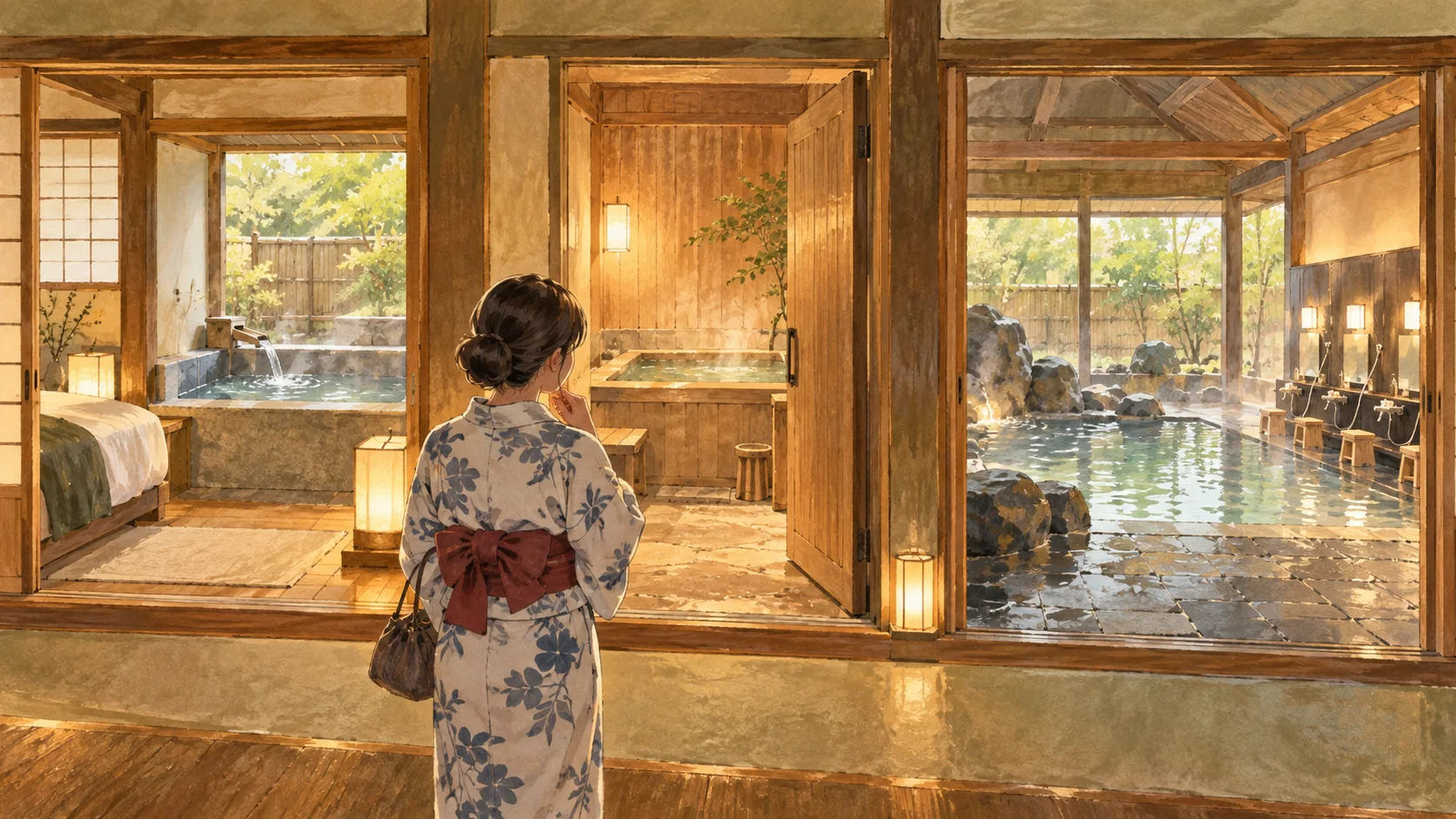
A public bath and a hotel day-use plan are different purchases. Arima Grand Hotel’s stay and day-use FAQ explicitly excludes day visitors from kashikiri, baths used exclusively by one party. Do not buy a day-use bathing ticket and assume the overnight guest’s private-bath description is included. Lunch-and-bath plans also need checks for reservation deadlines, available baths, towels and whether a guest room is provided for resting.
The hotel’s check-in and meal answers give regular check-in at 14:30 and checkout at 11:00 the next day, subject to the plan. Dinner-inclusive stays require a meal start between 17:30 and 20:00; dinner is not provided after 20:00. An afternoon in Kyoto followed by an evening arrival must fit that window. Being able to notify the hotel of lateness does not mean dinner can be delayed indefinitely: settle the timing before paying.
Tattoo rules are facility-specific too. Arima Grand Hotel’s tattoo policy restricts shared bathing and recommends booking a private bath. But day visitors cannot use kashikiri, so those two rules must be read together. This is not a uniform policy for the whole Arima town. If Kin no Yu does not provide the clear answer you need, ask that facility rather than transferring another hotel’s permission or refusal to it.
Plan an Arima bath around a workable return
A straightforward plan is to leave Osaka in the morning, walk the town after arrival and confirm opening and queues, then have lunch, visit one bath, drink water and rest before returning. Keep shops and walks flexible, without a second distant appointment you cannot miss. With a reserved hotel lunch, work backward from lunch and leave time to bathe afterward, rather than trying to combine every element of that version and the public-bath itinerary.
For Arima’s old streets, choose small shops and a snack along the route before or after bathing; there is no need to detour to every internet favourite. With a pushchair, luggage or sore knees, check whether the hotel entrance is uphill. For a hotel shuttle, confirm where to wait and how to contact it. Grand Hotel’s station, bus-stop and ropeway pick-up instructions ask guests to call after arriving, which differs from a fixed scheduled service.
In bad weather, reduce shop browsing and retain the confirmed bath and meal. If entry is temporarily limited, delaying the return should not be the only solution. Keep a workable alternative departure and agree on the latest time to leave town. If changing to an overnight stay, first recalculate cancellation charges and any double accommodation cost. A last-minute upgrade is not a cost-free backup.
Osaka to Kinosaki: treat the long-distance train and dinner as one arrangement
Kinosaki Onsen has its own JR station. The limited express Kounotori’s route links Shin-Osaka, Fukuchiyama, Toyooka and Kinosaki Onsen. Check the destination: some trains terminate at Toyooka or Fukuchiyama, so the service name alone does not guarantee a direct journey. Visit Kinosaki’s access overview describes about three hours from Osaka, while another FAQ on the same site gives a general two-and-a-half-hour figure. Plan using your particular departure.
Set out the entire journey from leaving the Osaka hotel to checking into the Kinosaki ryokan, including stations, waiting and the last shuttle. Starting conservatively with about three hours on the train makes a morning departure more likely to preserve the afternoon in town. An afternoon departure may leave only check-in, dinner and one public bath. There is little point paying for a full day of city attractions you will not have time to use while also leaving yourself only three usable hours at the ryokan.
For Kyoto, Himeji or Sannomiya, search the appropriate trains and connections rather than copying an Osaka Kounotori departure. Amanohashidate and Tottori extensions need a separate travel day and luggage arrangements; they are not casual walks to add after bathing. Match rail tickets and accommodation by date, arrival and party size before adding attractions, reducing the risk of incompatible non-refundable reservations.
Kinosaki’s public baths: check which open before planning all seven
Sotoyu are public baths outside the ryokan. Kinosaki’s current bathhouse page retains the seven-bath introduction, but Satono-yu has been closed for refurbishment since 1 April 2024. The Kono-yu extended-closure notice gives scheduled works from 11 May to 30 October 2026. This guide’s check date is still within that interval: it cannot promise seven operating baths or treat 31 October as a confirmed reopening.
During Kono-yu’s closure, the temporary refurbishment arrangements additionally open Mandara-yu on its normal closing day, from 15:00. That specific arrangement takes precedence over a general weekly closure table. Choose two baths you would like to visit from the official status for your day, then decide whether one belongs on the following morning. Adjust the number to how you feel; completing seven is not a requirement for a Kinosaki trip.
If the first bath is crowded, have a meal, walk by the canal or return to the room before checking another. Do not stay in hot water simply to wait for friends, or treat a published temperature as comfortable for everyone. Kinosaki’s advantage is moving unhurriedly between streets and baths. Protecting the evening walk and breakfast often serves an overnight stay better than repeatedly entering more bathhouses during the day.
Kinosaki bath passes: day tickets and overnight passes have different validity
Day visitors can buy a pass at a public bathhouse counter. Toyooka’s bathhouse ordinance, Schedule 1 sets the daily rate at ¥1,500 for adults and ¥750 for children. The adult category starts at age 12, except for children who have not yet reached the scheduled start of Japanese junior-high schooling. The child rate covers children aged three or over who are outside that adult category: a child who has turned 12 but has not yet reached that school-start date stays in the child category; once both conditions for the adult category are met, the adult rate applies. Children under three enter free. This child category differs from JR rail fares: do not use one age band to calculate transport, lodging and baths. The ordinance defines the day-pass rate as allowing one day of use. When buying a pass, confirm its valid date and cutoff time at the counter rather than assuming it covers two days.
Many inns supply a bath pass at check-in, but confirm that your property and plan include it. The official answer on accommodation passes gives validity from check-in until 13:00 on the checkout date. It does not automatically begin when you reach the station before registration, or run until 13:00 the day after any checkout time. When collecting it, clarify start, finish, return requirements and barcode presentation, then choose the arrival-afternoon and next-morning baths.
Two adult day passes total ¥3,000; two adults and a child in the eligible category total ¥3,750. If a stay already includes passes, do not add another ¥3,000 as a separate cost. Bath counts, time and transport have their own costs. Buying a pass does not open a closed bath or include a ryokan’s exclusive-use facilities; privacy still requires accommodation offering the relevant service.
Kinosaki tattoos, shuttles and bags: the scope of official welcome
Kinosaki’s official information explicitly welcomes decorative tattoos in the public sotoyu, and the bathhouse description explains gender-separated, unclothed bathing. This policy does not automatically cover every ryokan’s internal baths, rooms or kashikiri. Ask your accommodation about the way you intend to use them. For a tattooed visitor who prefers not to ask at every public bath, Kinosaki therefore has a clear advantage, while local washing and circulation rules still apply.
Overnight guests can use a shuttle from the station to local inns. The official shuttle and luggage FAQ says it follows limited-express arrivals rather than a fixed public timetable. Generally around 12:30–18:00, tell staff outside the station your accommodation name; if no one is there, ask the ryokan service centre. A ticket showing an 18:00 arrival does not guarantee a shuttle waiting at 18:05.
Large bags need not accompany every bath visit. First ask whether your accommodation accepts early luggage storage. The official luggage-service explanation describes paid forwarding from the ryokan service centre opposite the station to participating inns; SOZORO offers storage without that forwarding service. Confirm charges and acceptance times in person. Carrying an overnight bag and leaving the rest in confirmed storage is usually easier than repeatedly reorganising bags in the town.
Nishimuraya Honkan: minimum age, beds and the water in a room bath
Nishimuraya Honkan illustrates room restrictions rather than being the default answer for every family. The Honkan room and reservation page states that guests must be at least ten years old from 1 April 2024. A nine-year-old does not qualify just because there is enough room. Do not apply sister property Shogetsutei’s conditions, or interpret a booking platform allowing a child’s age to be entered as acceptance by the hotel.
Among the Honkan’s standard rooms, a one-room Japanese category accommodates two to four with eight tatami mats and a window-side area; the two-room category accommodates two to seven with ten plus six tatami mats. If floor bedding is uncomfortable, compare Wakakusa and Hagoromo’s mixed-style rooms, listed for two to six with beds. Confirm how many people use beds and how many futons. Sufficient capacity does not guarantee a Western single bed for each person.
Separate a room’s private tub from natural hot-spring water. Kinosaki’s official explanation of private in-room baths says they use ordinary heated water, whereas the main shared baths and many reservable exclusive-use baths use hot-spring water. Being able to wash privately whenever you wish and having natural onsen water in the room are different needs. An outdoor-bath photograph at Nishimuraya does not justify describing it as a private free-flowing spring in the room.
Nishimuraya arrival and the sister property’s private spa: resolve the discrepancy
Two Nishimuraya Honkan pages disagree on the latest arrival: the room page gives check-in at 15:00 and a 17:00 cutoff, while the facilities page gives 15:00–18:00. Both list checkout at 11:00. Do not simply choose the later number as a guarantee. With dinner included, plan conservatively to arrive before 17:00; if that is impossible, ask the ryokan before booking to confirm registration and dinner limits for your plan.
The Honkan and sister-property facilities description places the paid private spa at Nishimuraya Hotel Shogetsutei, about ten minutes away on foot or with pick-up available. This does not mean every Honkan room includes a free kashikiri slot. Ask about eligibility, price, duration and reservations, then allow the round trip outside dinner. A booked shared exclusive-use slot is also different from a tub in your room if you want spontaneous late-night bathing.
Two adults spending a night in Kinosaki can make an afternoon sotoyu, the ryokan dinner and a morning walk the essentials, with private spa time optional. If someone requires a step-free route, ask about the room entrance and path to the baths; ground floor does not automatically mean accessible. Some official room descriptions explicitly mention stairs even on the ground floor. Questions about bedding, meals and physical access needs provide a useful checklist before reserving.
A Kinosaki overnight that preserves the following morning
Aim to leave Osaka in the morning and arrive around lunch or in the afternoon. Drop the bags, eat by the canal, then check in and collect the bath pass. Pick one afternoon bath, followed by dinner and a walk or another bath if energy allows; a bathhouse’s closing time need not become your bedtime. Next morning, have breakfast and a short walk before deciding on another bath before or after checkout, checking the 13:00 validity and where the luggage is.
A dinner-and-breakfast plan includes those two meals, but dishes depend on season and price: it is not a year-round entitlement to the same crab. For a particular crab origin, a full course or avoiding shellfish, read the named ingredients and adjustment conditions in the plan for your date. Do not use a winter promotional photograph to guarantee a spring or summer booking. A regular ryokan dinner may be enough, leaving money for a room that better meets your sleeping needs.
In rain, shorten the walks between baths and rest at the inn, rather than repeatedly changing clothes to finish a circuit. For a Kinosaki day trip without an overnight stay, choose a few baths, lunch and a clear return departure, with dinner back in Osaka. That is a viable compromise, but it does not include an overnight ryokan experience and should not present a long round trip as an easy two-hour neighbourhood outing.
Osaka to Shirahama: reaching the station is not reaching your hotel
Start with the limited express Kuroshio’s route and vehicle information, then choose a service for your starting station at Shin-Osaka, Osaka or Tennoji; not every departure serves every starting point. From Shirahama Station, a local bus or taxi still takes you to coastal accommodation. Train arrival is not the time you can already be having tea in the room. Search long-distance fares for your date and seating rather than treating an old promotional price as a year-round tariff.
Do not picture all Shirahama accommodation on one compact street beside the station, as in Kinosaki. Mark Shirarahama Beach, your hotel, the public bath you want and the bus stop on a map; consider the two luggage days separately from unencumbered sightseeing. A headland hotel followed by daily trips in different directions can consume a room-price saving in taxis and waiting. If you chiefly want hotel rest, however, station-side accommodation may be unnecessary.
Kaisyu’s official transport FAQ explicitly says there is no hotel shuttle. Use a local bus to Sogen no Yu, then walk about three minutes, or take a taxi. Another Shirahama hotel’s free pick-up is not a town-wide service. For a dinner-inclusive reservation, check bus departures in advance, prepare an accepted payment method and notify the hotel if arriving late.
Shirahama bus passes: comparing one day with two
For local bus travel, compare Meiko Bus’s Shirahama mobile pass sales page. Adult prices are ¥1,100 for one day, ¥1,600 for two and ¥1,900 for three; the corresponding child fares are ¥550, ¥800 and ¥950. The mobile version requires the specified app and covers the routes on its map. Highway buses are excluded, so this does not pay for the long-distance round trip from Osaka.
A two-day adult pass costs ¥500 more than a one-day pass. Two separate one-day passes would cost ¥2,200, which is ¥600 more than the two-day pass. But first add the actual single fares you expect to use: if day two is a walk or one short ride, that difference does not automatically justify buying. For two people, two-day passes total ¥3,200 against ¥4,400 for two daily passes each, a ¥1,200 difference. This is still a comparison between ticket types.
If your phone is low on charge or offline, or you are unfamiliar with the app, do not start registration at the bus door. Read purchase, activation and presentation instructions beforehand, with a backup for paying a single fare. A pass eases covered rides; it does not increase frequency, guarantee a seat or make the bus stop at your hotel entrance. Check evening return departures separately. Meiko Bus’s own sales explanation also says the three-day paper ticket ended on 31 July 2024, while its digital version remains. Do not expect to buy a three-day paper pass locally.
Saki no Yu: hours and maintenance matter more than sunset
For a public open-air bath beside the sea, see Shirahama Town’s Saki no Yu rules. Admission is ¥500 from age three. Hours are 8:00–17:00 from October through March, 7:00–19:00 in July and August, and 8:00–18:00 from 1 April to 30 June and from 1 to 30 September. Last entry is half an hour before closing. Do not use summer hours to plan an autumn or winter sunset, or interpret no regular weekly holiday as no temporary maintenance.
The maintenance notice updated 20 October, retrieved for this guide, lists 26 October, 11 November and 26 November 2026, with closure from 12:30 through 17:00. Last admission on maintenance days is half an hour before that closure, meaning 12:00. These are announced dates, not a monthly rule to extrapolate. With rough seas or other temporary measures, check the notice for your day as well.
Saki no Yu prohibits shampoo, conditioner and soap because its bath water flows into the sea. It is for soaking, not completing a full wash with toiletries. Saki no Yu’s access and product information describes a Meiko bus from Shirahama Station to Yuzaki and about a five-minute walk. Bring a towel, clothes to change into and shoes suitable for slippery ground; arrange washing elsewhere and let weather decide whether to include the coastal bath.
Kaisyu rooms: similar outdoor baths can have different water and occupancy
Kaisyu helps distinguish room names, beds and water. The hotel’s room page lists the Nami no Sho Japanese-Western room at 41 m² for four, with two beds and two futons; its private outdoor tub uses ordinary heated water. The Akatsuki no Sho Japanese-Western room is 49 m² for five, with two beds and three futons, and also lists heated water. If both fit the party, compare space and whether floor bedding suits everyone.
For natural hot-spring water in the room, examine Hamaya Hanare’s single-level and maisonette categories. The single-level 60 m² category takes three with two beds and a futon; the two-level 92 m² category takes five with two beds and three futons. Both list free-flowing Aiki spring water in their outdoor baths. The maisonette has stairs, so greater floor area does not make it the first choice for reduced mobility. These are not features of every room in the hotel.
The Akatsuki no Sho double room, at 19 m² for two, has no private outdoor bath. Book that and you use the shared bath or seek an available exclusive-use bath, rather than expecting a room change based on another category’s photograph. For private bathing in Shirahama, ask whether the tub is in the room or a separate kashikiri, whether the water is thermal or ordinary heated water, and what occupancy and bedding are provided. Then the price comparison concerns comparable products.
Kaisyu’s free private baths, availability and ninety steps to the mixed bath
Kaisyu’s current bathing page lists two free exclusive-use outdoor baths, open 15:00–24:00 and 5:00–10:00. Ask the staff counter outside the shared bath when one is vacant; they are not reservable in advance. Free does not mean a guaranteed turn, and older articles mentioning three baths should not define an essential time slot. If private bathing is nonnegotiable, a room tub is generally more predictable than waiting for a shared facility available to one guest party at a time.
The description of Kaisyu’s mixed outdoor bath specifies ninety steps to the seaside bath and the provided yuamigi bathing garment; an ordinary swimsuit is not a substitute for that rule. With sore knees, a child in your arms or concern about wet steps, ask about access and select the shared bath or another suitable space. A wheelchair-accessible toilet in the lobby does not make every outdoor bath step-free, and scenic photographs do not establish accessibility.
Kaisyu’s FAQ explains its shared-bath tattoo restriction and private-bath alternative, unlike Kinosaki’s public-bath policy. Day-use bathing is listed at 17:00–21:00, with unavailable dates and changes possible, so ask first. Do not automatically combine an overnight guest’s free exclusive-bath access with an evening admission ticket. Keep the detailed bathing, tattoo and day-use answers alongside your actual booking conditions.
One or two Shirahama nights: make sightseeing replaceable
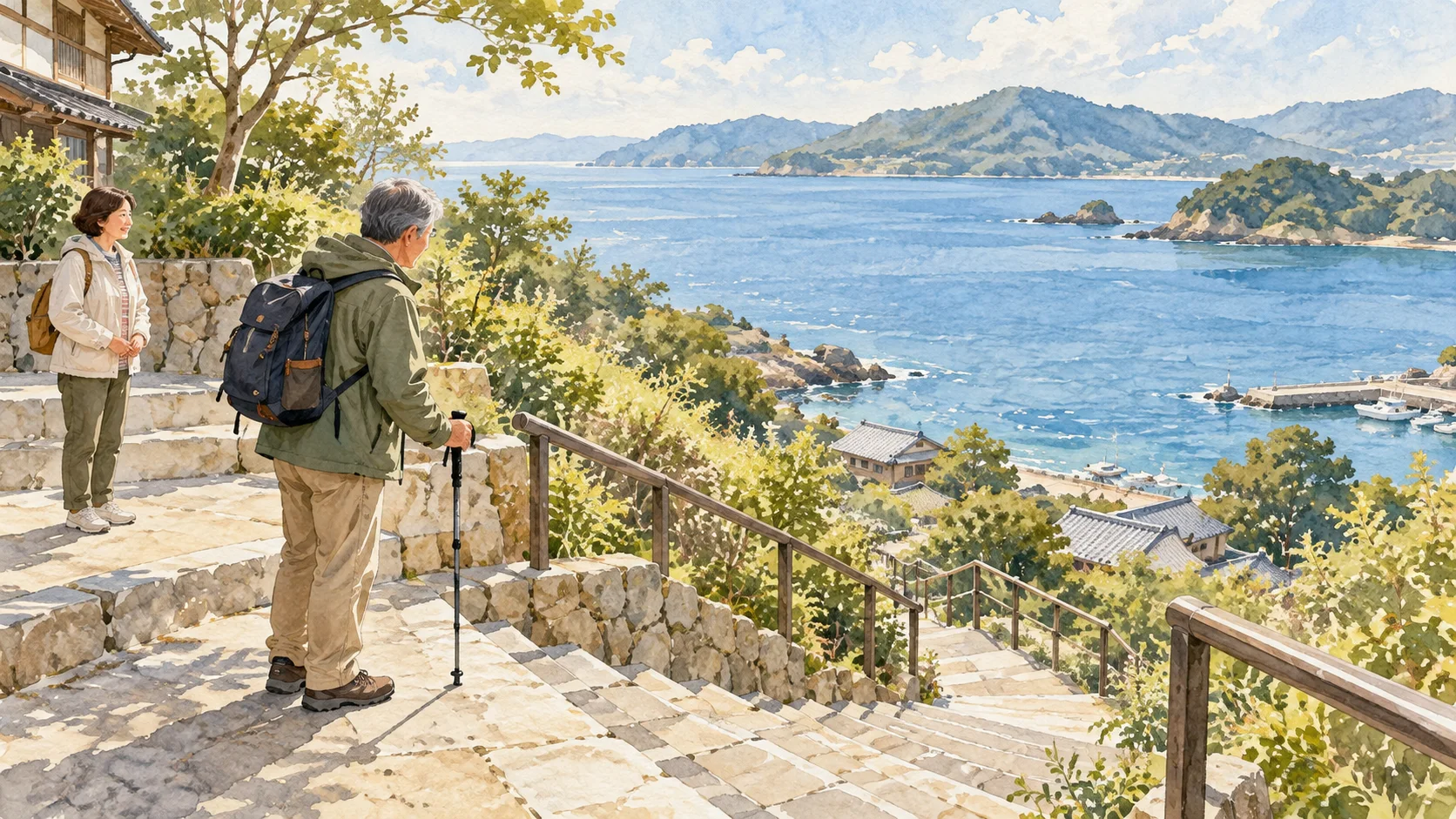
For one night, leave Osaka in the morning, deal with luggage on arrival and choose one coastal walk or suitable public bath. Check in during the afternoon, then bathe and have dinner. After breakfast the next day, allow only a short walk before returning to Osaka or continuing to another stay. If a scenic hotel’s best periods are dawn and late afternoon, avoid spending both in queues at distant attractions.
With two nights, use the second day for one fuller sightseeing direction and another period resting in the room, without changing hotels daily. Bad weather can replace a coastal walk with indoor meals and hotel facilities, but a hotel’s seaside baths are not automatically weather-proof. For a specific theme attraction or event, check its current official programme separately. Animals, performances and fireworks dates in old photographs are not promises for this visit.
Shirahama’s official tourism association carries current news and an introductory footbath video, useful for recognising different ways of bathing on the coast. Footbaths, public full-body baths and room tubs are different facilities. A video has not confirmed today’s opening, bus or any room-category view for you. Execution still depends on the named facility’s dates and access.
Compare room prices with the same guests, meals and cancellation conditions
Turn every quote into the full cost of one room for one night for all guests. Japanese ryokan often quote per person, and a per-person starting rate for double occupancy cannot be compared directly with another hotel’s per-room price. Children may have meal-and-bedding, meal-only or other categories. Enter every real age and check tax, bathing tax, service charges, room baths and bath passes before deciding whether a quote meets the budget.
Suppose two adults share: plan A is ¥28,000 per person with dinner and breakfast, while B is ¥42,000 per room without meals. A costs ¥56,000. If you separately assume ¥10,000 for both guests’ meals with B, B totals ¥52,000, a ¥4,000 difference. This is a constructed example to align the basis of comparison, not any hotel’s quote. It excludes transport and does not establish that two meals must be worth ¥10,000.
Add transport, cancellation risk and whether the original Osaka room can be refunded. If an onsen room price buys two people dinner, breakfast and a period without moving, that may be more informative than floor area alone. If you do not want the ryokan dinner or must leave early, that meal plan has less value. Use the total-cost approach to a Japan travel budget to identify what you actually want to pay for.
Calculate the whole Kansai WIDE pass itinerary without adding journeys to justify it
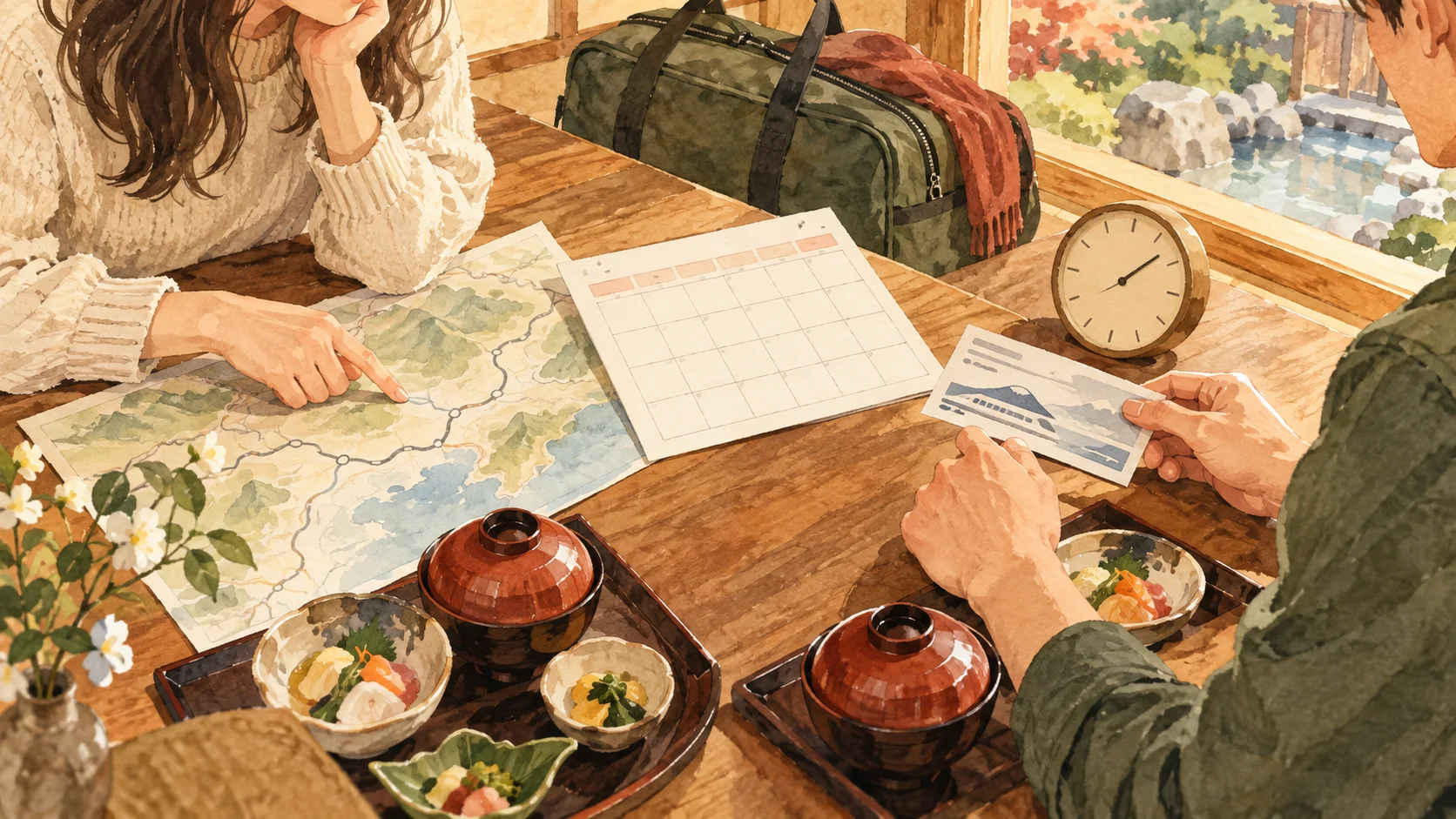
For a trip visiting other points in the wider region, compare JR-West’s Kansai WIDE Area Pass. Five days currently cost ¥12,000 for adults aged twelve and over or ¥6,000 for children aged six to eleven. Eligibility includes a foreign passport and Temporary Visitor status, with seat reservations subject to the usage rules. A pass does not include every train, seat or bus.
The official area description includes Kinosaki and Shirahama, but check your actual route on the validity map. Meiko local buses, the Hankyu highway bus to Arima and hotel pick-ups are not automatically included because a product is called Kansai. Arima and Shirahama are not the same transport segment either. Reserve seats before boarding; a generic “unreserved seat” symbol in a vehicle-page legend does not prove your departure has unreserved seating.
Compare ¥12,000 against actual single-ticket totals for confirmed journeys within the five days. If eligible tickets hypothetically total ¥11,000, buying separately costs ¥1,000 less; if they total ¥15,000, the pass has a ¥3,000 nominal advantage. These are assumed inputs, not claimed round-trip fares to Kinosaki or Shirahama. The comparison method for single tickets, regional passes and reserved seats helps avoid moving hotels again just to make a pass pay off.
Children, tattoos and access needs: eliminate unsuitable rooms first
For families, filter eligibility before scenery. Nishimuraya Honkan takes guests from ten; Arima Grand’s specified north-wing kinsen twin permits two including children; Kaisyu’s Nami no Sho takes four but has only two beds. These three examples show why a “family-friendly” label does not replace room rules. If you need one room, a bed for everyone or toddler meals, state all needs together and obtain the accommodation’s response.
If public unclothed bathing is uncomfortable, select a room bath or a private bath with confirmed eligibility before choosing the destination. Kinosaki’s tattoo-friendly public sotoyu policy is concrete; Arima Grand and Kaisyu’s shared-bath restrictions cannot be solved by assuming a cover-up always permits entry. Ask the named bath about gender arrangements, the age limit for a child entering an opposite-sex bathing area and any assistance needed for washing. A general foreign-language FAQ does not establish every facility’s current rule.
For mobility, ask about the actual path: the incline from drop-off to entrance, thresholds between room and bath, handrails, bath-transfer equipment, bed height and restaurant seating. Without answers, retain a cancellable option. Kaisyu’s ninety mixed-bath steps and stairs to some ground-floor Nishimuraya rooms show why floor numbers and photographs are insufficient. Do not leave someone to discover on arrival that the facility they most wanted is inaccessible.
| Representative room | Occupancy and beds | Water or age condition | Do not infer |
|---|---|---|---|
| Arima Grand north-wing fifth-floor kinsen twin | Two people total, including children | The named room has an outdoor kinsen bath | A large room does not permit a third guest |
| Nishimuraya Honkan standard one-room Japanese category | Two to four; eight tatami mats and window-side area | Honkan ages ten and over; room tubs differ from sotoyu | Sister-property rules cannot be transferred |
| Kaisyu Nami no Sho Japanese-Western room | Four; two beds and two futons | 41 m²; private outdoor tub with heated water | Not four Western beds or a natural-spring room |
Cancellation and meals: the three inns do not share one table
Arima Grand’s FAQ separates ordinary days, nights before holidays and busy periods, with plan-specific exceptions. Copying a single percentage would distort that policy. Nishimuraya Honkan’s cancellation terms generally charge parties of up to fourteen 50% the day before and 100% on the day or for a no-show, alongside earlier fees and plan differences. Keep the full deadline in your confirmation using the hotel’s local date; a platform’s “cancellable” label does not mean free cancellation at any time before staying.
Kaisyu’s official cancellation and meal FAQ generally lists 10% seven to five days before, 20% four to three days before, 50% two to one day before, 80% on the day with notice and 100% without notice. Special plans and groups of fifteen or more differ. It also calculates fees on the amount before coupons or points. With an assumed original ¥60,000 room bill and ¥5,000 discount, a 50% fee is ¥30,000; do not automatically cap it at half of ¥55,000, or ¥27,500.
Confirm allergies, children’s meals and ingredients you avoid before paying. Arima Grand’s meal-adjustment window asks for requests at reservation or at least three days before use; Kaisyu’s low-allergen menu requires contact at least two days before the stay and has its own service format. These are application windows, not guarantees of no cross-contact or acceptance of every requirement. Obtain a direct hotel response for important restrictions: leaving a booking note does not make an arrangement confirmed.
Put the room and transport into one workable onsen plan
Keep two eligible candidates. For each, note dates, every guest’s age, capacity and bedding, water type, both meals and check-in, cancellation deadlines, outward and return departures and the final transport cost. Ask one concrete question: can everyone use at least the thing that matters most to them? If a room bath is essential but the only option is waiting for an unreserved exclusive-use bath, change room category or destination before confirming.
Before departure, revisit the official items that can change execution: Arima’s two-bath calendar, Kinosaki closures and shuttle, Saki no Yu maintenance and sea conditions, and your hotel’s dinner and transport. Keep an offline copy of links, booking reference and contact number. The purpose is to carry confirmed conditions with you, not to expect a ryokan to honour everything in another article or old screenshot.
With only three Osaka days, protect your priorities using the city itinerary and interchangeable days, then decide whether to add Arima. With four or five days and willingness to change accommodation, a Kinosaki or Shirahama overnight fits more easily. The right base is one you can reach, eat dinner at on time and sleep comfortably in, without abandoning breakfast to catch the next train.
A few useful answers
Which onsen near Osaka should I choose for one day?
Compare Arima first: a direct reserved-seat bus runs from Umeda, and a public bath, lunch and town walk fit one day. Kinosaki and Shirahama can also be round trips, but long-distance and last-mile transport reduce rest and bathing time; an overnight is usually a better fit.
Does the Kin no Yu and Gin no Yu combined ticket always save money?
No. On an ordinary weekday, ¥650 plus ¥550 equals the ¥1,200 combined ticket. Usual admissions of ¥800 plus ¥700 total ¥1,500, a ¥300 difference. Check both are open; towels, transport and child tickets are separate.
Can an Arima day visitor use Grand Hotel’s private baths?
No. The hotel’s official FAQ excludes day visitors from kashikiri. Shared-bath admission, lunch plans and overnight entitlements differ; recommending a private bath for tattooed guests does not make it available on a day-use ticket.
Are all seven Kinosaki public baths currently open?
That cannot be guaranteed. At the 21 October 2026 check, Satono-yu remained closed for refurbishment and Kono-yu’s scheduled closure ran to 30 October. Reopening requires official confirmation; other baths retain their own closing days and temporary changes.
How long does an accommodation bath pass in Kinosaki last?
The official FAQ normally gives check-in until 13:00 on the checkout date, but first confirm your inn and plan supply it. A separately purchased day pass is limited to one day; confirm the date of use and cut-off time at the bathhouse counter when you buy it. A pass does not open closed baths or include hotel kashikiri.
Do tattoos allow access to every bath in Kinosaki?
Public sotoyu accept decorative tattoos, while ryokan internal and private baths have their own rules. Do not extend the public policy to all accommodation or assume a cover-up resolves another facility’s restriction.
Can I stay at Nishimuraya Honkan with a child?
Honkan has limited stays to guests aged ten and over since 1 April 2024. A child aged nine or younger cannot qualify merely because the room fits. Sister properties and other inns have separate conditions, and meals and bedding need confirmation too.
Does a private outdoor room bath in Kinosaki use natural spring water?
The word outdoor does not establish that. Official Kinosaki information describes ordinary heated water in private room tubs. For natural spring water, confirm a shared bath or named kashikiri. Privacy and water type are different conditions.
Does every Kaisyu room have a private natural hot-spring outdoor bath?
No. Some Nami no Sho and Akatsuki no Sho categories use heated water in their outdoor tubs; specified Hamaya Hanare categories list free-flowing spring water. The 19 m² Akatsuki double has no outdoor tub. Check the full category name.
Does Kaisyu provide a free Shirahama Station shuttle?
The current official FAQ says there is no shuttle: use a local bus or taxi. Sogen no Yu bus stop is about three minutes away on foot. This is not automatically another Shirahama hotel’s rule, and final-leg services and costs need separate checks.
Can I wash my hair at Saki no Yu?
No. Shampoo, conditioner and soap are prohibited; arrange washing at another suitable facility. Admission is ¥500 from age three, with seasonal hours and maintenance or sea-related changes. Sunset alone should not determine when you arrive.
Should I buy a Kansai WIDE pass for one onsen night?
Calculate the whole trip first. If eligible, there is nominal ticket value when confirmed covered journeys within five days exceed the adult ¥12,000 pass price. The Hankyu highway bus to Arima, Meiko buses and hotel services are not automatically included.
Check with the source
Schedules, availability and rules can change. These official sources are the place to confirm details before you book.
- Arima Kin no Yu: fees, hours, amenities and water
- Arima Gin no Yu: fees, closures and amenities
- Official Kin and Gin site: current calendar access
- Hankyu Kanko Bus: Osaka–Arima departures, fares and reserved seats
- Arima Grand Hotel: overnight, day-use, private-bath and meal FAQ
- Arima Grand Hotel: room categories
- Arima Grand official booking: north-wing fifth-floor kinsen twin, capacity and in-room meals
- Visit Kinosaki: town introduction and journey time
- Visit Kinosaki: bath passes, shuttles, luggage and room-bath water
- Visit Kinosaki: public-bath opening, closures and tattoo policy
- Kinosaki Tourism Association: Kono-yu refurbishment in 2026
- Nishimuraya Honkan: rooms, capacities and minimum age of ten
- Nishimuraya Honkan: facilities, arrival and sister-property private spa
- Nishimuraya Honkan: cancellation terms
- JR-West: limited express Kounotori route
- JR-West: limited express Kuroshio route
- JR-West: Kansai WIDE Area Pass prices, eligibility and coverage
- Shirahama Town: Saki no Yu fees, seasonal hours and prohibited products
- Shirahama Town: Saki no Yu maintenance updated 20 October
- Kaisyu: room occupancy, beds, heated water and natural-spring baths
- Kaisyu: shuttle, cancellation, tattoo, meal and private-bath FAQ
- Kaisyu: two private baths, bathing garments and ninety seaside steps
- Meiko Bus mobile ticket sales: Shirahama local passes
- Nanki Shirahama Tourism Association: news and official footbath video
- Meiko Bus: paper and digital pass availability
- Toyooka City: Schedule 1 of the Kinosaki Yushima bathhouse ordinance