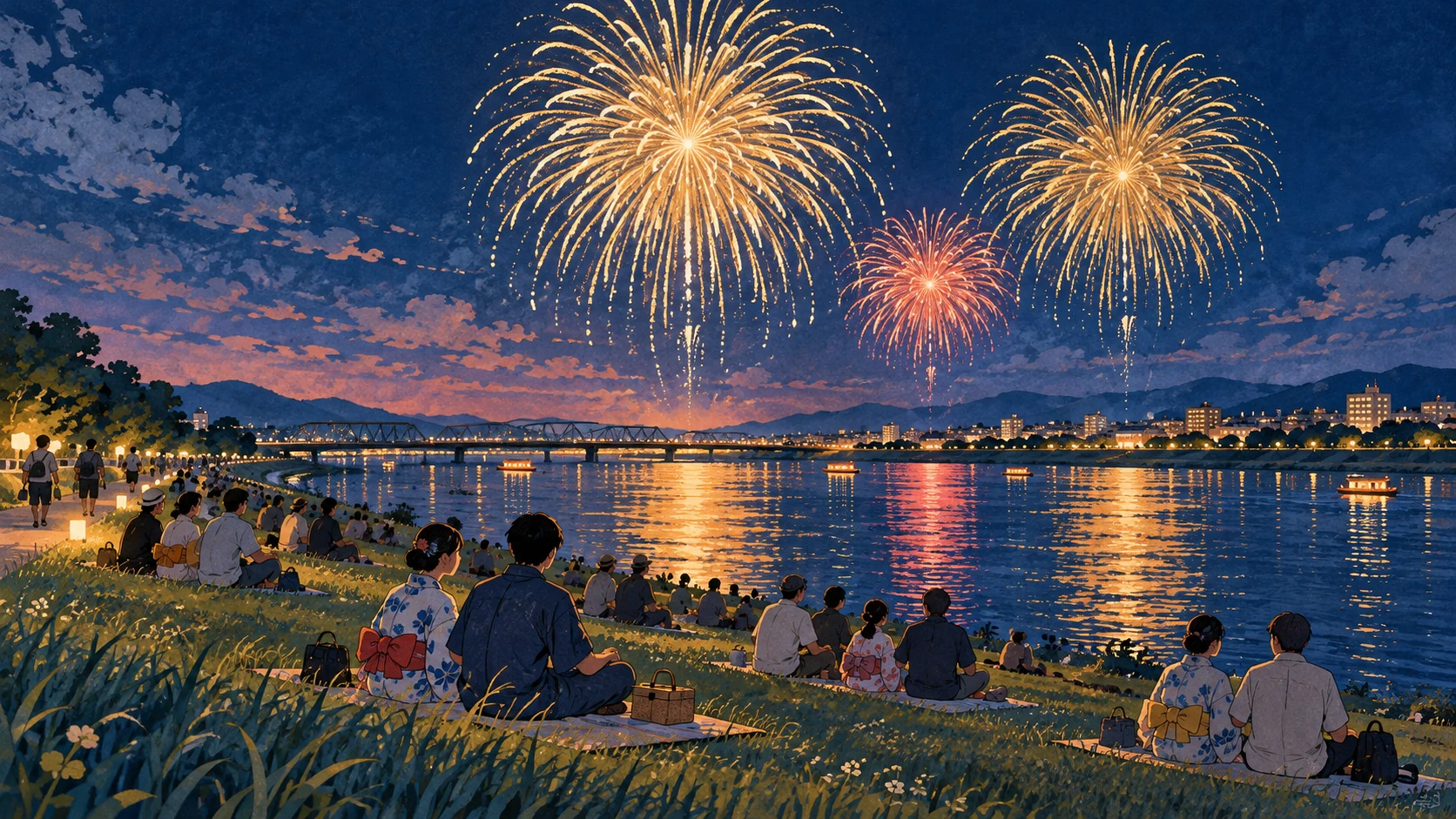
Before choosing a seat or city, work out where you can stay after the fireworks. This guide compares tickets, children’s admission, refunds, accommodation and transport at seven Japanese displays. It distinguishes the six completed 2026 events, the still-planned Tsuchiura competition and details not yet confirmed for the next editions, helping you arrange an evening with a workable journey back.
Choose one Japanese fireworks festival: start with the return journey, seats and purpose of the trip
For a first trip built around Japanese fireworks, answer “Where will I sleep afterwards?” before comparing the number of fireworks. Consider Nagaoka for a wide river setting, music and a story of recovery; compare summer Omagari with autumn Tsuchiura for competitive fireworks; or look at Otsu, Suwa, Onomichi and Gamagori for a lake or harbour evening within an existing trip. These seven events have different venues and tickets. One buying guide cannot cover them all, and no display guarantees low prices, small crowds, free entry and an easy exit at once.
The official information in this guide was checked on 22 October 2026. The table retains the dates and ticket arrangements for the 2026 editions as a basis for comparison. The dates for Onomichi, Gamagori, Nagaoka, Lake Biwa, Lake Suwa and summer Omagari have passed; Tsuchiura is still planned. This is not a confirmed 2027 calendar. Without an announcement for the next edition, do not simply move its date, seating, prices or sales arrangements forward by a year. For a trip next year, choose a base and flexible accommodation first, then wait for the organiser’s announcement before making nonrefundable commitments.
If you already have a region in mind, go straight to Nagaoka, Omagari, Tsuchiura, Lake Suwa, Lake Biwa in Otsu, Onomichi or Gamagori. Otherwise, compare the differences below before reading the seating and accommodation sections. Walking times are quoted only where the organiser provides them; they are not promises about moving through fireworks-night crowds.
| Event and base | 2026 date and time | First issue to resolve |
|---|---|---|
| Onomichi Sumiyoshi Fireworks Festival / Onomichi | 25 July, 19:30–20:30; date has passed | Separate city hall-side and Mukaishima tickets and return routes |
| Gamagori Festival fireworks / Gamagori | 26 July, from 19:30; date has passed | No refunds for supporter tickets on cancellation; station entry may be controlled |
| Nagaoka Fireworks Festival / Nagaoka | 2 and 3 August, from 19:20; dates have passed | JR travellers should consider the A right bank first; no free viewing seats |
| Lake Biwa Great Fireworks Festival / Otsu | 6 August, 19:30–20:30; finished | Dynamic prices; match the ticket area to its station and entrance |
| Lake Suwa Festival Fireworks Display / Kamisuwa | 15 August, 19:00–21:00; finished | Residence eligibility for the general lottery and the lakeside view |
| Omagari National Fireworks Competition / Daisen | 29 August, daytime 17:10–18:00, night 19:00–21:30; finished | Summer competition tickets are separate from spring and autumn events |
| Tsuchiura All Japan Fireworks Competition / Tsuchiura | 7 November, 17:30–20:00 planned | Existing valid tickets, paper-ticket delivery and staggered exits |
What to book first: make accommodation, admission and the return journey work together
Break the evening into four stages: where to leave your luggage, which entrance to use, which station to walk towards afterwards and how to get back to your room. If any stage depends on “I’ll work it out there,” hold off on noncancellable seats. A room near the station may be far from your viewing area. Opposite riverbanks, ends of a lakefront or sides of a harbour can mean entirely different walks and queues. The cheapest seat may not reduce the evening’s total cost if it adds a bridge crossing subject to crowd controls.
Start with the organiser’s dates and venue for the relevant edition, then compare cancellable room rates, train ticket sales dates and fireworks ticket eligibility. Put each payment deadline and the date cancellation charges begin into the same itinerary. Winning a lottery does not necessarily mean you have paid; successful payment does not necessarily mean you have collected a ticket you can use to enter. If tickets must be mailed to a Japanese address, obtain the hotel’s explicit agreement to receive them before entering its address.
Once a workable combination of accommodation and transport exists, decide whether fireworks are the trip’s main purpose or an addition to an established route. Crossing half of Japan for one display also costs long-distance fares, an extra night and recovery time the next day. Use the route-by-route approach in the Japan rail ticket guide. Do not schedule a train you cannot reach after the show simply to use a rail pass: permission to travel is not a guarantee that a popular reserved train still has seats.
Masu blocks, chairs and obstructed-view seats: headcount is only one consideration
A masu seat is a viewing space sold as a block; it does not necessarily include chairs. For sajiki seating, benches, tables and grass areas, read that organiser’s product description. Mark the price unit when comparing: per person, per ticket, a pair or a complete four-person block are different purchases. Two people buying a four-person space do not automatically pay half. Four adults in a block marked “maximum five” may be less comfortable than in four separate chairs. Bags, rain gear and children also need space.
Mikire means a restricted view, not simply a discounted standard seat. Trees, railings, buildings or the viewing angle may hide low-level and water-surface effects. A completely obstructed-view ticket at Lake Suwa should not be bought with expectations of an unobstructed lake show. Photographers must also check which ticket areas allow tripods. Promotional footage filmed high above the venue does not show the view from every ground-level seat.
Check children’s rules separately for each event. Some require tickets from age three; others use primary school entry as the dividing line. Free admission may require sitting on an adult’s lap without an additional seat. Wheelchair seating can have companion limits, documentation requirements, ramp access and accessible toilet arrangements; it is not simply a standard chair removed from a row. Before buying, state each child’s actual age, whether they need their own seat and any mobility requirements. That is more useful than asking only whether there is a family discount. The sections below retain the differences we could verify and make no promises on the organiser’s behalf where evidence is missing.
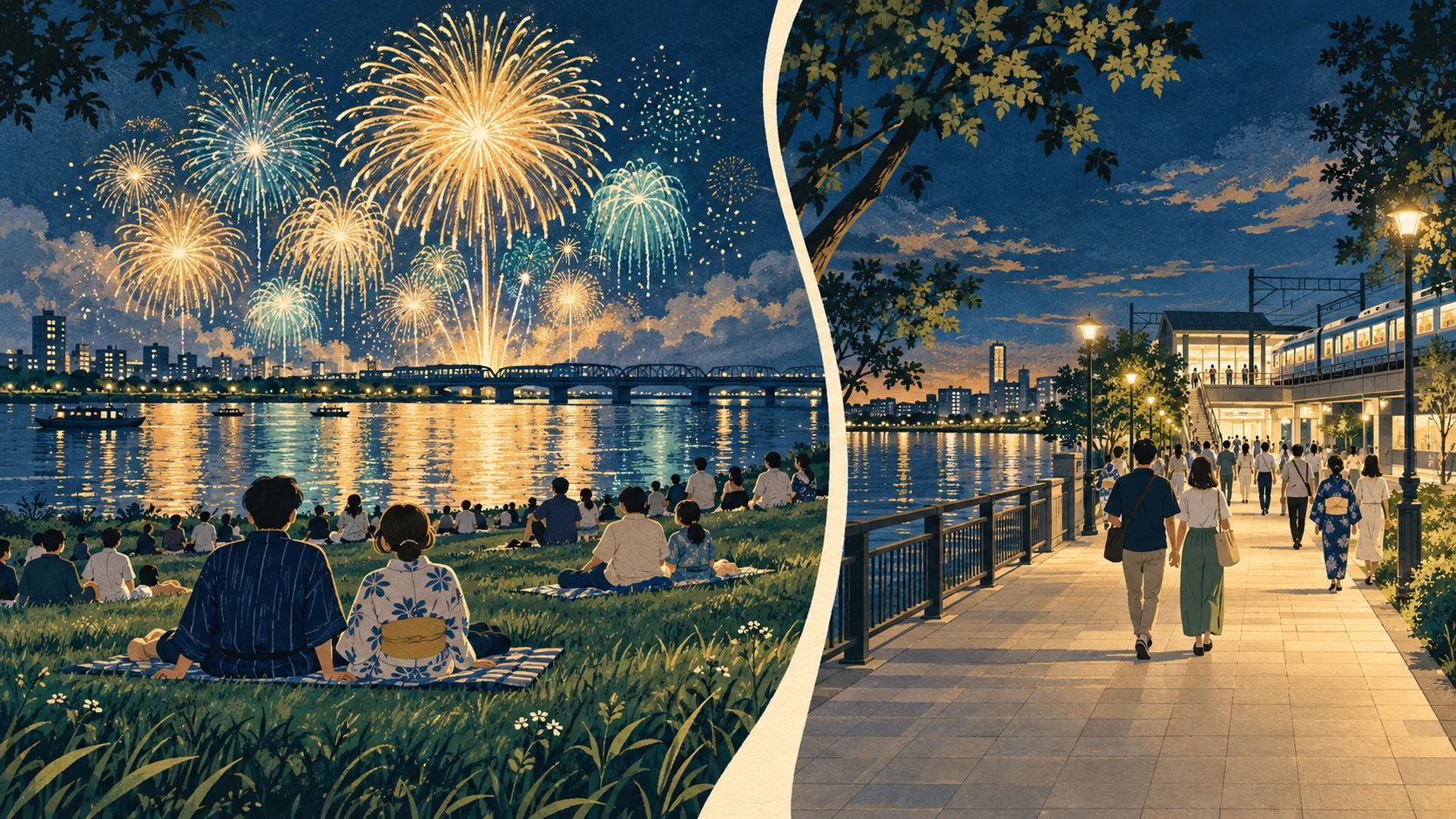
Nagaoka: each night needs its own ticket, and JR travellers should examine the A right bank first
The Nagaoka Fireworks Festival takes place along the Shinano River. Its 2026 dates were 2 and 3 August, with separate arrangements for each night. Both the official 2 August programme and official 3 August programme list a 19:20 start and programme items as late as around 21:25. Those are performance times, not times you will reach the station. Check the programme, seating and order for each night separately; one night’s ticket does not admit you on both nights.
Nagaoka suits a trip combining a large riverbank display with time in the city, provided you can work with its ticket and crowd arrangements. The organiser’s FAQ explicitly says there are no free viewing seats and no tickets sold at the venue on the day. If you have no ticket, do not treat embankments, bridges or roads as an alternative free venue. For the 2026 edition, which has already ended, the general lottery accepted online applications only, from 25 May at 12:00 to 8 June at 17:00. A Rakuten account was required, and applicants needed to check that their registered address was up to date. Only one application per address was allowed. Applicants could give a first and second choice for each of 2 and 3 August, and could win tickets for just one night. Result emails began going out after 15:00 on 17 June. Payment was charged immediately to the credit card registered to the Rakuten account upon winning, so applicants could not wait until they won to decide whether to pay. For tickets requiring shipment, the published 2026 sales schedule listed dispatch starting in late June. Delivery destinations and receipt arrangements still needed separate checking; overseas delivery could not be assumed. The planned second lottery was cancelled after the first round sold out, so it was not a guaranteed second chance to buy tickets. Follow authorised resale and any later official announcements of purchasing opportunities. An offer on social media does not establish that a ticket can lawfully be used or reissued.
Nagaoka Station is on the A right-bank side. The official access information estimates an ordinary walk of about 30 minutes from the station to venue A and about 40 minutes to venue B on the left bank, and advises JR passengers against adding a bridge crossing for B-side seats. The difference is more than ten minutes: bridge controls, seat exits and organised station entry change the nighttime route. If this is your first visit and you will return to your accommodation by train, compare similar A-side seats before comparing prices. Match the bank to your return journey.
Staying for Nagaoka: the journey ends at your room
Staying near Nagaoka Station can reduce the remaining task after the show to a walk back to your room. It reduces transfers; it does not guarantee no queues or a cheaper room. If Nagaoka is full, check that edition’s extra trains, bookable departures, station routing and the hotel’s latest check-in before considering Niigata or another rail-connected base. A daytime train duration does not prove the evening connection will work. Avoid putting an early airport departure immediately after a return journey with no margin.
A possible rhythm is to reach your base before noon, leave your luggage, eat and buy supplies during the afternoon, enter through the gate on your ticket and leave as staff direct. This is a planning suggestion, not the organiser’s gate timetable. To stay through the last programme item, choose accommodation that allows a late return. If your train cannot be changed, assess beforehand whether you must leave early and whether your section allows the exit direction you need. Do not leave it until you must run against the crowd.
The organiser’s FAQ generally requires tickets for primary-school children and older, with preschool children watching on a guardian’s lap; a young child occupying a separate seat also needs a ticket. For individual travellers from overseas, the separate 2026 lottery for individual overseas visitors had its own rules. It was open only to people living outside Japan; residents of Japan could not apply, and no Rakuten ID was required. Applications ran from 25 May at 12:00 to 8 June at 17:00, with one application per event day and a first choice allowed for each of the two nights. Results were emailed from 17 June, with payment processed at the same time as that day’s results notification. Applications could not be changed or cancelled after a win was confirmed. These overseas tickets were collected around Nagaoka Station on the day of the display, with details in the winning email; the general tickets’ postal arrangements could not be assumed to apply. Before filling in an application, check that edition’s phone-number fields and accepted payment-card requirements. The FAQ limits official resale to residents of Japan, and this overseas ticket was explicitly ineligible for resale, so resale is not a fallback available to every overseas visitor. These are the rules of the completed 2026 edition. Recheck 2027 general prices, overseas options, application conditions and postponement terms through the Nagaoka fireworks ticket centre. This guide has not verified those 2027 conditions and does not treat past rules as confirmed booking information for the following year.
Do not assume a full refund. The current official FAQ says postponed tickets remain usable on the designated date, without a refund if the traveller cannot attend; cancellation refunds are capped at 50%, with fees deducted; and stopping after the performance has begun brings no refund. The FAQ mixes material from different years. Before booking, check the complete terms for your edition and ticket type. Until the new edition’s conditions are available, no refund percentage should be treated as money certain to come back into your budget.
Omagari National Fireworks Competition: leave a full afternoon as well as the evening
Omagari’s summer National Fireworks Competition is separate from its Spring Chapter and Autumn Chapter. Dates, programmes and tickets cannot be interchanged. The official overview of the 98th summer competition lists 29 August 2026, at Omagari Fireworks Park beside the Omono River, with gates scheduled to open at 15:00. Daytime fireworks were scheduled for 17:10–18:00 and the night programme for 19:00–21:30. The website marks that edition as finished. Finding an Omagari event in October does not mean the August competition was moved to October.
Omagari rewards an interest in how pyrotechnicians combine colour, form and rhythm, rather than simply counting shells. The daytime competition uses coloured smoke and shapes; the evening adds size-10 shells and creative fireworks. To see both parts, keep the whole afternoon and evening free. Do not schedule a distant attraction first and then rush to the riverbank. Eating a proper meal, obtaining water and using the toilet before entering can reduce repeated journeys through the crowd once you are seated.
General ticket information for summer 2026 lists individual chairs at ¥8,000 per person including tax, two-person benches at ¥13,000 per block including tax and four-person tables at ¥38,000 per block including tax, with delivery or handling charges extra. Two adults buying chairs pay ¥16,000, compared with ¥13,000 for a two-person bench: a ¥3,000 difference for a different seating format, not just a different per-person price. Primary-school children and older need tickets. Preschool children may enter free with a guardian, but need a ticket if they occupy their own seat.
Omagari hotels, sales and postponement: choose a reachable base before a seat
The official Omagari access and accommodation page puts the venue centre about two kilometres from JR Omagari Station, normally about a 30-minute walk. After the show, you still have to return to the station entrance and follow that edition’s transport plan and on-site station routing. A room in Omagari reduces the final rail journey. If rooms are full, check the last trains and seats for travel back to the officially listed bases in that edition such as Akita, Yokote and Kakunodate. A room showing as available is not proof that you can reach it after the show. A Tokyo day trip cannot be judged from Shinkansen journey time alone. Drivers must also allow for road closures and leaving the parking area.
General online tickets in 2026 were sold first come, first served through official links to Lawson Ticket, e+ and other designated channels, with a separate specified channel for special photography seats. The pages reviewed concern an event that has ended. Overseas visitors should separately check accounts, phone verification, payment and delivery. Being able to open a Japanese ticket page does not mean every foreign card or overseas address is accepted. A travel package with seats and return coach transport may be worth comparing, but verify the actual departure point, time at the venue, accommodation and cancellation terms rather than relying on “fireworks ticket included.” The official FAQ also says all viewing seats inside the venue are paid and there are no free viewing seats. Roads outside it are not designated alternatives for people without tickets.
For postponement due to severe weather, the organiser says the replacement date will be decided according to restoration of the venue, and the original ticket remains valid. Refunds apply only if the event is cancelled, using the specified procedure. Programme changes or a shortened display do not qualify, and choosing not to attend does not create a general refund right. The wheelchair area has separate eligibility and capacity rules: the 2026 page requires wheelchair use and specified documentation. Do not assume an overseas document qualifies. Ask the organiser about a workable arrangement before making other nonrefundable bookings if the documentation or mobility requirements do not match the published conditions.
Tsuchiura: the 2026 show is still ahead, but past sales windows do not mean tickets remain
The official date for the 95th Tsuchiura All Japan Fireworks Competition is 7 November 2026, scheduled for 17:30–20:00, with 14 November as the severe-weather backup date. If neither date is possible, it will be cancelled. Unlike summer Omagari, this is not a daytime-and-evening programme; do not add another competition’s daytime fireworks to the Tsuchiura itinerary. The main venue is beside the Sakura River. Distinguish Tsuchiura Station, the shuttle stops and the actual entrance to your ticket area: reaching the station is not the same as completing admission.
The 2026 paid-seating announcement lists a full masu block at ¥26,000 including tax, with a maximum of five people but four adults recommended; a half block at ¥13,000 including tax for a maximum of two; and A-section chairs at ¥6,000 per person including tax. A five-person limit does not mean five chairs. Preschool children are free only if they fit within the assigned masu space or sit on an accompanying person’s lap in the chair area; primary-school children do not qualify. If you need a backrest, wheelchair access or frequent exits, check the ground, entrance and services for that ticket area before choosing a cheaper block.
The general lottery ran 12 August–10 September and the official resale lottery 27 September–2 October; both periods had ended when this guide was checked. The organiser specifies mailed paper tickets and an additional ¥990 special delivery charge. Even if the application interface displays an electronic-ticket option, that does not turn admission into a phone QR scan. For a November trip, establish whether you already have a valid ticket and a receiving arrangement. If you have none, this guide is not a guarantee that seats remain on sale.
Returning from Tsuchiura to Tokyo or staying locally: staggered exits affect train choices
Tsuchiura looks geographically straightforward as a day trip from Tokyo. The difficulty is the concentration of travellers moving in a short period after the fireworks. Accommodation around Tsuchiura Station can make the final leg a walk. For a Tokyo or Joban Line base, check that night’s trains and the journey from the venue back to the station. An available room along the line is only a candidate: include the station-to-hotel walk, latest check-in and an alternative if you miss the intended service.
The 2026 shuttle notice lists Tsuchiura Station’s east exit to Gakuen Bridge, outbound 15:00–17:30 and return 18:30–21:30, as scheduled hours. One-way fares are ¥400 for adults and ¥200 for children. About ten minutes is the ride itself; the queue may exceed 30 minutes. The 7 October exit notice requires staggered release by block from the sajiki venue, directs walkers towards the station’s east exit and prohibits crossing between the sajiki venue and the separate chair-seat venue. Do not book a close connection by adding an ordinary walking time to the scheduled 20:00 finish. The official rail guidance also states that a limited-express ticket gives no priority for entering the station.
A postponed Tsuchiura ticket remains usable on the backup date, but postponement or stopping after the start does not qualify for a refund. If the event is not held and refunds are offered, the listed refundable amounts include the ticket price, system fee and special sales handling fee; the ¥990 special delivery charge is excluded. Transport and accommodation follow their own contracts. If you leave Japan on 8 November, the 14 November backup date is of no practical use to you. The organiser also provides no free viewing seats. Without a ticket, do not substitute occupying an embankment or road for a ticket plan.
Lake Suwa: check the lake view and overseas purchasing eligibility together
The 78th Lake Suwa Festival Fireworks Display was listed for 15 August 2026. The official FAQ gives 19:00–21:00, and the website marks it as finished. Paid viewing areas are in Suwa’s lakeside park, with fireworks launched from Hatsushima and temporary platforms in front of the park. If water-surface fireworks are your priority, establish the seat’s line of sight over the lake first. A cheaper obstructed seat may hide exactly what you came to see. Other seasonal fireworks and shorter events around Lake Suwa have different tickets, scale and viewing arrangements; they are not interchangeable versions of the 15 August festival.
The 2026 general ticket lottery explicitly limits applicants to residents of Japan. Short-term overseas visitors should not assume they qualify. Representative tax-inclusive prices are ¥8,500 per person for lakeside chairs, ¥6,000 for obstructed-view seats and ¥3,000 for completely obstructed-view seats. The last category has no view of the lake surface and some fireworks are obscured; understand why it is cheaper. Any other officially authorised channel or accommodation package including tickets requires its own eligibility and content checks. Do not use a false address to bypass the restriction.
The organiser’s FAQ requires tickets from age three. Children under three may enter free if seated on a guardian’s lap. That differs from Omagari and Nagaoka, where primary school is the dividing line: the same four-year-old cannot have the same budget entry at every festival. With young children or companions who need frequent rests, make it possible to leave early rather than forcing everyone to stay in a crowded area for the entire programme.
Kamisuwa accommodation and weather: a lake-view room does not guarantee a fireworks view
The official FAQ estimates the normal walk from Kamisuwa Station to the venue at about ten minutes, with longer needed on fireworks day. Staying within walking distance in Kamisuwa can reduce transfers afterwards, but ask about dinner service, check-in deadlines, curfews and luggage storage. A ryokan package including dinner may conflict with admission time. Do not pay for two meals only to discover you must return for dinner before the fireworks. Use the first ryokan stay guide’s meal and check-in questions to work through the arrangements.
A lake view, a fireworks view and a viewing seat are three different things. A “lake-view room” promises only the view described in the booking. It does not automatically include a dedicated fireworks seat, the complete water-surface show or permission to use a tripod on the balcony. For a fireworks accommodation package, obtain explicit details for that edition: room orientation, how viewing works, whether you must travel separately to the venue and the cancellation schedule. If Suwa is full, check bases such as Chino or Okaya along the railway, including trains after the show and the final leg to the room; map distance alone is insufficient.
Lake Suwa normally proceeds in rain, but dangerous conditions can cause cancellation or interruption. There is no postponement or replacement date. If the event is cancelled before it starts, paid admission tickets can be refunded under the rules, with sponsor tickets excluded; fees, transport and accommodation are not refunded together with them. A raincoat helps during light rain when the event can go ahead. It does not solve dangerous weather. Keep daytime plans that do not depend on the display and retain a direct link to the organiser’s latest notices.
Can you see anything without a paid ticket? The organiser’s FAQ says there are no designated free seats, but fireworks may be watched free outside the paid area; water-surface effects may be difficult to see from outside. This grants no right to occupy private land, passageways or places where stopping is prohibited, and guarantees no seat. Distant viewing may suit someone content with part of the aerial display. If the lake-surface Grand Starmine is the main reason for your trip, viewing outside the paid area should not be treated as an equivalent substitute.
Lake Biwa: distinguish the Otsu event, dynamic prices and electronic tickets
The Lake Biwa Great Fireworks Festival discussed here is the organised event over the water off Shiga Prefecture’s Otsu Port, not every fireworks display with “Lake Biwa” in its name. The official website marks the 6 August 2026 event as finished, and that edition’s ticket information gives a scheduled 19:30–20:30 display. Match Otsu, the organiser and the date when searching. Do not mistake tickets for Nagahama, another shore or another organiser’s event for this one.
The official 2026 ticket page uses dynamic pricing. Listed tax-inclusive amounts such as ¥7,500 for chairs and ¥8,500 for lakeside chairs are base prices before variation, not fixed prices available at all times. Most ticket types are collected electronically. Complete d ACCOUNT registration, payment, ticket collection and any arrangements for companions before travelling. A surviving “Buy” button does not mean valid new seats remain for an event that has ended, and a base price does not establish next year’s budget.
Tickets are required from age three. Trees or railings may restrict low-level views, and tripods are allowed only in designated photography seats. On the west side of Nagisa Park, a separate wheelchair-and-companion ticket had a 2026 tax-inclusive base price of ¥13,200, covering one wheelchair user and one companion. This is not a general two-person discount. An unreserved area may still require admission tickets: “unreserved” does not mean free or no booking required. Read the chair, mat and entrance restrictions for the area you actually buy.
For viewing from the shore without paid seats, use the map for the relevant edition. The official 2026 route map separately marks a general viewing location farther east than the paid unreserved area, along the shore towards the Otsu Prince Hotel. It is distinct from ticketed unreserved seating. The map guarantees no personal seat, view or available capacity. Do not label the entire lakeshore “free seating” or enter red-marked no-entry and no-stopping areas. Wait for the next edition’s map to establish whether those areas remain the same.
Otsu and Kyoto hotels: let your ticket area determine the station and exit route
A Kyoto base lets you keep existing accommodation for the Otsu fireworks, but still leaves a walk, station queue and train journey afterwards. Staying on the venue side in Otsu may reduce transfers, provided the hotel location matches the entrance to your ticket area. JR Otsu Station, Zeze, stops on the Keihan line and Yanagasaki are not one interchangeable walking destination. The official 2026 route map gives admission from 17:00 for paid seats, 14:00 for the paid unreserved area and 12:00 for that area’s fast pass. These are different areas’ entrance times, not early access for every ticket.
The 2026 map warns of heavy congestion between Otsu or Zeze stations and the venue after 17:00, with possible staggered exits from paid seating. Boarding is not available through Otsu Station’s south entrance, and Zeze Station’s south entrance closes 20:00–24:00. When facing the stations, return queues for Otsu and JR Zeze put Kusatsu/Maibara travellers on the right and Kyoto/Osaka travellers on the left. If staying in Kyoto, identify your queue rather than following a normal-day shortcut through a south entrance. These measures apply to that edition: download a new map next year. A later start the following morning can also reduce pressure from a delayed return.
The official ticket terms exclude refunds for voluntary cancellation or programme changes. If severe-weather cancellation leads to refunds, the listed refundable amounts include the ticket price, system fee and advance sales service fee; ticket issuance and convenience-store payment fees are excluded. Official resale also excludes some ticket types and channels. A transaction exists only when a buyer is found: being able to list a ticket does not guarantee your money back. If changing your trip, calculate the separate losses on the fireworks ticket, room and train ticket.
Onomichi Sumiyoshi: the two sides of the channel have different tickets and routes
Onomichi Sumiyoshi Fireworks Festival takes place along the Onomichi Channel. The 2026 date was 25 July, 19:30–20:30, with the city hall supporter seating scheduled to open at 17:00. Choosing the Honshu side can keep the old streets, Onomichi Station and your accommodation on one side. A Mukaishima viewing area requires a separate plan to cross the water and return. A short everyday ferry crossing proves nothing about boarding the last service without queues or controls that night. Put the seat’s address into your itinerary before choosing accommodation, rather than collecting only a photograph of the water.
Official city hall supporter-seat information lists frontmost two-person masu blocks at ¥12,000, frontmost four-person blocks at ¥22,000 and individual chairs in the parking area at ¥4,000 in front rows or ¥3,500 in rear rows. These are prices for that year, bank and product. Do not combine them into one price list with the Mukaishima commerce association’s table-and-chair product. Steps, roof and ground-level positions at city hall also differ. Anyone avoiding stairs or extended floor sitting should consult the seating map and ask which areas they can reach.
For 2026 city hall seats, the organiser links to Ticket Pia and lists specified dates for in-person sales. Online orders paid at convenience stores have payment deadlines; after payment, voluntary cancellation is not available. Online purchases may be resold under Pia’s rules, without a guarantee of a buyer, while tickets bought in person are ineligible for resale. For cancellation before the start, that edition’s notice specifies refunds: online purchases receive the ticket price and issuance fee but not the system fee; in-person tickets receive face value. Severe weather that prevents the event means cancellation, with no postponement. These terms do not govern the other seller’s seats across the water and do not promise a full refund if the show stops after starting.
Onomichi hotels and Mukaishima: do not leave the ferry journey unconfirmed
For a hotel near Onomichi Station, establish that edition’s permitted route between the hotel and city hall-side viewing area. The 2026 traffic controls were scheduled for 18:00–22:00, with some junctions restricting incoming vehicles from 17:30 and reopening determined on site. A quiet-looking road does not permit a car inside the controlled area to leave early. Follow the designated queue when returning to Onomichi Station: use the toilet before crossing the specified junction, because leaving the queue afterwards means joining again at the back. If local hotels are full, check that night’s Sanyo Line and final connections before choosing a base such as Fukuyama. The presence of a Shinkansen station does not establish that you can reach it in time.
The Mukaishima option from the Onomichi Shimanami commerce association is at Mukaishima Chuck Square. Its 2026 price was ¥15,000 per block for up to four people, with one long table and four chairs, or ¥3,000 for an individual chair without a table. It provides viewing and seating on Mukaishima; it does not settle every transport leg from Onomichi’s Honshu side and back. Verify parking, extended ferry services, whether children count towards capacity and refunds with that product’s operator. City hall ticket terms cannot supply those answers.
The city hall supporter-seat FAQ excludes preschool children from capacity only when they sit on a guardian’s lap; a separate seat counts towards the limit. The Omoiyari masu blocks are in the ground-floor (1F) parking area, priced at ¥12,000 for a maximum of four people including an assistant, and are for applicants meeting conditions such as wheelchair use. This does not make every area step-free. Check the full route through the station, ramps, ground surfaces, toilets and the post-show return. Ask separately about Mukaishima’s child and accessibility conditions. Until the ferry or cross-channel route is confirmed, keep accommodation and viewing options on the same bank.
Gamagori: read the sponsor seats’ no-refund terms before choosing the giant shells
Gamagori Festival was listed for 25–26 July in 2026, with the fireworks scheduled to start at 19:30 on the 26th. That edition’s official booklet describes a display of about 80 minutes; the date has passed. Both Gamagori City’s official introduction and the organiser’s programme features emphasise giant shosanjakudama shells launched from offshore barges, alongside music and water effects. To enjoy the whole programme, compare the sea view and sound position. Seeing a giant shell in the distance does not mean every distant street corner offers the same experience.
The organiser’s FAQ lists 2026 special viewing seats for supporters: ¥6,000 for a single chair, ¥12,000 for a pair and ¥24,000 for a four-person mat area, all reserved. Ticket types occupy separate areas. A group that wants to sit together should choose the same type; purchases cannot simply be changed afterwards. Parts of a mat-area view may also be obscured by a passageway or seats in front. One preschool child may enter with a guardian per adult ticket, but no additional chair is provided.
The key condition for this product is that cancellation due to severe weather or other natural disasters still brings no refund. Do not import another festival’s cancellation policy. Tickets are purchased through the officially linked Ticket Pia or designated convenience-store machines, and the viewing areas have no dedicated parking. Understand what a seat secures: admission and viewing under its terms, without a guarantee of weather, a complete programme, parking or cancellation without loss.
Gamagori and a Nagoya base: allow time for the journey back from the sea
Gamagori Station serves JR and Meitetsu lines. The organiser directs visitors south from the station towards the sea and viewing areas. The transport page in the official 2026 programme booklet warns that station entry is controlled by direction from around 20:00, with separate queues for Meitetsu, JR towards Toyohashi and JR towards Nagoya. The return period 20:00–22:00 is particularly crowded, and you may miss your intended service. For a Nagoya hotel, locate the JR Nagoya queue rather than relying only on the normal journey time. A different Mikawa rail base or hot-spring inn still requires checking whether nighttime station transfers operate.
Keep the morning light in Gamagori or Nagoya, then move gradually towards the coast after midday. From Nagoya, avoid adding another full distant attraction that day. Use the Nagoya city itinerary and alternative days for the surrounding dates, leaving fireworks night free. Road congestion can continue beyond the show, so driving is not a cost-free way around train queues. Hire-car users must also check collection and return times and the parking area’s entrance and exit.
The 2026 FAQ says the event normally proceeds unless weather is severe, with a decision at 08:00 on 26 July and postponement to the following day planned for severe weather; notices for the edition take precedence. Reserving space with mats inside Takeshima Wharf is prohibited, and space-saving elsewhere must not obstruct others. Without a ticket, watch only from public areas where staying is permitted and space is actually available. Roads, controlled zones and private land are not “secret spots.” Follow the next edition’s official map and on-site directions if rules change.
Budgeting for fireworks: separate the total cost from the money you cannot recover
An evening’s total includes seats, ticketing fees, return transport, extra accommodation, meals, rain gear and luggage storage. The additional cost of visiting Otsu while already staying in Kyoto cannot be compared directly with a special journey from Tokyo to Omagari. Use the same party size and travel dates before deciding whether a better ticket area is worth the extra price. Claims such as “Japan’s cheapest” or “always cheaper than a tour” require evidence far beyond one ticket price.
The completed 2026 Omagari edition provides a calculation you can reproduce. Two adults buying ¥8,000 chairs pay ¥16,000 in face value; a two-person bench block costs ¥13,000. Four adult chairs total ¥32,000, while a four-person table costs ¥38,000, a difference of ¥6,000. None of these totals includes separately listed delivery, handling fees, train tickets or accommodation, and none promises the same price next year. The comparison measures a change of seating format, not a complete trip quote.
Calculate the adverse scenario separately: what is refundable if the event is cancelled before it starts, what remains payable, and which bookings are lost if it is postponed beyond your departure. Gamagori’s sponsor seats, Lake Suwa’s sponsor-ticket exception, Tsuchiura’s special delivery charge and Lake Biwa’s excluded fees show why one “fireworks tickets refundable” line is insufficient. Use the Japan budget guide’s fixed and adjustable expenses to leave a margin you can afford, rather than financing the next leg with an unconfirmed refund.
Buying from overseas: an account does not mean your ticket is ready to use
Enter the ticket channel through the organiser’s official website, then read residence eligibility, registration, phone verification, accepted payment cards, issuance methods and delivery timing. An English interface, acceptance of a foreign credit card and eligibility for an overseas visitor are three different questions. One does not establish the others; Lake Suwa’s residents-only lottery is a concrete example. If restricted, look for other legitimate sales options listed by the organiser. Do not borrow a false address or buy an account of unknown origin.
For paper tickets, establish where they will be delivered, when they will be sent and whether they can be kept safely before check-in. Convenience-store collection requires the collection number, deadline and correct chain. Electronic tickets must be received on your own device, with a clear plan for companions’ entry. A screenshot may not be valid, and an offline display may not be verifiable. Keep the order number, official contact information and usable backup power before departure, but do not publicly share your personal ticket QR code beyond your travelling party.
After a lottery win, verify the date, area, headcount and completed payment. Avoid family members placing duplicate orders that leave you with several noncancellable sets. Use only resale systems recognised by the organiser and check eligible ticket types, fees and deadlines. A resale function does not guarantee a buyer. If sales have ended and you have no valid ticket, choose another event confirmed to be available or keep your original city itinerary, rather than arriving to try your luck.
Exits and mobility needs: every traveller must be able to complete the final leg
The return journey is more than the shortest line on a phone map. Release from your seating area, temporary barriers, one-way bridges, organised station queues, lift waits and platform routing may matter before train travel time does. Record the official exit, station entrance and final usable services in advance, and save the venue map offline. Where timing cannot be predicted, do not promise the group a train within a fixed number of minutes after the show. If crowding or prolonged standing is difficult, reduce essential travel from the choice of festival and accommodation onward.
With a wheelchair, walking aid or pushchair, check a continuous usable route, not just an accessible seat. Ask about grass or gravel, stairs, toilet locations, whether companions can stay in the same area, and whether lifts or pickup points remain available afterwards. Wheelchair areas may have application criteria. An ordinary ticket does not provide the same services as a designated area. Explain specific needs to the organiser early enough to establish what can actually be provided.
Before separating, agree on a meeting point that does not obstruct movement, and make sure everyone knows the accommodation address and return direction. Children need continuous supervision. Photographers must follow tripod and standing rules for their area, keeping equipment out of passageways and other viewers’ sightlines. If a companion is exhausted, frightened by the noise or unable to stand longer, leaving early as staff direct is a reasonable adjustment. Seeing every minute need not be the only measure of a successful trip.
Rain gear, food and luggage: prepare for a long evening
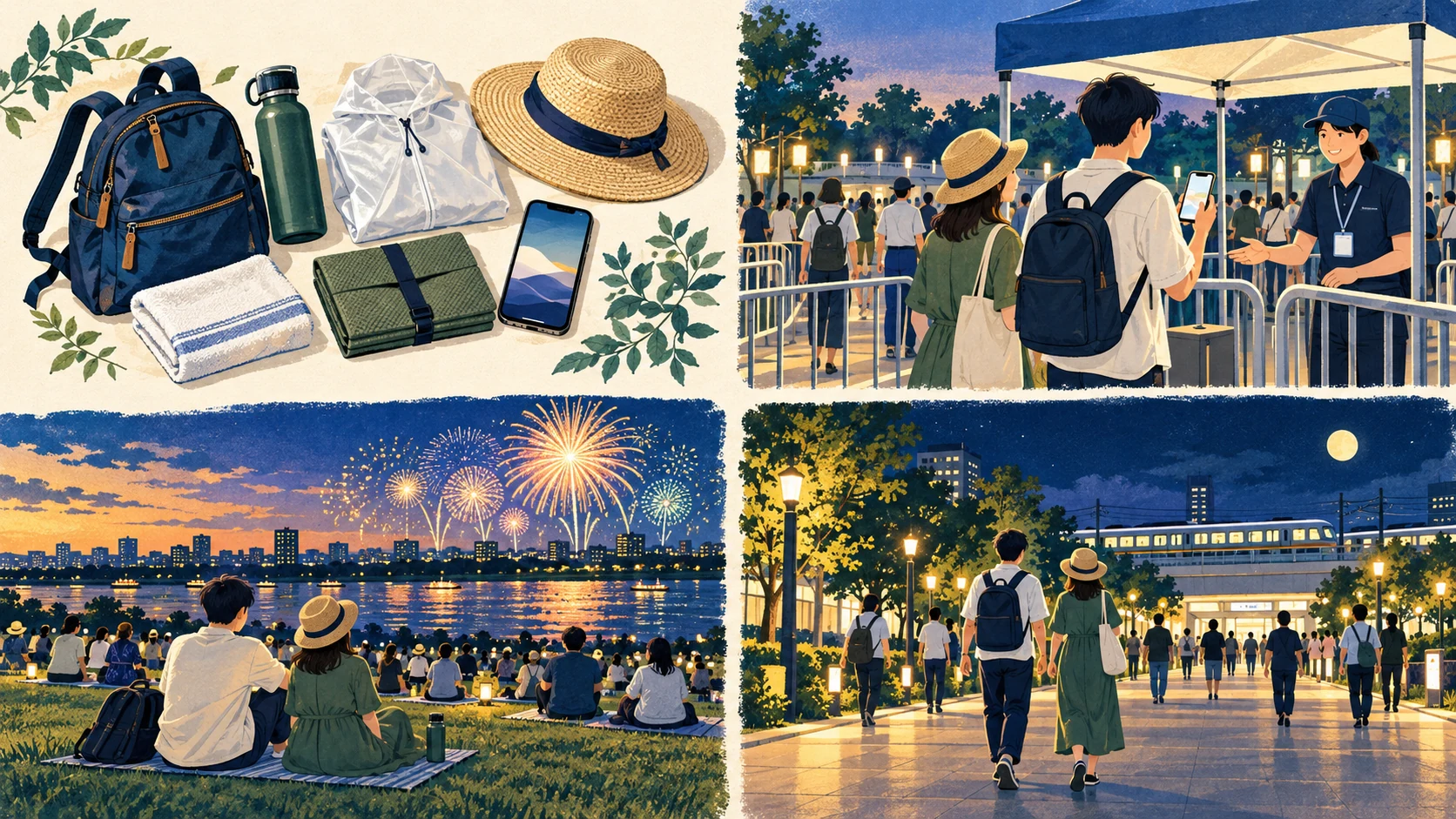
Bring a hands-free raincoat, walking shoes, the water you need, small food portions, a rubbish bag and charging equipment. Decide on a cushion according to your ticket area’s rules. Mats, folding chairs, tripods and large shade equipment are not permitted everywhere. Lake Biwa, for example, has different rules for standard seats and the unreserved area; a generic packing list cannot override them. If wearing a yukata or unfamiliar shoes, test during the day whether you can cover the admission and exit walking distances.
Eat a proper meal before admission when you have more time. Treat stalls as an additional option rather than making the whole family depend on finding dinner just before the start. For infant food, dietary restrictions or meals needed at set times, check permitted food and the nearest supply point. Leave large bags at confirmed accommodation or storage. Station lockers may be full that night, and storage services may have closed by the time you leave the show.
If weather causes the organiser to stop or evacuate the event, follow instructions to leave. Do not wait for refund news in an unsafe place. Keep separate bookmarks for the organiser, transport operations and hotel contacts, and check each for changes. Rain stopping does not mean the riverbank, wind or transport has recovered. The organiser determines whether the event can proceed; choose your travel response according to the delays and cancellation costs you can absorb.
Fit fireworks into your trip: three flexible approaches
For a fireworks-centred trip, allow an arrival day, a display day and a departure day, with some margin on either side of the main activity. Use the first day to locate accommodation, entrances and transport. Avoid long cross-region journeys on the second day and move towards the venue during the afternoon. Leave later on the third day. This rhythm can suit Nagaoka or Omagari, where the post-show journey may be lengthy. It guarantees no weather outcome and does not mean everyone must stay exactly two nights.
Within a Kyoto, Nagoya or Setouchi trip, consider Otsu, Gamagori or Onomichi as a one-night addition. Check whether your current accommodation permits a late return before moving to a local hotel. From Tokyo, those interested in autumn competition should compare Tsuchiura’s tickets and return options; “near Tokyo” does not remove the exit problem. If changing hotels adds storage and luggage handling, keeping the existing base and removing an early next-day activity may be more practical than moving merely to reduce map distance.
If you simply want a Japanese nighttime festival atmosphere, you need not pursue one of these seven large displays. Build a city trip around Tokyo’s neighbourhoods and accommodation bases, three days in Osaka or the pace of a Sapporo and Otaru visit, then check local official events. Those cities are outside this guide’s seven-event ticket coverage. An old year, date or memory of free viewing from a one-off event is not a confirmed plan for your next trip.
Check again before departure: replace last edition’s experience with this edition’s details
When you are ready to book, reopen the organiser’s homepage and verify the year, full event name, date, ticket area, seller and cancellation rules. Omagari has spring, summer and autumn events, Lake Biwa has displays on different shores, and Lake Suwa has several series. A shortened translated name can lead to another product. Read the update date together with the edition you intend to attend; a fresh-looking article or website may still contain the previous year’s ticket table.
A week before departure, check collected tickets, the accommodation confirmation, responses to special requests, that edition’s transport map and return trains. Before leaving on the day, check weather and whether the event will proceed. At the venue, follow the latest controls and staff directions. Old screenshots can help recognition but cannot override a changed entrance or programme announcement. If an essential condition is still missing, keep that stage marked unconfirmed rather than promising it to your companions.
A complete fireworks plan should answer five questions clearly: which edition and event you are attending, what ticket each traveller will use, which side you will enter from, how you will reach confirmed accommodation afterwards and which costs you bear if the event is cancelled or postponed. Answering these before choosing your favourite display gets you closer to a workable trip than collecting more popular-event lists. This guide explains the differences among seven events and the versions verified here. New dates, prices and live sales status still require the relevant edition’s official notices.
A few useful answers
Are the 2027 Japanese fireworks festival dates confirmed?
This guide has not confirmed complete announcements for the next editions of these seven events. Do not move the 2026 dates forward by a year. Compare bases and cancellable accommodation first, then use the organiser’s formal announcement before making nonrefundable bookings.
Which Japanese fireworks festival should I choose for a first visit?
Start with your existing base and return journey. Nagaoka emphasises a riverbank display; Omagari and Tsuchiura offer competition programmes; Otsu, Gamagori, Onomichi and Lake Suwa have different lake, harbour and accommodation conditions. A valid ticket and a workable return matter more than shell counts alone.
Can I use free viewing seats at Nagaoka without a ticket?
The organiser explicitly provides no free viewing seats and sells no tickets on the day. Do not use roads, bridges or controlled areas as substitute seats. Follow ticket or resale channels officially recognised for that edition.
Is Omagari’s Autumn Chapter the same event as the summer National Fireworks Competition?
No. They are separate events with different dates, programmes and tickets. The specific prices and daytime/nighttime hours in this guide refer to the 98th summer competition in 2026.
Can overseas tourists enter the general Lake Suwa ticket lottery?
The 2026 general lottery explicitly targets residents of Japan. Short-term overseas visitors should not assume eligibility. Check other options individually through officially authorised channels; do not apply using a false address.
If rain cancels the fireworks, will both tickets and hotels be refunded?
There is no universal rule. Gamagori’s 2026 supporter tickets explicitly exclude refunds even for cancellation due to severe weather or natural disasters. Nagaoka’s current FAQ also does not provide a full cancellation refund. Events may exclude specific fees, with separate conditions for postponement and stopping after the start. Accommodation and transport follow their own contracts.
Is the ¥7,500 Lake Biwa chair ticket a fixed price?
It is the 2026 official base price before dynamic variation, not the transaction price at every point in time and not a 2027 quote. Use the chosen ticket type and purchase screen for the relevant edition.
Do children always watch fireworks free?
Rules differ. Lake Suwa and Lake Biwa require tickets from age three. Nagaoka and Omagari have rules including tickets from primary-school age; free younger children may have to sit on a lap without an extra seat. Check each child’s actual age and ticket type.
Can I board the last train immediately after the show?
There is no guarantee. Staggered exits, bridge and station controls and queues can add time. Use that edition’s transport notices to choose accommodation and a return plan that can absorb delays. Do not simply add a normal walking time to the scheduled finish.
Can Onomichi city hall tickets and Mukaishima commerce association tickets be used interchangeably?
This guide treats them as separate locations and sales products. Their prices and terms cannot be applied to each other. Verify the address, seller, capacity and whether a ferry or another cross-channel journey is needed.
Can I see Lake Suwa fireworks without buying a ticket?
The organiser provides no designated free seats, but its FAQ allows free viewing outside the paid area. Water-surface effects may be difficult to see. Follow on-site controls and land-use rules; outside viewing guarantees neither a seat nor a complete view.
Check with the source
Schedules, availability and rules can change. These official sources are the place to confirm details before you book.
- Official 2 August programme
- Official 3 August programme
- Organiser’s FAQ
- Official access information
- Nagaoka fireworks ticket centre
- Official overview of the 98th summer competition
- General ticket information for summer 2026
- Omagari official access and accommodation
- Omagari official FAQ
- Tsuchiura 2026 paid-seating announcement
- 2026 shuttle notice
- 7 October exit notice
- Official rail guidance
- No free viewing seats
- Lake Suwa Festival Fireworks Display
- 2026 general ticket lottery
- Organiser’s FAQ
- Official website
- Official 2026 ticket page
- Official 2026 route map
- Official city hall supporter-seat information
- 2026 traffic controls
- Onomichi Shimanami commerce association’s Mukaishima option
- City hall supporter-seat FAQ
- Gamagori City official introduction
- Organiser’s programme features
- Organiser’s FAQ
- Transport pages in the 2026 programme booklet
- Onomichi Station return-queue guidance
- Nagaoka 2026 general lottery and official resale rules
- Nagaoka 2026 ticket sales schedule
- Nagaoka 2026 lottery for individual overseas visitors