With only a day, start by comparing GALA's direct station access. For consecutive lessons, weigh up a night beside Naeba's slopes. If your companions want hot springs and meals in town, staying near Echigo-Yuzawa Station may suit you better. Fit lessons, rentals, shuttles and accommodation into the same day's schedule to see how much time on snow remains beyond the shortest advertised journey.
First decide: lessons, snow play or two consecutive ski days
Choose what you want from the day before choosing a ski resort near Tokyo. If you have one day, need to return to Tokyo that evening and want to avoid moving luggage to another hotel, GALA Yuzawa's direct station connection is a useful first comparison. Staying beside Naeba's slopes can reduce daily equipment handling if you want consecutive lessons and afternoon breaks in your room. If some companions only want snow views and shopping, activities near Karuizawa Station are easier to arrange separately. These choices follow the transport arrangements; no resort is always the best for every beginner.
Echigo-Yuzawa is a transport and accommodation base, GALA is one resort in the area, and Naeba requires an onward road journey from Echigo-Yuzawa. Search results often group the three names together, but bookings are not interchangeable: staying by Yuzawa Station does not put you beside Naeba's runs, and a Mt.Naeba pass does not include GALA. Establish who wants to ski, snowboard or simply play in the snow, then decide whether everyone needs the same meeting point.
This guide uses official information that could be checked on October 22, 2026. Start with sections 2–4 for seasonal operations and transport. For GALA, continue with sections 5–8; for Naeba, sections 9–14. Accommodation and two-day plans begin at section 15. Complete beginners can also read lesson and equipment preparation for your first ski trip in Japan. Here, the focus is a day that actually fits together after leaving Tokyo.
| Main purpose | Option to compare first | First check |
|---|---|---|
| One day to learn to ski | GALA return trip from Tokyo | Lesson language, rentals and return train |
| Two consecutive ski days with a midday room break | Accommodation beside Naeba's slopes | Beds, lessons and hotel guest shuttle |
| Hot springs and meals as well as skiing | Accommodation near Echigo-Yuzawa Station | Current shuttles to your chosen resort |
| Some people ski, others shop | Area around Karuizawa Station | Meeting times for separate activities |
| The whole family wants to learn skiing | Include NASPA in the comparison | Ski-only restriction and current lessons |
Three calendar traps to avoid in the 2026–27 season
GALA's current operating dates and prices distinguish sightseeing from skiing. From December 12–18, 2026, only the gondola and sightseeing chairlift are scheduled to operate; skiing and snowboarding are not allowed even if there is snow. Ski operations are scheduled for December 19–May 5, 2027. If you want your first lesson in mid-December, do not book trains and a nonrefundable lesson merely because you see an opening date of December 12.
GALA has also announced that the South Area will be closed for 2026–27, including southern runs such as $2,600,000 and Bronco, and the Landau connecting ropeway to Yuzawa Kogen. Operations will mainly use the Central and North Areas, with a shuttle bus replacing the connection to Yuzawa Kogen. A connection on an old map does not mean you can ski it this year. Historical totals for all runs are also a poor basis for deciding how many routes to cover in a day.
Naeba's announcement schedules skiing for December 18, 2026–April 4, 2027, and Dragondola for December 26–March 22. The hotel shuttle starts earlier, on December 12. These are three separate periods. Resort opening, room availability, shuttle departures and the inter-resort gondola each have their own calendar. Check each one before booking dates near a season boundary.
Turn the fastest station time into your door-to-door journey
GALA advertises Tokyo Station to GALA Yuzawa in as little as 71 minutes. That is the rail segment on particular services, not the journey from your Tokyo hotel room to the instructor's meeting point. Add travel across the city, finding the platform, collecting tickets, rentals on arrival, changing, lockers and reaching the teaching area. If you stay in Shinjuku or Asakusa, the 71 minutes cannot begin when you leave the hotel. Nor can the train's arrival time double as your lesson start time.
Use a clearly labeled planning example: 40 minutes from hotel to platform, 80 on the train and 60 for rentals and getting ready total 180 minutes, before extra queues or weather delays. These are illustrative inputs, not official schedules or guarantees. Replace them with your hotel, chosen service and the school's requirements. If check-in is another 20–30 minutes before the lesson, work backward from the meeting time; do not expect to make up the difference by rushing on arrival.
Likewise, Naeba's hotel guest shuttle is listed at about 40 minutes, while the tourism association describes the regular route bus as about 50 minutes. They are different services with different stops. Add the Shinkansen journey to Echigo-Yuzawa, the wait and the walk after reaching Naeba before comparing an overnight stay with a day trip. For tickets, use the segment-by-segment approach to Japanese rail passes. An existing pass is no reason to force an unsuitable lesson into the day.
Shinkansen, direct bus or driving: which part does each simplify?
The Shinkansen lets you check the long rail journey and final shuttle separately. For GALA, first check whether the train actually terminates at GALA Yuzawa. A service ending at Echigo-Yuzawa requires another connection to the resort. GALA lists a free shuttle taking about 10 minutes from Echigo-Yuzawa, but the current winter timetable still needs checking. For an early lesson, find a specific service that connects before choosing a train that ends at Echigo-Yuzawa.
A direct ski bus includes most of the transport in one booking, which can appeal if you dislike transfers. However, the meeting point, early check-in, evening return and road delays all affect lesson time. Naeba Prince's access page lists the 2026–27 White Snow Shuttle operating period but says detailed services will be announced separately. The older list of departure cities on the Naeba tourism association's page is not evidence that those routes are on sale this year.
Driving requires allowances for parking, winter equipment and the driver's condition, beyond a map's uncongested journey time. If nobody in the group can handle winter roads comfortably, start with a base served by public transport and shuttles. Driving back to Tokyo after night skiing also adds fatigue. Staying overnight may better serve the trip, although a hotel booking does not improve the next day's road weather. If you have an international flight on the return day, avoid relying on the last mountain shuttle as your only way out.
GALA brings the arrival tasks into one place
GALA's station connects to the resort center, making it useful for a return trip with a daypack. There are still several steps between the station and the snow. Collect or exchange tickets, then follow your booking instructions for rentals, boot fitting, changing and lockers before going to the school's meeting point. Prepare each person's height, weight, shoe size and preferred language to reduce repeated questions at the counter. If boots do not fit, ask staff to fix them there; do not take a problem uphill to avoid being late.
Beginners do not need to make covering the entire resort their goal. Allow the instructor time to check equipment, stopping and turning, then choose open runs that suit your actual ability. The South Area closure makes old circuit itineraries unusable. Experienced friends should not promise that a first-timer can ski all the way to the base. Arrange meetings and returns around lift and instructor guidance, without treating a long descent as everybody's shortcut.
Companions coming only for snow play should check the areas available that day and whether they need a separate sightseeing ticket. Ski lift access, sledding activities and boot rentals may be different products. Choose an indoor meeting place that everyone may legitimately reach, rather than a spot beside an intermediate run. Agree on lunch and the meeting time for Tokyo as well, so non-skiers do not spend the day waiting while skiers keep moving.
Choose runs using GALA's current course list, rather than the total number of trails. The Central Area centers on the gondola's upper station and the Cheers rest center. On a first day, let the instructor check stopping and turning on the short Melody run before considering the longer Entertainment run. Super Swan is short but is an ungroomed advanced run with a maximum gradient of 33 degrees; its length does not make it a beginner practice slope.
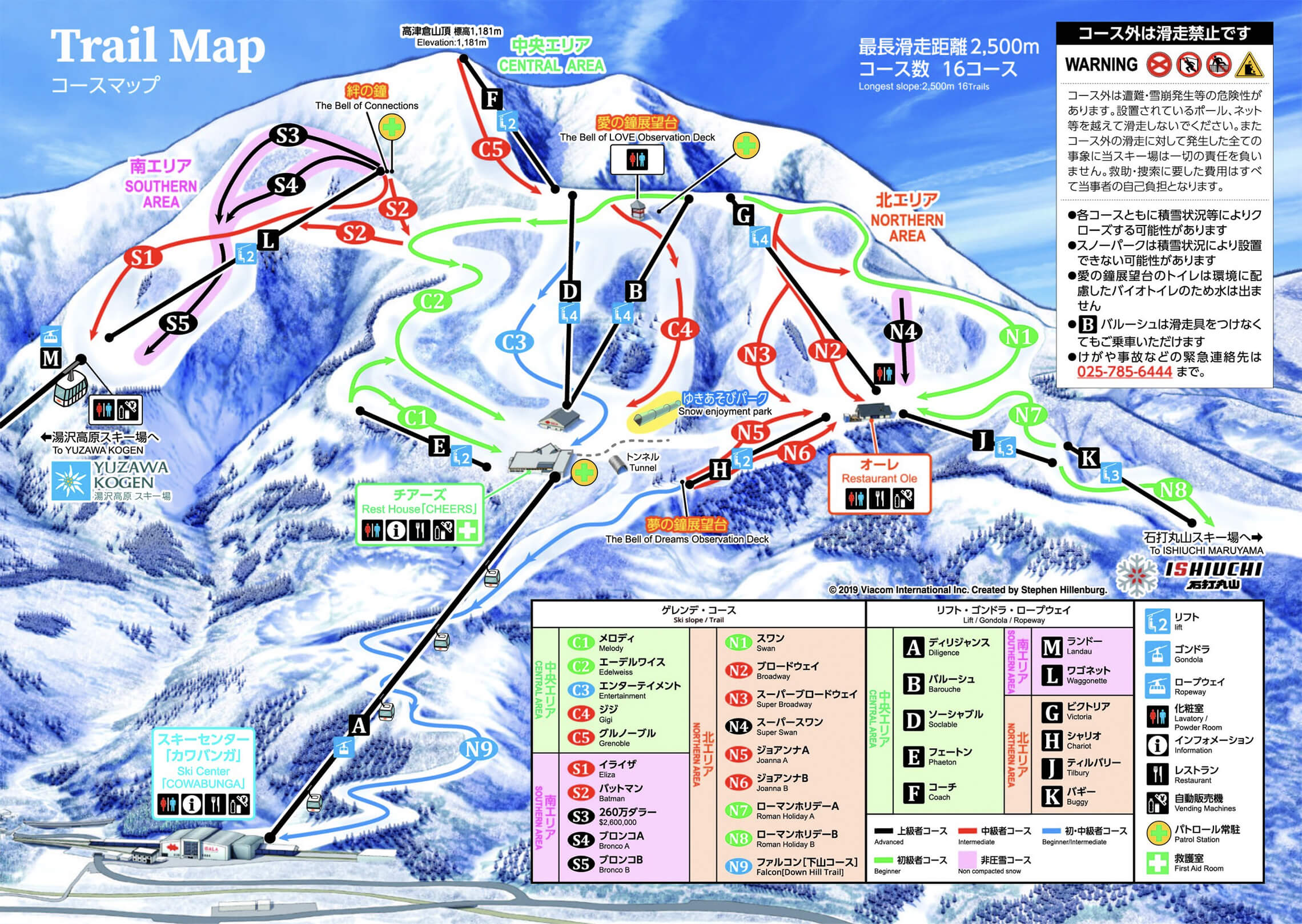
The Diligence gondola connects the base resort center with the Central Area. Plan to return to the upper station at Cheers and descend by gondola according to that day's arrangements; the 2.5-kilometer Falcon run is not a beginner's shortcut to catch a train. For a move north, the official site describes Swan as a bypass of Broadway leading into the North Area, with a narrow entrance. Before changing areas, ask staff which open route and chairlifts will get you back to Central, and when the last boarding is. Stay in Central if you cannot complete that return. The existing official network map is not marked 2026–27 and still shows the closed South Area. Use it only for relative positions, without treating its connections or historical last-lift times as a usable full circuit this season.
| Area and run | Official difficulty | Length / maximum gradient | How to use the run |
|---|---|---|---|
| Central | Melody メロディ | Beginner | 350 m / 12° | Repeat a short run; have an instructor assess ability on a first day |
| Central | Entertainment エンターテイメント | Beginner–intermediate | 920 m / 20° | Consider a longer descent after controlling speed and turns |
| North | Swan スワン | Beginner | 1,050 m / 15° | Broadway bypass into North; narrow entrance, with the return to Central to confirm first |
| North | Broadway ブロードウェイ | Intermediate | 700 m / 22° | Groomed moderate slope, not a complete beginner's first run |
| North | Super Swan スーパースワン | Advanced, ungroomed | 160 m / 33° | Short, steep, uneven terrain requiring appropriate skills and daily snow judgment |
GALA tickets: choose the use before comparing web prices
The official 2026–27 list prices the Gondola & Lift Ticket at ¥8,000 for adults and ¥4,000 for elementary school children, with web prices of ¥7,500 and ¥3,500. Four-hour tickets are ¥7,500 and ¥3,500, or ¥7,000 and ¥3,000 online. These were the page's listed prices on the checking date, not packages including train travel, lessons or equipment. Early-bird tickets sold through other channels cannot be assumed identical based on the name alone.
For non-skiers wanting the uphill gondola and Barouche to the Ai no Kane (Love Bell) observation point, compare the Gondola & Barouche Ticket: current-season list prices are ¥6,500 for adults and ¥3,400 for elementary-school children, or ¥5,500 and ¥2,900 online. The official Traditional Chinese price table labels it a sightseeing chairlift return combination. That description does not establish that it is a limited-area ski pass usable while wearing skis or in a beginner lesson. If a lesson needs other chairlifts, ask the school and ticket office to confirm the product and equipment coverage. The page allows up to two preschool children free per adult; the third and subsequent children pay the elementary-school rate. This is not a universal Japanese resort rule, and it does not make rentals or instruction free. List each child's age and school status before checking the chosen product's categories.
The choice between four hours and a longer lift ticket depends on the hours you can actually use. A half-day label does not necessarily mean a large saving: the adult web prices of ¥7,500 and ¥7,000 differ by only ¥500. If lessons, lunch and queues lengthen your stay, check when the clock starts and which facilities are included before restricting the time. Timing and cancellation terms must come from the selected product's payment information, not another resort or an older season's ticket.
GALA language lessons: split the fee among people at similar levels
Canyons' 2026–27 private GALA lessons allow up to six people per instructor: ¥34,000 for two hours, ¥45,000 for three and ¥75,000 for six. English, Chinese or Thai can be requested. The minimum ages are three for skiing and six for snowboarding, subject to discussing the child's needs with the school. Lift tickets, rentals and accident insurance are excluded. The instructor fee is not the total cost of a ski day.
Two-hour lessons are unavailable December 24–January 3 and February 1–21; the minimum during those periods is three hours. Four adults at similar levels splitting ¥34,000 pay ¥8,500 each. But grouping a complete beginner with someone practicing advanced turns may leave both without appropriate instruction. The school's FAQ also says one lesson cannot teach skiing and snowboarding together. Choose the equipment before calculating a shared price.
Submitting a request does not secure an instructor. The operator says the reservations team must confirm the booking and full prepayment must be completed. Keep workable transport options available, then lock in nonrefundable items after confirmation. GALA's complete current-season rental prices could not be established during checking; do not build the budget from 2025–26 prices. Before paying, confirm the required boot sizes, package contents, collection and return points, and current quote.
Check Canyons' lesson equipment rules as well: helmets are mandatory for participants under 20, and recommended for other adults. Before the lesson, decide whether to bring one or check sizing, rental cost and collection time with a rental shop. Paying the lesson fee does not establish that a helmet is included. This requirement comes from Canyons' lesson rules.
A GALA day trip needs time to pack up before the return
A workable sequence is arrival, rental collection, lesson, lunch, short practice and an early finish to pack up. Morning lessons require an early start. Afternoon lessons allow a calmer arrival, but leave no room for one more distant run afterward. Set your final run early enough before the train to descend, return equipment, change and collect belongings, with more margin for that day's crowds. Not everyone will be ready at the same instant after leaving the snow.
You can select the return train in advance, but understand its change conditions. A package restricted to particular services may handle a missed train differently from an ordinary ticket. Poor resort weather does not automatically trigger a railway or package refund. Save separate confirmations for trains, lift tickets, lessons and rentals, so you know which operator to contact when plans change instead of expecting one counter to resolve every booking.
After a first ski day, the best use of the remaining time may be separating wet clothes, eating something and boarding calmly. If companions are tired, remove extra hot-spring or shopping stops. Bath opening, admission and last-entry times need their own checks. A flexible Tokyo dinner is more comfortable than hurrying everyone around the resort to reach a fixed restaurant reservation.
Naeba, Mt.Naeba and Dragondola are different products
Naeba is one resort. The Mt.Naeba pass covers Naeba and the Kagura, Mitsumata and Tashiro areas of Kagura Ski Resort. Dragondola links them across the mountain, but ticket coverage does not mean the gondola runs every day or every hour. Wind, snow and equipment restrictions can change inter-resort access. If your first lessons will stay at Naeba, a larger-looking map is usually no reason to add a crossing to the plan.
Naeba's current prices and coverage list adult counter prices, including tax, of ¥11,800 for a one-day Mt.Naeba pass, ¥9,800 for a one-day Naeba Area pass, ¥8,300 for eight consecutive hours at Naeba and ¥6,300 for four consecutive hours. Adults are junior-high-school students and older. Elementary-school children and younger are free, but must collect a dedicated ticket at the counter rather than walking through the gates empty-handed.
Four- and eight-hour tickets exclude Dragondola and Kagura Ski Resort. A sightseeing return on Dragondola is separately listed at ¥4,000 per adult, subject to the current operation and ticket conditions. Autumn foliage sightseeing products and winter ski passes are not interchangeable. Before crossing, ask about the final return and how to get back to your base if the connection closes. Return to the side where you are staying early in the afternoon.
Naeba's current course and lift page lists D1, the south side of No. 4 High-Speed Lift, as a beginner run in the hotel-front base area. F2, south of No. 8 High-Speed Lift, is an advanced run in that same base area. Discuss D1 with the instructor for a first lesson; an experienced skier should not take a beginner onto F2 merely because it is shorter. The names refer to the slopes south of the respective No. 4 and No. 8 chairlifts. Actual entrances and exits depend on the branches open that day; neighboring slopes do not necessarily share a difficulty rating.
For a long intermediate descent, consider A1, the Daishamen–General Course in the summit area. The current page gives a vertical drop of 615 meters. It requires sustained speed control and turning; another beginner slope at Takenokodaira higher up does not establish that a first-timer can ski all the way back to the hotel. The course map currently linked by the resort is explicitly dated 2025–26. The marked A, Prince No. 2 Gondola upper station, and A1 help identify positions only. Before going up, confirm that day's gondola operation, the complete A1 return and any available downhill gondola arrangements. Without that return ability or confirmation, stay within the base-area lesson zone, and keep enough energy in the afternoon to return to the rental and bus meeting side. Dragondola is not an alternative descent for a beginner.
| Area and run | Official difficulty | Length / maximum gradient | Selection and return considerations |
|---|---|---|---|
| Hotel-front base | D1, south of No. 4 High-Speed Lift | Beginner | 821 m / 13.4° | Base run to assess for a first lesson; the slope south of No. 4 chairlift |
| Summit | A1 Daishamen–General Course | Intermediate | 2,387 m / 27.08° | Long descent to the base with a 615 m vertical drop; confirm the full return before going up |
| Hotel-front base | F2, south of No. 8 High-Speed Lift | Advanced | 490 m / 25.54° | South of No. 8 chairlift; shorter than D1 but harder, not a beginner shortcut |
Naeba transport: the 40-minute hotel bus is a separate service
Naeba Prince Hotel's winter guest-only bus announcement, published October 14, 2026, lists operation from December 12–April 4, 2027. The journey from Echigo-Yuzawa's East Exit to the hotel is about 40 minutes. Both directions require reservations, accepted from one month to two days before use. The name must match the accommodation booking's lead guest. Booking a room does not automatically reserve a seat.
For example, the published timetable includes a 10:10 departure from Echigo-Yuzawa arriving at the hotel at 10:50, and a 16:15 hotel departure reaching the station at 16:55. These are specific connections in the current timetable, not a standard itinerary for everyone. Allow for luggage storage and getting ready after arrival: stepping off at 10:50 does not promise you can be on a run at 11:00. The 16:55 return is a scheduled arrival in normal road conditions and should not sit immediately before a Shinkansen departure.
If you are not staying at the Prince Hotel, check the regular route bus or your own accommodation's transfer. The Naeba tourism association's access page describes the bus toward Naeba from Echigo-Yuzawa's East Exit as about 50 minutes. Stop numbers may change; check the destination. Winter timetables and fares need checking for your date. If switching to a taxi, obtain a current quote first. Staying somewhere in Naeba does not entitle you to the Prince's free guest-only bus.
Naeba day trip or overnight: when can the first lesson happen?
A same-day trip from Tokyo to Naeba is possible to plan, but the road transfer makes the usable morning more dependent on shuttles than at GALA. If only an early lesson remains, compare arriving the previous evening rather than expecting an instructor to wait for the bus. An overnight stay is valuable beyond night skiing: you can wake up, dress and eat breakfast at the same base before a lesson, reducing variables on a first ski trip.
For two days and one night, use day one for travel, check-in or luggage storage and a shorter introduction to the snow. Put the main lesson and skiing in the first part of day two, with a predetermined packing-up time. If you also book a first-day lesson, choose a slot that can absorb transfer delays and read the late-arrival rules. Filling both days with different schools and resorts often replaces needed practice with repeated equipment collection and searches for meeting points.
Naeba night skiing is a separate activity, not an automatic benefit of staying overnight. The current announcement schedules it through March 21, but available runs, lifts and hours depend on daily operations. After a long journey, or when children tire early, dinner and sleep may be more useful than extending the skiing. A plan to return to Yuzawa after night skiing must first establish that suitable return transport exists.
Naeba rentals: hotel guests and day visitors use different counters
Naeba's 2026–27 rental page lists a one-day adult three-piece ski or two-piece snowboard set at ¥7,500, and a jacket-and-pants set at ¥5,500. Elementary-school children and younger pay ¥6,000 and ¥4,500 respectively. Ski sets contain skis, boots and poles; snowboard sets contain a board and boots. Clothing is separate. Gloves, hats and goggles are not rented, so do not arrive in ordinary clothing assuming everything can be borrowed.
Hotel guests can use designated hotel counters. Day visitors have Brand Viking at N Plateau and Salomon Station at the South Gate, with different operating periods. Brand Viking is scheduled for December 26–March 22 and the South Gate for December 18–March 28. Building 4 does not accept web rental reservations. Hotel counters and the South Gate do not inherit Brand Viking's free equipment-exchange arrangement. Check which service you will actually collect from.
An adult Naeba four-hour ticket at ¥6,300, one-day equipment at ¥7,500 and clothing at ¥5,500 total ¥19,300. This example deliberately identifies the three verifiable products. It excludes transport, instruction, helmet, goggles, food and accommodation. If you choose a five-hour day-visitor rental instead, recalculate with that column's prices. A four-hour lift ticket does not mean every rental is charged for four hours too.
Naeba children's lessons: distinguish ages three, nine and twelve
The Pandaruman Naeba courses linked from Naeba's official school page list 2026–27 group ski lessons for ages 3–9 and private ski lessons for ages 3–12. Chinese, English and Japanese sessions follow the A, B and C calendar. There are no snowboard lessons. If your child wants to snowboard, find an appropriate school rather than assuming every course at Naeba teaches both disciplines.
Two-hour group lessons cost ¥22,000, ¥18,000 or ¥16,000 on A, B or C dates respectively. The price image divides dates into categories; check the selected date's category again when paying. Children's skis, boots and helmets are included during the lesson, not as an all-day rental. The reservation time is the lesson start, and the school requires check-in 20–30 minutes earlier. Finish changing and bathroom visits first, then meet on the second floor of Building 6.
Two children meeting the age requirement are not automatically suited to sharing a lesson with adults. Attention span, progress, the parent's collection point and plans for staying on snow afterward all affect the day. Pandaruman says its former children's playground closed after the 2023–24 season and it now focuses on lessons. Do not treat the play area in old photos as freely accessible childcare. Parents must collect children at the finishing time.
Keep four cancellation policies separate; bad weather does not refund all
Canyons' lesson FAQ lists cancellation charges of 20% at 15–7 days, 30% at 6–2 days, 50% the day before and 100% within 24 hours of the lesson. Changing the date or duration may also count as cancellation. The day-before and within-24-hours categories overlap, so obtain the operator's interpretation for the actual time. Lessons may continue in poor weather if the resort remains open. If it closes completely, the operator lists options including a nearby resort, postponement or a refund if it cannot provide the service.
Pandaruman's standard group policy charges ¥3,000 from confirmation through two days before, 50% the day before and 100% on the day. Private lessons charge ¥3,000 through four days before and 100% within three days. However, the special periods of December 19, 2026–January 10, 2027 and January 30–February 14 carry a 100% cancellation charge. These are this school's rules, not other instructors' terms. If flexibility matters, include the cancellation window in the lesson-price comparison.
Naeba's ticket page separately says no changes, cancellations or refunds after purchase. The same page gives inconsistent web-sales deadlines: the notes say 23:00 the previous day, while the FAQ says 15 minutes before ticket issuance on the day. Do not gamble on last-minute availability based on one passage. Check the selected product's checkout conditions early. Contact the ticket seller, school, hotel and transport operator separately; one agreeing to move a date does not confirm the other three.
Staying near Echigo-Yuzawa Station simplifies town life and resort changes
A station-area stay suits travelers who do not want two nights tied to one resort, or whose companions want baths, walks and meals in town. Leave large luggage at one base and take only ski-day essentials in the morning, but check each resort's shuttle departure point and last service separately. Being near the station does not mean being near every resort. Naeba in particular still requires a road journey, rather than a quick local transfer you can assume is effortless every day.
Write down four times before comparing room rates: station arrival, luggage drop, dinner and next morning's departure. A dinner-inclusive inn can reduce trips outside on snowy evenings, but the meal is wasted if your return shuttle cannot reach it in time. For a room-only stay, identify restaurants that will actually open and a backup. Many daytime shops along an onsen street do not guarantee seats late at night.
Solo travelers should check per-person versus per-room pricing, minimum occupancy and room types sold for one guest. Families should check everyone's sleeping space and bathroom needs first. For example, Grand's seven-person Japanese-Western room in the next section has two beds, with the others sleeping on futons on tatami. It is not seven single beds. Read room layouts and meal plans for a first ryokan stay to turn station convenience into a choice that fits your family's routine.
For control over breakfast, dinner and family living space, compare Building F at PURPOSE RESORT Echigo-Yuzawa Kura. This whole-unit stay is 64.10 square meters, with two bedrooms plus a living/dining/kitchen area and capacity for seven: three single beds and four futons, rather than seven fixed beds. The official FAQ says each unit has a private bathroom with a separate washing area and a toilet, but there is no communal bath. A household wanting private facilities and travelers wanting a hotel hot-spring bath every day need different products. Besides a kitchen, refrigerator, microwave and washer-dryer, the published equipment list includes a rice cooker, pots, knives and tableware. Food, drinks and seasonings are not supplied. Plan to buy ingredients and cook; a kitchen does not mean breakfast and dinner are included.
Kura's official access directions give about six minutes on foot from Echigo-Yuzawa Station's East Exit, with unstaffed check-in. The FAQ explicitly excludes luggage storage before check-in or after checkout. Arrange storage around the station for an early ski day, and allow extra time to pull suitcases through snow. The accommodation terms linked from the official site list ordinary-period cancellation at 50% from seven days before arrival through the previous day, and 100% on the day or for a no-show. Busy periods include December 24–January 3: the rate is 100% from three days before through arrival day and 50% seven to four days before. The FAQ also says cancellation depends on the plan and booking channel, so check your own order instead of applying Grand's three-days-before, 09:00 cutoff. A whole unit makes group living and self-catering possible, but may not save money for two people using only one bedroom. Compare totals for the same date, occupancy, meals and cancellation flexibility before paying more for a kitchen and living room.
| Named product / base | Sleeping and bathing | Meals, arrival and tradeoffs |
|---|---|---|
| Yuzawa Grand Japanese-Western room / West Exit | Ten tatami mats plus two beds, up to seven guests with the others on futons. Bathing depends on the room; semi-open-air room water is not hot-spring water. | Meal plans reduce trips out. About two minutes from the station but up a steep slope; call for pickup after arrival. |
| Naeba Prince Building 4 Family Twin A / Naeba slopes | Up to four: two 120 cm main beds plus two 100 cm sofa beds. Check the bathroom for the building and room type. | Activities concentrated at one resort. The Echigo-Yuzawa guest bus takes about 40 minutes; both journeys require a separate reservation. |
| Echigo-Yuzawa Kura Building F / whole unit east of station | 64.10 m², two bedrooms plus living/dining/kitchen, up to seven: three single beds and four futons, with private bath and toilet. | Kitchen, cookware and tableware for self-catering. About six minutes from the East Exit, unstaffed check-in, no luggage storage and no communal bath. |
| Climb Dining six-tatami Japanese room / central Iwappara | Listed for one to four; confirm futon quantities. Shared washbasins and separate men's and women's toilets on each floor, with gender-separated baths. | Mainly two meals this season. Saturdays and other specified dates require three guests, excluding the 幼児 young-child category. Walk the final winter stretch; luggage transfer 08:00–17:00. |
Station-area example: Yuzawa Grand Hotel's beds, slope and bathrooms
Yuzawa Grand Hotel's room page lists a Japanese-Western room with a ten-tatami area and two beds, for up to seven people. Confirm the remaining futon arrangements for your actual party. If you need three or more permanent raised beds, do not book on capacity alone. Modern Rooms have two configurations: four mattresses in the Western style, or two mattresses and two futon sets in the Japanese style. Layout preferences are requests and may not be guaranteed.
Check the exact bathroom room type too. A room with a free-flowing hot-spring open-air bath differs from the semi-open-air-bath room, whose water the official site explicitly says is not hot-spring water. Standard room equipment includes a bathroom and bidet toilet, but the 12-square-meter Western room and accessible room are specifically noted as having no bathtub. If family members cannot use public baths or a child needs a tub, confirm the booked room's bathroom instead of assuming every room offers a hot-spring soak because the hotel has an onsen.
Official access information gives a walk of about two minutes from Echigo-Yuzawa Station but warns of the steep slope in front of the hotel. After reaching the West Exit, call for a pickup; advance station-pickup reservations are not accepted. With a large suitcase, a child in your arms or icy ground, do not force the climb because it is only two minutes. For wheelchair needs, contact the hotel first to check the complete route through the entrance, room and bathroom.
Grand's child charges, dinner and cancellation add to the room comparison
Grand's accommodation terms classify elementary-school children and younger by meals and bedding. Adult-like meals with bedding cost 70% of the adult rate. For ages three to preschool, children's meals with bedding cost 50%; bedding alone costs 30%. Ages one and two still cost ¥2,200 without meals or bedding, while infants aged zero stay free. Individual plans may differ. Do not assume all young children stay free; specify what each adult and child will eat and where they will sleep.
The meal page lists one or two dinner sittings depending on guest numbers. A single sitting runs 18:00–20:30 with last entry at 19:30. With two sittings, last entry is 18:15 for the first and 20:00 for the second; selection at arrival depends on availability. The facilities page instead gives the simpler hours 18:00–20:00, so plan around your booked sitting and the hotel's reply. Being allowed to check in late does not mean dinner can be delayed indefinitely.
The room page gives standard cancellation charges of 30% from 09:00 three days before arrival, 50% from 09:00 the day before and 100% from 09:00 on arrival day; specific plan terms take precedence. Coin laundry is available, but do not assume all ski clothing can be tumble-dried: read its care labels. Hotel rentals are scheduled for December 26, 2026–March 31, 2027, with earlier service dependent on snow and resort opening. An opening-week stay does not automatically mean you can collect equipment inside the hotel.
Slope-side example: a four-person room in Naeba Prince Building 4
Naeba Prince suits people who want to concentrate activities within the resort and hotel, but choose the building, room and lesson meeting point together. The official room list marks Building 4 as reopening after an update in December 2026. Family Twin A sleeps one to four, with two 120-centimeter main beds and two 100-centimeter sofa beds. Four adults and two adults with two children may feel differently about sofa beds. Compare the actual beds as well as the maximum occupancy.
Building 4's Twin B has two main beds and accommodates one to two people. It cannot simply replace Family Twin by adding two children who need separate beds. Skis, boots, coats and luggage all take space; the clear floor in a room photo may disappear when sofa beds are opened. For time together in the room or children's naps, decide how many made-up sleeping places you need, then ask about actual available connecting rooms, larger rooms or separate rooms.
The hotel's FAQ says wheelchairs can be used but there are no dedicated accessible guest rooms. That does not establish a step-free journey throughout; check the particular bathroom, doorway and long indoor routes. A lesson may require check-in on the second floor of Building 6 while your room is in another building. Being in the same hotel is no reason to allow only two minutes. Check bathroom and laundry needs against your booked building's current facilities rather than treating another building's equipment as a room promise.
If you want to stay within a ski area and accept walking the final stretch, compare Guesthouse Climb Dining in the middle of Iwappara Ski Resort. Its named six-tatami Japanese-style room is listed for one to four people. Capacity does not mean four fixed beds; specify how many futons you need when booking. The facilities information lists shared washbasins and separate men's and women's toilets on each floor. The baths are also separated by gender and open 16:00–23:00. If private facilities matter or communal bathing is difficult, compare the whole-unit option in the table. A guesthouse name does not establish a private shower, and a room's capacity does not guarantee one- or two-person bookings on every date.
Climb's final winter approach requires walking on snow. Its luggage-transfer instructions published in September 2026 explicitly say there is no direct station-to-guesthouse pickup. Take the Iwappara shuttle from the station's East Exit to its terminus; guests with substantial luggage then walk about five minutes to the tunnel at the rear left of P6 and call to hand over bags. People still walk to the property themselves. The luggage service is listed as 08:00–17:00, so reach the handover point before 17:00. Check the ski resort separately for shuttle schedules and that day's operation; a free bus does not mean a ride to your room. This differs both from calling Grand for pickup after arriving at the station and from reserving Naeba Prince's guest bus.
Climb's 2026–27 plan page gives a winter period of December 19, 2026–March 28, 2027, mainly with dinner and breakfast. Saturdays, nights before public holidays and December 26–January 3 require a two-meal plan and at least three guests; children in the property's 幼児 (young-child) category do not count toward that minimum. The FAQ's room-only conditions for one or two guests do not fully match the current season's meal restrictions, so confirm an available plan for a couple or a stay without meals. The FAQ gives breakfast as 07:30–08:30, dinner starting at 18:00 on ordinary weekdays, and 18:00 or 19:00 on nights before public holidays. Cancellation is 30% seven to four days before, 50% three days before, 70% two days before, 80% the previous day, 90% on the day with notice, and 100% for a no-show; reducing the party size may also incur charges. The site requires overseas bookings through Rakuten. Check that order's meals, sleeping arrangements and cancellation terms. This is a named Japanese-room and shared-bath option within a ski area; without quotes for the same dates and party, it cannot be called cheaper than Grand or Naeba Prince.
Naeba Prince child rates and winter cancellations are separate from free lifts
Naeba Prince's FAQ gives child rates for ages six to under twelve. Under-sixes needing an existing bed also incur a child charge; on room-only plans they pay the same as adults. These categories differ from the resort's free lift tickets for elementary-school children and younger. A twelve-year-old elementary student does not automatically qualify for a hotel child rate because their lift ticket is free. Cribs and bed rails have room-type, quantity and use restrictions; confirm them before deciding sleeping arrangements.
The 2026–27 winter accommodation announcement lists cancellation charges for Prince Basic and consecutive-night plans: 20% at 14–8 days, 80% at 7–3 days and 100% from two days before through arrival or for a no-show. Dedicated prepaid plans for stays December 29, 2026–January 2, 2027 become noncancelable 30 days before arrival. Dedicated plans for the specified February 2027 dates in the announcement bring that forward to 60 days; both prohibit changes after booking. The general 14-day threshold does not apply to every date. Consider how much cancellation cost you could absorb if snow, lessons or companions change, before comparing nightly savings.
The announcement also lists prepaid products that cannot be canceled or changed. Save the exact room, meals, occupancy and terms when purchasing, and confirm whether lift tickets are included. A ski-resort hotel does not include lifts in every rate. Refundable-deposit lockers are available before check-in, and large luggage can be taken to the service desk. Storage does not grant room access; early arrivals need separate changing and resting arrangements.
Other options near Tokyo: Karuizawa, NASPA and Tambara
Karuizawa Prince Ski Resort's official access information gives about ten minutes on foot or two minutes by taxi from Karuizawa Station's South Exit, plus a resort shuttle requiring no reservation. It can suit a group splitting skiing from station-area shopping, although walking with luggage in snow still takes extra time. For the full town and accommodation plan, read Karuizawa town and ski choices instead of squeezing distant sights into ski day.
NASPA Ski Garden is explicitly ski-only, with an advertised shuttle journey of about three minutes from Echigo-Yuzawa Station. Include it if the whole family wants to learn skiing and you are comparing hotel-connected slopes. A snowboarder cannot join merely because the resort is described as beginner-friendly. Some current-season pages were still in preparation at checking, so confirm lift tickets, children's areas and lessons against the relevant product after release, without filling gaps from older packages.
Tambara's train-access page lists a Jomo-Kogen shuttle on specified dates: station departure 09:30, resort arrival 10:40, and return 16:00–17:10. Reservations are first-come, first-served for up to eighteen passengers, required both ways, and close at 16:00 the previous day. Although the page gives a 2026–27 operating period, the booking-start wording still includes 2025. Treat it as a comparison candidate and reconfirm bookable dates before paying. A seventy-minute mountain-road shuttle produces a different day-trip rhythm from GALA's direct station link.
Narrow the choice using terrain you can actually handle. For a first day practicing stopping and turning, compare GALA Central's short beginner run with Naeba's hotel-front D1, along with instructor meeting and rest locations. If you can already ski intermediate runs consistently and want a longer continuous descent, consider a run such as Naeba A1. Gradient figures are only one aid; they do not translate directly into equivalent difficulty between resorts. If a companion snowboards, first exclude ski-only NASPA, then compare transport and available lessons.
Give non-skiing companions their own half-day plan
A common disappointment is skiers assuming everyone else can just play in the snow nearby. Walking on runs is restricted, and children's teaching areas are not necessarily public playgrounds. Sightseeing gondolas, sledding areas, restaurants and baths each have opening and payment rules. Ask whether non-skiers want photos, hot springs or shopping, then choose a base where they can complete those activities independently instead of discovering on the mountain that their only option is a long restaurant wait.
Near Echigo-Yuzawa Station, non-skiers can stay in town and meet at the hotel before dinner. At Naeba, they depend more on the hotel and current on-site facilities. If a companion needs frequent room rests, nearby activities are easier than sightseeing across resort areas. When splitting up, save the meeting-place name, map and contact details, with a backup for phones draining quickly in the cold.
Families must distinguish supervision during a lesson from childcare before and afterward. If one parent takes a distant lift and the other goes bathing, nobody may reach the lesson exit in time. Taking turns to ski or staggering adult and child lessons may mean one less run, but it makes the day work without relying on last-minute help.
Compare one- and two-day budgets using the same checklist
Separate transport, lift tickets, instruction, equipment, clothing, small purchases, meals, lockers and accommodation. At GALA, four similarly skilled adults sharing a nonpeak two-hour Canyons lesson pay ¥8,500 each for instruction. Add the listed ¥7,500 adult web lift ticket and those two items subtotal ¥16,000. Rentals, trains and other costs remain excluded. The subtotal clarifies known costs; it is not a promise of a Tokyo ski day for only ¥16,000. Canyons participants under 20 must also have a helmet, brought from home or rented separately; this subtotal does not include helmet rental.
Naeba's earlier example totals ¥19,300 for a four-hour ticket, adult one-day equipment and clothing, before lessons or accommodation. Two travelers cannot reuse a per-person instructor fee calculated for four. Free children's lift tickets reduce one expense, while lessons, boots, meals and beds still have their own charges. Compare hotels using the same dates, party size, meals and cancellation flexibility so the totals are meaningful.
For an onsen stay, also confirm the hotel's bathing tax and other payments due locally. Yuzawa Town publishes accommodation-tax study committee materials. A study or recommendation does not establish that collection has begun, nor does it establish that there will never be a tax. Check the taxation applicable to your stay dates when booking. Do not rename bathing tax as accommodation tax or apply another city's rates to Echigo-Yuzawa.
Two days and one night: a station-area stay or consecutive Naeba lessons
For the station-area option, use day one for arrival in Yuzawa, luggage storage and one resort, returning to the inn for dinner. On day two, choose practice at that same resort or town activities, then collect luggage and return to Tokyo in the afternoon. If you want a bath after checkout, check guest rights and the cutoff. Grand's FAQ, for example, allows checked-out guests to bathe until 15:00; returning late after an afternoon on snow does not make that service available indefinitely.
For Naeba, keep both lessons at the same base so day two builds on day one. On arrival, confirm the next morning's meeting point, equipment storage and breakfast time. Pack before checkout on day two, then take the reserved shuttle to Echigo-Yuzawa after skiing. Ask separately about large-bag storage, changing after checkout and any available bath. Two consecutive ski days do not mean the hotel room or rental counter remains yours throughout.
Neither plan needs an extra inter-resort gondola trip or hotel change in the middle. If improvement is the goal, consistent lessons, sleep and practice matter more than the number of resorts. If snow views and baths matter more, remove day two's lift ticket and spend on a suitable room. Cut the itinerary to fit your actual goal rather than buying a full package first and pushing through every item to avoid wasting it.
Read different information the night before and on departure morning
The night before, check seasonal operations, routes, reservations and cancellation deadlines. On the morning itself, check live runs, lifts, transport and weather. General operating pages and planned calendars explain what was intended; live notices explain what you can do now. Even a weather box on a resort homepage needs a timestamp check, so an old off-season observation is not mistaken for that morning's conditions.
If a main lift stops, use official notices to establish what remains open and contact your booked school. Do not cross closure barriers to find an alternative run. A partial closure may affect beginners differently from advanced skiers, so social-media pictures alone cannot determine whether the whole resort is worthwhile. Match your lesson goals to the open areas; that supports a more useful decision than asking only whether there is powder today.
Finally, save every booking's contact details, Japanese hotel name, station exit, return service and child pickup times on one page. If plans change, deal with the nearest deadline first and inform the other operators next. This guide preserves seasonal prices and conditions verified at checking, while availability, snow and temporary operations can change. Return to each operator's notices on your travel day.
A few useful answers
Can I ski at GALA Yuzawa from December 12, 2026?
No. Only the sightseeing gondola and chairlift are scheduled for December 12–18, with no skiing even if there is snow. Ski operations are scheduled to start December 19.
With GALA's South Area closed, can I still take the ropeway directly to Yuzawa Kogen?
The 2026–27 closure includes the Landau connecting ropeway. The operator says a shuttle bus will connect to Yuzawa Kogen. Recheck the shuttle and your ticket instead of using an old map's ski connection.
Can a lesson start 71 minutes after I leave Tokyo for GALA?
Do not calculate it that way. The advertised 71 minutes is the shortest journey on a particular rail segment. Add hotel-to-station travel, waiting, rentals, changing, lockers and reaching the lesson meeting point.
Does the Mt.Naeba pass include GALA?
No. Mt.Naeba covers Naeba and Kagura's Kagura, Mitsumata and Tashiro areas. GALA is a separate resort.
Can a Naeba four-hour ticket take me to Kagura on Dragondola?
No. The official terms exclude Dragondola and Kagura from four- and eight-hour tickets. Choose an eligible pass for crossing and check the gondola's operation that day.
Does staying at Naeba Prince remove the need to reserve the Echigo-Yuzawa shuttle?
No. Both directions of the 2026–27 winter guest shuttle require reservations, accepted one month to two days before use, with limited seats. A room reservation does not automatically secure a bus seat.
If children's Naeba lifts are free, are hotels and lessons free too?
No. Lift tickets use elementary-school status or younger, while hotel and school charges depend separately on age, beds, meals and lesson type. Children still need to collect the dedicated free lift ticket.
Can we visit Pandaruman's playground just for snow play?
The school says its former children's playground closed after the 2023–24 season and it now focuses on lessons. Check separate current-season snow-play products open to visitors.
Are Grand Hotel's semi-open-air room baths hot-spring baths?
The room page explicitly says the semi-open-air-bath rooms do not use hot-spring water. Rooms with free-flowing hot-spring open-air baths are a separate product.
Are Yuzawa's accommodation tax and bathing tax the same charge?
No. Check them separately. Materials studying accommodation-tax introduction do not establish that collection has begun. Confirm applicable taxes against your stay date and hotel booking.
Check with the source
Schedules, availability and rules can change. These official sources are the place to confirm details before you book.
- GALA | 2026–27 operating dates and lift prices
- GALA | 2026–27 South Area and connecting ropeway closure
- Naeba Ski Resort | Current-season operating calendar
- Canyons | 2026–27 GALA private lessons, languages and ages
- Naeba | 2026–27 ticket prices, coverage and cancellation
- Naeba Prince | 2026–27 guest shuttle and reservations
- Naeba Tourism Association | Connections from Echigo-Yuzawa
- Naeba | 2026–27 rental contents, prices and counters
- Pandaruman Naeba | Children's ski lessons, calendar and cancellation
- Canyons | Lesson grouping, weather and cancellation FAQ
- Yuzawa Grand Hotel | Room types, beds and standard cancellation
- Yuzawa Grand Hotel | Station-area slope and pickup
- Yuzawa Grand Hotel | Child meals, bedding and accommodation terms
- Yuzawa Grand Hotel | Dinner sittings and last entry
- Naeba Prince | Building 4 update and room beds
- Naeba Prince | Children, luggage and accessibility FAQ
- Naeba Prince | 2026–27 winter-plan cancellation terms
- Karuizawa Prince Ski Resort | Station walk and shuttle
- NASPA | Ski-only policy and Echigo-Yuzawa shuttle
- Tambara | Seasonal shuttle dates and reservation terms
- Yuzawa Town | Accommodation-tax introduction study
- GALA | Station connection and Echigo-Yuzawa shuttle overview
- Yuzawa Grand Hotel | Post-checkout bathing and seasonal rentals FAQ
- Yuzawa Grand Hotel | Laundry and restaurant hours
- GALA | Central and North run ratings, lengths, gradients and lift names
- GALA | Existing network map, not marked 2026–27; relative positions only
- Naeba | Current course figures, difficulty and lift list
- Naeba | Officially linked 2025–26 course map; no new-season opening guarantee
- PURPOSE RESORT | Echigo-Yuzawa Kura Building F and access
- PURPOSE RESORT | Kura private bathrooms, luggage and cancellation FAQ
- PURPOSE RESORT | Published Kura equipment list: kitchenware, bedding and food exclusions
- PURPOSE RESORT | Officially linked Kura accommodation terms
- Climb Dining | Japanese-style room types and capacity
- Climb Dining | Shared washbasins, toilets and facilities
- Climb Dining | Gender-separated baths and opening hours
- Climb Dining | 2026–27 accommodation plans and restrictions
- Climb Dining | Meal times, cancellation and overseas-booking FAQ
- Climb Dining | September 2026 winter luggage-transfer instructions