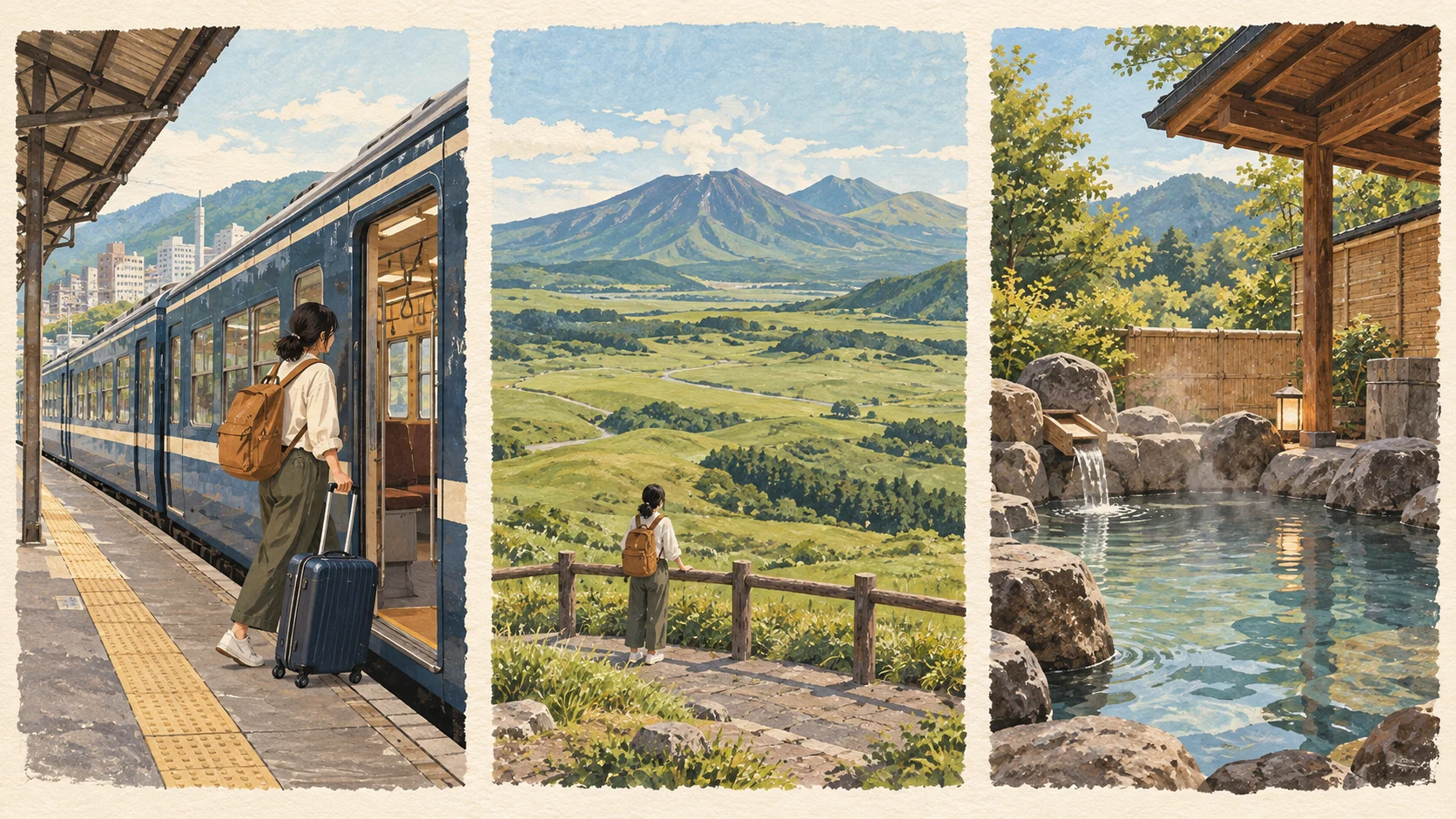
Start with one route you want to enjoy over seven days, then decide whether another city belongs in it. This guide separates Fukuoka round trips, departures from the south, northern rail routes and driving around Aso. Four interchangeable autumn foliage options let transport, accommodation and seasonal conditions shape the plan together.
Choose the days you want to spend before choosing cities
Seven days and six nights are enough for a coherent Kyushu route, but not necessarily for a night in each of its seven prefectures. Choose two priorities from port cities and neighborhoods, volcanic grasslands, and overnight hot springs; keep the third as an alternative instead of fitting everything into every day. Flying in and out of Fukuoka, with Nagasaki or Kumamoto as a second base, is a manageable starting point for a first visit. If Kagoshima matters most, make the journey south your main route and reconsider the departure airport. This protects time to stay and makes it easier to identify what to drop in bad weather.
Count arrival and departure days separately when calculating usable time. An afternoon landing, immigration, baggage collection, the trip into town and check-in may leave only time for dinner; an early return flight does not provide a full sightseeing day either. The seven-day examples here assume you can reach your overnight city before evening on day 1 and leave from Fukuoka on day 7. If your flights differ, move a night's accommodation or remove an excursion day instead of squeezing every stop. All examples are itinerary designs, not services already reserved for you.
| Main interests | Bases and transport | What to leave out first |
|---|---|---|
| Port cities, neighborhoods and food | Fukuoka, Nagasaki and Kumamoto, connected by rail | Do not also add all of Aso, Takachiho and southern Kyushu |
| Grasslands, hot springs and mountain scenery | Fukuoka, Kumamoto and Aso, with car rental concentrated on mountain days | Choose between Kurokawa and Takachiho; leave a day that can change with the weather |
| Southern Kyushu or Kirishima | Travel toward Fukuoka, Kumamoto and Kagoshima; compare departing from the south | Remove the Nagasaki and Oita legs instead of simply shortening every stay |
Follow railway routes rather than drawing a circle on the map
Kyushu's cities can be drawn into a circuit, but transport does not follow your circle. The Kyushu Shinkansen links Hakata with Kumamoto and Kagoshima-Chuo; Nagasaki requires a transfer at Takeo-Onsen; limited express routes toward Beppu and Oita run via Kokura. Yufuin, Aso and Takachiho each have different final connections. Before joining Kagoshima, Yufuin and Nagasaki into a loop, check the trains or roads you can actually use. Two nearby map pins are not necessarily neighboring stops on a direct service.
A counterclockwise route simply means heading west from Fukuoka, then south, east and north. It is not inherently faster than going clockwise, nor the only way to avoid retracing your steps. Returning by train through Kumamoto before taking another branch can sometimes work better than going around the east coast. Reversing direction may also be worthwhile if your preferred ryokan has availability on only one date. Include transfers, baggage collection and check-in when comparing options, then choose the sequence that best fits your services and accommodation.
Separate time on the train from time between hotel rooms
JR Kyushu's Relay KAMOME guide confirms that travel from Hakata to Nagasaki involves changing from a limited express to the Nishi Kyushu Shinkansen at Takeo-Onsen, normally across the same platform. One official JR timetable example for October 21, 2026 shows Relay KAMOME 1 leaving Hakata at 06:00 and reaching Takeo-Onsen at 07:00, connecting with KAMOME 1 at 07:03 and arriving in Nagasaki at 07:33: 93 minutes in total. This is one service on the date checked, not a promise about every train every day, and certainly not a 93-minute journey from a Fukuoka hotel to a Nagasaki attraction.
On a day when you change cities, add the journey from your hotel to the station, waiting time, local transport after arrival and baggage storage. If traveling with children, a wheelchair or large luggage, do not treat a typical passenger's cross-platform transfer time as a personal guarantee; ask the station in advance if assistance is needed. Driving also requires more than the navigation app's journey time: vehicle handover, refueling, breaks, finding parking and walking all take time. Two changes of city in one day tend to interrupt sightseeing more than one journey over the same total distance.
Compare the last night before choosing return or open-jaw flights
Flying in and out of Fukuoka lets you stay in the same area at both ends, use familiar airport transport and ask whether your hotel can hold large bags between two stays. Not every hotel offers this; do not make it a fixed part of your plan without agreement. If you reach Kagoshima and then return to Fukuoka, include the return railway fare, hotel price differences and extra time in the total, then compare departures or connections from Kagoshima. A cheap round-trip flight does not necessarily make the whole trip cheapest.
Open-jaw flights, arriving at one airport and leaving from another, remove a required return leg, provided routes, dates and connections suit you. Do not compare only airport positions on a map: airport buses, first departures and rental return locations can all change where you should spend the final night. Before an early flight, staying in the city or near the airport is usually easier to manage than remaining in a remote mountain area. Still check the actual service; being nearby does not guarantee that delays cannot occur.
Three airports need three different onward plans
The Fukuoka Airport subway directly serves the domestic terminal. International arrivals wanting the subway must first take the terminal shuttle, or choose a direct bus suitable for their accommodation. A few minutes on the subway is not the total time from an international landing to Hakata. If connecting to a long-distance train on day 1, allow for immigration and baggage collection, then choose a service with ticket-change conditions you can accept. Avoid relying on a tight transfer with an unchangeable ticket.
From Kumamoto Airport, take a city bus or the Airport Liner to Higo-Ozu and transfer to JR; there is no direct airport railway service. Under the current Airport Liner rules, the fare became ¥200 per person on July 1, 2026, so the old description of a free service no longer applies. Separate rules cover infants who do not require a seat and wheelchair reservations, and a full vehicle may mean waiting for the next departure. For Kagoshima Airport, check the city bus and its stops. The approximately 38 minutes to Kagoshima-Chuo listed for Nangoku Kotsu's direct service is a journey-time guide; other services take different routes, and traffic or a full bus can affect travel.
Seven days by rail in the north: Fukuoka, Nagasaki and Kumamoto
For cities and regional food without daily driving, spend nights 1 and 2 in Fukuoka, nights 3 and 4 in Nagasaki, night 5 in Kumamoto and night 6 back in Fukuoka. Keep day 1 for arrival and dinner nearby; choose a Fukuoka neighborhood or Dazaifu on day 2. On day 3, travel to Nagasaki and explore one compact area, then keep all of day 4 there. Move to Kumamoto on day 5 and choose Kumamoto Castle or a city walk in the afternoon. Leave day 6's morning for Kumamoto before returning to Fukuoka, and depart on day 7. This covers three cities without pretending to include extensive mountain exploration too.
There are still trade-offs. Nagasaki to Kumamoto needs its own transport plan; the two are not linked by a single direct Shinkansen. Avoid buying several timed activities for the afternoon of a luggage-moving day. If Kumamoto Castle and local food are your priorities, transfer a night from Nagasaki to Kumamoto. If your party dislikes changing hotels, keep just Fukuoka and Nagasaki as bases and turn day 5 into an extended Nagasaki day. For neighborhood detail, continue to the three-day Fukuoka guide to bases and meals; this overview need not repeat the city's entire list of places.
Seven days of mountain scenery: rent a car for the three days that need it
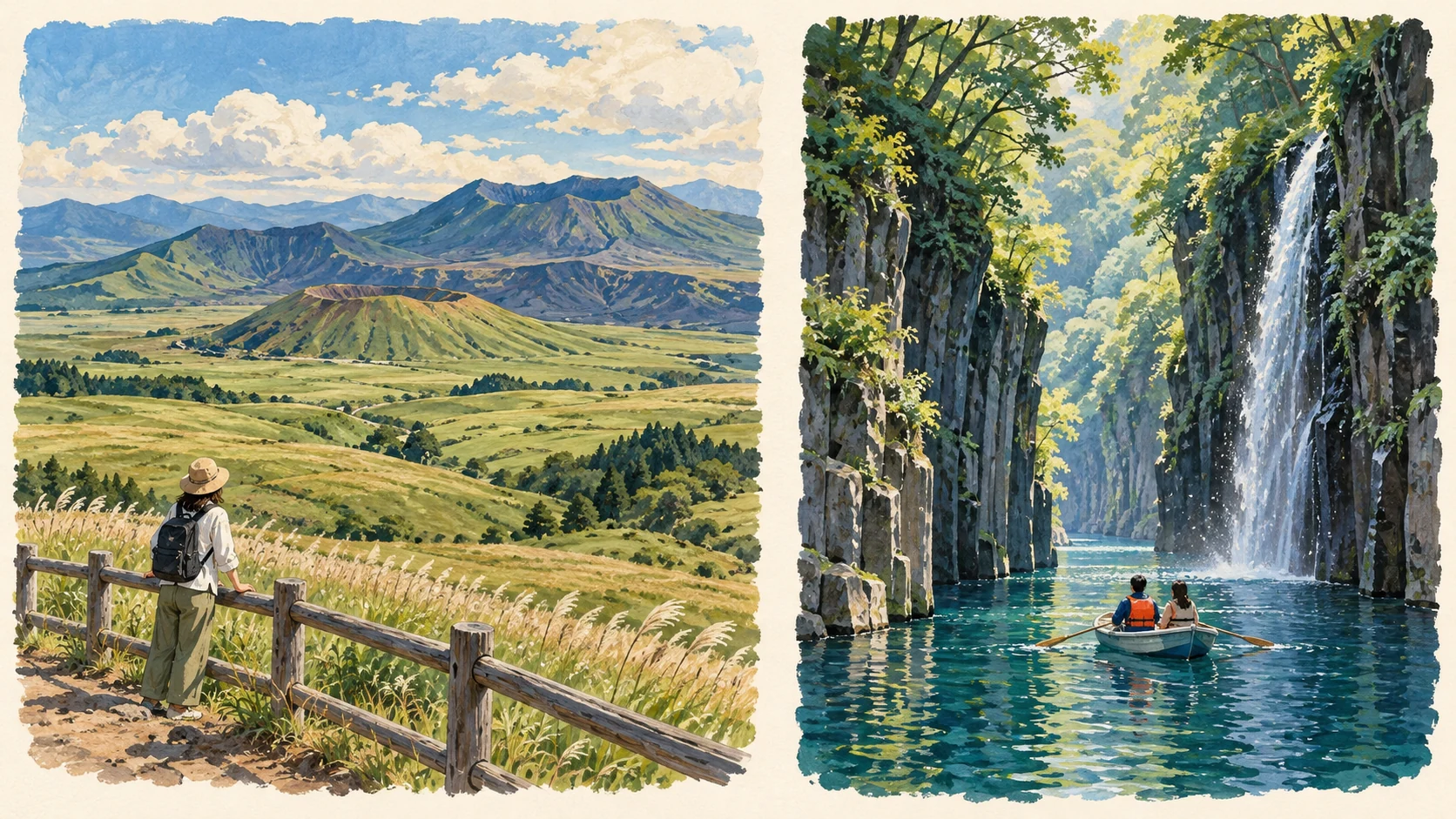
For grasslands and hot springs, try night 1 in Fukuoka, night 2 in Kumamoto, nights 3 and 4 at one base in or around Aso, night 5 in Kumamoto and night 6 in Fukuoka. Travel to Kumamoto by rail on day 2 and spend time in town, then collect a car for the mountains on day 3. Choose grasslands, a viewpoint or hot springs according to the weather on day 4, return the car in Kumamoto on day 5 and go back to Fukuoka on day 6. This reduces city parking days and leaves a full mountain day that can be rearranged. If staying in Kurokawa, make bathing and dinner that day's focus instead of treating a long drive as a small task before dinner.
Takachiho is another branch. If it is essential within seven days, replace one Aso night with Takachiho and drop Kurokawa or another distant stop. Without a car, redesign the plan around buses between Kumamoto and Takachiho and overnight timing rather than copying the driving sequence. Aso's crater is not a guaranteed open centerpiece either. For access restrictions, boating, lodging and last services, use the branch itineraries for Kumamoto, Aso, Kurokawa and Takachiho and confirm where you can actually get before booking rooms.
If you insist on a seven-day island circuit, accept what disappears
To include Fukuoka, Nagasaki, Kumamoto, Kagoshima, Yufuin and Beppu, an intensive outline could put night 1 in Nagasaki, night 2 in Kumamoto, night 3 in Kagoshima, night 4 in Yufuin or Beppu, and nights 5–6 in Fukuoka; day 1 still needs enough time after arrival. If night 4 is in Beppu, a named connection checked on October 22, 2026 is MIZUHO 602, leaving Kagoshima-Chuo at 07:24 and reaching Hakata at 08:51, followed by SONIC 11 at 09:21, arriving in Beppu at 11:33. SONIC runs via Kokura without a change of train there. The two rides take 87 and 132 minutes, with a 30-minute wait at Hakata: 249 minutes, or 4 hours 9 minutes, station to station, before hotel access at either end, luggage storage or delays. This example leaves the Shinkansen at Hakata. Compare products against the JR Kyushu Rail Pass coverage: the All Kyushu version can cover these sections, while neither a Northern nor a Southern Kyushu pass alone covers the whole journey; traveler eligibility, validity and seat conditions still apply. The pass also excludes the Sanyo Shinkansen between Hakata and Kokura. This is one connection for the checked date, not the fastest-route claim or a guarantee of future seats. If you still want to sightsee in Kagoshima on the morning of day 4, check a later arrival separately or drop the Oita direction. These days cannot also promise in-depth visits to Aso, Takachiho and Kirishima.
Removing a stop is usually more effective than shortening every meal. For port-city history, drop Kagoshima and give Nagasaki more time. For southern Kyushu, drop Nagasaki and Yufuin, follow Fukuoka–Kumamoto–Kagoshima and compare a southern departure. If a hot spring stay matters most, choose either Yufuin or Beppu as your base and consider the other as a daytime option if transport works. If no city can be removed, adding two or three nights is more likely to meet your expectations than repeatedly searching for the shortest route. Give that extra time first to a place where you would otherwise only sleep, rather than immediately adding another city.
Traveling without a car works, but check the last return service first
A rail itinerary does not mean every attraction is beside a station. To judge whether traveling without a car works, list three legs for each day: accommodation to station, station to attraction, and attraction back to accommodation. Start with the return. Where buses are sparse, a lunch queue, a missed departure or a delayed activity can affect everything afterward. Depending entirely on the last bus leaves little room for error. Consider an overnight stay, remove a second distant attraction, or compare a tour with a clearly defined pickup area in advance instead of assuming a taxi will be available on arrival.
A car does not remove every uncertainty. Mountain access restrictions, road closures, canceled sailings and full parking areas still apply, while someone must remain rested and alert enough to drive. A useful combination is often public transport in cities and a rental collected in Kumamoto or Oita. But confirm from the actual booking whether a different return location is allowed, whether it costs more, and the branch and shuttle operating hours. Avoid booking a nonrefundable hotel first and discovering later that the return branch is closed or will not accept a cross-region return.
Check JR Kyushu pass coverage before its consecutive validity days
The All Kyushu, Northern Kyushu and Southern Kyushu versions of the JR Kyushu Rail Pass are different products, not one pass under different names. The northern pass covers the Kyushu Shinkansen as far as Kumamoto; the southern pass covers it from Kumamoto toward Kagoshima-Chuo. The Sanyo Shinkansen between Hakata and Kokura is excluded from these passes. Buses, subways and other railway operators are not automatically included just because they are in Kyushu. A seven-day trip with three days in Fukuoka neighborhoods does not automatically require a seven-day pass.
List the long-distance journeys you will actually take, then check whether they fall within the pass's consecutive validity period. Journeys on days 2 and 6 may not fit a short-duration pass; adding a train ride just to break even does not improve the value of your holiday. The northern and southern passes' limits on free reserved-seat bookings, separately paid online reservations, eligibility and prices through different purchase channels all have details to check. This section helps choose your transport direction; for a full comparison, see how to choose Japanese point-to-point tickets and regional passes. Owning a pass does not mean a popular reserved seat has been secured.
Driving documents depend on where your license was issued, not the article's language
Before renting, check the issuing country or jurisdiction of every actual driver's license, its expiry date, permitted vehicle categories and the documents accepted for driving in Japan. JAF's guide to foreign licenses distinguishes International Driving Permits under the 1949 Geneva Convention from the route using a license issued in specified jurisdictions together with an accepted Japanese translation. A document under the 1968 Vienna Convention cannot simply be treated as an International Driving Permit recognized by Japan. Reading a Traditional Chinese article does not imply that a traveler holds a Taiwanese license.
Holders of licenses issued in Taiwan, Germany, France, Switzerland, Belgium and Monaco should check the applicable requirements for the original license and an accepted Japanese translation. Taiwanese travelers should not substitute an International Driving Permit for this translation route. For other issuing jurisdictions, check the rules that apply rather than extending this list into a conclusion about every country. Passports, entry records, the lawful driving period and the rental company's checks must also meet the requirements. Long-term residents and people making repeated entries face additional conditions; the one-year period often mentioned for short visits does not automatically restart. Bring original documents and have the branch confirm your actual eligibility instead of arriving with only copies on a phone.
Rental insurance, deductible waivers and NOC cover different things
Basic coverage included in the rental price does not mean an accident will cost you nothing. In Toyota Rent a Car's official insurance guide, for example, basic coverage still has deductibles for property and vehicle damage. A deductible waiver addresses eligible deductibles, while the Non-Operation Charge (NOC) covers lost business while the vehicle is being repaired or cleaned. Its Double Protection Package combines a deductible waiver with NOC protection and other items. These are different product levels within one company; their names and terms cannot be applied directly to another rental firm.
The same page lists exclusions such as failing to notify the police, an unregistered driver, driving without a valid license and driving under the influence. Saying that extra insurance covers everything would therefore be misleading. Compare how tires, towing, lost keys, interior cleaning and contract breaches are treated instead of looking only at the package name. At collection, confirm that all drivers are registered, photograph existing damage and ask staff to record it. After an accident, follow the police and rental company's procedures rather than settling privately and asking for compensation afterward. Include these steps in the vehicle handover time; they do not take zero minutes.
Calculate KEP, ETC and ordinary tolls separately
An ETC card is a tool for collecting expressway tolls; inserting it does not mean you have purchased an unlimited-use pass. The Kyushu Expressway Pass (KEP) is a separate product whose participating rental branch, vehicle, validity period and covered roads need confirmation. Times' ETC service page still describes reserving KEP together with ETC when renting, with availability varying by branch and the pass charged separately. That description alone cannot guarantee that your collection date, branch or booking supports the add-on.
When checked on October 22, 2026, NEXCO West Japan's KEP entry page redirected to a security-maintenance notice with no fixed end date. This guide therefore does not quote a KEP price that could not be confirmed that day, and does not interpret maintenance as proof that sales have stopped. First estimate your route using ordinary ETC tolls, then ask the rental branch whether it can supply KEP, which roads are covered and the full total price. Until confirmed, do not build expected savings into a budget you must meet. Do not assume that urban expressways, roads outside the region or roads outside the designated coverage are all included.
Collection, return, luggage and mountain roads matter more than a model name
Choose a vehicle by counting adults, child seats, suitcases, wheelchairs and other items together: enough seats do not necessarily mean enough trunk space. Booking screens often show a vehicle class; check the order to see whether a specific model or equipment is guaranteed. Confirm availability and charges for winter tires, child seats or other equipment before collection. Japan drives on the left. On your first drive, take time to learn the vehicle, sightlines when turning and road junctions rather than making the opening stretch a long rush to a last departure or dinner.
Allow time for refueling and the vehicle inspection on return day. An airport rental branch may not be inside the terminal and may require a shuttle; work backward from the branch's stated requirements. Prioritize daylight driving in the mountains. In dense fog, snow, ice or road restrictions, change your plans or stay put rather than treating continued navigation directions as a safety assessment. Instead of assigning every mountain road a deceptively precise journey time, confirm before booking that you can handle the season's road conditions and leave an overnight stay that can be adjusted.
Compare seven-day transport budgets using the same group size
Rail fares are priced per person, while most rental costs are per vehicle. Fix the number of travelers and days that genuinely need a car before comparing. This is only a calculation example, not a rental quote: assume ¥27,000 for three days' rental, ¥6,000 for additional protection, ¥6,000 for fuel, ¥8,000 for tolls and ¥3,000 for parking. The total is ¥50,000: ¥25,000 each for two adults or ¥12,500 each for four. If four people need a larger vehicle, recalculate the ¥27,000 rental assumption rather than concluding from the lower per-person number alone.
For rail, add long-distance fares, subways and attraction buses, and any necessary taxis separately. Do not omit a final connection that the pass excludes. Compare accommodation for the actual party size, including tax and whether meals are included. If a ryokan stay includes dinner, do not add a second allowance for eating out that evening; equally, a rate with dinner and breakfast cannot be compared directly with room-only accommodation. Add a contingency amount you are comfortable with, so changing transport, canceling an activity or staying an extra night does not immediately derail the trip. For more on fixed costs, see the order for estimating a Japan travel budget.
Spring flowers and summer greenery need different alternatives
Spring works well for combining city walks and flowers, but blossoms do not follow your flight dates. Choose a base with several indoor and outdoor activities, then make parks, riversides or nearby excursions interchangeable days. This is more flexible than moving among three places solely for blossoms. Temperatures differ between mountains and cities, and mornings, evenings or rain may still call for a jacket. Before adding Yufuin or Aso in spring, check roads and hotel transfers rather than assuming the highlands share the city's warmth.
Summer grasslands and coasts suggest a different rhythm. The Fukuoka Regional Headquarters of the Japan Meteorological Agency's guide to northern Kyushu's climate places the usual rainy season from early June to mid-July and notes autumn rain and typhoons in September. This is regional climate background, not a forecast that a particular day will be wet. Schedule long outdoor activities at times you can tolerate, with breaks, water and indoor alternatives. Heavy rain can affect transport after the rain has stopped; sunshine outside your window does not by itself mean a valley itinerary can resume.
For autumn, start with elevation and then check this year's observations
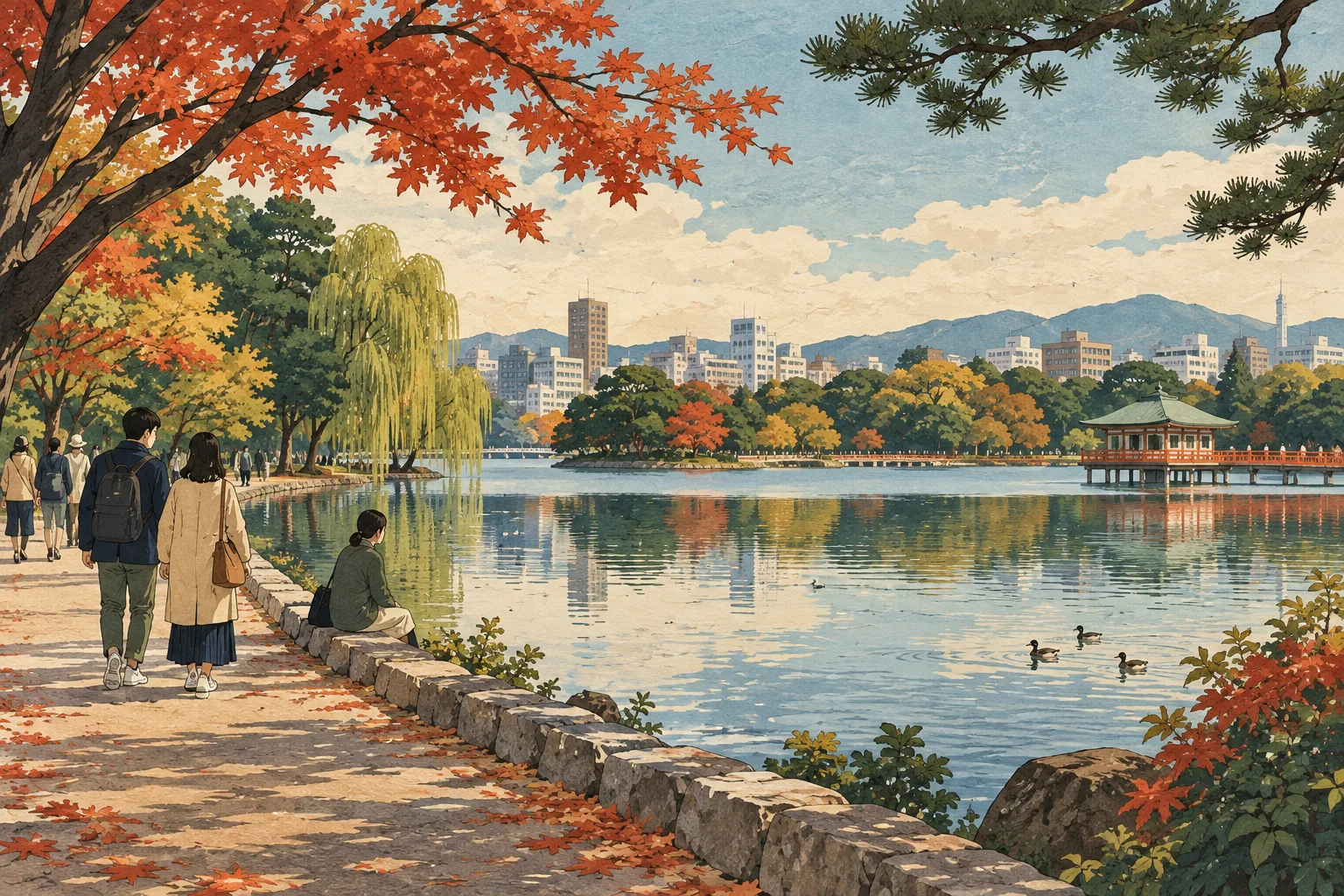
There is no single week when all of Kyushu reaches peak foliage together. The Chojabaru Visitor Center's seasonal guide says color usually begins around the Kuju summits in mid-October and moves downhill afterward; the mountains can see their first snow in November. Dazaifu gardens and shrines in the south cannot use the same dates. Before choosing dates, decide what kind of mountain visit you want: a stroll beside a parking area, trees in a hot spring town and a proper mountain hike are three different plans.
Distinguish typical timing, this year's forecasts and actual observations when reading foliage reports. Typical timing helps choose a month, forecasts help keep alternatives open, and local observations get closest to current conditions. Even a vivid recent photograph may show only one tree or a high-altitude stretch. Book a base that makes changing direction manageable, then decide nearer departure whether to choose Unzen, Yabakei, Dazaifu or Kirishima. If you miss hillsides at full color, towns, food and hot springs can still make the trip worthwhile rather than leaving it entirely dependent on chasing leaves.
Choose autumn clothing for the way you will spend your time. Adjustable base layers, insulation and a windproof outer layer help with the change from city to highland; adapt them to the destination forecast before heading out. Standing still for evening illuminations can require more warmth than walking by day. Wear familiar walking shoes with good grip, and still slow down on wet leaves, stone steps and wooden boardwalks: a non-slip label is not a guarantee against falling. For an actual mountain route, prepare equipment for its difficulty instead of treating a city foliage checklist as a hiking checklist.
Unzen foliage: the hot spring town and Nita Pass are separate stops
For autumn color in the Nagasaki direction, make Unzen an overnight branch rather than a casual detour before dinner in Nagasaki city. Unzen City's notice, updated October 20 with observations from October 16, reports that Fugen-dake and Kijindani, and Myoken-dake and Nita Pass, had begun changing color while the hot spring town was still green. Its typical-season ranges also distinguish higher elevations from the town. This cannot prove that your chosen November day will be at peak color, but it explains why the phrase Unzen autumn leaves alone is not enough.
Without a car, one direct example links Nagasaki with Unzen's hot-spring town. Checked on October 22, 2026, the Nagasaki Prefectural Bus express Nagasaki–Obama–Unzen service, whose table is marked as of April 1, 2026, leaves stand ③ at Nagasaki Ekimae Terminal (長崎駅前ターミナル) at 09:10 and reaches the Unzen stop at 10:51. The return leaves Unzen at 16:10 and reaches the transport plaza in front of Nagasaki Station at 17:51. The outbound terminal and return transport plaza are different stops. Each ride takes 101 minutes, and this pair appears in the weekday, Saturday and Sunday/public-holiday tables; compare the timetable linked from the route page. Seats do not require reservations and boarding follows the queue, but road delays and current notices still matter. This return trip supports the hot-spring town, not Nita Pass. An old seasonal mountain shuttle notice cannot guarantee a future service. If no current onward connection has been verified, stay in the town; a taxi also needs an actual vehicle and time confirmed rather than being treated as already booked. Drivers must check roads and parking separately, and ropeway passengers must check wind and operations. A sunny summit photo is no guarantee that you can reach the top.
Yabakei foliage: choose the area before checking the bus
Yabakei is not one attraction immediately outside a railway station. Without a car, one option is a return trip from Nakatsu Station to the Ao-no-Domon area. Checked on October 22, 2026, the timetable still linked by Oita Kotsu shows a Daiko Hokubu bus with destination “守実温泉” via “柿坂” leaving Nakatsu Ekimae at 10:10 and passing Ao-no-Domon Chushajo (青の洞門駐車場) at 10:37. The return from that stop toward Nakatsu Station is 15:35, arriving at Nakatsu Ekimae at 16:02. Both rides take 27 minutes and appear for weekdays and Saturdays/Sundays/public holidays. The route table and parking-stop tables are marked revised October 1, 2025, while the Nakatsu Ekimae stop table is revised April 1, 2026; the selected services agree. The actual alighting point must follow the operator diversion notice: Ao-no-Domon Chushajo uses a temporary stop across the river on National Route 212, whereas the original Ao-no-Domon stop uses Shimosogi Iriguchi (下曽木入口). Do not merge these two stops. The tourism association walking map dated March 28, 2026 leads from the temporary stop across Zenkai Bridge to the south side of the tunnel; identify the Nakatsu Station direction for your return. The map gives no walking minutes, so allow separate time to get back to the stop. The published 10:37/15:35 times are scheduled passage times at the parking stop, not a minute-exact guarantee for the diverted stop. Recheck notices before traveling. The tunnel currently allows pedestrians only and remains closed to vehicles. The association bus guide separates other destinations; this example does not stack several gorge areas into successive short connections, and a long-distance train after Nakatsu needs a buffer.
Driving lets you choose more dispersed stops, but peak foliage traffic and parking use time you may have allocated elsewhere. A workable day visits one main area in the morning, leaves time for a walk and lunch, then decides on a second stop according to conditions. It does not promise every famous foliage site at the start of the day. By bus, let a confirmed return service set the boundary for eating and walking. With older travelers, check gradients, steps and opportunities to sit and rest rather than allowing the phrase gorge walk to stand in for an assessment of the effort required.
Dazaifu foliage: Kamado Shrine as an interchangeable Fukuoka day
With Fukuoka as your base, Dazaifu is relatively easy to arrange as a day trip without changing hotels. Kamado Shrine's guide to its grounds places typical foliage in mid- to late November, but this is not a color guarantee for a specific date in 2026. Plan the shrine visit, a walk around the grounds and lunch first, then decide whether to stay longer according to current opening arrangements and daylight. Without that year's illumination announcement, do not buy an unchangeable return ticket based on a previous year's schedule.
The shrine's access page lists approximately 40 minutes on foot from Dazaifu Station, or about 10 minutes and ¥100 on the Mahoroba community bus. Walking and riding are different choices; do not assume everyone wants to walk uphill just to save one fare. If also visiting Dazaifu Tenmangu that day, retain time for travel and rest between the two. This branch can replace a Fukuoka city day without turning an existing northern Kyushu itinerary into a whole-island circuit.
Kirishima foliage works best when southern Kyushu is your main route
Kirishima fits better after a stay in Kagoshima and the surrounding area than as a long day trip from Fukuoka for one foliage spot. Shrine visits, hot spring nights and mountain walks can be separated across days. On a seven-day trip, deciding on Kirishima should also mean reducing the Nagasaki or Oita legs. Elevation and terrain differences mean one forecast date for Kagoshima city cannot cover every site here; check local tree conditions, roads and weather individually.
Without a car, one return example links Kagoshima Airport with Maruo's hot-spring town. Checked on October 22, 2026, the Kirishima City transport page updated October 5 and its timetable marked “from April 1, 2026” show Kagoshima Kotsu's Kirishima Jingu Access Bus leaving airport stand ⑨ daily at 09:30 and reaching Maruo ① at 10:00. The daily return leaves Maruo ② at 16:36 and reaches the airport at 17:06; each ride is 30 minutes. This service requires the specified Kirishima Nottari Oritari My Plan (霧島のったりおりたりマイプラン) one-day ticket: ¥1,500 for junior-high-school pupils and older, ¥750 for elementary-school pupils. It can be bought aboard this Access Bus; an ordinary JR ticket does not authorize boarding. Maruo is the stopping area in this example. To continue to the shrine or mountains, check separate services and stops. The Kirishima Jingu access page also distinguishes the JR station from the airport direction: a similar station name does not mean you alight at the shrine. A timetable guarantees neither unchanged service nor available seats on your travel date, and 17:06 is not an assured airport arrival suitable for a tight flight connection. If you fly home that day, place shrine sightseeing the day before and leave the final day for airport transport.
Winter hot springs and mountains need more than the idea that Kyushu is warm
Cities and hot springs can anchor a winter trip, but highlands such as Kuju and Aso do not share coastal cities' road conditions. Chojabaru Visitor Center's winter guide warns of severe cold and snow in the highlands. This affects driving, walking and transport, not just the need for an extra layer. Travelers without snow experience can prioritize hot spring accommodation accessible by public transport with confirmed transfers, treating higher mountain excursions as extras only when conditions allow.
Much of the value of a ryokan stay with dinner and breakfast comes from arriving in the afternoon, settling in, bathing and having dinner at ease rather than rushing from far away at night. At booking, check the latest check-in, dinner start time, what happens if you miss the meal, and whether children have beds, yukata and meals. A room for four does not necessarily contain four beds. If you need a private bath, an accessible route through the property or dietary arrangements, obtain answers for the specific plan before payment rather than relying on general facility photographs.
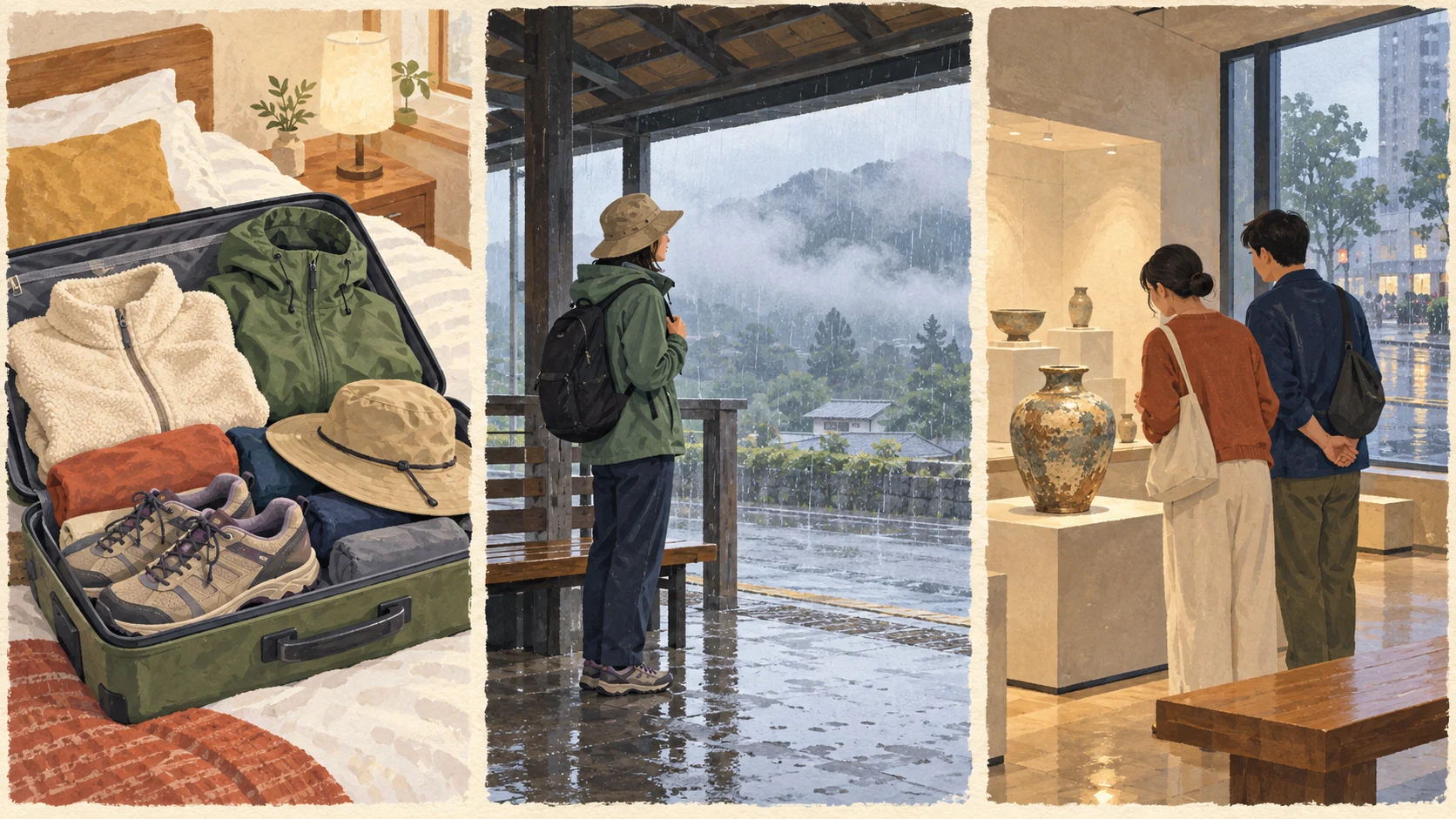
Plan rain alternatives, luggage and cancellation order before departure
An alternative should be somewhere you would have wanted to visit anyway. In Fukuoka, move neighborhood shopping or an indoor exhibition to a rainy day; in Kumamoto, keep city meals and indoor visits available for changes to mountain plans. The facility must still be open that day and transport operating normally. If weather and official notices indicate danger, stop affected activities first instead of switching to another mountain road merely to avoid wasting a ticket. Hotels, rentals, trains and activities have separate contracts: one canceled service does not automatically make the other bookings free to cancel.
Before leaving, make a simple list of each reservation's cancellation deadline, contact details, payment recipient and latest arrival time, then deal with the earliest deadline first. For sending large bags between cities, confirm acceptance with the receiving hotel, delivery days and size limits. Keep essential medication, a change of clothes and that day's necessities in a hand-carried bag. For a single-night move, storage or fewer hotel changes may be simpler. Mark the day you most want to protect, then remove the parts that would turn it into a rush. That usually does more for a Kyushu trip than adding more places.
A few useful answers
Do I need to rent a car for my first seven days in Kyushu?
Not necessarily. Rail can form the main route between cities such as Fukuoka, Nagasaki and Kumamoto. The final connections to grasslands, hot springs or gorges determine whether a car helps. Check return services first; you can also rent only for mountain days.
Can I travel around all of Kyushu in seven days?
You can design an outline with frequent transfers, but dividing six nights among several cities leaves little time to explore them deeply. To keep Aso, Takachiho or Kirishima, remove a distant city or add nights.
Is counterclockwise always the best direction for a Kyushu circuit?
No. Actual rail routes, flights, hotel availability and roads determine the order. A route that does not cross itself on a map is not necessarily fastest. Departing from the south may also work better than returning to Fukuoka.
Can I take the subway directly from Fukuoka Airport's international terminal?
The subway directly serves the domestic terminal. International passengers can first take the terminal shuttle or choose a bus appropriate for their destination. Include immigration and the shuttle in the total journey time.
Is the shuttle from Kumamoto Airport to Higo-Ozu still free?
Airport Liner began charging ¥200 per person on July 1, 2026. Separate rules cover infants who do not require a seat, wheelchair reservations and full vehicles; consult the operator's current FAQ.
Does a JR Kyushu pass cover the Shinkansen from Hakata to Kokura?
The All Kyushu, Northern Kyushu and Southern Kyushu JR Kyushu passes exclude this Sanyo Shinkansen section. Both endpoints being in Kyushu does not make it covered; check eligible trains or buy a separate ticket.
Can a Taiwanese license holder drive in Japan with only an International Driving Permit?
Under the applicable rules, prepare the original Taiwanese license and an accepted Japanese translation, along with documents such as a passport for verification. Requirements differ by issuing jurisdiction, so this route cannot simply be applied to every traveler.
If rental insurance is included, does that remove the NOC?
Not necessarily. Basic coverage, deductible waivers and loss-of-business charges are separate. NOC waivers and exclusions depend on the actual rental company and the package purchased.
Can I be certain KEP is available now?
When this guide was checked on October 22, 2026, NEXCO's product entry displayed a maintenance notice, so that page could not confirm current prices or sales availability. Rental firms still describe the product. Confirm with the designated branch and budget using ordinary ETC tolls first; maintenance does not establish that sales have stopped.
Is all of November the best time for Kyushu autumn leaves?
Timing varies greatly by elevation and area. Higher parts of Kuju can turn earlier, while lower locations such as Dazaifu have their own usual ranges. Choose a month using typical timing, then adjust with that year's local observations; color on a particular date is not guaranteed.
Check with the source
Schedules, availability and rules can change. These official sources are the place to confirm details before you book.
- JR Kyushu: Relay KAMOME guide
- Official JR timetable example
- Fukuoka Airport subway access
- Airport Liner: current rules
- Nangoku Kotsu: direct airport bus
- JR Kyushu Rail Pass
- JAF: driving in Japan with a foreign license
- Toyota Rent a Car: official insurance guide
- Times: ETC service
- NEXCO West Japan: KEP entry page
- Fukuoka Regional Headquarters, JMA: northern Kyushu climate
- Chojabaru Visitor Center: seasonal guide
- Unzen City: October 20 update recording October 16 foliage conditions
- Nakatsu Yabakei Tourism Association: bus guide
- Kamado Shrine: grounds guide
- Kamado Shrine: access
- Kirishima Jingu: official access
- JR Kyushu: MIZUHO 602 timetable for October 22, 2026
- JR Kyushu: SONIC 11 timetable for October 22, 2026
- Nagasaki Prefectural Bus: Nagasaki–Obama–Unzen express route
- Nagasaki Prefectural Bus: stops and Nagasaki Station area map
- Nagasaki Prefectural Bus: Unzen line timetable, as of April 1, 2026
- Oita Kotsu: currently linked route timetable, page 15, revised October 1, 2025
- Oita Kotsu: Ao-no-Domon diversion and replacement stops
- Nakatsu Yabakei Tourism Association: 2026 Ao-no-Domon walking and temporary-stop map
- Kirishima City: Kirishima Jingu Access Bus page, updated October 5, 2026
- Kirishima Jingu Access Bus timetable, from April 1, 2026