Start a Kagoshima trip by deciding where to return each evening. Kagoshima-Chuo suits train departures, Tenmonkan makes dining convenient, Kirishima rewards an overnight hot-spring stay, and Ibusuki needs a plan for both sand bathing and the journey back. This guide connects bases, ferries and buses with private baths, children’s conditions and the sand-bath process, helping you choose where to spend three to five days.
Separate three trips: a city base, a mountain overnight and a seaside sand bath
A first Kagoshima trip can easily become a schedule in which every stop is reachable but every day feels rushed. Kagoshima-Chuo, Tenmonkan, Kirishima Onsen and Ibusuki share a prefecture but suit different evenings. Chuo simplifies the next train departure; Tenmonkan keeps dinner and walking in town; Kirishima merits an early finish for ryokan dinner and bathing; Ibusuki requires deciding whether to travel back after the sand bath. Choose the evenings before linking daytime places by map distance.
For three days and two nights, use Kagoshima City as a base and choose priorities on Sakurajima and in Ibusuki without forcing in a Kirishima overnight. Four days and three nights can mean two city nights plus one in Kirishima, or all city nights with an Ibusuki day trip. Five days or more leave more room for a night in each onsen direction. This is a suggested arrangement based on luggage moves and connections, not a fixed package. With a late flight, young children or an important ryokan dinner, reduce hotel changes.
Prices and normal timetables below come from official information checked on October 22, 2026. Saraku’s year-end maintenance, Kirishima bus operating days, special ferry timetables and event dates have their own scope. Check the item that changes your choice of overnight base before buying a non-refundable room.
| Main purpose | Base to compare first | Trade-off |
|---|---|---|
| Frequent JR trips or a short stay | Kagoshima-Chuo | Separate trips to the port and dining districts |
| City dining and evening walks | Tenmonkan | An extra journey for early JR trains |
| Ryokan dinner, private baths and rest | Kirishima Onsen | Check bus frequency and pickup first |
| A slower pace after sand bathing | Ibusuki | Yamagawa still needs another transport leg |
Kagoshima-Chuo: prioritize early trains and large luggage
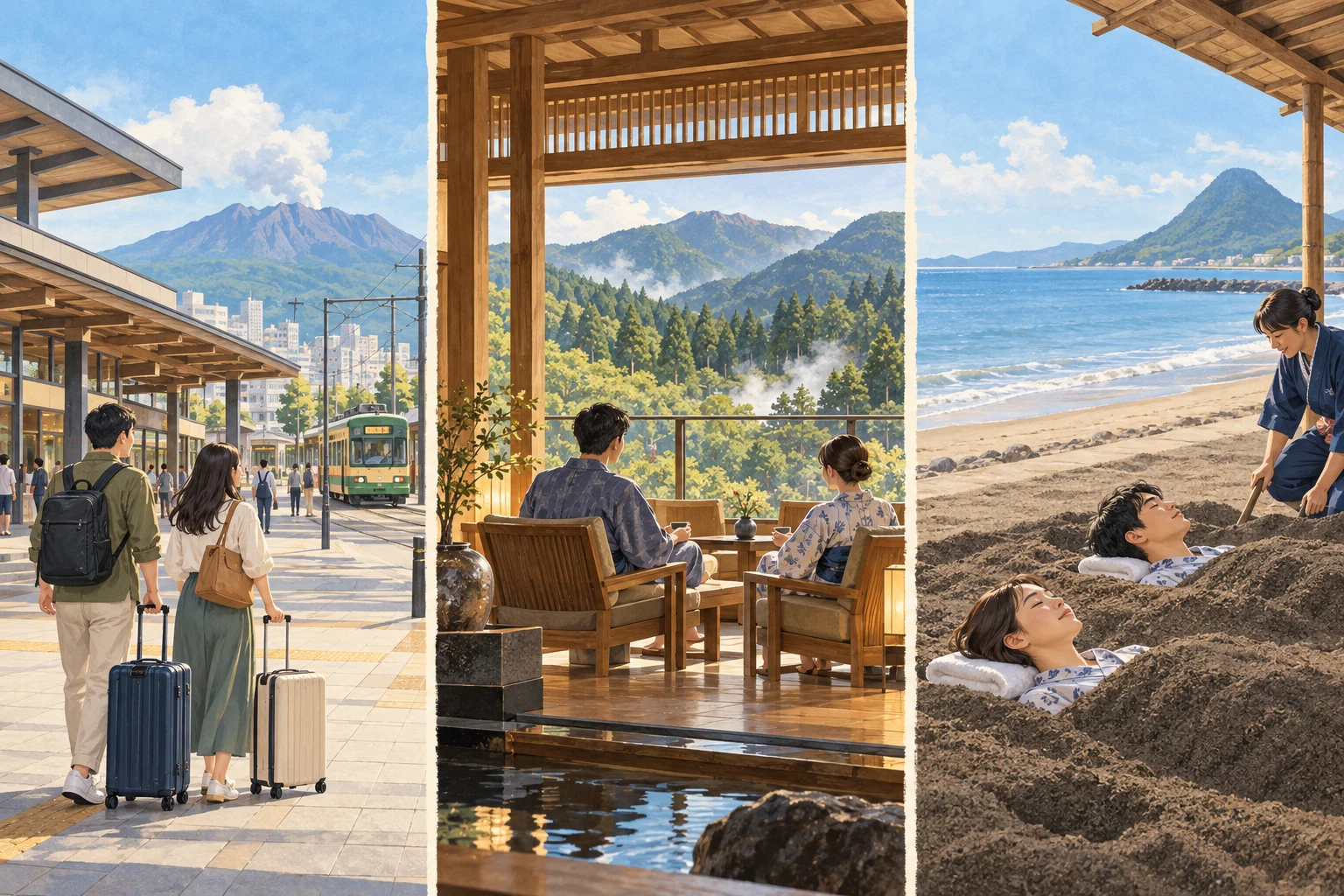
For Shinkansen trips, Ibusuki no Tamatebako or repeated departures, the Chuo area has a clear practical advantage. Check the actual room-to-platform route: which exit, whether you must cross the station, luggage storage and whether breakfast starts before your train. “Near the station” includes several directions; with two large suitcases, these differences may matter more than an extra chair in a room photograph.
For example, JR Kyushu Hotel Kagoshima’s access page describes a direct connection to Kagoshima-Chuo, a useful comparison for minimizing luggage handling. That advantage concerns location: it does not make every room spacious, volcano-facing or free for children. For a 09:56 sightseeing-train departure, time checkout, storage, breakfast and platform-finding separately rather than leaving at the last minute because of the hotel address.
Kagoshima-Chuo Station and Kagoshima Station are not the same station. Keep the full name when checking hotels, port access and bus signs. If a search result merely promises a few minutes from “Kagoshima Station,” open the property’s own access map. Several nights in one place save packing and check-in time, even if they do not produce the lowest nightly rate.
For a concrete room comparison, look at JR Kyushu Hotel Kagoshima’s North Wing Deluxe Twin (北館デラックスツイン): it measures 33 m², and the two-person room option lists two beds measuring 140 × 200 cm each. Three or more guests require the corresponding plan; a paid extra bed is not already included in the two-person plan. The breakfast page separately lists tax-inclusive prices for hotel guests of ¥2,200 per adult and ¥1,100 for “children” (小人), without stating the child age range. When bringing children, confirm the existing-bed sharing age limit, number allowed and meal charges for the selected plan. Wide beds do not establish free child stays, and another hotel’s child policy cannot be applied here.
Tenmonkan and Shiroyama: dining convenience and hotel time are separate costs
If dinners, shopping streets and after-dinner walks matter most, start with Tenmonkan. Put intended restaurants, tram stops and the nighttime walk back on one map. Tenmonkan is a district: a hotel beside a main road, inside an arcade or on the edge creates different journeys. Add a trip to Chuo for an early train, and remember the luggage on departure day even if dinner is convenient.
For scenery, breakfast and time inside the hotel, compare hillside-view properties such as Shiroyama separately. SHIROYAMA HOTEL kagoshima’s shuttle guidance lists free services toward Chuo and Tenmonkan but warns that full vehicles may prevent boarding and festival routes can change. Compare the last shuttle, luggage handling and boarding needs before rates. If you expect repeated evening trips downtown, waiting in both directions is also a cost.
A hotel with views does not mean your booked room faces Sakurajima or shows the fireworks. Check the room name, direction, floor conditions and whether a view is guaranteed; if unclear, treat it as unconfirmed. Arriving late and leaving early may leave little use for a view upgrade, while Chuo or Tenmonkan’s transport benefits are immediate.
SHIROYAMA’s Forest Twin (フォレストツイン) provides another named comparison: 25 m², two beds measuring 110 × 195 cm each, a listed capacity of two and “no view” (眺望なし). The hillside hotel location does not guarantee a Sakurajima view from this room. In the official list for this room type, the “【朝食付】城山基本プラン” breakfast-inclusive standard plan allows at most one child to share each existing bed. Its tax-inclusive facility charges are ¥4,400 for an elementary-school child, ¥1,650 for a preschool child aged 3–6 and free for ages 0–2; breakfast for those same categories costs an additional ¥1,300, ¥550 and ¥0 respectively. A one-child-per-bed allowance does not permit arbitrary extra occupants: confirm that the booking accepts your actual party. These are child supplements for that specific breakfast-inclusive plan. The general breakfast introduction separately lists ¥1,700 for elementary-school children and ¥700 for children aged 3–6, so the lower figure cannot simply be chosen for a different plan.
Before comparing room prices, fill in beds, children, meals and cancellation times
Even “two people in one room” can mean a small double, two singles or an existing bed plus sofa bed. With children, check total occupancy, the age and headcount limits for free bed-sharing, separate breakfast charges and bedding. A booking form accepting two adults and one child does not establish three beds. At a ryokan, distinguish children’s meals, adult meals and bedding-only options.
Compare three properties using identical dates, party size, children’s ages and meals, recording the total, payment method and cancellation deadline in Japan time. A room-only city rate and a Kirishima dinner-and-breakfast rate cannot be compared by simple subtraction: the latter also reserves an evening and may save a taxi. For a lower budget, choose just one meal-inclusive ryokan night and keep other nights in convenient city hotels. The first-ryokan booking checklist helps check meals and arrival arrangements.
Tattoos, private baths, infants and accessible routes follow each property’s rules; one accommodating example does not apply across the area. Include dates, room type, children’s ages and specific needs in one inquiry instead of asking only whether it is family-friendly. If dinner or pickup times already do not work, change the plan before paying rather than relying on negotiations on arrival.
Cancellation terms must also be tied to the plan. SHIROYAMA’s “【朝食付】城山基本プラン” above charges 20% of the accommodation charge for cancellation the day before arrival, 80% on the day and 100% for a no-show. The inability to change or cancel through MyPage after 23:59 two days before arrival is an online-service cutoff, not a free-cancellation deadline. The hotel also lists a “【2026年-2027年】年末年始・迎春宿泊プラン(朝食付)” year-end and New Year breakfast plan for stays from December 26, 2026 to January 2, 2027, requiring advance payment by credit card. Its cancellation charges follow calendar periods: 20% from September 1 through October 31, 2026; 50% from November 1 through 30; and 100% from December 1 through the stay date, with no-shows also charged 100%. Children’s facility and breakfast charges from December 31 through January 2 have separate holiday rates, so the ordinary breakfast-plan figures above cannot be reused. These examples compare terms and do not establish room availability on your chosen dates. Before paying, check the total against the actual room type, children’s ages, meals and cancellation terms in your booking.
Arrival and departure: count the airport, Chuo and onsen areas as separate journeys
Kagoshima Airport is neither Kagoshima-Chuo Station nor somewhere you can simply walk into a Kirishima ryokan after landing. Establish which service is realistically reachable after your flight, then choose a city or mountain first night. A late arrival with dinner included can leave transport running after the ryokan has stopped serving. The airport being relatively close to Kirishima does not replace confirmation of the property’s last arrival and dinner.
For a Kirishima-to-airport departure, work backward from recommended airport check-in, adding mountain travel, waiting and a margin for missing one service. A route map showing Kagoshima Airport does not mean every departure serves it, and reversing the outward journey’s duration is unreliable. If only one connection can make the flight, take an earlier service, prearrange a viable alternative or move the previous night’s stay.
Ibusuki to Chuo and then the airport involves at least two land journeys. Avoid promising a sand bath, timed sightseeing train and flight on the last day. With an afternoon flight, moving the bath to the previous day is usually calmer. For a first Japan trip that also needs connectivity and luggage storage, use the predeparture guide for first-time visitors and keep arrival day simple.
Sakurajima Ferry: distinguish the ports before deciding whether to take a car
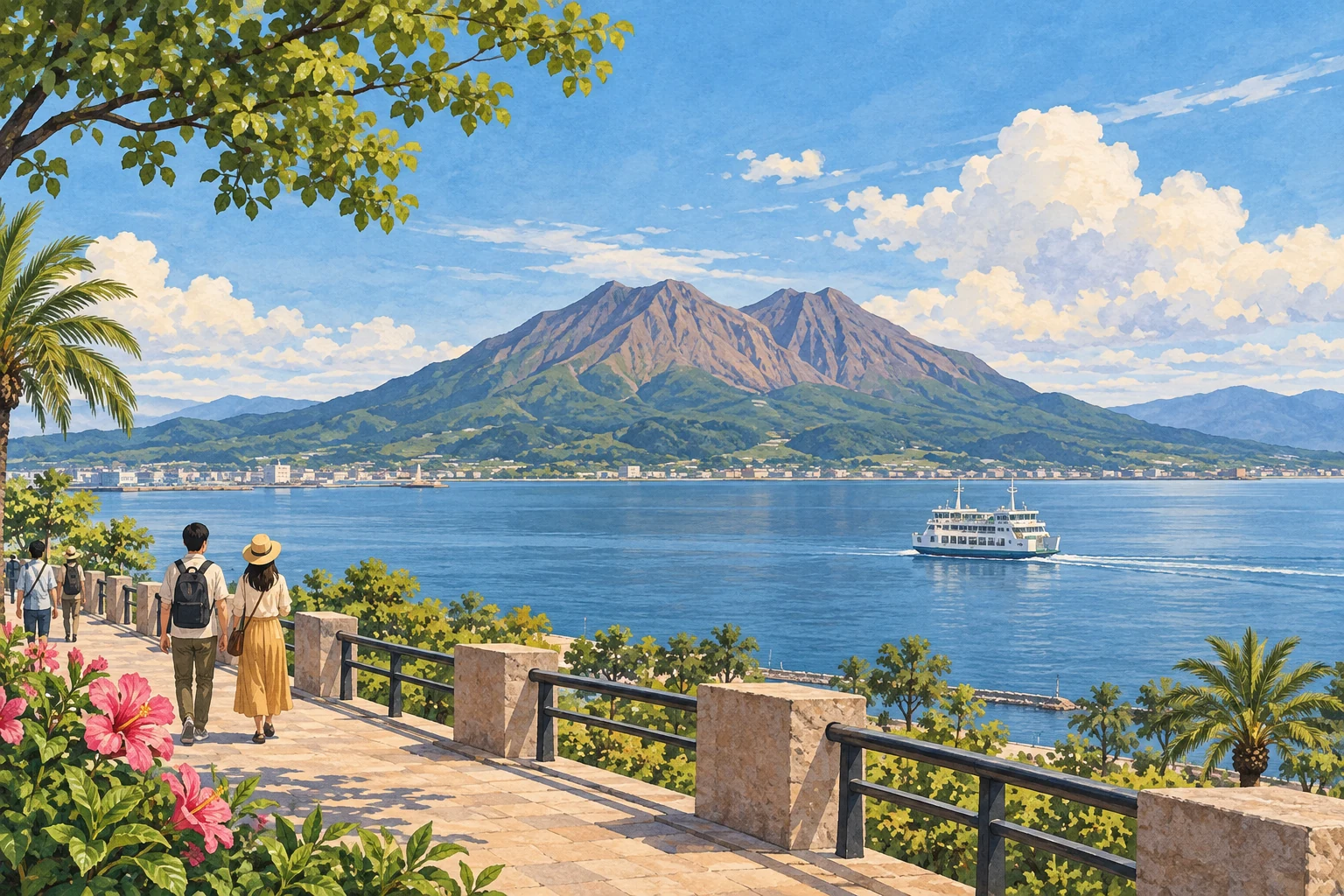
The normal crossing from Kagoshima Port to Sakurajima Port takes about fifteen minutes, potentially around twenty with weather and other factors, plus disembarkation. The official ferry timetable uses the schedule introduced in October 2025: it no longer runs 24 hours. Normal weekday and weekend tables show Kagoshima departures from 04:30 to 23:30 and Sakurajima departures from 04:00 to 23:00. Special operating dates have separate tables; one weekday screenshot is not sufficient for an event night.
An adult foot passenger pays ¥250 one way; the child age and school-stage conditions are in the official fare table. Vehicles are charged by length, with one driver included. For a vehicle at least four but under five meters long, the one-way fare is ¥2,350, with another adult paying ¥250. Two adults taking that car both ways therefore total ¥5,200 using ordinary single fares, versus ¥1,000 on foot. Compare that difference with island destinations, bus changes and the car’s other uses.
Payment facilities are on the Sakurajima side; follow the pedestrian or vehicle route in each direction. Getting from town to the terminal takes time too. A fifteen-minute crossing is not a fifteen-minute hotel-to-viewpoint journey. Drivers need boarding-queue time, while foot passengers should check the island bus before picking a ferry that arrives after the sightseeing service has finished.
Island View serves the western sightseeing circuit, not every island bus
For a first visit without a car, Sakurajima Island View can connect western sights. The city transportation bureau’s route and timetable currently lists 09:30–16:30, every thirty minutes, with a circuit of about fifty-five minutes. Hour and half-hour departures follow slightly different routes; only half-hour services pass the International Volcanic Sabo Center. That circuit is driving time, excluding your visits, photographs and wait for another bus.
Single fares are ¥230 for adults and ¥120 for children; the specific day pass costs ¥500 and ¥250. Two adult single rides total ¥460 and three total ¥690, so count the times you will get off and reboard before choosing. The pass covers this sightseeing bus, not all local Sakurajima routes. Full buses may prevent boarding, and the pass does not guarantee a seat at every time.
If also using municipal trams, other eligible municipal buses and the ferry that day, compare the official CUTE coverage: a one-day pass is ¥1,400 for adults and ¥700 for children, while two days cost ¥2,100 and ¥1,050. This is not a joint ticket for all private buses and ferry companies. Add the transport you definitely need, without inventing a distant stop just to recover the pass price.
A Sakurajima half-day: choose viewpoints and lava walks within volcanic restrictions
On a first island visit, use Yunohira Observatory as the main volcanic-landscape stop, then choose one harbor-area stop according to weather and walking ability. The visitor center suits learning about activity; nearby lava landscapes offer walks. Do not turn every bus-stop name into a mandatory visit. Two extra stops add two waits, and a morning half-day must still include the return port, ferry and lunch.
Eastern places such as the buried Kurokami shrine gate are outside this western circuit. If the east side is your priority, plan suitable local buses or a car separately; that is where bringing a vehicle has clearer value. Connected roads on a map do not establish easy walking, and Sakurajima in a ticket name does not mean unrestricted island-wide boarding. A short harbor visit and an island circuit are different but valid trips.
Sakurajima remains an active volcano. Before departure, read Kagoshima City’s exclusion-zone guidance and current alerts. The city designates a two-kilometer radius around the Minamidake summit crater and Showa crater as off-limits; follow closures and evacuation directions. An attraction being open does not permit approaching the craters, and travel photographs do not show today’s restrictions. With ash or poor visibility, shorten outdoor time, use an accessible indoor harbor facility or return to town. A clear volcano photograph is not worth pushing the return to the last ferry.
Kirishima transport: the railway station, shrine and Maruo are different stops
Kirishima-Jingu Station is a railway station; Kirishima Jingu is the shrine; Maruo is a common bus hub for onsen properties and the market. Search results may also mention Kirishima-Onsen Station, which does not establish a hotel beside that station. Mark the full property address and pickup meeting stop before matching trains and buses. A transfer for the final stretch directly affects luggage handling.
Kirishima City’s Kirishima Jingu Access Bus page separates weekday and weekend departures. Current regular daily examples leave the airport at 09:30, reach Maruo at 10:00, the shrine at 10:15 and the station at 10:28; other airport departures are 12:30 and 14:30. These show the order of places. Traffic still affects arrival, so the times cannot guarantee a tight onward connection.
Read the reverse direction column by column. The current daily afternoon service via the shrine and Maruo leaves the station at 16:10, the shrine at 16:21 and Maruo at 16:36, reaching the airport at 17:06. Other airport-bound station departures do not all use the same sightseeing route. The Access Bus day pass costs ¥1,500 for adults and ¥750 for children within its own coverage, not every ordinary route. Ask the hotel to confirm your stop, direction and pickup, rather than saying only that you will arrive in Kirishima that afternoon. The tourism association’s October 2026 stop-change notice also moves shrine-to-Maruo boarding to in front of Akamatsuso, replacing the old stop beside Satsuma Jokiya.
Kirishima Jingu, Onsen Market and Maruo Falls: one main visit plus a short walk
Allow Kirishima Jingu its own time for worship rather than treating the red shrine as a five-minute photo stop. If also bathing, choose the lunch-area timing first, then connect by bus; you cannot visit every sight along the route on a single bus journey. Read the shrine’s official visitor information, and follow on-site guidance for festival and special-event routes.
The Kirishima Onsen Market at Maruo offers dining, souvenirs, steamed food and a footbath, useful before hotel arrival or while waiting for a bus. General listed hours are 08:30–18:00, but individual shops vary and closures are irregular. The footbath costs ¥100 for adults and ¥50 for children, with towels supplied. A hot-spring egg makes a small snack, but a footbath is not a ryokan bath and does not justify missing a reserved dinner.
The prefecture’s Maruo Falls page gives a roughly ten-minute walk from Maruo bus stop and says there is no parking. Drivers should not assume they can stop beside the falls; travelers with mobility needs or strollers should check surfaces and the actual route. In rain, fading light or with large luggage, postpone or omit the falls instead of trying to find roadside parking in a hurry.
If the shrine is your main stop here, the official precinct map supports a simple walking order: the second torii, the purification basin, the third torii, then worship in front of the worship hall (haiden). The main sanctuary (honden) stands behind the worship hall; the sacred cedar is to the front right when you face the worship hall and can be visited afterward. If you approach from the lower shrine bridge (神橋) along the front approach, the official description includes about 80 steep stone steps. Allow for that climb rather than counting only a quick photo stop after getting off the bus. The honden murals and the heiden’s dragon pillars are not generally open to the public; this route focuses on worship in front of the shrine buildings and seeing the sacred tree.
For an extra scenic stop or family rides, consider Kirishima Shinwa-no-Sato Park. Its official access page lists a bus from JR Kirishima-Jingu Station to “キリシマ神話の里公園入口”; drivers can use free parking. Inside the park, the road train runs from the parking area to the clubhouse chairlift station, from which the sightseeing chairlift goes up to the observation plaza. For the Super Slider, descend from the upper area along its 390 m course. Rides cost extra, and children’s accompaniment rules should be checked for each activity. Normal opening hours are 09:00–17:00; sudden weather changes or other conditions may suspend the chairlift and slider without notice. Since June 2026 the restaurant has closed every Wednesday. If worship and bathing are your main aims that day, there is no need to add the park just to complete a sightseeing list.
Day bathing and a Kirishima overnight buy different amounts of time
A day bath avoids changing hotels, but must fit around bus timetables, admission hours and the return to town. For example, Kirishima Hotel’s day-use bath guidance normally gives 11:00–17:00, possibly ending early. Adult admission is ¥1,200 including tax and ages three to twelve cost ¥600; special holiday rates can differ. During Wednesday maintenance, day visitors can use only the front Tonoyu and Himenoyu baths, not necessarily the full garden-bath scene in photographs.
The property’s Free Zone is mixed-gender, with women-only time at 20:00–21:30. That is an evening arrangement, not an afternoon day-ticket entitlement. Some bath sections are deep, and the operator requires children to bathe with a parent. If mixed bathing concerns a companion, check separate areas and usable times in advance. A family-hotel label does not establish which facilities a child can actually use.
An overnight leaves bathing, dinner and rest unhurried by a return journey. On arrival, confirm bath maintenance, meals and the next morning’s transfer, then plan only one sight the following day. Kirishima Hotel’s pickup instructions say to contact the hotel after reaching Iodani bus stop; they do not promise free transfers from Chuo or the airport. Check other properties individually instead of treating mountain shuttles as on-demand public transport.
Private baths, children and assistance require specific reservation questions
Ryokojin Sanso’s official FAQ gives staying guests one free reserved forty-five-minute private outdoor-bath session per room per night. This differs from a room with its own onsen. Check the bath and slot when booking. An additional session is free if space remains, but a second bath is not guaranteed; the FAQ asks staying guests to inquire at reception after 18:00. A private-bath label can hide the number and timing limits. An ordinary guest-room bathroom also does not establish hot-spring water.
For day visitors, the day-use plan currently lists fifty private-bath minutes for ¥1,200 per adult or ¥600 per elementary-school child, including the large bath. Reception is 11:00–14:00 in arrival order, without advance telephone booking. Two adults pay for two people: ¥1,200 is not the price for the entire bath. If you make a special mountain journey without an alternative, you may find the baths full and have nothing to do but wait for the return bus.
Some private outdoor baths involve steps; wheelchair needs require checking the particular bath. With young children, ask about water temperature, leaving partway through, parental accompaniment and changing space. Ask the intended facility directly about tattoos rather than assuming private use guarantees acceptance. Maruo pickup also requires contacting the property in its specified way after arrival. These checks establish whether you need an overnight, a private day bath or somewhere easier to reach from town.
Should you stay in Ibusuki? The sand bath is brief; the whole trip is not
Lying in the sand commonly takes around ten minutes, not the entire visit to Ibusuki. Add the station transfer, queue, changing, washing and dressing. Lunch, the waterfront and a timed sightseeing-train return can quickly divide the day into small pieces. For a first single sand-bath experience, start with Saraku, whose station transfer is easier to plan, then add other activities only if time permits.
For Sayuri in Yamagawa, outdoor hot springs or nearby coast, consider an overnight or driving. These are not all continuously walkable from Ibusuki Station. Staying does not automatically solve transport: hotel shuttles serve their own points and times, while bath transfers, luggage storage and the next departure need separate checks. Before buying another facility ticket, establish whether your hotel offer includes sand bathing, where it is used and what happens if it is closed.
If a companion does not want hot sand covering their body, everyone need not buy the same package. You can bathe separately in an ordinary bath or rest in a permitted public area, then meet at an agreed time. Accompanying entry and photography still have rules; do not simply follow into changing or sand-bath areas. Treat this as an experience with a process, without detoxification, treatment or longer-is-better claims.
Ibusuki no Tamatebako: after booking the outward seat, check the return immediately
JR Kyushu’s Ibusuki no Tamatebako limited express has only reserved seats, which must be secured before boarding rather than requested afterward. Ordinary reserved-seat sales begin at 10:00 Japan time one month before travel; the JR Kyushu online service has its own membership and collection process. The official normal-season adult one-way example totals ¥2,950 for fare plus reserved-seat limited-express charge. Seasonal differences may apply by date; this is not a year-round fixed price.
Following the March 14, 2026 timetable revision, current Chuo departures are 09:56, 11:56 and 13:56, arriving at Ibusuki at 10:47, 12:48 and 14:49. Return departures are 10:56, 12:57 and 15:07, reaching Chuo at 11:48, 13:48 and 16:00. The key limit is the last sightseeing-train return at 15:07. Taking the 13:56 outward train leaves only eighteen minutes after arrival before that return, clearly unsuitable for a sand bath. For a leisurely stay, use the sightseeing train one way and check ordinary trains for the other.
Check the official operating calendar, carriage formation and sea-facing seats. Replacement stock may not have the same window-facing counter seats, and a reserved seat guarantees neither fine weather nor an unobstructed sea view throughout. Rail-pass holders should check area coverage and reservation rules rather than assuming every pass named Kyushu qualifies. For wider comparisons, use the Japan rail-ticket decision guide and list actual journeys before calculating.
Saraku prices and hours: include towels, maintenance and the midday pause
Sand Bath Hall Saraku’s official fees and hours currently list the lowest normal-period sand-bath package at ¥1,500 for junior-high-school age and older and ¥800 for elementary-school age and younger, using Japanese school stages. It includes sand bathing, the ordinary hot-spring bath and a rental yukata. Compare other packages if you need towels: the minimum price does not include every towel. Buying a small souvenir towel or renting a bath towel each costs ¥300. Special periods have different prices, so do not use normal rates for a year-end visit without checking.
Normal opening is 08:30, last reception 20:00 and closing 21:00. On weekdays, sand-bath reception pauses from 12:00 to 13:00. The current maintenance closure is December 14–18, 2026. Crowds may cause early reception cutoffs, and weather or equipment can affect operation. These conditions change which train to use; last reception is not the time to arrive at Ibusuki Station.
Official access gives roughly twenty minutes on foot or five minutes by taxi from Ibusuki Station. Make a seaside walk part of the day if desired, but budget a ride in summer heat, rain or with children. An afternoon visit can work; insisting on the 15:07 Tamatebako return leaves little room for queues and washing. Choose the return first, then work backward to a practical queue-entry time and adjust if waiting is too long.
Using Saraku: no general reservations, and photography arrangements have changed
According to Saraku’s official FAQ, ordinary visitors cannot book and enter in arrival order; groups should contact the facility beforehand. The operator estimates about an hour for the whole process, without a guaranteed maximum queue. Change after receiving the yukata, leave belongings in the designated place, take required towels and the locker key, and follow staff into the sand bath. Wash off sand before the ordinary baths. Read the official process before discovering at the sand area that your towel is still in the locker.
An all-weather shelter means ordinary rain need not prevent use. A position on the natural beach near the waves depends on spring-tide low water, weather and sand conditions, decided by staff rather than purchased as a selectable spot. Do not follow old travel accounts by handing staff your phone. Visitors currently cannot take their own photographs in changing, sand-bathing or bathing areas; from October 1, 2026, staff provide a paid photography service instead. Non-bathing companions are subject to the same restriction.
Around ten minutes is a reference duration, not a requirement to endure discomfort until the time ends. Tell staff immediately if you feel unwell. Photographs, a beach location and duration should not outweigh how you feel. Listen to the day’s instructions before buying, then allow time for drinking water, dressing and rest afterward. Finishing the bath at the train’s departure time is not a workable station plan.
Tattoos, young children and health: Saraku’s rules apply only to Saraku
Saraku’s FAQ explicitly permits tattoos: cover them with the yukata during sand bathing, and cover them as much as possible and shorten time in the ordinary bath. This is that facility’s current approach, not every Ibusuki or Kirishima bath’s policy. Check a hotel bath or Sayuri directly. Non-bathing companions should also ask reception where they may go; a relative’s ticket does not grant unrestricted entry.
The operator mentions starting around two to three years old, provided the child can communicate heat or discomfort. That condition matters more than age alone and does not make every two-year-old suitable. Parents should assess whether the child can follow the process and stop if frightened or uncomfortable, rather than forcing participation for a family picture. A child fare describes charging, not universal eligibility.
The facility also lists contraindications including pregnancy, certain cardiovascular or respiratory conditions and fever. If these apply, you are receiving treatment or are uncertain, read the official contraindications and consult a medical professional; hot sand is not treatment. Ordinary sightseeing, food or a short coastal walk are alternatives. Different experiences on the same day still allow traveling together without enduring discomfort to complete a list.
Is Sayuri open now? Distinguish reopening history from today’s operations
Yamagawa’s Sayuri has a history of closures and weather-disaster suspensions, with old accounts still appearing in search. Ibusuki City’s June 2025 notice says it reopened on June 12 after that landslide-related suspension. An older long-term closure is therefore not its normal current status. A reopening notice is not a promise of opening on a future date; check that day’s notice.
The local tourism association’s Sayuri page gives 08:30–17:00, last reception 16:30, potentially stopping around 16:00 when busy. It normally closes Wednesdays, moving to the following day after a holiday, with no-closure arrangements for the year-end/New Year, Golden Week and Obon periods; severe weather can still close it. This guide plans around the 17:00 closing time listed by the local association; late arrivals should telephone for the day’s hours and reception. Hiring a car or staying specially in Yamagawa makes reliance on a search excerpt for a final-half-hour arrival particularly unwise.
Sayuri is in Yamagawa, separate from central Ibusuki’s Saraku. Check onward trains, buses or taxis from Ibusuki and whether the final access road and slopes suit companions. JR Kyushu’s October 2026 notice lists selected daytime train suspensions on the Ibusuki or Yamagawa–Makurazaki sections on November 16–20 and December 16, 2026, and January 12–15 and February 17, 2027, without replacement buses. It does not mean the whole Chuo–Ibusuki line is suspended. For Yamagawa, check each service and the exact affected section.
Saraku or Sayuri: prioritize the town route or the Yamagawa coast
Published normal-period Sayuri sand-bath prices are ¥1,100 for adults and ¥600 for elementary-school age and younger in the Japanese school system, including a yukata but not towels. Special periods have different charges. The official page also lists a combined ticket with the outdoor Tamatebako Onsen, unavailable in special periods; an old combined price cannot cover all dates. Saving a few hundred yen on admission may not save overall if it adds return taxi fares.
Saraku’s advantage is the easier-to-plan transfer from Ibusuki Station and longer normal hours. Sayuri generally suits an existing Yamagawa coastal plan, nearby facilities or a willingness to give that journey more time. Each has its own closures, towels and companion rules. Do not transfer one facility’s answer on booking, infants or tattoos to the other. If a condition determines whether you participate, obtain that facility’s explicit answer before choosing a ticket.
Two sand baths in a day are not essential to understanding Ibusuki. Start with one and leave time for lunch, the coast and transport; sightseeing-train users should choose the return first. If Sayuri closes unexpectedly, Saraku is a possible alternative only after checking that day’s reception and maintenance dates. There is no guarantee one always operates. The city’s Saraku 2026 maintenance notice specifically says Sayuri will not close during Saraku’s maintenance; this differs from the usual Wednesday rule but remains subject to daily weather notices.
| Item | Saraku | Sayuri |
|---|---|---|
| Location and plan | From Ibusuki Station; suits a first single experience | Yamagawa area; allow separate transport time |
| Lowest normal-period sand-bath fee | Adult ¥1,500 / child ¥800 | Adult ¥1,100 / child ¥600 |
| Included | Sand bath, ordinary bath, yukata | Sand bath and yukata; towels extra |
| Main limits | Weekday midday reception pause; December 14–18 maintenance | Wednesday closing rules; possible early afternoon cutoff |
| Check before use | Day’s wait, package, contraindications and photography | Day’s operation, transport and individual eligibility |
Three days and two nights: a city base for Sakurajima and one sand bath
With return flights inside a three-day trip, day one often fits only settling in and a city dinner. Use day two for a full Ibusuki visit: decide whether to take Tamatebako outward, then arrange Saraku and lunch. For a longer evening stay, use ordinary trains back. Work backward from departure transport before adding Sakurajima on day three. If it allows only a rushed crossing with no island time, a fuller city half-day is better.
With an early arrival and late departure, Sakurajima can fit the first afternoon, Ibusuki day two and a city walk day three. Both excursions start from the same hotel, reducing luggage moves. Kirishima is omitted because mountain bathing needs its own time. Two transfers for half an hour’s bathing merely to add a place name seldom serve an unhurried first trip.
In poor weather, switch the Sakurajima and Ibusuki days only after checking reserved-seat changes and Saraku closures. If transport or accommodation cannot change, preserve the core experience rather than chasing services to complete the itinerary table. A city hotel’s flexibility often matters more than one extra sight.
Four or five days: give the extra night to the place where you want to slow down
A four-day, three-night plan can mean two city nights and one in Kirishima: city arrival, Sakurajima on day two, then Kirishima on day three with the shrine or Maruo before an early ryokan arrival, followed by departure according to the flight. Save Ibusuki for another trip. If sand bathing matters more, replace the Kirishima night with Ibusuki or keep a city base and day-trip south. The extra night prevents the priority experience from ending in a rush.
Five days and four nights can include two city nights, one in Ibusuki and one in Kirishima, but treat movement between the onsen areas as a transport day. Do not also promise a morning sand bath, afternoon shrine and the earliest ryokan dinner. Check the real north–south connections first. Without a car or an appetite for packing, three city nights plus one Kirishima night still allow an Ibusuki day trip. More nights do not require more bases, particularly with a family and repeated checkouts.
Driving removes some waiting, but parking, mountain roads, ferry queues and meal times remain. Concentrating rental days on Kirishima or Yamagawa may be easier to cost than driving downtown daily. Check your own collection/return branches, opening hours and one-way fees. Keep at least one unreserved interval for a queue, shopping or simple rest in any version.
Budget for two people before comparing passes and hotel changes
For a short Sakurajima outing by two adults without a car, return ferries total ¥1,000. Two Island View day passes add ¥1,000, making ¥2,000 for both, excluding the city-to-terminal trip, meals and other admission. This is one transport example under defined conditions. Two single sightseeing-bus rides each would cost less; repeated municipal transport the same day calls for a fresh CUTE comparison. A day pass is not automatically a saving.
At Ibusuki, two adults’ minimum normal-period Saraku packages total ¥3,000, with towel needs and transport extra. If both take Tamatebako both ways at the normal-season example of ¥2,950 per person per leg, train tickets total ¥11,800. A one-way sightseeing ride needs the actual other-leg fare listed separately. Transport may dominate the day’s cost, so a bath a few hundred yen cheaper may change little overall.
Compare accommodation together with meals, per-person extras, transfers/taxis and cancellation costs. Add a fixed-time column to the Japan travel budget categories: a dinner-and-breakfast stay is also a commitment to arrive on time. On a limited budget, retain one desired experience and remove duplicate bathing or unnecessary hotel changes rather than keeping every day tight to save a small fare difference.
Kinko Bay fireworks: the 2026 date is past, not a date for the next event
As of October 22, 2026, the official Kagoshima Kinko Bay Summer Night Fireworks website gives August 29 for the 2026 event, which has already passed. The overview consulted on October 22 focused on 2026, and a supplementary check on October 23 still showed 2026 information. The 2027 date and ticket announcements need separate verification. Do not treat the 2026 date as the next available event. For next year, choose a preferred base first, then wait for dates, seating products and cancellation terms before locking in non-refundable flights or rooms.
Admission areas, paid seats, traffic restrictions and dispersal follow each year’s notice; a place used at a previous event may not reopen. The 2026 guidance required the appropriate admission arrangements for designated venues and warned of no general parking at the venue, with the Sakurajima side not a spontaneous parking solution. This tells you what to check, not future ticket prices or access rights.
For a fireworks trip, compare city accommodation and a realistic walk back after the event before checking special tram, bus and ferry services. Normal last departures and past extra services are not guarantees, especially the obsolete 24-hour ferry claim. Do not assume a Kirishima or Ibusuki ryokan remains reachable after the display. Fireworks views from a hotel room or an in-house viewing offer need that year’s explicit property information.
Rain, ash or a sudden suspension: preserve the purpose of the trip
Saraku’s rain shelter does not make every activity unaffected by rain. Judge Sakurajima viewpoints, the Yamagawa coast and Maruo walks separately. Keep changeable days for outdoors and place city meals, indoor visits or hotel rest on the poorer-weather day. If an official notice stops sailings, closes a road or ends bath reception, omit that segment and use somewhere confirmed reachable rather than detouring merely to fill a cell in the plan.
The day before, check three things: the main transport, the destination’s operation and the overnight property’s latest arrival. Recheck temporary notices that morning and keep official telephone numbers or transport links. When rearranging, secure the bed and return journey before adding minor stops. That order matters especially without a car, where missing one service can cost much more than a few minutes.
A suitable Kagoshima trip often needs only a convenient city base, time to see the volcano and one hot-spring experience enjoyed at a restful pace. Choose a mountain private bath or an Ibusuki sand bath; add nights to do both. Once services, eligibility and meals are confirmed, leave the remaining space for scenery and rest rather than another meeting time.
A few useful answers
Should I stay near Kagoshima-Chuo Station or Tenmonkan?
Compare Chuo first for frequent JR trips, large luggage or early trains; Tenmonkan suits dinners and neighborhood walks. In either area, check the actual route between the hotel, transport and restaurants. Views and bedding depend on the room booked.
Does the Sakurajima Ferry still run 24 hours?
No. The regular timetable changed in October 2025. The last departures are 23:30 from Kagoshima Port and 23:00 from Sakurajima Port; first departures are 04:30 and 04:00 respectively. Check the official timetable for your date for events and special operations.
Does the Sakurajima Island View day pass cover every bus on Sakurajima?
No. It is specific to that sightseeing bus; check local buses on the east side separately. Adult fares are ¥230 per ride or ¥500 for the day pass. Count your actual rides before buying.
Can I reach an onsen hotel as soon as I leave Kirishima-Jingu Station?
Not necessarily. The station, shrine and Maruo are separate places. Check buses and the final pickup for the hotel’s address. Property transfers usually have specified meeting stops; do not assume free collection from the airport or Kagoshima-Chuo.
Do I need to book Saraku, and are tattoos permitted?
Saraku normally does not take reservations and admits people in arrival order. Its FAQ permits tattoos: cover them with the yukata during sand bathing and cover them as much as possible and limit time in the indoor baths. Groups and accompanying visitors follow the facility’s rules; these do not apply automatically elsewhere.
How old must a child be to use a sand bath?
Saraku’s FAQ mentions around two to three years old, but the child must be able to communicate heat or discomfort; age alone does not establish suitability. Check other facilities separately. A child fare does not mean all ages can use the service.
Is Sayuri still closed?
Ibusuki City says Sayuri reopened on June 12, 2025 after that disaster-related suspension; older long-term-closure reports are not its current normal status. Check current official information or contact the facility for that day’s operation, Wednesday closing rules and early cutoffs.
Does Ibusuki no Tamatebako have non-reserved seats?
No: all seats are reserved, so secure a seat before boarding. The last current sightseeing-train return from Ibusuki leaves at 15:07. For an evening return, check ordinary trains and service on the day rather than treating the sightseeing train as frequent all-day transport.
Can I book for the 2027 Kinko Bay fireworks using the 2026 date?
No. The official overview checked on October 22, 2026 focused on the 2026 event, and a supplementary check on October 23 still showed 2026 information. August 29, 2026 is already past. Check the organizer’s official website separately for the 2027 date and ticket announcements, then verify hotel cancellation conditions and transport after the event.
Check with the source
Schedules, availability and rules can change. These official sources are the place to confirm details before you book.
- JR Kyushu Hotel Kagoshima: official access
- SHIROYAMA HOTEL kagoshima: access and shuttle
- Sakurajima Ferry: timetables and special operations
- Sakurajima Ferry: passenger and vehicle fares
- Kagoshima City Transportation Bureau: Sakurajima Island View
- Kagoshima City tourism: city day passes and CUTE
- Kagoshima City: Sakurajima crater exclusion zones
- Kirishima City: Kirishima Jingu Access Bus
- Kirishima Jingu official website
- Kirishima Onsen Market: facilities, hours and footbath
- Kagoshima Prefecture tourism: Maruo Falls
- Kirishima Hotel: baths and day use
- Kirishima Hotel: access and bus-stop pickup
- Ryokojin Sanso: official FAQ
- Ryokojin Sanso: day-use bathing plans
- JR Kyushu: Ibusuki no Tamatebako limited express
- Sand Bath Hall Saraku: fees, hours and closure notices
- Sand Bath Hall Saraku: visiting process
- Sand Bath Hall Saraku: reservations, photography and eligibility FAQ
- Ibusuki City: Sayuri reopening in June 2025
- Ibusuki Tourism Association: Yamagawa sand bath Sayuri
- Kagoshima Kinko Bay Summer Night Fireworks official website
- Kirishima Tourism Association: shrine bus-stop change in October 2026
- JR Kyushu: selected daytime Ibusuki Makurazaki Line suspensions, November 2026–February 2027
- Kagoshima Prefecture tourism: Sayuri
- Ibusuki City: Saraku’s 2026 maintenance and special Sayuri opening
- JR Kyushu Hotel Kagoshima: current room names, sizes and beds
- JR Kyushu Hotel Kagoshima: North Wing Deluxe Twin for two guests
- JR Kyushu Hotel Kagoshima: breakfast prices for hotel guests
- SHIROYAMA HOTEL kagoshima: Forest Twin room
- SHIROYAMA: official Forest Twin breakfast and year-end plans, child charges and cancellation terms
- SHIROYAMA HOTEL kagoshima: general breakfast prices
- Kirishima Jingu: precinct map, front approach and public-access limits
- Kirishima Shinwa-no-Sato Park: access, weather suspensions and restaurant closures
- Kirishima Shinwa-no-Sato Park: road train from the parking area to the chairlift station
- Kirishima Shinwa-no-Sato Park: Super Slider and child accompaniment rules
- Kirishima Shinwa-no-Sato Park: access by station and bus