Decide where you will sleep each night before linking the mountain transport. Three days can cover Takayama, Shirakawa-go and Kamikochi from one base. With five, add Toyama, an Alpine Route crossing and Omachi. This guide separates reservations, luggage, accommodation and seasonal service dates so that every journey works as well as the scenery.
Choose three or five days before deciding on an Alpine Route crossing
Takayama, Shirakawa-go, Kamikochi and the Tateyama Kurobe Alpine Route may all look close to the Japanese Alps, but they occupy different transport branches. Takayama serves as a Hida accommodation base. Shirakawa-go sits on the bus route toward Hokuriku. Kamikochi is accessed through Hirayu or from the Matsumoto side. The Alpine Route links Tateyama Station in Toyama Prefecture with Ogizawa in Nagano. Write down each night's accommodation first to establish whether you are returning to one base or crossing the mountains with luggage.
With only three full days, choose either Takayama, Shirakawa-go and Kamikochi, or Toyama, the Alpine Route and Omachi. The first emphasizes town streets and valley walks; the second gives a day to mountain transport. Five full days make linking all four destinations more workable. An international arrival that leaves only an evening is not a full first day. Companions who struggle with prolonged standing, stairs or frequent transfers will benefit particularly from fewer crossings.
Information was checked on October 22, 2026; the transport prices and seasonal dates below have specific limits. Kamikochi's general 2026 visitor season ends November 15, while the published November Alpine Route timetable runs through November 30. Shirakawa-go's January 2027 illumination is a separate winter trip: autumn crossings through Kamikochi and the Alpine Route cannot be carried over. If you also want time in Kanazawa, add a day and use the Kanazawa city walks and accommodation guide instead of squeezing it out of a mountain day.
| Choice | Best suited to | Main tradeoff |
|---|---|---|
| Three days based in Takayama | One day each for old town, Shirakawa-go and Kamikochi | An early start and Hirayu transfer on the Kamikochi day |
| Three-day Toyama–Omachi crossing | The Alpine Route is the centerpiece | Luggage forwarding and accommodation on both sides |
| Five-day linked trip | All four destinations, accepting hotel changes | A buffer between mountain travel and departure |
| Winter Takayama and Shirakawa-go | Snow, onsen and a reserved illumination visit | Excludes the seasonally closed Alpine Route crossing and ordinary Kamikochi buses |
Read the map by transport endpoints, not similar place names
Three mountain gateways are easily confused. For the Alpine Route, the west approach is Dentetsu-Toyama to Tateyama Station. From Takayama to Kamikochi, first reach Hirayu Onsen. For Shirakawa-go, board for Ogimachi at Takayama Nohi Bus Center. An ordinary urban ticket does not provide unrestricted travel across all three, and a mountain-view hotel is not necessarily near the right entrance. Zoom a hotel map in to the actual nearest station or stop and check the walking exit.
Keep the Tateyama Kurobe Alpine Route separate from the Kurobe Gorge Railway. The former runs through Murodo, Kurobedaira and Kurobe Dam to Ogizawa; the latter is a different trip approached through Unazuki. Sharing the name Kurobe does not create a direct connection from the dam to the sightseeing train. The five-day plan here excludes Kurobe Gorge. If that is your priority, add separate days and check the sections currently operating.
From Nagoya, use official access information to compare trains and highway buses to Takayama. From Hokuriku, compare services from Toyama or Kanazawa. Time aboard is only part of the decision: whether you can still store luggage, eat and catch the next bus after reaching Takayama determines the usable day. Save Takayama's official regional transport page with your accommodation address. Avoid a dinner requiring punctual arrival on a mountain-transfer day.
Takayama bases: station, old town or an onsen hotel?
For two or three nights in Takayama with buses in different directions each day, begin with hotels near Takayama Station and Nohi Bus Center. The advantage is less luggage handling on early departures and late returns, not a guarantee of cheaper rooms. If your priority is the Miyagawa in the morning and neighborhood meals at night, old-town accommodation may suit you better. Check the actual luggage route, rain shelter and entry restrictions rather than equating near old town with near the bus terminal.
For bathing and dinner-and-breakfast stays, compare Takayama onsen hotels or move one night to Hirayu. Nightly rates alone are insufficient: Hirayu is more direct for Kamikochi the following morning but complicates the Shirakawa-go day. Takayama concentrates dinner options, while hotels farther from the station require a last-shuttle check. Put meals, transfers and cancellation terms for every night into the same comparison to reveal the real difference.
A family of four should list children's ages, required beds and whether Japanese floor mattresses are acceptable before choosing a room. A twin accommodating three may use an extra bed; a four-person Japanese-Western room may contain two beds and two futons. If separate sleeping areas matter, check for a door or partition rather than two spaces that merely look separate in a photograph. That is more useful than choosing a hotel from a ranking and trying to fix the room arrangement afterward.
A named example: Takayama Green Hotel's rooms and private baths
Takayama Green Hotel provides a concrete onsen-hotel comparison. Its official Orinkaku introduction lists the standard Comfort Twin for two, a separate Comfort Twin accommodating three and a Premier Twin accommodating four. Book the category for your party rather than assuming every twin accepts another bed. The hotel FAQ says Orinkaku's Japanese-Western rooms have no partition between the two areas, while Tenryokaku and open-air-bath rooms have separation. That matters for early-sleeping children and different routines.
Private hot-spring water is the easiest point to misread. The hotel explicitly says guest-room baths, including open-air-bath rooms, do not use hot-spring water. If natural onsen in your room is essential, the hotel's onsen branding does not establish that condition. Compare its other advantages only if a shared large bath suits you. The hotel also says first-year elementary-school pupils cannot use a bed-sharing plan. Choose child category B for a children's meal or A for an adult-like meal; preschool meals and bedding depend on the actual offer.
The free shuttle uses Takayama Station's West Exit, a different approach from Nohi Bus Center. The official shuttle timetable lists morning hotel departures, some via Takayama Jinya, and afternoon station returns; a bus is not available whenever you arrive. For an early Kamikochi bus, plan walking or other transport rather than waiting and hoping. The FAQ's standard cancellation fees are 30% three days before, 50% two days before, 80% the previous day and 100% on the day or for a no-show. Groups of nine or more have separate terms, and individual plans may differ: use your booking's conditions.
Takayama accommodation tax: per person, per night, excluding meals
Takayama introduced accommodation tax on October 1, 2025. The city's tax explanation lists ¥100 per person per night below ¥10,000 in accommodation charges, ¥200 from ¥10,000 to below ¥30,000, and ¥300 at ¥30,000 or more. The base includes accommodation and its service charge, excluding meals and consumption tax. Do not put the entire dinner-and-breakfast package into a band. This tax is also separate from any bathing tax charged on an onsen stay.
The official child exemption lasts until the first March 31 after the twelfth birthday. It cannot be simplified to all twelve-year-olds paying tax. The city specifically says children born on or after April 2, 2014 are exempt for stays through March 31, 2027. Enter birth dates or school stages accurately. If a booking platform and hotel disagree, ask the hotel to confirm for the actual stay date rather than borrowing an airline's child-age categories.
For example, two adults staying two nights, each paying ¥12,000 per person per night for accommodation excluding meals and taxes, owe ¥200 × 2 × 2 = ¥800. This illustrates tax, not a room quote. The city says collection depends on the accommodation provider: it may be included in prepayment or collected locally. Check which taxes a tax-inclusive label covers. Toyama, Omachi and other cities do not inherit Takayama's bands; check every booking when changing cities.
A Takayama walking day: morning markets, old town and time for a meal
A morning without long-distance travel is more relaxed than arriving in the afternoon and rushing through every district. Walk from Takayama Station toward Miyagawa Morning Market, then follow the river and streets to Sanmachi and the Jinya area before returning to rest. This is a suggested order, not a claim that every shop opens together. The official FAQ gives Miyagawa hours of 07:00–12:00 in April–November and 08:00–12:00 in December–March. Jinya-mae Market switches earlier: 07:00–12:00 in April–October and 08:00–12:00 in November–March.
Markets offer seasonal produce, pickles and local snacks; allow old-town time for crafts, sake breweries and architecture. Before an early bus, choose one main breakfast or shopping priority. A noon closing time does not mean every stall is fully operating at any hour. Rain, stall attendance and individual shop closures still affect the visit. For Takayama Jinya's buildings and gardens, check admission hours separately: accessible outdoor streets do not establish that buildings are open.
Choose a seated Hida-beef barbecue, sukiyaki or set meal, or try a small portion as a snack. Decide whether you need a meal or a taste before comparing queues. Different cuts, portions and preparations are not equivalent products merely because both say Hida beef. One proper seated meal with Takayama ramen, hoba miso or simpler food at other times can balance budget and appetite. For allergies or avoiding beef, check stock and ingredients in advance. A local specialty is not obligatory for everyone.
An ordinary Shirakawa-go day: reserve the way out before planning the village
The official standard journey from Takayama Nohi Bus Center to Shirakawa-go's Ogimachi is about 50 minutes. Some services require reservations; others do not. A mobile ticket for an unreserved service is not a reserved seat. For reserved services, verify the date, endpoints and your name. Enter the designated booking portal through Nohi Bus's Shirakawa-go line page, which also shows onward Kanazawa, Toyama and Takaoka services, instead of relying on an old timetable screenshot.
At the time of checking, adult single fares were ¥2,800 Takayama–Shirakawa-go, ¥2,400 Shirakawa-go–Toyama and ¥2,800 Shirakawa-go–Kanazawa. For a sightseeing stop followed by onward travel, confirm separate segments. A direct Takayama–Toyama fare is not automatically a total allowing arbitrary stopovers. The operator warns that parking congestion, snow and expressway closures can cause delays of more than two hours. Avoid a tight international flight connection on the day you leave Shirakawa-go.
Choose an acceptable return or onward service first, then work backward through village activities. A first visit can allow half a day for one open gassho house, village lanes and lunch, adding the viewpoint only if conditions and time permit. If the latest return is full, change the date, base or other stops. Do not enter the village expecting an extra service. Read change and refund conditions before purchase; a late bus does not automatically cancel a restaurant, hotel or another ticket without charge.
Village luggage, viewpoints and gassho houses: leave residents their space
If carrying large bags through Shirakawa-go toward Hokuriku, treat storage as a service needing confirmation. Bus luggage space is limited and does not guarantee acceptance of every bag size. Village storage capacity and closing time need not match the last bus. A reliable approach is sending unneeded large bags ahead to later accommodation after confirming acceptance and delivery days, or checking that day's bus-terminal storage before leaving. Keep valuables and essential medicines with you, and note the collection deadline before walking away.
The village is not a theme park. Some gassho houses remain homes, and visitor buildings have their own charges and closures. Choose an open house and follow its shoe, photography and staircase rules. Stay on public routes when photographing fields and roofs, without entering gardens, field edges or private entrances. Remove icy or closed paths from the plan instead of bypassing barriers for a promotional-photo angle.
The viewpoint adds an overview, but not every companion needs to climb. Ordinary-day shuttle and walking arrangements depend on weather and local notices. Illumination nights have separate village and viewpoint admission; daytime rules do not carry over. With only an hour, a nearby village walk and timely bus-terminal return usually work better than rushing uphill and back. For strollers or limited mobility, check gradients, snow and usable shuttles rather than assuming a short map distance is easy.
Shirakawa-go illumination 2027: date, entry and viewpoint are separate
The tourism association's 2027 event outline lists four evenings, January 11, 17, 24 and 31, each 17:30–19:30. Advance reservation and an entry ticket are mandatory. You cannot arrive without a reservation hoping for a chance, and no same-day admission tickets are sold. Ordinary daytime sightseeing, a regular route-bus seat and illumination admission are different things. A normal Takayama–Shirakawa-go bus ticket does not include the event.
The five official participation methods are a village stay that night, a reserved designated parking space for your car, a taxi with designated parking reserved, a route-bus operator's illumination package, or a travel-agency bus tour. Viewpoint access depends on the plan. Village entry alone is insufficient: obtain a designated accommodation or bus package including viewpoint rights. Viewpoint tickets are not sold separately, and heavy snow can still close the climb for safety even to ticket holders.
Entry checkpoints begin at 15:30 on event days. Ordinary daytime bus visitors without event tickets are instructed to use services arriving by 15:20. Regular return buses largely finish before the illumination, so watching and then taking an ordinary last bus is not a workable assumption. Snowy evening walks require warm clothing, waterproof nonslip shoes and lighting. Tripods are prohibited at the viewpoint and drones in the village. Include these limits when choosing a package rather than trying to negotiate on arrival.
Booking illumination: the lodging lottery, bus releases and parking differ
As observed October 22, 2026, the 2027 lodging lottery accepts applications October 1 at 13:00–October 31 at 23:59, 2026, limited to one per person. Only successful applicants are notified November 10, then complete an online reservation and card payment as instructed. A lottery application is not a room reservation. If keeping another hotel as backup, note its cancellation deadline rather than treating unconfirmed illumination lodging as your only bed.
Route-bus packages go on sale by event: January 11 opens October 13 at 14:00; January 17 on October 19 at 14:00; January 24 on October 26 at 14:00; January 31 on November 2 at 14:00, all Japan time. Read Nohi Bus's 2027 illumination products with the association's general rules. Check origin, viewpoint and meal inclusions, return location and cancellation fees. On sale does not mean seats remain: the booking system's current display determines availability.
Nohi Plan A costs ¥13,000 for adults and elementary-school children alike, including return Takayama travel, Gasshozukuri Minkaen admission and zenzai sweet soup, without the viewpoint. Plan B is ¥16,000 for both categories, including return travel, viewpoint admission and a local product; the viewpoint approach is generally on foot both ways. Both require online booking and card payment, with up to six people per booking. No changes are accepted after payment. Canceling before departure incurs a ¥100 refund-handling fee; cancellation after departure is not accepted. Exchange tickets at Takayama Nohi Bus Center from 07:00 on the day and do so early: an ordinary route-bus ticket cannot substitute.
The first designated parking release sold out; the official second release opens December 1, 2026 at 13:00. The second-release price is ¥7,000 per car for 1–5 occupants or ¥10,000 for 6–10, excluding the viewpoint. Except for headcount changes, bookings cannot be changed or canceled for a refund. Arriving with six or more on a 1–5 booking costs an additional ¥4,000; a 6–10 booking arriving with five or fewer gets no difference refunded. Organizer cancellation for heavy snow or similar reasons follows the announced refund terms. Taxis also need a parking reservation before the vehicle is arranged; a roadside drop-off is not an alternative entry. Without a valid plan, visit by day instead of treating an unticketed evening as a backup.
| Plan | Per person | Inclusions and limits |
|---|---|---|
| A: Minkaen | ¥13,000 | Takayama return travel, Minkaen and zenzai; no viewpoint |
| B: viewpoint | ¥16,000 | Takayama return travel, viewpoint ticket and local product; normally walk to and from viewpoint |
Alpine Route direction: west to east, east to west or return the same way
For west to east, stay in Toyama, take Toyama Chiho Railway to Tateyama Station, then travel through Bijodaira, Murodo, Daikanbo, Kurobedaira, Kurobeko and Kurobe Dam to Ogizawa, continuing toward Shinano-Omachi or Nagano. This suits earlier days in Takayama, Shirakawa-go and Hokuriku followed by Nagano or Tokyo. However, add the morning Dentetsu-Toyama–Tateyama journey separately. A reserved departure from Tateyama Station is not a Toyama Station meeting time.
East to west reverses the journey from Nagano or Shinano-Omachi through Ogizawa to Toyama. Choose according to your surrounding accommodation and luggage, not a belief that one side must be less crowded. A same-side return suits keeping one hotel and weather flexibility. For Kurobe Dam alone, an Ogizawa return covers less ground. For Murodo, compare the return routes reaching it. Different turning points have different costs and times; there is no need to sacrifice the place you want to enjoy simply to complete the whole route.
The operator suggests about six to seven hours, including lunch, for a full Tateyama Station–Ogizawa crossing, plus another one to two hours in busy periods. This excludes onward access to Toyama or Omachi. Walk between Kurobeko and Kurobe Dam, and allow for stairs and queues elsewhere. Adding vehicle minutes on the transport diagram captures only part of the travel, not the complete visit.
Alpine Route fares and children: compare the same segment
The official regular-fare table is dated February 27, 2026. Tateyama Station–Ogizawa costs ¥10,940 one way for adults and ¥5,480 for elementary-school children; returns are ¥19,680 and ¥9,840. Ogizawa–Murodo returns are ¥12,300 and ¥6,150. These do not automatically include Dentetsu-Toyama–Tateyama or Ogizawa–Shinano-Omachi/Nagano access fares.
School-stage exceptions matter. A twelve-year-old still at elementary school pays the child fare; a six-year-old not yet in elementary school remains a preschool child. School stages switch on April 1 in the year of entering elementary or junior high. The regular-ticket page lists free travel for preschool children, but do not transfer that treatment to group products, particular services or other buses. Kamikochi's line below has separate seat and ticket requirements for young children, so the same child can need different tickets on different routes.
Two adults and two elementary-school children crossing one way from Tateyama Station to Ogizawa total ¥32,840 at these regular fares, excluding access transport, food and storage. For limited-period discounts, compare dates, direction, valid sections and change/refund terms rather than using expired spring prices for autumn. Check each rail pass individually: the Takayama-Hokuriku Area Tourist Pass includes designated bus sections from Takayama Nohi Bus Center through Shirakawa-go to Kanazawa or Toyama, with excluded services and required reservations. Holding it does not reserve a seat. Its coverage list does not include the complete Alpine Route or Kamikochi buses; arrange those separately. Neither JR nor Hokuriku in a pass name makes every bus free. Apply the comparison of single tickets and passes to your settled route before buying.
What a web-ticket time reserves, and time needed for collection
An Alpine Route web-ticket time is a departure from Tateyama Station on the Toyama side or Ogizawa on the Nagano side, not reserved seats on every service all day. Later connections follow on-site arrangements, with waits expected on popular dates. The official web-ticket guide requires registration, selection of date, endpoints, one-way or return, product and departure time, then payment and saving the QR code. Available options differ by date and product.
Collect physical tickets at designated equipment at Dentetsu-Toyama, Tateyama or Ogizawa. The operator recommends reaching the departure station 30 minutes early and completing procedures no later than 15 minutes before departure. Automatic collection begins at noon the previous day, subject to each station machine's hours. After collection, online changes are unavailable. If you are still considering weather-related changes, read your product's cancellation and rebooking rules before collecting early merely to save a few minutes on the day.
If taking the access bus from Nagano or Shinano-Omachi with an additional official option ticket, you generally show the driver the order details outbound and collect the main ticket at Ogizawa. A QR screenshot that does not show the access segment is insufficient. Save offline copies of origin, destination, date, departure time, ticket type and payment details. If a service is not available for sale, choose another workable date or shorter route rather than assuming the same departure can be bought on arrival.
Luggage across the mountains: 2026 forwarding ends November 8
Luggage is an early decision for an Alpine Route crossing. The official Alpen Porter page schedules 2026 service for April 15–November 8, at ¥4,000 per item including tax, paid in cash, with no reservation needed for ordinary individual customers. It is not year-round. From November 9, continued route operation does not make same-day luggage forwarding available. Choose a same-side return or send bags ahead by ordinary delivery, keeping your overnight essentials.
Common endpoints are Dentetsu-Toyama Station and the baggage office in front of JR Shinano-Omachi Station. Dentetsu-Toyama accepts bags 05:00–10:00 and releases them 15:30–18:00; Shinano-Omachi accepts 07:40–10:30 and releases 15:00–17:45. The operator explicitly excludes Tateyama Station, Ogizawa, Nagano Station, Unazuki Onsen, Hotel Tateyama and Midagahara Hotel as collection/delivery points. Some designated foothill hotels participate for their own guests only; not every hotel in the area can receive bags.
In particular, a direct Ogizawa–Nagano express bus does not also take you past the Shinano-Omachi baggage office. Follow the forwarding operator's collection connections or choose transport that stops for collection. Bad weather or roads can delay or suspend forwarding. Keep passports, wallets, medication and the day's warm clothing with you. For a Murodo walk, also note the announcement that Murodo coin lockers close October 26–29, 2026, with reopening planned October 30. Temporary storage and cross-mountain forwarding are different services.
Toyama, the foothills, Murodo or Omachi: the bed shapes the next morning
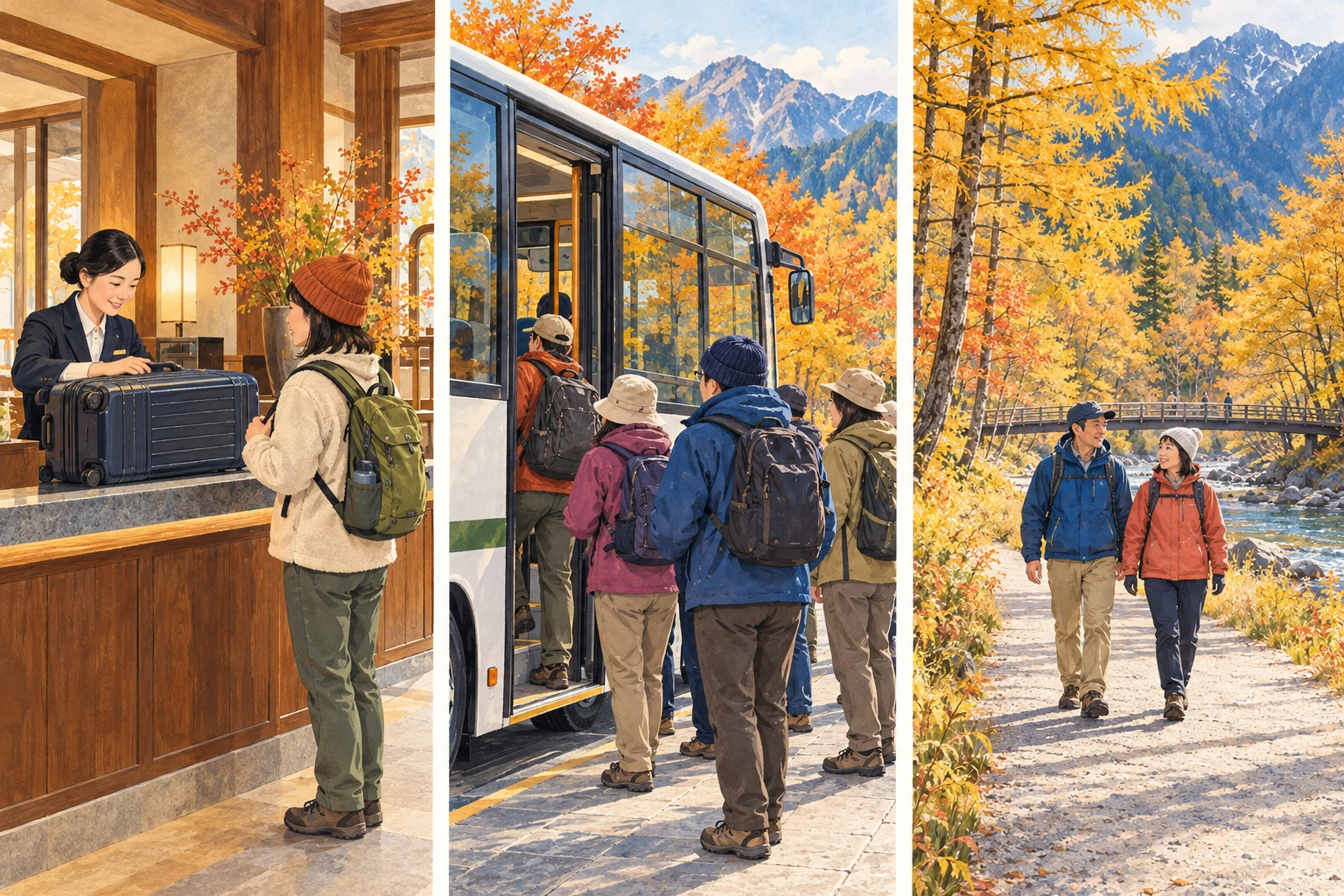
Toyama city suits meals, supplies and rail connections before and after the route, but you must still travel to Tateyama Station the following day. A foothill stay shortens the approach, provided the hotel is genuinely walkable from the station or has a confirmed reserved transfer, and food remains available after a late arrival. If choosing an official forwarding partner, confirm the exact property on the list, not another with a similar name.
Mountain lodging keeps dawn and evening in the mountains and splits the crossing over two days, but check every property's season. Midagahara Hotel's official Western triple room measures 36.1 square meters for up to four: three single beds plus one sofa bed, so a fourth guest uses a different bed type. It has a bathroom and toilet. The official 2026 season is April 15–November 10. This is a concrete family-room option if a sofa bed is acceptable, subject to date availability, child charges and meals. Route operation to late November does not keep this hotel open.
Hotel Tateyama is another common misunderstanding. Its official room page lists the planned 2026 season only as April 15–August 30, so it cannot simply enter an autumn 2026 booking shortlist. Its facilities page says the shared large bath uses heated spring water, while the family bath is explicitly neither an onsen nor open-air. Having baths, an in-room bathroom, private bathing and natural onsen are four separate conditions; check each for mountain accommodation.
For natural onsen near Murodo, compare Mikurigaike Onsen. The official 2026 last stay date is November 24. Private rooms are six-tatami Japanese rooms; shared rooms have bunk beds for up to eight. There are no private tubs or private showers, only sex-separated shared baths. The roughly twelve-minute walk from Murodo Station includes stone steps and slopes, varies with weather and fitness, and requires carrying your own luggage. From November 4, winter mountaineering equipment is required even for this approach. For stays from that date, reservations are accepted only through the official website or by telephone. These limits may rule it out if you need direct station-to-room access, a large wheeled suitcase or a private bathroom.
On the east side, central Shinano-Omachi suits rail connections and station-area baggage collection; Omachi Onsenkyo makes bathing and dinner part of the stay. Neither is Ogizawa itself. Check the bus stop, hotel transfer and dinner cutoff. If taking an early Shinkansen next morning, Nagano city may fit the onward route better, but recalculate luggage collection too. Establish tomorrow's departure station and tonight's baggage pickup before comparing feasible rooms and baths.
Staying in Unazuki Onsen suits travelers who want bathing, time in the hot-spring town and a separate day for Kurobe Gorge. If the next day is for crossing the Tateyama Kurobe Alpine Route, accept a longer approach into the mountains. Compare station-area lodging such as Kurobe Unazuki Onsen Yamanoha: the hotel estimates about three minutes on foot from Unazuki-Onsen Station. The Shinkansen arrives at JR Kurobe-Unazukionsen Station instead; you still need to go to neighboring Shin-Kurobe Station and transfer to Toyama Chiho Railway. Unazuki-Onsen Station and JR Kurobe-Unazukionsen Station are different locations. For onward travel to Tateyama, Toyama Chiho Railway’s official weekday route-query example lists departure from Unazuki-Onsen at 07:13, a change at Terada onto the Tateyama Line and arrival at Tateyama Station at 09:28. That is about two hours and 15 minutes just to reach the Alpine Route entrance, before any cable car or mountain connections. This is a weekday route example: recheck the actual services for your departure date and coordinate them with your mountain-entry reservation. For an early crossing, staying in Toyama or the Tateyama foothills the previous night is easier to arrange. Plan the Kurobe Gorge Railway from Unazuki separately from the Alpine Route through Murodo and Kurobe Dam to Ogizawa; staying in Unazuki does not create a direct connection from beside the dam back to your hotel.
Autumn color on the Alpine Route follows elevation, not one peak date
Murodo, Daikanbo, Kurobedaira, Midagahara and the foothills do not reach the same autumn stage together. The official seasonal page places Murodo around 2,450 meters and Midagahara around 1,930, well above Tateyama Station. Decide whether you want alpine vegetation, layered mountainsides or lower forests, then look at dated images from that area. September or October foliage periods are starting points for research, not promises of mountains covered in color on a chosen day.
Before leaving, consult official seasonal news, local weather and operation updates. If higher areas have lost their leaves or received snow, shift viewing lower along the route while following transfer rules. After leaving the Highland Bus at Midagahara or Tengudaira, the operator requires arranging your next service at the designated counter before walking. Do not finish the walk and assume any later bus has space.
Do not dress for autumn Murodo using Toyama city's temperature. Carry an insulating layer, windproof and waterproof outerwear, gloves and footwear for slippery ground. In strong wind, fog or snow, shorten outdoor time and obey restrictions. Snow scenery is a possible weather outcome, not a complimentary safe footpath. Ordinary sightseers should not improvise a switch from a lowland itinerary to mountaineering, snow crossings or closed trails.
Allow a separate half day around the Tateyama foothills for Shomyo Falls rather than squeezing it into a short gap after a full-day crossing. The official 2026 Shomyo Falls sightseeing-bus timetable applies May 11 (planned)–November 10. It gives 15 minutes each way from Tateyama Station to the Shomyo Falls stop, with the last listed return to the station departing at 15:30. The bus reaches only the entrance parking area. According to Tateyama Town’s walking directions and the official route map, continue from the Shomyodaira parking area along the riverside path, across Shomyo Bridge to Takimidai Enchi, the waterfall-viewing area. This is about 30 minutes and 1.3 kilometers one way, with a 100-meter elevation difference; allow additional time for the walk back, waiting and viewing the falls. Toyama Prefecture’s road notice updated September 1 gives normal September–November road access as 07:00–18:00. That does not mean the bus runs until 18:00. The road may close at night, in bad weather or under temporary restrictions; rainfall controls or congestion can also suspend the entire bus service. Before leaving, check both the road and Tateyama Town’s park-access and bear notices. Stay on the path and follow the town’s advice to avoid walking alone and carry sound-making items and bear-protection equipment. Do not extend this shuttle timetable beyond November 10; check current notices separately for winter road opening and closure dates.
November Alpine Route: check the timetable, bags and lodging separately
The official 2026 timetables are divided into April 15–November 3 and November 4–30. From November 4, download the latter and recheck final entrance services, departures from Murodo in both directions and Ogizawa access buses. A last-service message on the homepage for one day does not establish the whole month. Summer's latest departures are particularly unsuitable for a shorter winter afternoon.
Cross-check at least three calendars: route operation, accommodation and food service, and luggage forwarding. Forwarding is scheduled to end November 8 regardless of transport continuing to November 30. Mountain hotels each have their own last night; do not wait until arrival to seek rooms. If reaching an entrance late, staying below and using the following full day is usually easier than compressing the whole route into half a day.
Work backward from the day's required exit. Choose onward transport below the mountains, allow transfers and waits, then allocate Murodo walking and lunch. If operations become irregular, do not spend your remaining exit margin on a distant sight. Ask station staff about feasible directions and final connections. More flexible onward accommodation can reduce rerouting costs but cannot solve every suspension. Avoid a mountain crossing on the day before an inflexible departure.
Getting to Kamikochi: Takayama via Hirayu, or the Matsumoto approach
From Takayama, take Nohi Bus to Hirayu Onsen and transfer to the Kamikochi line. The official guide gives about 90 minutes from Takayama via Hirayu and about 30 from Hirayu, before waiting and queues. The 2026 Kamikochi line operates April 17–November 15, with all seats unreserved and no seat reservations possible. Busy-day boarding follows the queue. A ticket does not guarantee your originally intended service.
Private cars are restricted in Kamikochi. From Gifu, park at Akandana in Hirayu and transfer; from Matsumoto, follow official guidance to transfer at Sawando by bus or taxi. Read Kamikochi's official vehicle restrictions together with the bus page. A navigation app producing a driving time does not authorize driving your car in. A valley hotel booking does not automatically provide private-vehicle access either.
At the time of checking, Hirayu–Kamikochi adult fares were ¥1,500 single and ¥2,800 return. The Takayama–Kamikochi transfer return ticket via Hirayu was ¥5,800 for adults and ¥2,900 for elementary-school children and younger, valid seven days and routed through Hirayu. This line specifically requires young children to have a child ticket and their own seat rather than sitting on an adult's lap. Infants under one year travel free. This differs from the Alpine Route's ordinary preschool rule; budget by route rather than writing under-sixes free for everything.
Kamikochi walks: deepen either Taisho Pond–Kappa Bridge or the Myojin loop
For a first visit, alight at Taisho Pond, walk past the Tashiro Pond area toward Kappa Bridge, then leave from the bus terminal, provided paths, weather and the party's fitness allow. The official nature trail gives roughly four kilometers and 80 minutes one way between Taisho Pond and Kappa Bridge. This is a walking baseline excluding photographs, rests and meals. Families and slower walkers should allow half a day rather than using that figure to pack several long branches into a morning.
For Myojin, use Kappa Bridge as the starting and return point. The official walking routes give about 60 minutes on the right bank via Dakesawa Marsh and 50 back along the left bank: about 110 minutes of walking before stops. Taisho Pond, Myojin and Tokusawa each reward an unhurried visit but are unsuitable as a complete checklist on a short day trip. For nearby streams and peaks, a short out-and-back around Kappa Bridge can be a complete outing.
Select paths with toilets, rest stops and the return point in mind. Wet boardwalks, fallen leaves and late-season ice can make flat routes difficult. Shorten the walk if clothing or fitness is inadequate; flat is not risk-free. Do not feed wildlife, collect plants or leave designated paths. Missing a particular animal does not make the visit a failure. Read current official notices before leaving; closures and staff directions take precedence over old travelogues.
Kamikochi foliage and clothing: scenery picks the date, transport sets the exit
Kamikochi's autumn is not synchronized with higher Tateyama. Valley trees, larches, broadleaves and peaks create different seasonal layers. The official FAQ lists October as foliage season. A September 2026 official autumn preview says larches are generally most striking in late October–early November. The actual peak depends on that year's temperatures, rain, snow and wind. For golden woodland, use recent images with a clear location rather than treating a general Nagano forecast from another altitude as Kappa Bridge's current condition.
Autumn mornings can be cold while midday walking generates heat. Dress in adjustable layers and carry rainwear, insulation, gloves and spare socks, with soles suitable for wet ground. Near the end of the season, photographs do not justify thin-soled shoes or an umbrella as your only protection. If rain or snow is forecast and you lack equipment, a Takayama town day is more sensible. This discussion concerns ordinary visitor paths; it does not replace the equipment and judgment needed for mountain routes.
Foliage walks often overrun because people keep moving forward until they are too far from the terminal. At Kappa Bridge, decide the latest turnaround using the slowest companion's pace and allow for queues and changing weather. For slow photography, split Myojin and Taisho Pond across days or stay in the valley. The fact that the last bus has not left yet is no reason to keep walking deeper.
Kamikochi's final 2026 week: a room does not keep every service open
Kamikochi's 2026 closing ceremony is November 15, but facilities end at different times. The official October 6 closing announcement lists Myojinkan's last stay as October 31; Konashidaira's Morino Resort Konashi, Yama-no-Hidaya, Tokusawa-en and Yokoo Sanso end November 3; Kamonjigoya and Tokusawa Lodge end November 4. They are not accommodation options for the last seven days, November 9–15.
Taishoike Hotel's last stay is November 13. The Imperial Hotel, Kamikochi Onsen Hotel, Lemeiesta, Alpen Hotel, Nishi-Itoya Sanso, Gosenjaku, The Parklodge and Shirakabaso announce stays through November 14. This means the last available operating night, not remaining room availability or continued restaurant service and day bathing after checkout. Sakamaki and Nakanoyu list year-round operations with closure days, but their locations and approaches are not interchangeable with valley accommodation by Kappa Bridge.
The announcement's one-page PDF separates food, cafes, shops and day bathing, making it useful before departure. Kamikochi Onsen Hotel's food and cafe service ends November 8 despite lodging through the 14th. Kamonjigoya's meals continue to November 10, unlike its November 4 lodging finish. On November 15, Kamikochi Shokudo food ends at 14:00 and its shop at 12:00. Closing time means leaving; last orders may be 30–60 minutes earlier. Hotaka Shrine Okumiya admits visitors only through November 14. Its toilet is scheduled through the 14th but may close earlier. On a November 15 Myojin walk, neither the shrine visit nor that toilet should be assumed available. The fact that the mountain has not closed yet is particularly poor justification for leaving lunch and supplies to chance in the final week.
Kamikochi's last bus is not necessarily the last connection to Takayama
Nohi's 2026 timetable lists the latest Kamikochi–Hirayu departure at 17:30, arriving 17:55, but the same page's last Hirayu–Takayama bus departs at 17:30. Taking Kamikochi's last bus therefore does not allow continuation to Takayama on those regular services. Work backward from the Hirayu connection if your hotel is in Takayama. Even the listed 17:00 departure reaching Hirayu at 17:25 leaves only a nominal five minutes and is an uncomfortable target for a relaxed day.
Return to the terminal while the afternoon still has margin, aiming for a service earlier than the last connecting option and allowing for queues, traffic and weather. No fixed number of early minutes guarantees boarding. Follow on-site notices for reductions or road disruption. A Hirayu stay removes one mandatory evening connection but still needs a dinner and transfer check. The last bus is not the hotel's latest check-in time.
If weather worsens, you miss a connection or services end early, ask the bus counter about transport first, then contact your original accommodation. Do not walk onto closed roads or assume a valley room will be available that night. Winter conditions begin after November 15, so this ordinary bus-and-walk plan does not apply from November 16. Winter entry is not simply adding a day to summer/autumn walking: use the separate official winter-entry rules, equipment and transport requirements.
Three days from Takayama: one base and alternatives for the weather
With three full days, give day one to Takayama: markets, old town and one visitor building in the morning, a seated lunch, then shopping or hotel rest. Day two is a Shirakawa-go return and day three Kamikochi via Hirayu. This order suits confirmed bus seats and suitable Kamikochi conditions. If day two has better weather, swap the countryside days only if tickets and accommodation permit, after reading change/refund terms.
If the three days include an afternoon arrival, shorten day one to old town and dinner, put one countryside outing on day two and leave after a market visit on day three. Choose Kamikochi for walking, rivers and peaks, or Shirakawa-go for village architecture with obtainable return seats. Removing one keeps the trip's purpose instead of turning most of three days into platform and locker searches.
In unsuitable Kamikochi weather, choose indoor culture, craft shops or a proper meal in Takayama rather than another high-altitude sight exposed to the same weather. The backup should leave achievable activities and transport. If Shirakawa-go roads also carry major-delay warnings, staying at the base makes onward plans more manageable than forcing a circuit. Treat prepaid losses and rearrangement costs separately; having paid is not itself a reason to depart.
Five linked days: Takayama, Kamikochi, Shirakawa-go, Toyama and Omachi
For five full days: day one, Takayama walks and a Takayama night; day two, Kamikochi return and another Takayama night; day three, Takayama–Shirakawa-go sightseeing followed by Toyama and a Toyama night; day four, west-to-east Alpine Route crossing and a night in Shinano-Omachi or Omachi Onsenkyo; day five, pack, enjoy breakfast and continue to the next city. Shirakawa-go becomes an en-route stop and Kamikochi needs only a daypack.
On day three, confirm Takayama–Shirakawa-go and Shirakawa-go–Toyama tickets separately, along with luggage. On day four, check Toyama–Tateyama Station, the main route reservation and east-side accommodation. Alpen Porter requires a date within its season and collection at the correct office. For travel from November 9, arrange another delivery or same-side-return plan before booking hotels, instead of discovering the closure the evening before crossing.
This is not a fixed package filling every day. If Kamikochi transport stops, stay in Takayama on day two. If the Alpine Route cannot be crossed, keep day four in Toyama or use ordinary rail onward, rechecking hotel cancellation and luggage location. Preserve adjustment room on day five rather than tightly linking a late Omachi arrival with next-day departure from Japan. Add days before also trying to explore Kanazawa, Matsumoto or the Nakasendo in depth.
Budget, booking order and final checks
At ordinary adult fares, the five-day example's Takayama–Kamikochi transfer return costs ¥5,800, Takayama–Shirakawa-go ¥2,800, Shirakawa-go–Toyama ¥2,400 and Tateyama Station–Ogizawa ¥10,940. These four items total ¥21,940 for one adult, or ¥43,880 for two. This is not the full trip budget. It excludes travel into and out of the region, Dentetsu-Toyama–Tateyama, Ogizawa access buses, hotels, meals, attraction admissions and luggage forwarding. Clear exclusions help more than a low total claiming five days are cheap.
Settle the most constrained parts first: season and mountain lodging, available Alpine Route departures and Shirakawa-go onward seats, then accommodation on both sides, access rail and luggage. Record every cancellation deadline and ticket-collection requirement. Compare complete segments and meals when prices differ, without adding an expensive hotel move or taxi for a small fare saving. For a first dinner-and-breakfast ryokan stay, read ryokan dinner, child and arrival rules rather than planning at a city hotel's pace.
The evening before and morning of departure, recheck transport, weather, roads and destination opening notices, as well as offline orders, cash, luggage labels, warm clothes and return limits. Write the latest turnaround into the plan and allow yourself to drop a stop. Time beside the river, in old streets or on the mountain depends on making room for transfers and seasons, not the number of place names completed.
A few useful answers
Can Takayama, Shirakawa-go, Kamikochi and the Alpine Route all fit into three days?
For three full days, choose Takayama, Shirakawa-go and Kamikochi, or an Alpine Route trip from Toyama to Omachi. Five full days better accommodate all four, including stops and transfers. Calculate usable arrival and departure time separately.
Can Alpine Route luggage go directly from Tateyama Station to Ogizawa?
The official 2026 Alpen Porter service does not collect or deliver at Tateyama Station, Ogizawa or Nagano Station. Common endpoints are Dentetsu-Toyama and the office outside JR Shinano-Omachi, plus designated partner hotels. Service is scheduled only through November 8; route operation through November 30 does not extend forwarding.
Does an ordinary Shirakawa-go bus ticket include illumination?
No. The 2027 event requires an eligible accommodation, parking or illumination-bus plan, with a further eligible package for viewpoint access. No reservation means no same-day admission purchase.
Can I return to Takayama on Kamikochi's 17:30 last bus?
The 2026 Nohi timetable has the 17:30 Kamikochi departure reaching Hirayu at 17:55, after Hirayu's 17:30 last Takayama bus. Work backward from the onward service and select an earlier departure, allowing for queues, delay and weather.
Do all Kamikochi hotels and restaurants stay open until November 15?
No. Myojinkan's 2026 last stay is October 31, several lodges end November 3 or 4, Taishoike Hotel November 13, and several Kappa Bridge-area hotels November 14. Food, cafes, shops and bathing have separate closing dates; check each column in the official notice.
Are preschool children free on both the Alpine Route and Kamikochi buses?
The rules differ. The Alpine Route's regular-ticket page lists free travel for preschool children, with school stage changing April 1 in the entry year. Nohi's Kamikochi line requires a child ticket and seat, prohibiting lap travel; infants under one are free.
Are Takayama Green Hotel's open-air room baths private onsen?
The official FAQ says guest-room baths, including open-air-bath rooms, do not use hot-spring water. If natural onsen in your room is essential, do not judge by the hotel name. Check shared large baths and room baths separately.
Can a Hokuriku or Japan rail pass cover all transport?
It depends on the product and section. Some regional passes cover designated Shirakawa-go buses without covering the Alpine Route or Kamikochi branches. Confirm each segment on your settled route before comparing individual fares and passes.
Check with the source
Schedules, availability and rules can change. These official sources are the place to confirm details before you book.
- Takayama City | Regional transport
- Official Takayama tourism | Old town
- Official Takayama tourism | Markets, seasons and luggage FAQ
- Takayama City | Accommodation tax and child exemption
- Takayama Green Hotel | Orinkaku rooms
- Takayama Green Hotel | Rooms, baths, children and booking FAQ
- Takayama Green Hotel | West Exit shuttle
- Nohi Bus | Takayama, Shirakawa-go and Hokuriku services and fares
- Shirakawa-go Tourism Association | 2027 illumination rules and reservations
- Nohi Bus | Shirakawa-go illumination 2027 products
- Alpine Route | Route and transport modes
- Alpine Route | 2026 regular fares
- Alpine Route | Web-ticket guide
- Alpine Route | Transfers, school stages and journey-time FAQ
- Alpine Route | 2026 luggage-forwarding conditions
- Alpine Route | 2026 timetables
- Hotel Tateyama | Murodo locker closure notice
- Alpine Route | Elevations and seasons
- Nohi Bus | 2026 Kamikochi transport, tickets and young-child seats
- Official Kamikochi | Private-vehicle restrictions
- Official Kamikochi | Walking routes and reference times
- Official Kamikochi | Seasonal clothing
- Official Kamikochi | 2026 last accommodation dates
- Official Kamikochi | 2026 food, shops and public-facility closing PDF
- Official Kamikochi | Nature and visitor rules
- Official Takayama-Hokuriku Area Tourist Pass | Coverage
- Official Kamikochi | 2026 autumn preview and larch season
- Official Kamikochi | Seasons and closing FAQ
- Midagahara Hotel | Four-person bed layout and 2026 season
- Hotel Tateyama | Rooms and planned 2026 season
- Hotel Tateyama | Bath water and family bath
- Mikurigaike Onsen | 2026 stays and November booking conditions
- Mikurigaike Onsen | Rooms, shared baths and approach restrictions
- Kurobe Unazuki Onsen Yamanoha: station walk and Shin-Kurobe transfer
- Toyama Chiho Railway: weekday Unazuki-Onsen–Tateyama route query via Terada
- Tateyama Town: access and walking directions for Shomyo Falls
- Official Alpine Route map: Shomyodaira, Shomyo Bridge and Takimidai Enchi
- Official Alpine Route: 2026 Shomyo Falls sightseeing-bus timetable (April 15 version)
- Toyama Prefecture: Shomyo Road access hours and restrictions (updated September 1, 2026)
- Tateyama Town: Shomyo Falls access, seasonal hours and bear precautions (updated July 6, 2026)