Walk from Dogo Onsen Station to the west entrance of the Honkan, and plan your soak around numbered waiting tickets and last-entry cut-offs. Compare the Three-Bath Pass, Asuka-no-Yu family baths, and stays in Dogo or central Matsuyama.
- Region & Focus
- ShikokuAttractions
- Reading Scope
- 20 min read · 12 chapters · 5 Q&As
- Official Verification
- 27 official sources checkedUpdated 22 November 2026
- Key Topics
- Hot springsItinerariesRyokan
Chapter Route Map (tap any stop)
- Find the west entrance first, then judge how far to wander
- Four general bathing courses: baths, lounges, and time limits compared
- Where to find private rooms versus true private baths
- Visiting the Yushinden and spotting details from the Onarimon gate to the roof
- When the Three-Bath Pass actually saves you money
- Early December 2026 deep-cleaning closures: swap your bath days ahead of time
- Reaching Dogo from JR Matsuyama Station, Matsuyamashi Station, and the airport
- Sequencing the Karakuri Clock, footbaths, and covered arcade
- Three workable itineraries anchored around fixed entry times
- Rainy days, step-free access, and travelling with young children
- Staying in Dogo versus central Matsuyama for onward connections
- Packing from the locker to the bath without fuss
- Quick Q&A
On a first visit to Matsuyama's Dogo Onsen Honkan, walk from the tram terminus through the covered shopping arcade and head straight to the west entrance to check availability for the bath course you want. If you simply wish to step inside the Meiji-era bathhouse, a ¥700 Kami-no-Yu Downstairs ticket is all you need; add an upstairs lounge option if you want to sit on tatami with tea afterwards. On busy days when numbered waiting tickets are issued, you must return to the ticket counter within 15 minutes of your call, giving you time to browse the immediate neighbourhood while you wait. Knowing what time you have to leave Dogo makes it easy to decide whether to hold out for the Honkan, switch to an annex bath, or save your soak for the following morning.
Find the west entrance first, then judge how far to wander
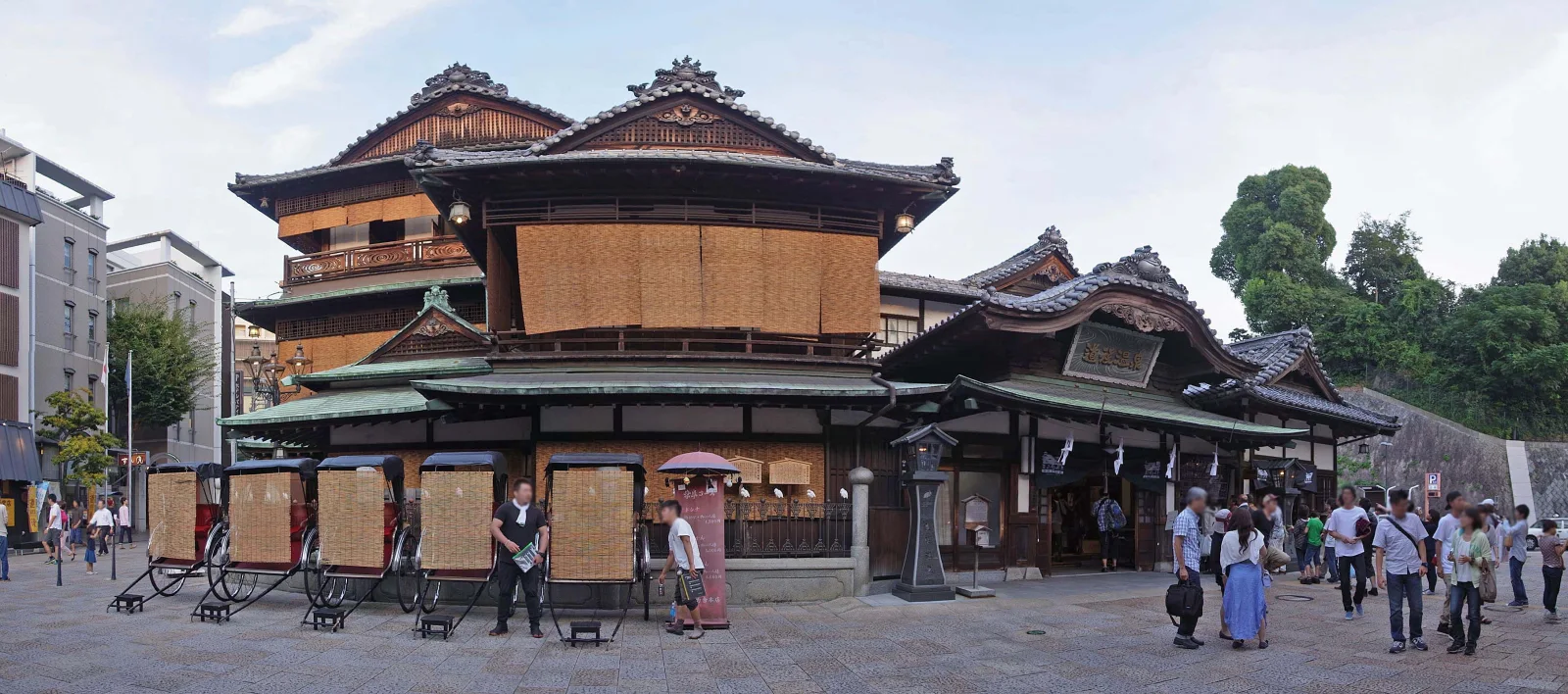
The tram terminates at Dogo Onsen Station, and the Botchan Karakuri Clock in Hojoen Park greets you the moment you step outside. From Hojoen, walk into the covered Dogo Haikara-dori shopping arcade and follow signs to the Dogo Onsen Honkan square, an official walk of roughly three minutes from the station. Facing the timber bathhouse, look for the fudaba ticket counter outside the west entrance. Around the opposite side sits the ornate Onarimon gate serving the Yushinden Imperial wing, well worth a detour for its exterior alone.
When walk-in entry is open, buy your bathing ticket at the fudaba, lock your shoes in a free shoe locker inside the door, and hand your ticket to reception. Kami-no-Yu Downstairs guests follow the central corridor and turn left midway, where the men's changing room lies to the right and the women's to the left. Those holding upstairs lounge tickets continue to the end of the corridor and climb the left-hand staircase to be seated by staff. If companions are splitting between the men's and women's baths, agree beforehand whether to reconvene in your assigned lounge or meet back outside on the square.
During peak periods, one representative per group registers the chosen course, party size, and contact details to receive a numbered waiting ticket, then waits for a phone call before returning to purchase entry. If you fail to return within 15 minutes of the call, that slot is automatically cancelled. Keep your phone audible and stay together as a group, or agree who will bring the children back to the ticket counter first. When queues are short, staff occasionally ask visitors to line up directly instead, so gather your whole party beside the fudaba before buying.
Before setting off, check the live wait-time page on the official Dogo Onsen website so you know which bathhouse to head for before even entering the arcade. Once you hold a waiting ticket, stick to short loops around the Honkan, pick up takeaway snacks, or browse souvenir shops close to the exit. Sit-down meals, shrine stair climbs, and the Dogo Park museum are best saved until after your soak. If waiting tickets have already sold out for the day, walk straight over to the neighbouring annex bathhouses on the adjacent block rather than lingering at a closed door.
Walk from Dogo Onsen Station to the west entrance of the Honkan, and plan your soak around numbered waiting tickets and last-entry cut-offs. Compare the Three-Bath Pass, Asuka-no-Yu family baths, and stays in Dogo or central Matsuyama.
Four general bathing courses: baths, lounges, and time limits compared
If you have only an hour or two in Dogo, choose Kami-no-Yu Downstairs and budget more than half your visit for walking and waiting. Kami-no-Yu is the Honkan's main public bath, with an official time limit of 60 minutes downstairs that covers undressing, washing, and getting dressed again. Soap and shampoo are supplied in the bath, while towels can be brought along or hired on site. Upgrading to the Kami-no-Yu 2nd-floor Tatami Lounge uses the exact same bathing hall; the extra fare goes towards relaxing after your soak in a hired yukata with tea and a sweet.
Visitors keen to see both bathing halls and the Imperial rooms get the best value from the Tama-no-Yu 2nd-floor Tatami Lounge. At ¥2,000 per adult, it includes both Kami-no-Yu and Tama-no-Yu, a shared tatami lounge, yukata and towel hire, plus self-guided access to the Yushinden. Prioritise Tama-no-Yu and the Yushinden first before deciding whether you still have time for the second bath. If you want space to stretch out quietly or have children and belongings to organise, paying ¥500 more for a Tama-no-Yu 3rd-floor Private Room extends your total stay to 90 minutes.
All four general bathing courses open at 06:00, and each carries a strict last-ticket cut-off known as fudazashi. Downstairs stays open until 23:00, while all upstairs lounge options close at 22:00. Arriving at 21:00 still gives you time for Kami-no-Yu Downstairs until its 22:30 cut-off, whereas 2nd-floor lounge tickets stop at 21:00 and Tama-no-Yu 3rd-floor Private Rooms close sales at 20:30. At weekends, never assume you can join the queue right up to the published cut-off, as daily tickets frequently sell out earlier; if you want to hear the 18:00 drum from outside, keep the late-afternoon hour free so you are not rushing to dress.
| Ticket counter name | Adult / Child | Last ticket | Time limit inside |
|---|---|---|---|
| Kami-no-Yu Downstairs | ¥700 / ¥350 | 22:30 | 60 min |
| Kami-no-Yu 2nd-floor Tatami Lounge | ¥1,300 / ¥650 | 21:00 | 60 min |
| Tama-no-Yu 2nd-floor Tatami Lounge | ¥2,000 / ¥1,000 | 21:00 | 60 min |
| Tama-no-Yu 3rd-floor Private Room | ¥2,500 / ¥1,250 | 20:30 | 90 min |
Where to find private rooms versus true private baths
On the Honkan's 3rd floor, Shirasagi-no-Ma and Hisho-no-Ma are private resting rooms rather than private baths. Room hire starts at ¥6,000 and ¥3,000 per group respectively, plus ¥1,300 per adult and ¥650 per child aged 2 to 11. Two adults booking Hisho-no-Ma pay ¥5,600 in total for 90 minutes, covering private lounge rest and entry to either the Kami-no-Yu or Tama-no-Yu public baths. Families with toddlers or couples hoping to bathe together in one private room should look directly to the family baths at Asuka-no-Yu Onsen instead.
Shirasagi-no-Ma runs five daily sessions at 06:30, 09:30, 12:30, 15:30, and 18:30, while Hisho-no-Ma runs five slots at 08:00, 11:00, 14:00, 17:00, and 20:00. Guests staying in Dogo have the easiest reach for the earliest morning session. Travellers based around Okaido who dine in central Matsuyama first can work backwards from the 20:00 Hisho-no-Ma slot to time their tram ride and check-in.
The 2nd-floor Special Bathrooms (family baths) at Asuka-no-Yu Onsen are the dedicated option with both a private tub and a private resting space. Rates are ¥2,040 per group plus ¥1,690 per adult and ¥830 per child, bringing two adults and one child to ¥6,250 for 90 minutes total, including access to the 1st-floor public bath. Wash your hair and body downstairs in the main bath first, as soap and shampoo are prohibited inside the 2nd-floor private baths. Staff also supply a traditional bathing robe (yucho) designed for wearing inside the private tub, separate from the yukata worn while resting.
Bookings for both private rooms at the Honkan, standalone Yushinden tours, and Asuka-no-Yu's Special Bathrooms open 90 days ahead. Online reservations close at 22:00 JST the evening before; on the day itself, telephone 089-921-5141 for the Honkan or 089-932-1126 for Asuka-no-Yu, where same-day slots remain bookable up to two hours before start time if available. Staff normally phone to confirm two hours ahead, or one hour ahead for 07:00 and 08:00 bookings, so keep your phone handy and report directly to the 1st-floor main ticket counter at Asuka-no-Yu around 10 minutes before your slot; arriving more than 30 minutes late without notice cancels the reservation.
Visiting the Yushinden and spotting details from the Onarimon gate to the roof
When some members of your group want to soak while others only wish to see the historic architecture, buy separate tickets and meet back in the square. A 30-minute guided tour of the Yushinden costs ¥500 for adults and ¥250 for children aged 6 to 11, running between 09:00 and 17:00 with last admission at 16:30. Built exclusively for Imperial visits, the wing lets you view the Oima resting room, the ceremonial Gyokuza-no-Ma Throne Room, and the Oyudono Imperial bath. If you already hold a Tama-no-Yu ticket that includes self-guided Yushinden access, note what you want to see beforehand and set aside part of your allotted time inside.
Even if you are only waiting outside, the exterior reveals layers of different building eras. Walk past the bathers' entrance on the west square around to the east facade to see the Onarimon gate leading to the Imperial bath. Look up to the Shinrokaku pavilion crowning the three-storey wooden structure, where red glass panes and the white heron atop the roof stand out immediately. Conservation records note that the names of craftsmen who built Kami-no-Yu are inscribed on the heron's feathers; while you can make out the bird's silhouette from street level, the full inscriptions are documented in the official floor-by-floor restoration archive.
The Kami-no-Yu main building seen today dates from an 1894 reconstruction, and in 1994 it became the first active public bathhouse in Japan designated a National Important Cultural Property. A major conservation project begun in 2019 allowed the entire building to reopen on 11 July 2024 before all remaining works wrapped up on 20 December that year. The entrance still functions exactly as it did over a century ago as a working doorway for arriving bathers and queues, so step back towards the edge of the square to frame a full-building photograph without blocking foot traffic.
At 06:00, 12:00, and 18:00, listen outside the Honkan for the toki-daiko hour drum struck from the Shinrokaku pavilion. Down by the station, the Botchan Karakuri Clock performs between 08:00 and 22:00. To catch both in one day, time one for the top of the hour and save the other for a half-hour performance on dates when extra clock shows run. Dusk photographers can linger on the Honkan square for a few minutes before walking back through the lantern-lit arcade to Hojoen Park as night falls.
When the Three-Bath Pass actually saves you money
From 1 September 2026, the Three-Bath Pass costs ¥1,440 for visitors aged 12 and over and ¥680 for children aged 2 to 11, valid across the day of purchase and the following day. It covers one visit each to Kami-no-Yu Downstairs at the Honkan, the 1st-floor bath at Asuka-no-Yu Onsen, and Tsubaki-no-Yu. Passes can be bought and validated at any of the three ticket counters. Because the three included entries are fixed and cannot be upgraded for a surcharge, buy a dedicated upstairs course directly if you want tatami lounge tea at the Honkan.
Single adult admissions to the three baths total ¥700 + ¥610 + ¥500, or ¥1,810, so using all three saves ¥370. However, visiting only the two pricier entry-level baths comes to ¥1,310, making individual tickets cheaper for any two-bath combination. For children, three separate entries total ¥850, while the two costlier baths add up to ¥650—less than the ¥680 child pass. Decide adult and child tickets separately: if a child prefers a stroll on one of the days while an adult still plans a third soak, tailor each ticket accordingly.
Overnight guests can pair two contrasting baths on arrival day and leave the third until the next morning. If you arrive late on the first night wanting only a quick wash, start at Tsubaki-no-Yu beside the arcade, take the morning session at the Honkan, and save Asuka-no-Yu for before you depart. Travellers who prefer relaxing in a lounge back at their ryokan or hotel get full value from the Three-Bath Pass's three ground-floor entries, or you can skip the pass for a single upstairs Honkan splurge and spend your remaining hours in Dogo Park.
From May 2026, Tsubaki-no-Yu charges ¥500 for adults and ¥200 for children, opening from 06:30 to 23:00 with last ticket sales at 22:30 and a one-hour bathing limit. Operating as a neighbourhood public bathhouse, it requires you to bring your own toiletries. Asuka-no-Yu shares the same street address and courtyard, so check the signs as you enter to pick the right doorway. Asuka-no-Yu's 1st floor opens at 06:00 with toiletries provided and an open-air bath, making it ideal if you have been caught in the rain and want a straightforward wash; its 2nd-floor lounges and private rooms carry separate last-entry times and are bought as standalone courses.
Inside Asuka-no-Yu's 1st-floor bathing halls, look beside the pools for the Tobe-ware ceramic murals depicting Ehime's Mount Ishizuchi in the men's bath and the Seto Inland Sea in the women's. Projection-mapping shows inspired by waka poetry linked to Dogo play every 30 minutes from 06:30 to 22:30, all included with a standard 1st-floor ticket. On chilly days or when companions want to sit down together, upgrade to the 2nd-floor Grand Hall for ¥1,280 per adult with yukata, tea, and sweets (last entry 21:00), or book a 2nd-floor enclosed private lounge for ¥1,690 per adult; both upstairs tiers share the same 1st-floor public baths.
Early December 2026 deep-cleaning closures: swap your bath days ahead of time
Official notices schedule a full-day deep-cleaning closure at the Honkan on Tuesday 1 December 2026, with the Sora-no-Sanpomichi Sky Promenade and 4th Spring Source Station also closed that morning. On Wednesday 2 December 2026, both Asuka-no-Yu and Tsubaki-no-Yu close all day for their own deep clean. Visitors arriving on 1 December can admire the Honkan's exterior on a stroll and bathe in the annex quarter instead, while those in town solely on 2 December can head straight to the Honkan and walk down to the station clock in the evening.
If you are in Dogo across both days and mainly want to experience the historic Honkan, shift shopping, shrine visits, or central Matsuyama sightseeing into 1 December and return for your soak on 2 December. Travellers aiming to complete all three baths should knock off Asuka-no-Yu and Tsubaki-no-Yu on 1 December before visiting the Honkan on 2 December. Anyone unable to buy the Three-Bath Pass until 2 December will need to leave time on 3 December for both annexes, whereas guests checking out on 2 December will travel with far less rush by buying a single ticket for whichever bathhouse matters most.
The same notice confirms normal year-end and New Year operations outside those two cleaning days for late 2026 into early 2027. Families travelling over New Year can bathe during the daytime and reserve evenings for ryokan dinners or the station clock. Surrounding parks, museums, restaurants, and trams keep their own holiday timetables: the Yuzuki Castle Museum, for instance, closes from 29 December to 3 January—leaving the outdoor castle grounds walkable unless rain pushes you back under the covered arcade or into the baths.
Reaching Dogo from JR Matsuyama Station, Matsuyamashi Station, and the airport
Outside JR Matsuyama Station, look for the JR Matsuyama-ekimae tram stop and take Line 5 all the way to Dogo Onsen, a journey of around 25 minutes. From Iyotetsu's Matsuyamashi Station, board Line 3 to the same terminus in roughly 20 minutes; despite the similar names, these are two distinct stations with separate transfer layouts. Shoppers already around Okaido can catch any regular city tram heading towards Dogo Onsen straight from the Okaido stop—check the destination sign on the front before boarding so companions do not have to backtrack.
Standard city trams charge a flat adult cash fare of ¥250, dropping to ¥230 with ICOCA, Suica, or supported cashless payment. The vintage Botchan Train costs ¥1,300 for adults and ¥650 for children, operating only on Saturdays, Sundays, and Japanese national holidays (suspended from 30 December to 3 January). It runs on same-day boarding, with numbered tickets issued from 08:30 at the station-front counter for departures from Dogo Onsen; even if paying by IC card, collect your numbered ticket first and pay on board. If you have an onward JR train or fixed dinner booking, a regular city tram gives far more reliable timing.
Direct limousine buses from Matsuyama Airport stop at Dogo Onsen-ekimae in around 40 minutes for ¥1,200 adult cash or ¥1,180 cashless. Airport passengers step off right beside the station and walk down the same covered arcade as tram riders. In summer, autumn, or wet weather when flights shift, double-check Iyotetsu's monthly airport limousine timetable against your flight and stop, as certain services terminate before Dogo. Allow extra minutes for baggage claim, waiting for the bus, and walking before deciding whether you can still make an upstairs lounge cut-off that evening.
Drivers can set their satnav to the municipal Dogo Onsen Parking on Kanmuroyama at 4-30 Dogo Yunomachi. Matsuyama City's November 2026 guide lists 86 spaces open from 05:30 to 23:30 at ¥100 per 30 minutes. Validating your parking ticket at the machine inside any of the three bathhouses deducts the first hour, so remember to bring the ticket inside with you. Because walking between Kanmuroyama car park and the baths involves slopes and steps, drop off wheelchair users or less mobile companions near the bathhouse entrance before driving up to park.
Sequencing the Karakuri Clock, footbaths, and covered arcade
The Botchan Karakuri Clock in Hojoen Park performs daily between 08:00 and 22:00, normally on the hour. On weekends, Japanese national holidays, throughout March, April, August, and November, plus 1–5 May and 28 December–5 January, shows double to every 30 minutes. Arriving at 10:45 on a weekday without a Honkan booking lets you catch the 11:00 show and try the adjacent footbath straight away; if you already have a bath or tour slot, watch the clock on your way back rather than making a special trip. Stand inside Hojoen Park itself rather than crowding the narrow arcade corner, and look for which face of the tower opens to reveal the figures.
A tidy short loop runs straight up the covered arcade from the station to the Honkan, across to the courtyard shared by Tsubaki-no-Yu and Asuka-no-Yu after your bath, and back down the arcade to the trams. If anyone in your group prefers not to walk far, use the station-front footbath as a meeting spot and pack a small hand towel so socks go straight back on afterwards. Save bulky boxed souvenirs for the return walk so you have fewer bags to squeeze into changing-room lockers, and when arranging to meet outside, specify either the Honkan's west square or the annex courtyard—they sit only steps apart but out of sight of each other.
In clear weather, climb Kanmuroyama south of the Honkan to the Sora-no-Sanpomichi Sky Promenade for tiled-roof views over the bathhouse. Its free footbath operates daily from 06:00 to 21:00 with a pavilion, benches, and changing booths (bring your own towel). Reaching it involves slopes or stairs, so swap it for the level station-front footbath in Hojoen on rainy days. Families curious about shrine roof architecture can also climb the long stone steps to Isaniwa Shrine, judging the climb against everyone's energy—best saved for dry stone rather than right after a bath with wet towels in hand.
On a half-day visit, treat Dogo Park as your final stop heading away from the hot-spring street. Built over the medieval Yuzuki Castle site, the park offers short paths past the moat and earthworks plus the free Yuzuki Castle Museum covering the Kono clan and castle history. Outdoor grounds stay open round the clock, while the museum opens 09:00 to 17:00, closed Mondays (or the following weekday when Monday is a holiday) and over year-end and New Year. Early morning bathers waiting for shops to open can wander the park first, whereas afternoon visitors should work backwards from the 17:00 museum close and bathe afterwards.
Three workable itineraries anchored around fixed entry times
If you arrive early and plan to spend the afternoon in central Matsuyama, start at the Honkan around 09:00. With two and a half hours to spare, go straight to the west counter for Kami-no-Yu Downstairs, circle past the Onarimon gate after your soak, and walk back down to the station for the next clock performance, fitting in a footbath or souvenir shop only if time permits. If the estimated callback time at the Honkan runs too close to your tram departure, switch immediately to Asuka-no-Yu's 1st floor or Tsubaki-no-Yu and return via the arcade instead of bouncing between queues.
Visitors exploring Matsuyama Castle or Okaido until mid-afternoon can shift Dogo to early evening. Pause outside the Honkan for the 18:00 hour drum, then either queue for Kami-no-Yu Downstairs or walk over to the annex baths. If you have your heart set on a 2nd-floor tatami lounge with tea, take an earlier tram and register at the fudaba before eating, rather than lingering over dinner until 20:30 and rushing the last-ticket cut-off. City-centre guests should also note the correct return tram direction before bathing—either Line 3 for Matsuyamashi Station or Line 5 for JR Matsuyama-ekimae, checking whether your tram calls at Okaido.
Overnight guests have the easiest job: anchor fixed-time bookings into either arrival day or departure morning. Book a Yushinden tour for the morning after bathing the evening before, or let a reserved Asuka-no-Yu family bath dictate what time you eat dinner. When staying on a kaiseki dinner plan, leave buffer time to return, change, and check in with your ryokan, saving casual public bathing or arcade strolls for after dinner. With just one or two timed anchors, ryokan meals, baths, and trams slot neatly into place.
When walking with older relatives, identify the single longest stretch on the map before setting off. If the walk from the station to the Honkan already uses up most of their stamina, keep the return trip strictly along the flat, covered arcade and save steps for inside the chosen bathhouse. Groups can also split comfortably between the historic Honkan and step-free Asuka-no-Yu, reuniting afterwards in the annex courtyard; choose a meeting spot beneath a clear signboard or easy to coordinate by phone rather than saying vaguely 'the entrance to the onsen street'.
Rainy days, step-free access, and travelling with young children
As a traditional wooden bathhouse, the Honkan has multiple steps at the entrance, inside changing rooms, and into the baths. Matsuyama City notes steps and handrails between the dressing areas and tubs in both men's and women's Kami-no-Yu, whereas the men's Tama-no-Yu tub entry has no handrail. Visitors using wheelchairs, managing knee pain, or wanting a ground-floor route without stairs should choose Asuka-no-Yu, which provides an entrance ramp and an internal lift. Tsubaki-no-Yu also has an entrance ramp, and the adjacent Ikoi-no-Ie facility serves eligible visitors and carers—call 089-932-3115 in advance for usage details.
For babies and toddlers at the Honkan, baby cots are installed in both the men's and women's changing rooms of Kami-no-Yu and Tama-no-Yu, while Asuka-no-Yu lends portable baby cots on request. Visitors needing to nurse can use the public nursing room on Tsubaki-no-Yu's 1st floor, reached from the Asuka-no-Yu courtyard between 06:00 and 23:00 by pressing the intercom beside the door. Two families travelling with prams can meet right in that shared courtyard so adults can take turns bathing, dressing, and minding little ones.
Light drizzle is easily handled with the clock, the Honkan, and the covered arcade, while heavy rain that makes waiting on the square miserable is a cue to head to the Matsuyama City Shiki Memorial Museum, around five minutes' walk from Dogo Onsen Station. Permanent exhibition admission is ¥500 for adults, free for high school students and younger, and ¥250 for visitors aged 65 and over with ID. Opening hours run 09:00 to 18:00 from May to October and 09:00 to 17:00 from November to April, with last entry 30 minutes earlier and regular Tuesday closures subject to the annual holiday calendar. Visit before taking a waiting ticket or after your bath so a callback does not interrupt you midway through.
First-time visitors unfamiliar with Masaoka Shiki can start with the Meiji-era Dogo and Matsuyama exhibits before moving on to the haiku and tanka galleries. Audio guides in Chinese and Taiwanese can be hired for ¥100, taking roughly 30 to 40 minutes for the highlights. If winter closing hours catch you after last entry, head straight to the arcade for dinner or straight into a bath, and save the museum for an early afternoon slot the following day before an evening soak.
Staying in Dogo versus central Matsuyama for onward connections
Base yourself in Dogo if you want to stroll back to your room within minutes of stepping out of the bath. Yamatoya Honten stands right beside the Honkan, roughly five minutes on foot from Dogo Onsen Station, and even houses an indoor cypress Noh stage. Staying overnight lets you wander the arcade after dinner, catch the Honkan's 06:00 opening soak the next morning, and return for breakfast before check-out. If you are switching hotels the next day, leave heavy bags at your accommodation and carry only towels and a change of clothes—or use the paid large-luggage storage at the Honkan and Asuka-no-Yu if you have already checked out and are heading straight to your next train.
Okaido connects directly to Dogo by city tram while keeping central shops and restaurants on your doorstep. Daiwa Roynet Hotel Matsuyama, officially a one-minute walk from the Okaido tram stop, suits travellers touring Matsuyama Castle by day before heading up to Dogo in the evening. Guests staying centrally who want the Honkan's earliest morning bookable slot will need to factor in the first tram or a taxi. If your onward itinerary relies on an early JR departure towards Imabari or Iyo-Ozu, staying near JR Matsuyama Station cuts out morning luggage transfers—just fit your Dogo soak into the evening before.
Travellers flying out of Matsuyama Airport or catching Iyotetsu suburban rail lines should compare hotels near Matsuyamashi Station's North Exit. APA Hotel Matsuyamashi-ekimae, opened in 2026 around three minutes' walk from the North Exit, puts you right on Line 3 for Dogo as well as the airport limousine bus stop outside the station, and offers connecting rooms with internal doors and separate bathrooms for groups of four. That said, if the entire focus of a family trip is soaking at the Honkan and strolling the arcade, staying beside the bathhouse lets anyone tired wander back early while others explore the annexes.
For multi-generational trips, check-in deadlines often matter more than straight-line distance from the bathhouse. Confirm fixed dinner times before booking; if arriving late, opt for a room-only rate and eat along the arcade before heading to the hotel. Families wishing to bathe together should look for rooms with private onsen tubs or bookable ryokan family baths—or reserve Asuka-no-Yu's Special Bathrooms directly. Relatives booked into separate rooms can use the hotel lobby as a rendezvous point, and if your accommodation sits further from the Honkan, check its access map for hills so you know whether to walk or hop on a tram.
Packing from the locker to the bath without fuss
On the lowest-tier courses at the Honkan or Asuka-no-Yu, bring one small hand towel and one bath towel, or hire them at the counter. Use the small towel to wipe yourself dry before stepping out of the bathing room, and keep the bath towel in your locker for getting dressed; if staying at a ryokan, grab a small waterproof pouch for damp cloth before heading out. Tsubaki-no-Yu requires your own shampoo and soap plus ¥10 coins—lockers cost ¥10 and hairdryers take ¥10 for three minutes—so set a few coins aside in an accessible pocket before locking your wallet away.
Leave your mobile phone inside the locker and wash thoroughly in the shower area before entering any tub. Tie up long hair, keep your towel out of the bathwater, and towel off excess water inside the washing area before stepping onto the changing-room mat. Rinse your bucket and stool clean and return them neatly where you found them. Dedicated bathing garments designed to cover post-mastectomy or skin-graft scars are permitted, whereas standard swimwear and underwear are not allowed in the public baths. On tea-and-sweet courses, follow staff directions back to your lounge; outside food and drink are prohibited inside all three bathhouses, so save arcade snacks until you exit.
A few useful answers
Can I buy Dogo Onsen Honkan tickets on the day?
Tickets for Kami-no-Yu Downstairs, Kami-no-Yu 2nd-floor Tatami Lounge, Tama-no-Yu 2nd-floor Tatami Lounge, and Tama-no-Yu 3rd-floor Private Rooms are sold on the day at the west ticket counter (fudaba). During busy periods, follow staff instructions to collect a numbered waiting ticket and return within 15 minutes of receiving the phone call.
Two of us only want to visit the Honkan and Asuka-no-Yu. Is the Three-Bath Pass worth it?
Buy single tickets instead: that comes to ¥1,310 per adult. The Three-Bath Pass at ¥1,440 per adult is only worthwhile if you plan to visit all three bathhouses.
If I want a private bath, should I book a 3rd-floor private room at the Honkan?
No. The Honkan's 3rd-floor private rooms, Shirasagi-no-Ma, and Hisho-no-Ma are private resting lounges only. For a private tub, book a 2nd-floor Special Bathroom at Asuka-no-Yu Onsen.
Can I visit the Honkan without bathing?
Yes. You can book a Yushinden guided tour for ¥500 per adult. To admire the exterior only, walk freely around the Honkan's west square and the Onarimon gate on the east side.
We have an hour left after the shopping arcade. Where should we take the children?
For a short detour, walk back to the station for the Botchan Karakuri Clock or the adjacent footbath; performances run hourly on weekdays and every half-hour at weekends and in peak seasons. In dry weather, stroll to Dogo Park to see the medieval moat and earthworks.
Official information and references
Sources used in this guide.
- Dogo Onsen Honkan | Courses, Fares, Yushinden and Architecture
- Dogo Onsen | Live Wait Times and Bathhouse Information
- Dogo Onsen | Entrances, Numbered Tickets and Visitor Flow
- Dogo Onsen | Reservations, Luggage Storage and Towels
- Dogo Onsen | Asuka-no-Yu Onsen Family Baths
- Dogo Onsen | Tsubaki-no-Yu Fares and Facilities
- Dogo Onsen | September 2026 Three-Bath Pass Fare Revision Notice
- Dogo Onsen | December 2026 Deep-Cleaning Closure Notice
- Dogo Onsen | Bathing Etiquette
- Iyotetsu | Routes, Journey Times and Fares to Dogo Onsen
- Iyotetsu | Matsuyama Airport Limousine Bus
- Iyotetsu | Botchan Train
- Matsuyama City | Botchan Karakuri Clock Schedule
- Matsuyama City | Sora-no-Sanpomichi Sky Promenade Footbath
- Matsuyama City | Bathhouse Accessibility and Nursing Room
- Matsuyama City | Municipal Dogo Onsen Parking
- Matsuyama City | Dogo Onsen Honkan Exterior and Shinrokaku
- Matsuyama Convention and Visitors Bureau | Hour Drum and Dogo History
- Dogo Park Yuzuki Castle Site | Park and Museum Opening Hours
- Shiki Memorial Museum | Opening Hours, Audio Guides and Admission
- Isaniwa Shrine | Worship and Architecture
- Yamatoya Honten | Walk from Dogo Onsen Station and Facilities
- Daiwa Roynet Hotel Matsuyama | Walking Route from Okaido Station
- Dogo Onsen | Asuka-no-Yu Ceramic Murals and Projection Themes
- Iyotetsu | IC Card Discounts on Regular City Trams
- APA Hotel Matsuyamashi-ekimae | North Exit Access and Connecting Rooms
- Dogo Onsen Facility Guide | Asuka-no-Yu 1st-Floor Projection Times